전체적으로, 세계의 건설 활동의 회복이, 예측 기간중의 건축 및 건설 업계의 알루미늄 수요를 견인할 것으로 예상됩니다.
아시아태평양이 시장을 독점할 전망
예측 기간 중 아시아태평양이 알루미늄의 최대 시장이 될 것으로 예상됩니다.
중국의 자동차 제조업은 세계 최대입니다 중국 기차 공업 협회에 따르면, 2022년의 자동차 생산 대수는 2,702만대에 달했고, 2021년의 2,608만대에 비해 약 3.4% 증가했습니다.
인도에서는 향후 7년간 주택에 약 1조 3,000억 달러가 투자되어 그 사이에 6,000만 호의 주택이 새로 건설될 전망입니다.
인도의 일렉트로닉스 시장은 2025년까지 4,000억 달러에 이를 것으로 예상되고 있습니다. 또한, 인도는 2025년까지 세계 제5위의 가전·일렉트로닉스 산업이 될 것으로 예상되고 있습니다.
인도포장산업협회(PIAI)에 따르면 인도의 포장산업은 예측기간 중에 22%의 성장이 전망되고 있습니다.
일본에서는 2025년까지 포장 식품 시장의 소매 매출은 2,045억 달러에 이를 것으로 추정되며, 3.6% 증가해 70억 달러의 성장이 예상됩니다.
따라서 아시아태평양 국가에서 최종 사용자 산업이 급성장하고 있기 때문에 이 지역이 예측 기간 중에 세계 시장을 독점할 것으로 예상됩니다.
알루미늄 산업 개요
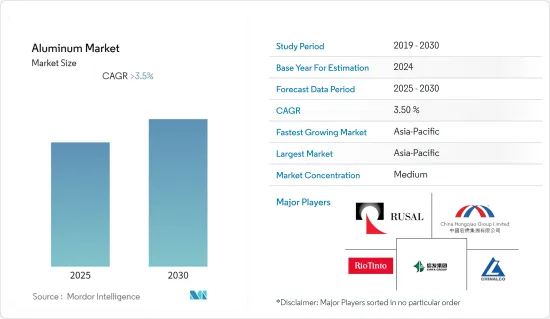
알루미늄 시장은 그 특성상 부분적으로 단편화되어 있습니다. 주요 기업으로는 중국 알루미늄 집단 유한 공사(CHINALCO), 중국 홍교 집단 유한 공사(China Hongqiao Group Limited), 루사르(RusAL), 심화 그룹(Xinfa Group), 리오 틴토(Rio Tinto) 등이 있습니다.
기타 혜택 :
엑셀 형식 시장 예측(ME) 시트
3개월간의 애널리스트 서포트
목차
제1장 서론
조사의 전제조건
조사 범위
제2장 조사 방법
제3장 주요 요약
제4장 시장 역학
성장 촉진요인
아시아태평양의 건설 활동 증가
기타 촉진요인
성장 억제요인
알루미늄 가공에 관한 엄격한 규제와 환경 문제
산업 밸류체인 분석
Porter's Five Forces 분석
공급기업의 협상력
구매자의 협상력
신규 진입업자의 위협
대체품의 위협
경쟁도
수출입 동향
가격 분석
제5장 시장 세분화
가공 유형
주물
압출
단조
평면 압연 제품
안료 및 분말
최종 사용자 산업
자동차
항공우주 및 방위
건축 및 건설
전기 및 전자
포장
공업
기타 최종 사용자 산업
지역
아시아태평양
중국
인도
일본
한국
기타 아시아태평양
북미
미국
캐나다
멕시코
유럽
독일
영국
프랑스
이탈리아
기타 유럽
남미
브라질
아르헨티나
기타 남미
중동 및 아프리카
사우디아라비아
남아프리카
기타 중동 및 아프리카
제6장 경쟁 구도
M&A, 합작사업, 제휴, 협정
시장 점유율(%) 분석
주요 기업의 전략
기업 프로파일
Alcoa Corporation
Aluminum Bahrain BSC(Alba)
Aluminum Corporation of China Limited(CHINALCO)
China Hongqiao Group Limited
East Hope Group
Emirates Global Aluminum PJSC
Novelis Inc.
Norsk Hydro ASA
Rio Tinto
RusAL
State Power Investment Corporation(SPIC)
Xinfa Group Co. Ltd
제7장 시장 기회와 앞으로의 동향
전기자동차 시장의 성장
기타 기회
KTH
영문 목차
영문목차
The Aluminum Market is expected to register a CAGR of greater than 3.5% during the forecast period.
Key Highlights
COVID-19 negatively impacted the market in 2020. Building and construction, a major sink for aluminum, was badly hit, especially due to curtailment in residential real estate resulting in the suspension of home registrations and slow home loan disbursements. However, the sector is recovering well since restrictions were lifted. The aluminum market recovered significantly in 2021-22, owing to rising consumption from various end-user industries such as building and construction, packaging, and others.
A major factor driving the market studied is the increasing construction activities in the Asia-Pacific region. The rising demand for aluminum from the food, packaging, and pharmaceutical industries will likely favor the market's growth.
However, strict regulations and environmental concerns about aluminum processing will likely hamper the market's growth.
Growth in the electric vehicles market will likely provide new growth opportunities.
The Asia-Pacific accounts for the highest market share and is expected to dominate the market during the forecast period.
Aluminum Market Trends
Increasing Demand from the Building and Construction Industry
In the building and construction industry, aluminum is the second most widely used metal. It is extensively used in windows, curtain walls, roofing and cladding, solar shading, solar panels, railings, shelves, and other temporary structures.
The revenue of the global construction industry is expected to grow steadily over the next few years. At the end of 2022, it is projected to be around USD 8.2 trillion.
China includes the largest construction market in the world, encompassing 20% of all construction investments globally. China is expected to spend nearly USD 13 trillion on buildings by 2030. According to the National Bureau of Statistics of China, the total output value of construction businesses in China in the fourth quarter of 2022 was approximately CNY 276 billion (~USD 40 billion), a growth of approximately 50% when compared with the previous quarter (~USD 27.6 billion).
The privately-owned residential units permitted by building permits were at a seasonally adjusted annual rate of 1,873,000 in December 2021, according to figures published by the US Census Bureau and the US Department of Housing and Urban Development. A total of 1,128,000 single-family permits were issued each year. The yearly rate of unit authorizations in structures with five or more units was 675,000. In 2021, 1,724,700 housing units were scheduled to be granted through building permits. This figure was 17.2% more than the 1,471,100 predicted for 2020.
India will likely witness an investment of around USD 1.3 trillion in housing over the next seven years, during which it will likely witness the construction of 60 million new homes. The availability rate of affordable housing is expected to rise by around 70% in 2024. The Indian government's 'Housing for All by 2022' is also a major game-changer for the industry.
The value of construction new work in current prices in Great Britain in 2021 experienced strong growth (15.3%) to GBP 115,579 million (~USD 1,59,008.77 million) after a 15.9% fall to GBP 100,199 million (~ USD 1,28,622.12 million) in 2020.
Overall, the recovering construction activities worldwide are expected to drive the demand for aluminum from the building and construction industry during the forecast period.
Asia-Pacific Region Expected to Dominate the Market
The Asia-Pacific region is expected to be the largest market for aluminum during the forecast period. Industries such as electronics, building and construction, aerospace, etc., are growing in countries such as China, India, and Japan.
The Chinese automotive manufacturing industry is the largest in the world. According to the China Association of Automobile Manufacturers, in 2022, automotive production in the country reached 27.02 million units, which increased by about 3.4%, compared to 26.08 million vehicles produced in 2021.
India will likely witness an investment of around USD 1.3 trillion in housing over the next seven years, during which it will likely witness the construction of 60 million new homes. The Union Cabinet of India approved the setting up a USD 3.58 billion alternative investment fund (AIF) to revive around 1,600 stalled housing projects across the top cities in the country.
The Indian electronics market is expected to reach USD 400 billion by 2025. Additionally, India is expected to become the world's fifth-largest consumer electronics and appliances industry by 2025.
According to the Packaging Industry Association of India (PIAI), the Indian packaging industry is expected to grow at 22% during the forecast period. Moreover, the Indian packaging market is expected to reach USD 204.81 billion by 2025, registering a CAGR of 26.7% between 2020 and 2025.
In Japan, it is estimated that by 2025, the retail sales in the packaged food market are expected to reach USD 204.5 billion, a growth of 3.6% or USD 7 billion. Such projected growth in the packaging industry will likely drive the demand for aluminum used as foils during the forecast period.
Hence, with the rapidly growing end-user industries in countries of the Asia-Pacific region, the region is expected to dominate the global market during the forecast period.
Aluminum Industry Overview
The aluminum market is partially fragmented in nature. The major companies include (not in any particular order) Aluminum Corporation of China Limited (CHINALCO), China Hongqiao Group Limited, RusAL, Xinfa Group Co. Ltd., and Rio Tinto, among others.
Additional Benefits:
The market estimate (ME) sheet in Excel format
3 months of analyst support
TABLE OF CONTENTS
1 INTRODUCTION
1.1 Study Assumptions
1.2 Scope of the Study
2 RESEARCH METHODOLOGY
3 EXECUTIVE SUMMARY
4 MARKET DYNAMICS
4.1 Drivers
4.1.1 Increasing Construction Activities in the Asia-Pacific Region
4.1.2 Other Drivers
4.2 Restraints
4.2.1 Strict Regulations and Environmental Concerns Related to Aluminum Processing
4.3 Industry Value Chain Analysis
4.4 Porter's Five Forces Analysis
4.4.1 Bargaining Power of Suppliers
4.4.2 Bargaining Power of Buyers
4.4.3 Threat of New Entrants
4.4.4 Threat of Substitute Products and Services
4.4.5 Degree of Competition
4.5 Import-Export Trends
4.6 Price Analysis
5 MARKET SEGMENTATION (Market Size in Volume)
5.1 Processing Type
5.1.1 Castings
5.1.2 Extrusions
5.1.3 Forgings
5.1.4 Flat Rolled Products
5.1.5 Pigments and Powders
5.2 End-user Industry
5.2.1 Automotive
5.2.2 Aerospace and Defense
5.2.3 Building and Construction
5.2.4 Electrical and Electronics
5.2.5 Packaging
5.2.6 Industrial
5.2.7 Other End-user Industries
5.3 Geography
5.3.1 Asia-Pacific
5.3.1.1 China
5.3.1.2 India
5.3.1.3 Japan
5.3.1.4 South Korea
5.3.1.5 Rest of Asia-Pacific
5.3.2 North America
5.3.2.1 United States
5.3.2.2 Canada
5.3.2.3 Mexico
5.3.3 Europe
5.3.3.1 Germany
5.3.3.2 United Kingdom
5.3.3.3 France
5.3.3.4 Italy
5.3.3.5 Rest of Europe
5.3.4 South America
5.3.4.1 Brazil
5.3.4.2 Argentina
5.3.4.3 Rest of South America
5.3.5 Middle-East and Africa
5.3.5.1 Saudi Arabia
5.3.5.2 South Africa
5.3.5.3 Rest of Middle-East and Africa
6 COMPETITIVE LANDSCAPE
6.1 Mergers and Acquisitions, Joint Ventures, Collaborations, and Agreements
6.2 Market Share (%) Analysis
6.3 Strategies Adopted by Leading Players
6.4 Company Profiles
6.4.1 Alcoa Corporation
6.4.2 Aluminum Bahrain B.S.C. (Alba)
6.4.3 Aluminum Corporation of China Limited (CHINALCO)