ㅁ Add-on 가능: 고객의 요청에 따라 일정한 범위 내에서 Customization이 가능합니다. 자세한 사항은 문의해 주시기 바랍니다.
ㅁ 보고서에 따라 최신 정보로 업데이트하여 보내드립니다. 배송기일은 문의해 주시기 바랍니다.
한글목차
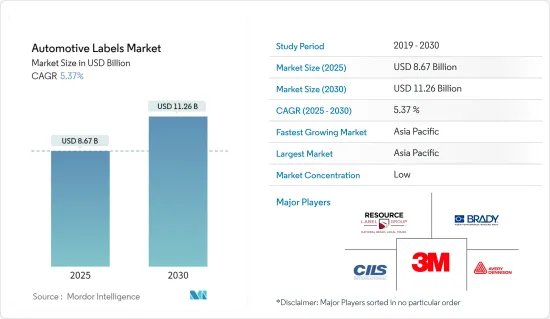
자동차 라벨 시장 규모는 2025년에 86억 7,000만 달러로 추정되고, 예측 기간 2025년부터 2030년까지 CAGR 5.37%로 성장할 전망이며, 2030년에는 112억 6,000만 달러에 달할 것으로 예측됩니다.
자동차 산업에서 자동차에 대한 요구 증가 및 자동차 부품 식별, 정보 및 안전을 위한 무선 자동 식별(RFID) 및 바코드와 같은 라벨에 대한 요구가 시장을 견인할 것으로 예측됩니다. 모든 최종 사용자 산업에서 포장 및 라벨링 시장이 성장함에 따라 자동차 라벨 산업은 크게 확대되고 있습니다.
주요 하이라이트
자동차 라벨은 일반적으로 바코드, 평가, 차량 식별 번호(VIN) 라벨과 같은 배지 및 라벨로 구성되며 부품 정보, 회사 이름 및 로고, 가격, 기술 정보 및 기타 중요한 세부사항을 표시합니다. 시장 성장을 가속할 것으로 예상되는 기타 요인으로는 RFID 및 바코드와 같은 스마트 라벨에 대한 수요 증가, 친환경 라벨 제조 방법에 대한 수요 증가 등이 있습니다.
자동차 제조에서 산업 부품의 추적은 매우 중요합니다. RFID 태그는 효율적인 추적을 보장하고 공급망의 무결성을 높이고 고객의 안전을 개선하며 부채를 줄입니다. 2023년 8월, SML은 Clarity Store 솔루션에 새로운 기능을 도입하여 배송지에서 재고 수령을 필요로 하지 않았습니다. 이 솔루션은 PervasID RFID 리더를 클라리티 플랫폼과 통합하고 핸즈프리 배달 증명(POD)을 위해 배송 차량에 고정된 RFID 리더를 사용합니다.
승용차에서 자동차 라벨의 사용이 증가하는 것은 시장 성장을 가속하는 주요 요인 중 하나입니다. 또한 자동차 제조 설비에 대한 투자 증가와 승용차 생산량 증가가 자동차 라벨 시장 수요를 촉진하는 주요 요인이 되고 있습니다. 또한 자동차 라벨 시장은 거의 모든 산업에서 발생하는 기술 개발로 확대되고 있습니다. 자율 주행 플랫폼이 생성하는 수백만 개의 사진과 동영상을 적절하게 분류하는 것이 중요합니다.
자동차 산업은 청소 용품 및 자동차 제조 업체에서 F1 및 대중 교통에 이르기까지 많은 라벨링 요구 사항이 있습니다. 이 산업에서는 외장 및 엔진과 같은 자동차의 거의 모든 영역에서 라벨이 사용됩니다. 이 분야에서는 시동 모터, 케이블, 펌프, 모터, 엔진 관리 시스템 등에 자동차 라벨을 사용할 수 있습니다.
자동차 라벨 시장이 계속 성장함에 따라 잉크 부품에 대한 세계 규정 준수 규정도 엄격해지고 있습니다. 그 결과, 배합자에게는 이러한 시장에 적합하고 디자인 잉크가 될 수 있는 요소와 다른 성분을 선택하는 것은 복잡하고 어려운 과제가 되고 있습니다. 이로 인해 각국의 생산 비용 상승이 시장 성장을 방해할 것으로 예상됩니다.
자동차 라벨 시장 동향
바코드 부문이 주요 시장 점유율을 차지
바코드 라벨은 데이터를 저장하고 검색하는 빠른 방법을 제공합니다. 바코드 라벨에는 회사 및 제품의 세부 사항이 행과 숫자 형식으로 표시됩니다. 바코드 라벨은 재고 관리에도 사용할 수 있으며 추적성을 제공하여 리콜 부담을 줄일 수 있습니다. 자동차 라벨 바코드는 엔진, 도어, 대시보드 등의 부품에서 볼 수 있습니다.
2차원 바코드는 자동차 부품 라벨에 사용되는 가장 일반적인 바코드 유형 중 하나입니다. 라벨링은 자동차 부품 제조업체 공급망에서 중요한 역할을 합니다. 제품의 정확한 배송을 보장하고 중요한 바코드 및 기타 정보를 제공하며 제품 이동을 가속화합니다. 고객 고유의 요구와 신흥 시장 판매자의 브랜드 요구 사항에서 수출입 관리 및 세관 감사에 이르기까지 라벨링에는 노력과 비용이 듭니다.
반면 3D 스캐너는 바코드의 3D 스캔을 생성합니다. 이 스캔은 모든 방향에서 읽을 수 있습니다. 3D 바코드 스캐너는 자동차 조립 및 제조와 같은 산업용 응용 분야에서 일반적으로 사용됩니다.
여러 제조업체가 자동차 바코드 라벨을 광범위하게 제공합니다. 예를 들어, 금속 공예사는 다양한 용도의 플라스틱 바코드 라벨을 제조합니다. 앞 유리, 케이블, 와이어, 대시보드 등에 사용할 수 있습니다. 또한 탬퍼 증거 트래블과 금속화 라벨도 있으며, 그 밖에도 다수가 있습니다.
자동차 부품 및 자동차 재고 라벨링은 자동차 및 자동차 부품을 생산하는 데 중요합니다. 자동차 제조업체는 창고의 제품을 추적하고 제3자물류(3PL) 공급업체의 재고를 확인하기 위해 바코드를 사용합니다. 그들은 또한 일련 번호, 날짜, 모델과 같은 다른 광범위한 정보를 가진 부품을 식별하기 위해 바코드(인쇄 바코드 포함)를 사용합니다.
바코드 프린터와 스캐너는 이러한 바코드를 인쇄하고 제품에 붙여 넣는 라벨을 만들 수 있습니다. 이는 재고 추적에 도움이 되며 실수나 중요한 정보 누락 위험을 최소화합니다. OICA에 따르면 올해 경차 판매량은 4.73% 증가할 것으로 예상됩니다. 전반적으로 성장하는 자동차 산업이 시장 성장을 도울 것으로 예상됩니다. 게다가 OICA의 보고에 따르면 2023년에는 중국이 아시아태평양 승용차 시장에서 압도적인 힘을 보이고 판매 대수는 2,600만 대를 넘었습니다. 인도는 약 410만 대의 판매 대수를 자랑해, 2위의 지위를 확보했습니다.
아시아태평양이 시장을 독점할 전망
아시아태평양은 큰 시장 점유율을 차지하고 있으며 예측 기간 동안 가장 높은 성장이 예상됩니다. Avery Dennison과 같은 기업이 라벨과 패키징 산업을 성장시키고 혁신 능력을 높이기 위해 이 지역에서 신흥 기업을 늘리는 것이 시장 성장을 뒷받침하는 중요한 요소가 되고 있습니다.
자동차 애프터 판매 시장의 성장은 중국에서의 자동차 생산 및 판매 증가나 자동차 부품 산업의 확대 등 다양한 요인에 의한 것입니다. 또한, 엔진 애프터 판매 시장은 고객 중심의 커스터마이징 증가와 중고차 시장에 의해 예측 기간 동안 견조한 성장률을 나타낼 것으로 예측됩니다. 판매 후 부문에서는 부품 교체, 유지 보수 및 수리 서비스 제공, 안전 보장, 법규 준수를 위해 라벨을 활용합니다. 시장이 확대됨에 따라 엔진 라벨 및 기타 자동차 라벨에 대한 수요도 증가할 것으로 보입니다.
인도의 자동차 산업은 거시경제의 확대와 기술 개발의 양면에서 큰 역할을 하고 있기 때문에 경제의 호조를 나타내는 우수한 지표가 되고 있습니다. 중산 계급이 증가하고 젊은 인구가 큰 비율을 차지하는 인도에서는 이륜차 부문이 대수 기준으로 시장을 독점하고 있습니다. 이 분야의 성장은 지역 시장을 개척하려는 기업의 관심이 높아지기도 합니다. 그 결과 자동차 생산량이 증가하고 있습니다. 자동차 산업이 계속 성장함에 따라 라벨을 포함한 자동차 부품 수요도 증가할 것으로 예상됩니다.
일본 정부는 무선자동식별(RFID)을 대규모 재정투자에 의해 지원되고 있는 혁신적인 기술로 인식하고 있으며, 일본의 강력한 생산기반이 향후 수년간 RFID 용도에서 주도적인 역할을 할 것을 확실히 하고 있습니다. RFID 기술의 상당한 진보는 정부의 지원을 바탕으로 달성될 수 있습니다. 이는 자동차 분야에서 사용하기에 적합한 보다 고도로 효과적인 RFID로 이어질 수 있습니다.
일본 자동차 공업회에 따르면 일본 자동차 제조업체는 2022년 일본 국외 생산 시설에서 약 1,696만 대의 자동차를 생산해 전년 1,646만 대에서 증가했습니다. 일본 국외에서의 생산 확대는 일본의 자동차 제조업체에 의한 세계 확대 전략을 나타내고 있습니다. 자동차 제조업체가 해외 시장에서 더 강한 존재를 확립함에 따라, 다른 지역과 언어의 고유한 요구사항을 수용하기 위해 특수 라벨이 필요할 수 있으며, 자동차 라벨 시장에 대한 수요를 더욱 높일 수 있습니다.
자동차 라벨 시장 개요
3M Company, Avery Dennison Corporation, Resource Label Group, HB Fuller Company 등 여러 대형 기업이 존재하기 때문에 시장이 단편화되고 있습니다. 이러한 선도적인 기업들의 참여를 특징으로 하는 진화하는 산업 상황은 새로운 기회를 포착하기 위해 노력하는 기업 간의 경쟁을 격화시키고 있습니다. 동시에 중소기업도 성장궤도를 타고 시장의 큰 성장 가능성을 활용하려고 합니다.
2023년 6월-에이블리 데니슨 코퍼레이션은 에메랄드 테크놀로지 벤처스와의 전략적 제휴를 발표했습니다. 이 제휴는 에이블리 데니슨의 혁신과 지속가능성 목표 달성을 위한 중요한 단계입니다.
2022년 10월-또한 자원 라벨 그룹은 시카고에 본사를 둔 Deco Flexible Packaging을 인수하여 중서부의 존재를 강화하고 라벨 및 포장 업계의 리더십을 강화했습니다. 이 인수는 자원 레이블 그룹의 확장 포트폴리오에 24번째 추가되었습니다.
기타 혜택 :
엑셀 형식 시장 예측(ME) 시트
3개월간의 애널리스트 서포트
목차
제1장 서론
조사 전제조건 및 시장 정의
조사 범위
제2장 조사 방법
제3장 주요 요약
제4장 시장 인사이트
시장 개요
업계의 매력도-Porter's Five Forces 분석
공급기업의 협상력
구매자의 협상력
신규 참가업체의 위협
대체품의 위협
경쟁 기업간 경쟁 관계
업계 밸류체인 분석
시장에 대한 COVID-19의 영향
제5장 시장 역학
시장 성장 촉진요인
자동차 산업에서 RFID 라벨 수요 증가
라벨에 관한 법규제에 대한 대응 증가
시장 성장 억제요인
소규모 제조업체의 제조 비용 증대
제6장 시장 세분화
식별 기술별
바코드
QR코드
RFID 태그
기타 식별 기술
유형별
브랜딩
추적
경고 및 안전
자산 라벨
기타 유형(타이어 라벨, 내후성 라벨)
용도별
내장 용도
외장 용도
엔진 용도
기타 용도
지역별
북미
미국
캐나다
유럽
영국
독일
프랑스
스페인
아시아
중국
인도
일본
호주 및 뉴질랜드
라틴아메리카
중동 및 아프리카
제7장 경쟁 구도
기업 프로파일
3M Company
Avery Dennison Corporation
Resource Label Group LLC
CILS International
Brady Worldwide Inc.
Asean Pack
Polyonics Inc.
Imagetek Labels
Weber Packaging Solutions
Advantage Label & Packaging Inc.
Label-Aid Systems Inc.
Clarion Safety Systems
제8장 투자 분석
제9장 시장의 미래
AJY
영문 목차
영문목차
The Automotive Labels Market size is estimated at USD 8.67 billion in 2025, and is expected to reach USD 11.26 billion by 2030, at a CAGR of 5.37% during the forecast period (2025-2030).
The increasing need for vehicles from the automotive industry and the requirement for labels like radio-frequency identification (RFID) and bar codes for the automotive part's identification, information, and safety are anticipated to drive the market. Due to the growth of the packaging and labeling markets across all end-user industries, the automotive labels industry is expanding significantly.
Key Highlights
Automotive labels typically consist of badging and labels, such as barcode, estimate, and vehicle identification number (VIN) labels, that display component information, a company's name and logo, price, technical information, and other important details. Additional factors anticipated to fuel market growth include the increased demand for smart labels, such as RFID and barcodes, and the rising demand for eco-friendly label production methods.
Tracking industrial components in automotive manufacturing is crucial. RFID tags ensure efficient tracking, enhance supply chain integrity, improve customer safety, and reduce liabilities. In August 2023, SML introduced a new feature to its Clarity Store solution, eliminating stock-receiving at destinations. This solution uses fixed RFID readers in delivery vehicles for hands-free proof of delivery (POD), integrating PervasID's RFID readers with Clarity's platform.
The increasing utilization of automotive labels in passenger cars is one of the key factors driving the market growth. Moreover, the increasing investments in automobile manufacturing facilities and rising passenger car production are key factors fostering the market demand for automotive labels. The market for automotive labels market is also expanding due to technical developments occurring in almost every industry. It's important to properly categorize the millions of photos and videos that autonomous driving platforms produce.
The automotive industry has many labeling requirements, from cleaning supplies and car producers to Formula 1 and public transportation. There are labels used in this industry in almost every area of a car, including the exterior and the engine. In this sector, automotive labeling may be used on starting motors, cables, pumps, motors, and engine management systems, among other things.
As the market for automotive labels continues to grow, so too are the global compliance regulations for ink components. As a result, it has become complex and challenging for formulators to select ingredients to meet such a market and are different from the elements that could be a design ink. This and rising production costs in various countries are expected to hinder the market's growth.
Automotive Labels Market Trends
Barcode Segment to Hold Major Market Share
Barcode labels provide a fast way to store and retrieve data. Barcode labels contain company and product details in line and number formats. Barcode labels can also be used to manage inventory and reduce the recall burden by providing traceability. Automotive barcodes on automotive labels can be found on parts of engines, doors, dashboards, and more.
The 2D barcode is one of the most common types of barcode used to label car parts. Labeling plays a critical role in the supply chain of a car part manufacturer. It guarantees a product's accurate delivery, provides important barcodes and other information, and accelerates the movement of goods; from customer-specific needs and branding requirements for distributors in emerging markets to import and export controls and customs audits, labeling can be labor-intensive and expensive.
On the other hand, 3D scanners generate a 3D scan of the bar code. This scan can be read from any direction. 3D barcode scanners are commonly used in industrial applications such as automotive assembly and manufacturing.
Several manufacturers provide a wide range of automotive barcode labels. For instance, Metalcraft, Inc. manufactures plastic barcode labels that come in various applications. They can be used on windshields, cables, wires, dashboards, etc. Also, there are tamper-evident and metalized labels, many others.
Car parts and automotive inventory labeling are important in producing cars and car parts. Car manufacturers use barcodes to keep track of products in their warehouses and to check inventory from their third-party logistics (3PL) suppliers. They also use barcodes (with printed barcodes) to identify parts with a wide range of other information, including serial numbers, dates, and models.
Barcode printers or scanners can print these barcodes to produce the label applied to a product. This helps track inventory and minimizes the risk of mistakes or missing important information. According to OICA, the sales of light vehicles are expected to increase by 4.73% this year. Overall, the growing automotive industry is expected to aid the market's growth. Further more, in 2023, China emerged as the dominant force in the Asia-Pacific passenger car market, with sales exceeding 26 million units, as reported by OICA. India secured its position as the second-largest market, boasting sales of almost 4.1 million units.
Asia-Pacific Expected to Dominate the Market
The Asia-Pacific region holds a major market share and is expected to witness the highest growth over the forecast period. The growing number of startups in the region by companies like Avery Dennison to grow the labels and packaging industry and boost its innovation abilities is a significant factor aiding the market's growth.
The automotive after-sales market's growth is attributed to various factors, including increased vehicle production and sales in China and the expansion of the automotive components industry. Additionally, the market for engine after-sales is projected to experience a robust growth rate over the forecast period, driven by an increase in customer-centric customization and the market for used cars. Within the after-sales segment, labels are utilized to replace parts, provide maintenance and repair services, ensure safety, and adhere to regulations. As the market continues to expand, there is likely to be a corresponding increase in the demand for engine and other automotive labels.
As the Indian automotive industry plays a major role in both macroeconomic expansion and technological development, it has been an excellent indicator of how well the economy is doing. Due to the growing middle class and a large proportion of India's young population, the two-wheeler segment dominates the market in terms of volume. The sector's growth is also supported by increased interest by businesses to explore regional markets. This has resulted in an increase in the production of vehicles. As the automotive industry continues to grow, the demand for automotive parts, including labels, is also expected to increase.
The Japanese government recognizes radio-frequency identification (RFID) as an innovative technology supported by major financial investment to ensure that the strong production base in Japan will play a leading role in RFID applications over the coming years. Significant advances in RFID technology can be achieved based on government support. This could lead to more advanced and effective RFID, which would be better suited for use in the automotive sector.
According to the Japan Automobile Manufacturers Association Inc., in 2022, Japanese automakers manufactured around 16.96 million vehicles at production facilities outside of Japan, increasing from 16.46 million in the previous year. Expanding production outside Japan indicates a global expansion strategy by Japanese automakers. As they establish a stronger presence in foreign markets, they may require specialized labels to cater to the unique requirements of different regions and languages, further driving demand in the automotive labels market.
Automotive Labels Market Overview
The market exhibits fragmentation due to the presence of several major players, including 3M Company, Avery Dennison Corporation, Resource Label Group, H.B. Fuller Company, and more. This evolving industry landscape, characterized by the involvement of these major players, has intensified competition among companies striving to seize emerging opportunities. Simultaneously, smaller firms are on a growth trajectory, seeking to harness the market's substantial growth potential.
In June 2023, Avery Dennison Corporation announced a strategic collaboration with Emerald Technology Ventures focused on Industrial, Sustainable, and New Packaging Materials Technologies. This collaboration represents a significant step towards advancing Avery Dennison's innovation and sustainability objectives.
Furthermore, in October 2022, Resource Label Group bolstered its presence in the Midwest and reinforced its leadership in the label and packaging industry by acquiring Deco Flexible Packaging, a Chicago-based company. This acquisition marked the twenty-fourth addition to Resource Label Group's expanding portfolio.
Additional Benefits:
The market estimate (ME) sheet in Excel format
3 months of analyst support
TABLE OF CONTENTS
1 INTRODUCTION
1.1 Study Assumptions and Market Definition
1.2 Scope of the Study
2 RESEARCH METHODOLOGY
3 EXECUTIVE SUMMARY
4 MARKET INSIGHTS
4.1 Market Overview
4.2 Industry Attractiveness - Porter's Five Forces Analysis
4.2.1 Bargaining Power of Suppliers
4.2.2 Bargaining Power of Buyers
4.2.3 Threat of New Entrants
4.2.4 Threat of Substitutes
4.2.5 Intensity of Competitive Rivalry
4.3 Industry Value Chain Analysis
4.4 Impact of COVID-19 on the Market
5 MARKET DYNAMICS
5.1 Market Drivers
5.1.1 Growing Demand From the Automotive Industry for RFID Labels
5.1.2 Increasing Compliance With Label Laws
5.2 Market Restraints
5.2.1 Cost of Manufacturing Greater for Small Manufacturers
6 MARKET SEGMENTATION
6.1 By Identification Technology
6.1.1 Barcode
6.1.2 QR Code
6.1.3 RFID Tags
6.1.4 Other Identification Technologies
6.2 By Type
6.2.1 Branding
6.2.2 Track & Trace
6.2.3 Warning & Safety
6.2.4 Asset Labels
6.2.5 Other Types (Tire Labels, Weatherproof Labels)