ㅁ Add-on 가능: 고객의 요청에 따라 일정한 범위 내에서 Customization이 가능합니다. 자세한 사항은 문의해 주시기 바랍니다.
ㅁ 보고서에 따라 최신 정보로 업데이트하여 보내드립니다. 배송기일은 문의해 주시기 바랍니다.
한글목차
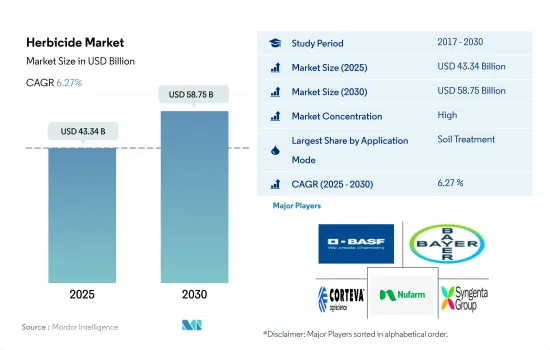
제초제 시장 규모는 2025년에 433억 4,000만 달러로 예측되고, 2030년에는 587억 5,000만 달러에 이를 것으로 예측되며, 예측 기간(2025-2030년) 중 CAGR 6.27%로 성장할 전망입니다.
토양 적용은 세계의 제초제 시장을 독점
잡초는 농업 시스템에서 수율 손실과 품질 저하의 주요 원인입니다. 잡초는 빛, 물, 양분 등의 자원을 둘러싸고 작물과 경쟁합니다. 잡초는 또한 파괴적인 식물 병원균이나 이들 병원균을 식물에서 식물로 이동시키는 곤충의 매개물, 또는 그 양쪽 모두의 저장고 역할을 함으로써 작물에 해를 입히기도 합니다. 제초제 사용은 가장 효과적인 잡초 관리 수단이며 다른 잡초 관리 수단보다 저렴하고 신뢰성이 높아 노력과 시간을 절약할 수 있습니다. 다양한 크기의 초본 잡초, 수목, 관목을 방제하기 위해 몇 가지 제초제 살포 기술을 사용할 수 있습니다.
토양 살포는 세계 제초제 시장을 독점하고 2022년에는 48.4% 시장 점유율을 차지했습니다. 출수 전 제초제는 토양 처리를 통해 살포할 수 있습니다. 잡초의 발생을 조기에 억제함으로써 작물은 작기 중에 강력한 시작을 할 수 있습니다. 유효성분이나 살포시기가 다른 토양활성제초제는 귀찮은 저항성 잡초에 대처해 제초제 저항성 발달을 늦추는 데 도움이 됩니다.
엽면 살포는 2022년 세계 제초제 시장액의 30.3%를 차지했습니다. 포스트 에머전스 제초제는 이 방법으로 살포될 수 있습니다. 포스트 이머전스 제초제가 효과를 발휘하려면 잎 표면에서 이동하여 표적 부위에 도달해야 합니다. 엽면 살포법에 이어 화학적 살포법은 2022년 세계 제초제 시장의 19.6%를 차지했습니다.
농업 부문에서 제초제를 사용하면 작물 생산성을 최적화하고 전반적인 수익성을 높입니다. 제초제 사용량은 예측 기간인 2023-2029년 CAGR 5.1%를 나타낼 것으로 예상됩니다.
잡초에 의한 작물 손실 증가가 제초제 수요를 끌어올릴 것으로 예상
잡초는 다양한 작제 시스템에서 생산에 대한 주요 생물학적 제약입니다. 잡초로 인한 작물의 수율 손실은 잡초 발생 시기, 잡초 밀도, 잡초 유형, 작물 유형 등 여러 요인에 따라 달라집니다. 잡초는 관리하지 않고 방치하면 100% 수율 손실을 초래할 수 있습니다. 제초제는 세계적으로 잡초 방제에 필수적인 요소입니다.
2022년 남미는 세계 제초제 시장의 35.5%(금액 기준)를 차지했습니다. 남미 제초제 시장은 아르헨티나, 브라질, 칠레 및 기타 남미 국가를 포함한 다양한 국가에서 성장하고 있습니다. 이 나라들은 광대한 농지가 있는 주요 농업 생산국이기 때문에 제초제의 사용은 잡초 개체수를 관리하고 최적의 작물 수확을 보장하는 데 매우 중요합니다. 남미 제초제 시장은 예측 기간(2023-2029년) 중 CAGR 5.2%를 나타낼 것으로 예측됩니다.
북미는 2022년 제초제 세계 시장의 31.6%(금액 기준)를 차지했습니다. 북미는 다양한 기후 때문에 지역 전체에서 폭넓은 종류의 작물을 재배할 수 있습니다. 북미에서는 곡물, 콩류, 과일, 야채, 관상용 식물이 재배되고 있습니다. 프라임타임의 농업 종사자는 대부분이 모노컬쳐, 즉, 매우 넓은 면적에서 주요 수입원이 되는 단일의 작물을 재배하는 것을 실천하고 있어 잡초의 만연 증가나 수확량의 감소로 이어지고 있습니다. 존 글래스, 버니야드 글래스, 파머 아말란서스, 프리클리시드가 이 지역에서 볼 수 있는 주요 잡초입니다.
세계의 제초제 시장은 예측 기간(2023-2029년) 중 CAGR 5.1%를 나타낼 것으로 예측됩니다. 농작물 손실의 증가, 농작물을 보호할 필요성, 잡초 방제에 대한 의식의 고조, 농업 제품에 대한 수요의 고조가 시장의 성장을 촉진하고 있습니다.
세계의 제초제 시장 동향
잡초가 다른 환경에 적응하고 내성을 발달시키는 능력이 높기 때문에 제초제의 살포율이 높아지고 있습니다.
제초제의 헥타르당 세계 평균 소비량은 과거 기간 동안 44.4% 증가했으며, 2017년 1.8kg/ha에서 2022년에는 2.6kg/ha가 되었습니다. 잡초의 적응성과 급속한 번식으로 잡초는 작물과의 경쟁이 높아져 수확량 손실 증가로 이어지기 때문에 화학제초제 살포를 늘릴 필요성이 전년 동기 대비 높아지고 있습니다. 따라서 잡초를 방제하여 농업 생산성 저하를 막기 위해 제초제 살포를 늘릴 필요성이 높아지고 있습니다.
제초제는 살균제나 살충제에 비해 가장 많이 사용되고 있는 화학농약입니다. 2022년 헥타르당 소비량은 전체 지역 중 남미가 5.3kg으로 가장 많았는데, 이는 콩, 옥수수, 사탕수수와 같은 작물의 생산이 활발하고 대규모 상업 경작과 고밀도 작부가 많기 때문입니다. 집약적인 농법은 잡초의 압력을 높이기 때문에 잡초의 개체수를 관리하고 작물의 수확량을 효과적으로 지키기 위해 제초제가 필요합니다. 2022년 헥타르당 평균 소비량은 각각 1.8kg과 1.7kg으로 남미에 북미와 유럽이 이어집니다.
제초제 내성 잡초 증가와 만연은 세계 농업 종사자에게 심각한 문제가 되고 있으며, 이러한 내성 잡초 집단과 싸우기 위해 제초제의 사용량 증가나 복수의 제초제의 살포로 이어지고 있습니다. 예를 들어, 파머 아말란서스나 커먼워터헴프는 글리포세이트, 우마노스쿠사나 자이언트부타쿠사는 여러 제초제에 내성이 있고, 코키아는 아세트젖산합성효소 저해형 제초제에 내성이 있습니다.
잡초가 다양한 환경에 적응하고 저항성을 발달시키는 능력이 높은 등의 요인에 의해 제초제 살포의 필요성이 급격히 높아지고 있습니다.
2,4-D와 글리포세이트는 활엽 잡초의 선택적 방제에 세계적으로 널리 사용되는 제초제입니다.
메트리부딘은 트리아딘계에 속하는 제초제입니다. 가격은 1톤당 1만 6,600달러. 농작물의 다양한 잡초 방제에 널리 사용되고 있습니다. 메트리브딘은 엽록체의 광화학계 II(PSII) 단백질 복합체를 특이적으로 표적으로 하여 식물이 광합성 중에 빛 에너지를 화학 에너지로 변환하는 능력을 저해합니다. 그 결과 유독한 제품별이 축적되고 결국 대상 잡초가 고사합니다.
아틀라진은 옥수수와 벼농사에서 에키노크로아, 엘신속, 아마란사스빌리지스 등의 광엽잡초나 벼과 잡초의 방제에 널리 사용되고 있는 제초제입니다. 제초제는 2022년에 1만 3,500달러로 평가되었습니다. 인도는 세계 최대의 아틀라진 기술 수입국이며, 중국은 최대 수출국입니다.
파라코트는 널리 사용되는 제초제이며, 비피리딜륨 화합물의 일종에 속합니다. 파라코트는 즉효성이 있고 비선택적이기 때문에 작물이 출수하기 전에 잡초를 방제하기 위해 일반적으로 프리플랜트 제초제 또는 프리이머젠스 제초제로 사용됩니다. 면화, 옥수수, 대두, 사탕수수 등 폭넓은 작물에 효과적입니다. 파라코트의 2022년 가격은 7,000달러였습니다.
펜디메탈린은 디니트로아닐린계의 제초제입니다. 농작물의 다양한 1년생 풀과 히로바 잡초의 방제에 널리 사용되고 있습니다. 2022년 가격은 톤당 3,300달러였습니다. 펜디메탈린은 잡초의 초기 발육을 저해함으로써 잡초의 성장 초기 단계에서 작물과의 경쟁을 줄여줍니다.
2,4-D와 글리포서트는 활엽잡초의 선택적 방제에 세계적으로 널리 사용되고 있는 제초제입니다. 2022년 가격은 각각 2,300달러, 1,100달러였습니다.
제초제 산업 개요
제초제 시장은 상당히 통합되어 있으며 상위 5개 기업에서 69.12%를 차지하고 있습니다. 이 시장의 주요 기업은 BASF SE, Bayer AG, Corteva Agriscience, Nufarm Ltd, Syngenta Group 등입니다.
기타 혜택
엑셀 형식 시장 예측(ME) 시트
3개월의 애널리스트 서포트
목차
제1장 주요 요약 및 주요 조사 결과
제2장 보고서 제안
제3장 서문
조사의 전제조건 및 시장 정의
조사 범위
조사 방법
제4장 주요 산업 동향
1헥타르당 농약 소비량
유효 성분의 가격 분석
규제 프레임워크
아르헨티나
호주
브라질
캐나다
칠레
중국
프랑스
독일
인도
인도네시아
이탈리아
일본
멕시코
미얀마
네덜란드
파키스탄
필리핀
러시아
남아프리카
스페인
태국
우크라이나
영국
미국
베트남
밸류체인 및 유통채널 분석
제5장 시장 세분화
용도 모드별
화학 관개
엽면 살포
훈증
토양 처리
작물 유형별
상업 작물
과일 및 야채
곡물
콩류 및 지방종자
잔디 및 관상용
지역별
아프리카
국가별
남아프리카
기타 아프리카
아시아태평양
국가별
호주
중국
인도
인도네시아
일본
미얀마
파키스탄
필리핀
태국
베트남
기타 아시아태평양
유럽
국가별
프랑스
독일
이탈리아
네덜란드
러시아
스페인
우크라이나
영국
기타 유럽
북미
국가별
캐나다
멕시코
미국
기타 북미
남미
국가별
아르헨티나
브라질
칠레
기타 남미 국가
제6장 경쟁 구도
주요 전략 동향
시장 점유율 분석
기업 상황
기업 프로파일
ADAMA Agricultural Solutions Ltd
BASF SE
Bayer AG
Corteva Agriscience
FMC Corporation
Jiangsu Yangnong Chemical Co. Ltd
Nufarm Ltd
Sumitomo Chemical Co. Ltd
Syngenta Group
UPL Limited
제7장 CEO에 대한 주요 전략적 질문
제8장 부록
세계 개요
개요
Porter's Five Forces 분석 프레임워크
세계의 밸류체인 분석
시장 역학(DROs)
정보원 및 참고문헌
도표 일람
주요 인사이트
데이터 팩
용어집
AJY
영문 목차
영문목차
The Herbicide Market size is estimated at 43.34 billion USD in 2025, and is expected to reach 58.75 billion USD by 2030, growing at a CAGR of 6.27% during the forecast period (2025-2030).
Soil application dominates the global herbicide market
Weeds are a major contributor to yield loss and reduced quality in an agricultural system. They compete with the crop for resources like light, water, and nutrients. Weeds can also harm crop plants by acting as reservoirs for destructive plant pathogens, the insect vectors that move these pathogens from plant to plant, or both. The use of herbicides is the most effective weed management tool, as it is cheaper, more reliable, and more labor- and time-saving than other weed control measures. Several herbicide application techniques can be used to control herbaceous weeds, trees, and bushes of various sizes.
Soil application dominated the global herbicide market, accounting for a market share of 48.4% in 2022. Pre-emergence herbicides can be applied through soil treatment. By reducing weed pressures early on, crops can get off to a strong start during the cropping season. With different active ingredients and application timings, soil-active herbicides can help tackle troublesome resistant weeds and slow down the development of herbicide resistance.
Foliar application accounted for 30.3% of the global herbicide market value in 2022. Post-emergence herbicides can be applied through this method. A post-emergence herbicide must move from the leaf surface and reach the target site to be effective. Following the foliar method, chemigation accounted for 19.6% of the global herbicide market in 2022.
In the agricultural sector, herbicide usage optimizes crop productivity and enhances overall profitability. The usage of herbicides is expected to register a CAGR of 5.1% during the forecast period (2023-2029).
Rising crop losses due to the weeds are expected to boost the demand for herbicides
Weeds are a major biotic constraint to production in different cropping systems. Yield losses in crops due to weeds depend on several factors, such as weed emergence time, weed density, type of weeds, and crop types. Weeds can result in 100% yield loss if left uncontrolled. Herbicides are an integral part of weed control globally.
In 2022, South America accounted for a market share of 35.5%, by value, of the global herbicide market. The herbicide market in South America is experiencing growth in various countries, including Argentina, Brazil, Chile, and the rest of South American countries. As these countries are major agricultural producers with vast expanses of farmland, the use of herbicides is crucial to manage weed populations and ensure optimal crop yields. The South American herbicide market is projected to record a CAGR of 5.2% during the forecast period (2023-2029).
North America accounted for 31.6%, by value, of the global herbicide market in 2022. North America's diverse climate allows for the cultivation of a wide range of crop types across the region. North Americans cultivate grains, legumes, fruits, vegetables, and ornamental plants. Primetime farmers mostly practice monoculture, i.e., cultivating a single crop for their primary income in a very large area, leading to an increase in weed infestation and reduced yields. Johnsongrass, barnyard grass, Palmer amaranth, and prickly sid are major weeds found in the region.
The global herbicide market is projected to register a CAGR of 5.1% during the forecast period (2023-2029). The rising crop losses, the need to protect crops, increasing awareness of weed control, and rising demand for agriculture products are driving the market's growth.
Global Herbicide Market Trends
The high ability of weeds to adapt to different environments and develop resistance is leading to higher herbicide application rates
The global average per-hectare consumption of herbicides increased by 44.4% during the historical period, from 1.8 kg/ha in 2017 to 2.6 kg/ha in 2022. The need for increased application of chemical herbicides is growing Y-o-Y as the adaptability and rapid reproduction of weeds make them highly competitive with crops, leading to higher yield losses. Hence, there is a growing need for more herbicide applications to control weeds and prevent reduced agricultural productivity.
Herbicides are the most applied chemical pesticides compared to fungicides and insecticides. Among all the regions, South America had the highest per-hectare consumption in 2022, accounting for 5.3 kg, attributed to its extensive production of crops such as soybeans, corn, and sugarcane, which often involves large-scale commercial farming and high-density planting. Intensive agricultural practices contribute to higher weed pressure, necessitating herbicides to manage weed populations and protect crop yields effectively. South America was followed by North America and Europe, with an average per hectare consumption of 1.8 kg and 1.7 kg, respectively, in 2022.
The rising prevalence and spread of herbicide-resistant weeds have become a growing issue for farmers across the globe, leading to the escalated usage of herbicides or the application of multiple herbicides to combat these resistant weed populations. For instance, palmer amaranth and common water hemp are resistant to glyphosate, horseweed and giant ragweed are resistant to multiple herbicides, and kochia is resistant to acetolactate synthase-inhibiting herbicides.
The need for herbicide application is increasing drastically due to factors like the high ability of weeds to adapt to different environments and develop resistance.
2,4-D and glyphosate are widely used herbicides globally for selective control of broadleaf weeds
Metribuzin is a herbicide belonging to the chemical class of triazines. It was priced at USD 16.6 thousand per metric ton. It is widely used to control various weed species in crops. Metribuzin specifically targets the photosystem II (PSII) protein complex in chloroplasts, disrupting the plants' ability to convert light energy into chemical energy during photosynthesis. This leads to the accumulation of toxic by-products and, ultimately, the death of the targeted weeds.
Atrazine is an herbicide widely used to control broadleaf and grassy weeds like Echinochloa, Elusine spp., and Amaranthus viridis in maize and rice crops. The herbicide was valued at USD 13.5 thousand in 2022. India is the largest importer of atrazine technical worldwide, while China is the largest exporter.
Paraquat is a widely used herbicide belonging to the chemical class of bipyridylium compounds. Due to its rapid action and non-selective nature, paraquat is commonly used as a pre-plant or pre-emergence herbicide to control weeds before crops emerge. It is effective in a wide range of crops, including cotton, corn, soybeans, and sugarcane. Paraquat was priced at USD 7.0 thousand in 2022.
Pendimethalin is a herbicide belonging to the chemical class of dinitroanilines. It is widely used to control various annual grasses and broadleaf weeds in agricultural crops. It was priced at USD 3.3 thousand per metric ton in 2022. By disrupting early weed development, pendimethalin helps reduce weed competition with crops during their early growth stages.
2,4-D and glyphosate are widely used herbicides globally for selective control of broadleaf weeds. They were priced at USD 2.3 thousand and USD 1.1 thousand, respectively, in 2022.
Herbicide Industry Overview
The Herbicide Market is fairly consolidated, with the top five companies occupying 69.12%. The major players in this market are BASF SE, Bayer AG, Corteva Agriscience, Nufarm Ltd and Syngenta Group (sorted alphabetically).
Additional Benefits:
The market estimate (ME) sheet in Excel format
3 months of analyst support
TABLE OF CONTENTS
1 EXECUTIVE SUMMARY & KEY FINDINGS
2 REPORT OFFERS
3 INTRODUCTION
3.1 Study Assumptions & Market Definition
3.2 Scope of the Study
3.3 Research Methodology
4 KEY INDUSTRY TRENDS
4.1 Consumption Of Pesticide Per Hectare
4.2 Pricing Analysis For Active Ingredients
4.3 Regulatory Framework
4.3.1 Argentina
4.3.2 Australia
4.3.3 Brazil
4.3.4 Canada
4.3.5 Chile
4.3.6 China
4.3.7 France
4.3.8 Germany
4.3.9 India
4.3.10 Indonesia
4.3.11 Italy
4.3.12 Japan
4.3.13 Mexico
4.3.14 Myanmar
4.3.15 Netherlands
4.3.16 Pakistan
4.3.17 Philippines
4.3.18 Russia
4.3.19 South Africa
4.3.20 Spain
4.3.21 Thailand
4.3.22 Ukraine
4.3.23 United Kingdom
4.3.24 United States
4.3.25 Vietnam
4.4 Value Chain & Distribution Channel Analysis
5 MARKET SEGMENTATION (includes market size in Value in USD and Volume, Forecasts up to 2030 and analysis of growth prospects)
5.1 Application Mode
5.1.1 Chemigation
5.1.2 Foliar
5.1.3 Fumigation
5.1.4 Soil Treatment
5.2 Crop Type
5.2.1 Commercial Crops
5.2.2 Fruits & Vegetables
5.2.3 Grains & Cereals
5.2.4 Pulses & Oilseeds
5.2.5 Turf & Ornamental
5.3 Region
5.3.1 Africa
5.3.1.1 By Country
5.3.1.1.1 South Africa
5.3.1.1.2 Rest of Africa
5.3.2 Asia-Pacific
5.3.2.1 By Country
5.3.2.1.1 Australia
5.3.2.1.2 China
5.3.2.1.3 India
5.3.2.1.4 Indonesia
5.3.2.1.5 Japan
5.3.2.1.6 Myanmar
5.3.2.1.7 Pakistan
5.3.2.1.8 Philippines
5.3.2.1.9 Thailand
5.3.2.1.10 Vietnam
5.3.2.1.11 Rest of Asia-Pacific
5.3.3 Europe
5.3.3.1 By Country
5.3.3.1.1 France
5.3.3.1.2 Germany
5.3.3.1.3 Italy
5.3.3.1.4 Netherlands
5.3.3.1.5 Russia
5.3.3.1.6 Spain
5.3.3.1.7 Ukraine
5.3.3.1.8 United Kingdom
5.3.3.1.9 Rest of Europe
5.3.4 North America
5.3.4.1 By Country
5.3.4.1.1 Canada
5.3.4.1.2 Mexico
5.3.4.1.3 United States
5.3.4.1.4 Rest of North America
5.3.5 South America
5.3.5.1 By Country
5.3.5.1.1 Argentina
5.3.5.1.2 Brazil
5.3.5.1.3 Chile
5.3.5.1.4 Rest of South America
6 COMPETITIVE LANDSCAPE
6.1 Key Strategic Moves
6.2 Market Share Analysis
6.3 Company Landscape
6.4 Company Profiles (includes Global level Overview, Market level overview, Core Business Segments, Financials, Headcount, Key Information, Market Rank, Market Share, Products and Services, and analysis of Recent Developments)
6.4.1 ADAMA Agricultural Solutions Ltd
6.4.2 BASF SE
6.4.3 Bayer AG
6.4.4 Corteva Agriscience
6.4.5 FMC Corporation
6.4.6 Jiangsu Yangnong Chemical Co. Ltd
6.4.7 Nufarm Ltd
6.4.8 Sumitomo Chemical Co. Ltd
6.4.9 Syngenta Group
6.4.10 UPL Limited
7 KEY STRATEGIC QUESTIONS FOR CROP PROTECTION CHEMICALS CEOS