South America Fungicide - Market Share Analysis, Industry Trends & Statistics, Growth Forecasts (2025 - 2030)
상품코드:1683999
리서치사:Mordor Intelligence
발행일:2025년 03월
페이지 정보:영문
라이선스 & 가격 (부가세 별도)
ㅁ Add-on 가능: 고객의 요청에 따라 일정한 범위 내에서 Customization이 가능합니다. 자세한 사항은 문의해 주시기 바랍니다.
ㅁ 보고서에 따라 최신 정보로 업데이트하여 보내드립니다. 배송기일은 문의해 주시기 바랍니다.
한글목차
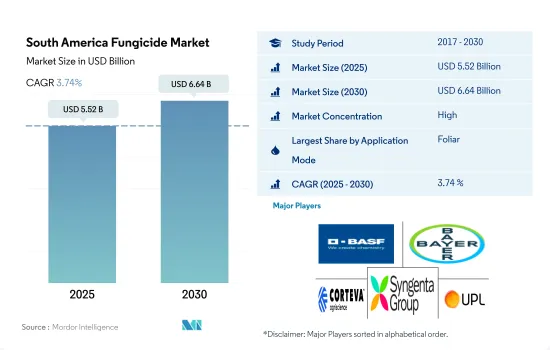
남미의 살균제 시장 규모는 2025년에 55억 2,000만 달러로 추정되고, 2030년에는 66억 4,000만 달러에 이르고, 예측 기간중(2025-2030년)의 CAGR은 3.74%를 나타낼 것으로 예측됩니다.
살균제 살포의 주요 방식으로서 가장 중요한 것은 잎 표면 살포입니다.
남미에서는 농업에서 곰팡이병을 효과적으로 방제하기 위해 다양한 살균제 살포 방법을 활용하고 있습니다. 적절한 살포 방법을 선택함으로써 농부들은 비용 효율적인 솔루션을 얻을 수 있으며, 특정 지역에 정확하게 살포하고 불필요한 사용량을 최소화할 수 있습니다. 이렇게 개선된 효능은 살균제 활용도를 최적화하여 농가의 투입 비용을 절감할 수 있습니다.
농업의 다양한 살균제 살포 방법 중 잎 표면 살포는 2022년 전체 살균제 사용량의 59.8%를 차지할 정도로 지배적인 방식입니다. 이 방식은 42.1%로 가장 큰 시장 점유율을 차지하는 맥류와 유지종자에서 주로 활용되고 있습니다. 잎 표면 살포의 표적화되고 효율적인 흡수 특성은 질병 방제 효과에 기여하여 잠재적으로 수확량 증가와 농가의 비용 절감으로 이어집니다.
2022년 종자 처리 방법은 전체의 14.2%를 차지하며 두 번째로 큰 시장 점유율을 기록했습니다. 묘목을 보호하고 생산성을 높이기 위해 살균제 종자 처리 제품을 사용하는 것의 이점에 대한 농부들의 인식이 높아짐에 따라 종자 처리 제품의 채택이 크게 증가했습니다. 그 결과 남의 살균제 종자 처리 시장은 2023년부터 2029년까지 예측 기간 동안 4.0%의 연평균 성장률을 나타낼 것으로 예상됩니다.
남미의 농업 부문에서 살균제는 작물 수확량을 극대화하고 전반적인 수익성을 개선하는 것을 주요 목표로 활용됩니다. 이 용도 부문은 예측 기간(2023-2029년) 동안 4.0%의 연평균 성장률로 상당한 성장을 나타낼 것으로 예상됩니다.
농작물에 대한 곰팡이병의 위협이 점점 더 심각해지면서 브라질이 시장을 장악했습니다.
많은 작물이 남아메리카의 열대 기후에서 잘 자랍니다. 브라질, 아르헨티나, 파라과이는 남미의 3대 주요 농업 생산국입니다. 이들 국가는 대두, 옥수수, 설탕, 커피, 과일, 채소의 주요 수출국입니다.
브라질은 2022년 59.4%의 시장 점유율을 차지하며 시장을 지배하고 있습니다. 브라질의 농업이 확장되고 다양화됨에 따라 농작물에 대한 곰팡이병의 위협이 점점 더 커지고 있습니다. 곰팡이 병원균은 다양한 작물에 악영향을 미쳐 수확량 손실, 품질 저하, 농가의 경제적 손실로 이어질 수 있습니다.
칠레는 2022년 남의 살균제 시장의 4.8%를 차지했습니다. 칠레는 북쪽의 아타카마 사막은 온화한 기후, 중부의 비옥한 중앙 계곡 지역은 지중해성 기후, 남쪽의 낮은 해안 산지와 동쪽의 험준한 안데스 산맥은 서늘하고 습한 기후를 가지고 있습니다. 이러한 기후 조건은 이 나라에서 곰팡이병의 확산에 유리합니다. 캡탄과 티람은 칠레에서 널리 사용되는 두 가지 살균제입니다. 캡탄은 유기물 함량이 높은 자연 토양과 가장 큰 상호 작용을 하는 것으로 밝혀진 반면, 티람은 점토 함량이 높은 토양을 선호하는 것으로 나타났습니다.
살균제 시장을 이끄는 요인으로는 경작지 감소, 인구 증가, 작물 수확량 개선의 필요성 등이 있습니다. 기존 살균제에 대한 다양한 곰팡이의 내성과 식물에 새로운 질병의 출현으로 인해 기업들은 새로운 곰팡이 돌연변이와 싸우고 농가의 손실을 줄이기 위한 새로운 제품을 찾게 되었습니다. 작물 질병 퇴치를위한 살균제에 대한 수요 증가는 예측 기간 동안 시장을 주도 할 것으로 예상됩니다.
남미의 살균제 시장 동향
재배 밀도 증가와 같은 농업 관행의 강화는 곰팡이 병원균의 급속한 증식에 유리한 환경을 조성합니다.
곰팡이 감염은 식물의 전반적인 건강 상태를 약화시켜 성장 장애로 이어질 수 있습니다. 감염된 식물은 키가 작아지고 잎이 작아지며 가지 수가 줄어들어 작물 수확량 감소로 직결될 수 있습니다. 또한 곰팡이는 식물의 호르몬 균형을 교란하여 식물의 발달과 전반적인 생산성에 영향을 미칠 수 있습니다.
남미의 서던 콘은 질병 전염병이 가장 심각한 지역 중 하나입니다. 이 지역은 아르헨티나, 볼리비아, 칠레, 브라질, 파라과이, 우루과이로 구성되어 있습니다. 전염병과 생산 손실을 유발하는 심각한 질병으로는 잎 녹병, 흰가루병, 곰팡이성 잎마름병(셉토리아 잎마름병, 반점병) 등이 있습니다. 이러한 질병은 정상적인 조건에서 발생과 전파에 유리하기 때문에 매년 발생하고 있습니다. 엽고병(셉토리아 엽고병, 반점병) 등입니다. 이러한 병해는 정상적인 조건이 병해의 발생과 만연에 적합하기 때문에 매년 발생합니다.
칠레는 남미에서 살균제를 가장 많이 소비하는 국가로, 2022년에 4.1kg/ha의 살균제를 소비할 것으로 예상됩니다. 이는 칠레의 특정 지역이 높은 습도, 강우량, 기온 변동과 같은 기후 조건으로 인해 곰팡이병 발생에 유리한 환경을 조성할 수 있기 때문입니다. 이러한 질병을 예방하고 관리하기 위해 농부들은 사전 조치로 살균제에 의존하는 경우가 많습니다.
브라질 남부의 기후 조건은 몇 가지 중요한 곰팡이성 잎병의 발생에 매우 유리합니다. 12년에 걸친 연구에 따르면 살균제를 뿌린 밀은 평균 40%의 수확량 증가를 보인 것으로 나타났습니다. 브라질은 2022년에 0.9kg/ha로 두 번째로 많은 살균제 소비량을 기록했습니다.
재배 밀도 증가와 같은 농업 관행의 강화는 곰팡이 병원균의 빠른 증식과 정착에 유리한 환경을 조성하여 예측 기간 동안 살균제에 대한 수요를 촉진합니다.
만코제브는 남미에서 가장 널리 사용되는 살균제입니다.
만코제브는 디티오카바메이트 계열에 속하는 살균제입니다. 남미에서는 다양한 작물의 곰팡이병을 방제하기 위해 일반적으로 사용됩니다. 만코제브는 감자, 토마토, 포도, 바나나 등의 작물에서 역병, 노균병, 조기 역병, 탄저병 등 다양한 곰팡이병을 효과적으로 관리할 수 있습니다. 만코제브는 곰팡이의 대사 과정을 방해하여 성장과 번식을 막는 방식으로 작용합니다. 또한, 만코제브는 다른 살균제에 비해 광범위한 활성 스펙트럼을 가지고 있으며 곰팡이 세포 내 여러 부위에 작용하여 더 효과적입니다. 만코제브의 가격은 7,800달러였습니다.
프로피넵 역시 만코제브와 유사한 디티오카바메이트 계열의 살균제입니다. 농업에서 다양한 곰팡이병을 방제하는 데 사용됩니다. 프로피넵은 다양한 작물의 노균병, 역병, 잎마름병, 무름병과 같은 곰팡이 병을 관리하는 데 효과적입니다. 만코제브와 마찬가지로 프로피넵도 여러 부위에 걸쳐 작용하기 때문에 곰팡이 개체군에서 내성이 생길 가능성이 적습니다. 프로피넵의 2022년 남미 가격은 3,540달러입니다.
만코제브 및 프로피넵과 마찬가지로 지람은 디티오카바메이트 계열의 화학물질에 속하며, 2022년 가격은 미터당 3,300달러였습니다. 일반적으로 농업에서 곰팡이병을 방제하는 데 사용되며 역병, 노균병, 잎마름병, 탄저병과 같은 곰팡이병을 효과적으로 관리하는 것으로 알려져 있습니다. 지람은 곰팡이 세포의 여러 주요 효소를 억제하여 다양한 대사 과정을 방해하고 병원균의 성장과 번식 능력을 방해합니다. 여러 부위에서 작용하기 때문에 장기적으로 질병을 통제하는 데 효과적인 도구입니다.
남미의 살균제 산업 개요
남미의 살균제 시장은 상당히 통합되어 있으며 상위 5개사에서 70.48%를 차지하고 있습니다. 이 시장 주요 기업은 다음과 같습니다. BASF SE, Bayer AG, Corteva Agriscience, Syngenta Group and UPL Limited.
기타 혜택
엑셀 형식 시장 예측(ME) 시트
3개월의 애널리스트 지원
목차
제1장 주요 요약과 주요 조사 결과
제2장 보고서 제안
제3장 소개
조사의 전제조건과 시장 정의
조사 범위
조사 방법
제4장 주요 산업 동향
헥타르당 농약 소비량
유효성분의 가격 분석
규제 프레임워크
아르헨티나
브라질
칠레
밸류체인과 유통채널 분석
제5장 시장 세분화
적용 모드
화학 처리
잎 표면 살포
훈증
종자 처리
토양 처리
작물 유형
상업 작물
과일 및 채소
곡물
콩류 및 유지종자
잔디 및 관상용
생산국
아르헨티나
브라질
칠레
기타 남미
제6장 경쟁 구도
주요 전략 동향
시장 점유율 분석
기업 상황
기업 프로파일(세계 수준 개요, 시장 수준 개요, 주요 사업 부문, 재무, 직원 수, 주요 정보, 시장 순위, 시장 점유율, 제품 및 서비스, 최근 동향 분석 포함)
ADAMA Agricultural Solutions Ltd.
American Vanguard Corporation
BASF SE
Bayer AG
Corteva Agriscience
FMC Corporation
Rainbow Agro
Sumitomo Chemical Co. Ltd
Syngenta Group
UPL Limited
제7장 CEO에 대한 주요 전략적 질문
제8장 부록
세계의 개요
개요
Five Forces 분석 프레임워크
세계의 밸류체인 분석
시장 역학(DROs)
출처 및 참고문헌
도표 일람
주요 인사이트
데이터 팩
용어집
HBR
영문 목차
영문목차
The South America Fungicide Market size is estimated at 5.52 billion USD in 2025, and is expected to reach 6.64 billion USD by 2030, growing at a CAGR of 3.74% during the forecast period (2025-2030).
The foliar application holds the utmost significance as the primary mode of fungicide application
In South America, numerous methods of fungicide applications are utilized to effectively control fungal diseases in agriculture. By choosing suitable application methods, farmers can attain cost-efficient solutions, ensuring accurate coverage of specific areas and minimizing unnecessary usage. This improved efficacy optimizes fungicide utilization, resulting in decreased input costs for farmers.
Among various fungicide application methods in agriculture, foliar application is the dominant mode, accounting for 59.8% of the total fungicide usage in 2022. This approach is primarily utilized in pulses and oilseeds, which hold the largest market share at 42.1%. The targeted and efficient absorption properties of foliar application contribute to its effectiveness in controlling diseases, potentially resulting in increased yields and saving costs for farmers.
In 2022, the seed treatment method held the second-largest market share, comprising 14.2% of the total. The rise in farmers' awareness about the benefits of using fungicide seed treatment products to protect seedlings and boost productivity has resulted in a significant rise in their adoption. As a result, it is projected that the South American fungicide seed treatment market may experience a CAGR of 4.0% during the forecast period from 2023 to 2029.
In the agricultural sector of South America, fungicides are utilized with the primary aim of maximizing crop yields and improving overall profitability. The mode of the application segment is anticipated to experience substantial growth, with a CAGR of 4.0% during the forecast period from 2023 to 2029.
Brazil dominated the market as the threat of fungal diseases to crops became increasingly significant
Many crops thrive in the tropical climates of South America. Brazil, Argentina, and Paraguay are the three major agricultural producers in South America. These countries are major exporters of soybeans, maize, sugar, coffee, fruits, and vegetables.
Brazil dominated the market, accounting for a market share of 59.4% in 2022. As Brazil's agriculture expands and diversifies, the threat of fungal diseases to crops becomes increasingly significant. Fungal pathogens can adversely impact a wide range of crops, leading to yield losses, reduced quality, and economic losses for farmers.
Chile accounted for 4.8% of the South American fungicide market in 2022. Chile has a temperate climate in the Atacama Desert in the north, a Mediterranean climate in the central and fertile central valley region, and a cool and damp climate in the southern low coastal mountains and rugged Andes in the east. These climatic conditions favor the proliferation of fungal diseases in the country. Captan and thiram are two fungicides widely used in Chile. Captan is found to have the greatest interaction with natural soils with high organic matter content, while thiram showed a preference for soils with high clay content.
Factors driving the market for fungicides include decreasing arable land, increasing population, and the need to improve crop yields. Resistance of various fungi to the existing fungicides and the emergence of new diseases in plants led the companies to find novel products for fighting the new fungus mutations and reducing the loss to farmers. The increasing demand for fungicides to fight crop diseases is expected to drive the market during the forecast period.
South America Fungicide Market Trends
Intensification of agricultural practices, such as increased planting densities, creates a conducive environment for the rapid proliferation of fungal pathogens
Fungal infections can weaken the overall health of plants, leading to stunted growth. Infected plants may exhibit reduced height, smaller leaves, and fewer branches, which can directly translate into lower crop yields. Fungi can also disrupt the hormonal balance within plants, affecting their development and overall productivity.
The Southern Cone of South America is one of the most critical regions for disease epidemics. The region is comprised of Argentina, Bolivia, Chile, Brazil, Paraguay, and Uruguay. Serious diseases that cause epidemics and production losses include leaf rusts, powdery mildew, and fungal leaf blights (Septoria leaf blotch, spot blotch). These diseases are present every year since normal conditions are conducive to their appearance and dissemination.
Chile is the largest consumer of fungicides in South America, with a consumption of 4.1 kg/ha in the year 2022. This is because certain regions in Chile have climatic conditions, such as high humidity, rainfall, and temperature fluctuations, which can create a conducive environment for fungal disease development. To prevent and manage these diseases, farmers often rely on fungicides as a proactive measure.
Climatic conditions prevailing in southern Brazil are highly conducive to the development of several important fungal foliar diseases. A twelve-year study demonstrated that wheat plants sprayed with fungicide showed a mean yield increase of 40%. Brazil accounted for the second most fungicide consumption rate of 0.9 kg/ha in 2022.
The intensification of agricultural practices, such as increased planting densities, creates a conducive environment for the rapid proliferation and establishment of fungal pathogens, thereby fueling the demand for fungicides during the forecast period.
Mancozeb is the most popularly used fungicide in South America
Mancozeb is a fungicide belonging to the chemical class of dithiocarbamates. It is commonly used in South America to control fungal diseases in various crops. Mancozeb is effective in managing a wide range of fungal diseases, including late blight, downy mildew, early blight, and anthracnose, in crops like potatoes, tomatoes, grapes, and bananas. Mancozeb works by interfering with the metabolic processes of the fungi, preventing their growth and reproduction. In addition, Mancozeb has a broad spectrum of activity compared to other fungicides and acts on multiple sites within the fungal cell, making it more effective. Mancozeb was priced at USD 7.8 thousand in South America in 2022.
Propineb is also a fungicide belonging to the chemical class of dithiocarbamates, similar to Mancozeb. It is used to control various fungal diseases in agriculture. Propineb is effective in managing fungal diseases such as downy mildew, late blight, leaf spot, and blight in various crops. Like Mancozeb, Propineb also works through multi-site activity, making it less prone to resistance development in fungal populations. Propineb was priced at USD 3.54 thousand in South America in the year 2022.
Similar to Mancozeb and Propineb, Ziram belongs to the chemical class of dithiocarbamates, priced at USD 3.3 thousand per metric in 2022. It is commonly used to control fungal diseases in agriculture and is known to effectively manage fungal diseases such as common blight, downy mildew, leaf spot, and anthracnose. Ziram inhibits several key enzymes in the fungal cell, disrupting various metabolic processes and interfering with the pathogens' ability to grow and reproduce. The multi-site activity makes it an effective tool for disease control over the long term.
South America Fungicide Industry Overview
The South America Fungicide Market is fairly consolidated, with the top five companies occupying 70.48%. The major players in this market are BASF SE, Bayer AG, Corteva Agriscience, Syngenta Group and UPL Limited (sorted alphabetically).
Additional Benefits:
The market estimate (ME) sheet in Excel format
3 months of analyst support
TABLE OF CONTENTS
1 EXECUTIVE SUMMARY & KEY FINDINGS
2 REPORT OFFERS
3 INTRODUCTION
3.1 Study Assumptions & Market Definition
3.2 Scope of the Study
3.3 Research Methodology
4 KEY INDUSTRY TRENDS
4.1 Consumption Of Pesticide Per Hectare
4.2 Pricing Analysis For Active Ingredients
4.3 Regulatory Framework
4.3.1 Argentina
4.3.2 Brazil
4.3.3 Chile
4.4 Value Chain & Distribution Channel Analysis
5 MARKET SEGMENTATION (includes market size in Value in USD and Volume, Forecasts up to 2030 and analysis of growth prospects)
5.1 Application Mode
5.1.1 Chemigation
5.1.2 Foliar
5.1.3 Fumigation
5.1.4 Seed Treatment
5.1.5 Soil Treatment
5.2 Crop Type
5.2.1 Commercial Crops
5.2.2 Fruits & Vegetables
5.2.3 Grains & Cereals
5.2.4 Pulses & Oilseeds
5.2.5 Turf & Ornamental
5.3 Country
5.3.1 Argentina
5.3.2 Brazil
5.3.3 Chile
5.3.4 Rest of South America
6 COMPETITIVE LANDSCAPE
6.1 Key Strategic Moves
6.2 Market Share Analysis
6.3 Company Landscape
6.4 Company Profiles (includes Global level Overview, Market level overview, Core Business Segments, Financials, Headcount, Key Information, Market Rank, Market Share, Products and Services, and analysis of Recent Developments)
6.4.1 ADAMA Agricultural Solutions Ltd.
6.4.2 American Vanguard Corporation
6.4.3 BASF SE
6.4.4 Bayer AG
6.4.5 Corteva Agriscience
6.4.6 FMC Corporation
6.4.7 Rainbow Agro
6.4.8 Sumitomo Chemical Co. Ltd
6.4.9 Syngenta Group
6.4.10 UPL Limited
7 KEY STRATEGIC QUESTIONS FOR CROP PROTECTION CHEMICALS CEOS