인도의 살균제 시장 : 시장 점유율 분석, 산업 동향 및 통계, 성장 예측(2025-2030년)
India Fungicide - Market Share Analysis, Industry Trends & Statistics, Growth Forecasts (2025 - 2030)
상품코드:1683990
리서치사:Mordor Intelligence
발행일:2025년 03월
페이지 정보:영문
라이선스 & 가격 (부가세 별도)
ㅁ Add-on 가능: 고객의 요청에 따라 일정한 범위 내에서 Customization이 가능합니다. 자세한 사항은 문의해 주시기 바랍니다.
ㅁ 보고서에 따라 최신 정보로 업데이트하여 보내드립니다. 배송기일은 문의해 주시기 바랍니다.
한글목차
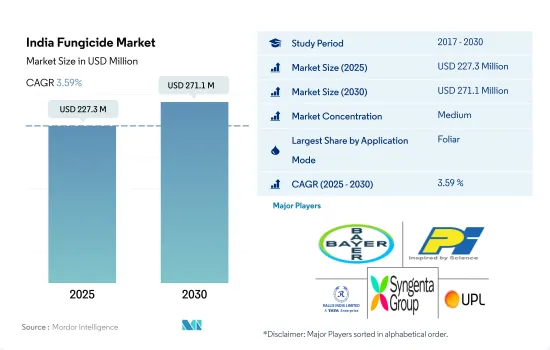
인도의 살균제 시장 규모는 2025년에 2억 2,730만 달러로 추정되고, 2030년에는 2억 7,110만 달러에 이를 것으로 예측되며, 예측 기간 중 2025년부터 2030년까지 CAGR 3.59%로 성장할 전망입니다.
진균성 병해 증가에 따라 다양한 살포 방법으로 살균제 수요가 높아지고 있습니다.
살균제는 특정 요건과 질병에 따라 다양한 방식으로 살포될 수 있습니다. 이러한 방법에는 화학적 살포, 엽면 살포, 훈증, 종자 및 토양 처리 등이 포함됩니다. 이러한 다양한 살포 방법은 조건에 따라 다양한 작물에 살균제를 효과적으로 살포하는데 중요한 역할을 합니다.
2022년에는 엽면 살포가 살균제 살포 부문을 지배하여 60.9%의 최대 시장 점유율을 차지했습니다. 이 방법은 잎의 병원체를 직접 표적으로 함으로써 엽면 진균병에 대한 효율적인 보호를 제공하기 때문에 매우 선호되었습니다. 엽면 살포는 살균제의 식물 조직에의 신속한 침투 및 흡수를 촉진하고, 진균 병원체에 대한 효과적인 작용을 보증합니다.
살균제 종자 처리는 식물 발달의 초기 단계에서 곰팡이 감염과 싸우는 데 널리 사용됩니다. 이러한 치료는 종자 주위에 보호 장벽을 제공하여 종자의 부패, 묘종 고갈, 습해, 뿌리 썩음 등 다양한 질병을 효과적으로 예방합니다. 2022년 인도의 살균제 시장에서 살균제 종자 처리제 부문은 13.8% 시장 점유율을 차지했습니다.
곡물 및 곡류 생산자는 이러한 작물이 해충의 영향을 받기 쉽기 때문에 작물의 스테이지나 해충의 발생 상황에 따라, 모든 살포 방법을 재배에 도입하고 있습니다. 이 작물에서는 엽면 살충제 살포가 주로 채택됩니다.
살포 방법의 선택은 특정 대상 병해, 작물의 유형, 병기, 설비의 유무 등 다양한 요인에 영향을 받습니다. 살균제 시장은 예측 기간 동안 CAGR 3.9%를 나타낼 것으로 예상됩니다.
인도의 살균제 시장 동향
기후 변화 및 병해압력 상승이 살균제 소비를 촉진할 전망
인도는 살균제를 포함한 작물 보호 화학 물질의 중요한 소비국입니다. 이 나라의 농업 부문은 규모가 크고 다양한 유형의 작물이 재배되기 때문에 살균제에 대한 수요가 큽니다. 곰팡이병은 농산물의 생산량과 품질을 현저하게 저하시켜 상당한 손실을 초래합니다. 살균제는 다양한 질병의 예방과 관리에 필수적이며 농업 생산의 건전성과 생산성을 유지합니다. 2022년 인도의 살균제 1헥타르당 소비량은 101.5g/ha였습니다.
인도는 작물의 다양성이 높고 쌀과 밀과 같은 주식 작물에서 면화, 과일, 야채와 같은 환금 작물에 이르기까지 다양한 병해가 발생하고 있습니다. 녹, 전염병, 베토병, 부패병은 이러한 작물에 대한 균류 병해의 치명적인 영향의 예입니다. 이러한 위험을 줄이고 작물을 보호하기 위해 인도 농부는 살균제를 병해 관리 전략의 중요한 도구로 사용합니다.
인도에서는 농업 관행의 변화 및 식량 수요 증가에 따라 제작 면적이 증가하고 있습니다. 농부들은 작부를 자주 반복하거나 매년 작부 주기를 늘리고 있습니다. 이러한 작부 집약화는 진균성 병해를 비롯한 병해 발생 위험이 증가하여, 살균제의 필요성을 증가시킵니다. 인도의 헥타르당 살균제 소비량은 2017년부터 2022년까지 5.0% 증가했습니다.
인도 정부는 살균제와 같은 작물 보호 화학 물질의 사용을 장려하기 위해 여러 가지 계획과 프로그램을 수립했습니다. 정부는 보조금, 보급 서비스, 연수 프로그램을 통해 병해 관리에 살균제를 이용하도록 농부들에게 일하고 있습니다.
기후 변화는 진균의 생존력과 감염력, 숙주의 감수성을 변화시켜 새로운 병해의 발생으로 이어집니다.
곰팡이병은 중요한 작물에 큰 위협입니다. 곰팡이 병원균은 인도의 다양한 작물에서 큰 수율 손실을 초래합니다. 곡물에서는 수율 제한 요인으로 알려져 있습니다. 인도에서 곰팡이 감염으로 인한 작물 수율 감소는 연간 약 500만 톤에 이를 것으로 예상됩니다.
만코제브는 광범위한 접촉 살균제로, 옥수수, 쌀, 밀, 야채, 과일, 사탕수수, 담배 등의 작물로, 아이스포트, 링스폿, 도열병, 딱지별, 잎곰팡이병, 우동병, 줄기해병, 줄기부패병, 갈색부패병, 백색줄기부패병 , 흑색줄기부패병 등의 진균 병해 방제에 사용됩니다. 2022년에는 1톤당 7,700달러로 평가되었습니다.
프로피네브는 접촉 살균제로 2022년에는 톤당 3,500달러로 평가되었습니다. 사과, 감자, 고추, 토마토 등의 작물로, 옴 선조기 및 만고병, 박카이 부패병, 우동병, 과실반점병, 갈색 세엽반점병 등, 다양한 병해의 방제에 사용됩니다.
지람은 기본적인 접촉 엽면 살균제로 2022년 가격은 톤당 3,200달러였습니다. 주로 감자 조고병과 만고병, 덩굴성 식물 및 박과 식물 곰팡이와 흑부병, 사과 딱지, 바나나 시가토카, 감귤류의 멜라노스를 방제합니다.
기후 변화는 곰팡이의 생존력, 감염력, 숙주의 감수성에 영향을 미치고 새로운 병해의 발생을 초래할 수 있습니다. 예를 들어 인도 아대륙의 서해안, 중앙부, 내륙반도, 북동부의 기후의 온난화 동향은 설감베과병(SDM)과 터키기엽엽병(TLB) 등 옥수수의 병해에 좋은 조건을 낳고 있습니다. 이러한 요인은 살균제의 가격과 수요에 영향을 미칠 것으로 예상됩니다.
인도의 살균제 산업 개요
인도의 살균제 시장은 적당히 통합되어 상위 5개사에서 53.11%를 차지하고 있습니다. 이 시장 주요 기업은 다음과 같습니다. Bayer AG, PI Industries, Rallis India Ltd, Syngenta Group 및 UPL Limited(알파벳순 정렬).
기타 혜택
엑셀 형식 시장 예측(ME) 시트
3개월의 애널리스트 서포트
목차
제1장 주요 요약 및 주요 조사 결과
제2장 보고서 제안
제3장 서문
조사 전제조건 및 시장 정의
조사 범위
조사 방법
제4장 주요 산업 동향
1헥타르당 농약 소비량
유효성분의 가격 분석
규제 프레임워크
인도
밸류체인 및 유통채널 분석
제5장 시장 세분화
적용 모드별
화학 관개
엽면 살포
훈증
종자 처리
토양 치료
작물 유형별
상업 작물
과일 및 야채
곡물
콩류 및 지방종자
잔디 및 관상용
제6장 경쟁 구도
주요 전략 동향
시장 점유율 분석
기업 상황
기업 프로파일(세계 수준 개요, 시장 수준 개요, 주요 사업 부문, 재무, 직원 수, 주요 정보, 시장 순위, 시장 점유율, 제품 및 서비스, 최근 동향 분석 포함)
ADAMA Agricultural Solutions Ltd
BASF SE
Bayer AG
Corteva Agriscience
FMC Corporation
PI Industries
Rallis India Ltd
Sumitomo Chemical Co. Ltd
Syngenta Group
UPL Limited
제7장 CEO에 대한 주요 전략적 질문
제8장 부록
세계의 개요
개요
Porter's Five Forces 분석 프레임워크
세계 밸류체인 분석
시장 역학(DROs)
정보원 및 참고문헌
도표 일람
주요 인사이트
데이터 팩
용어집
AJY
영문 목차
영문목차
The India Fungicide Market size is estimated at 227.3 million USD in 2025, and is expected to reach 271.1 million USD by 2030, growing at a CAGR of 3.59% during the forecast period (2025-2030).
The rising fungal diseases are driving the demand for fungicides in various application methods
Fungicides can be applied using a variety of methods, depending on the specific requirements and diseases. These methods include chemigation, foliar application, fumigation, and seed and soil treatments. These diverse application methods play a crucial role in effectively applying fungicides to various crops, depending on the conditions.
In 2022, foliar application dominated the fungicide application segment, which held the largest market share of 60.9%. This method was highly preferred as it provides efficient protection against foliar fungal diseases by directly targeting pathogens on leaves. The foliar application facilitates swift penetration and absorption of fungicides into the plant tissues, ensuring their effective action against fungal pathogens.
Fungicide seed treatments are extensively employed to combat fungal infections in the early stages of plant development. These treatments provide a protective barrier around the seeds, effectively preventing a range of diseases such as seed rots, seedling blights, damping off, and root rots. The fungicide seed treatments segment held a market share of 13.8% in the Indian fungicide market in 2022.
Grains and cereal crop growers are majorly adopting all the application methods in their cultivation based on the crop stage and insect pests as these crops are more susceptible to insect pests. Foliar insecticide application was majorly adopted by the farmers in these crops.
The selection of the application mode is influenced by various factors, including the specific target disease, crop type, disease stage, and the availability of equipment. The fungicide market is expected to register a CAGR of 3.9% during the forecast period.
India Fungicide Market Trends
The changing climate and rising disease pressure are expected to drive the consumption of fungicides
India is a significant consumer of crop protection chemicals, including fungicides. The country's agricultural sector is large, with diverse types of crops being cultivated, leading to a substantial demand for fungicides. Fungal diseases can significantly reduce agricultural output and quality, resulting in considerable crop losses. Fungicides are essential in the prevention and management of various diseases, maintaining the health and productivity of agricultural production. In 2022, the consumption of fungicides in India per hectare accounted for 101.5 g/ha.
India has a high crop diversity, ranging from staple food crops like rice and wheat to cash crops like cotton, fruits, and vegetables, creating a varied disease spectrum. Rust, blight, mildew, and rot are a few examples of the devastating effects of fungal diseases on these crops. To mitigate the risks and protect their crops, farmers in India rely on fungicides as an important tool in their disease management strategies.
Crop intensity is rising in India because of changing agricultural practices and increased food demand. Farmers frequently engage in repeated cropping or increase the number of crop cycles every year. This intensification leads to a higher risk of disease outbreaks, including fungal diseases, and, consequently, a greater need for fungicides. The consumption of fungicides in India per hectare increased by 5.0% from 2017 to 2022.
The Indian government has developed several plans and programs to encourage the use of crop protection chemicals such as fungicides. The government has pushed farmers to utilize fungicides for disease management through subsidies, extension services, and training programs.
Climatic changes altering fungal survivability and infectivity as well as host susceptibility, leading to new disease outbreaks
Fungal diseases are a major threat to important crops. Fungal pathogens cause large yield losses in different crops in India. They are known to be yield-limiting factors in cereals. The fungal infections-related decline in crop yield in India is believed to be approximately 5.0 million tons per year.
Mancozeb is a broad-spectrum contact fungicide used to control fungal diseases like eyespot, ringspot, blast, scab, leaf mold, powdery mildew, stem bois, stem rot, brown rot, white stem rot, and black stem rot in corn, rice, wheat, vegetables, fruit, sugarcane, and tobacco crops. It was valued at USD 7.7 thousand per metric ton in 2022.
Propineb is a contact fungicide valued at USD 3.5 thousand per metric ton in 2022. It is used to control various diseases like scab early & late blight dieback, buckeye rot, downy mildew, fruit spots, and brown, narrow leaf spot diseases in apple, potato, chili, and tomato crops.
Ziram is a basic contact foliar fungicide priced at USD 3.2 thousand per metric ton in 2022. It mainly controls early & late blight of potatoes/tomatoes, downy mildew and black rot of vines and cucurbits, scab of apples, Sigatoka of bananas, and melanose of citrus.
Climatic changes can affect fungal survivability, infectivity, and host susceptibility, resulting in new disease outbreaks. For instance, the warming trend in climate along the Indian subcontinent's west coast, central, interior peninsula, and northeast regions creates favorable conditions for maize diseases like sorghum downy mildew (SDM) and turcicum leaf blight (TLB). These factors are expected to influence the prices and demand for fungicides.
India Fungicide Industry Overview
The India Fungicide Market is moderately consolidated, with the top five companies occupying 53.11%. The major players in this market are Bayer AG, PI Industries, Rallis India Ltd, Syngenta Group and UPL Limited (sorted alphabetically).
Additional Benefits:
The market estimate (ME) sheet in Excel format
3 months of analyst support
TABLE OF CONTENTS
1 EXECUTIVE SUMMARY & KEY FINDINGS
2 REPORT OFFERS
3 INTRODUCTION
3.1 Study Assumptions & Market Definition
3.2 Scope of the Study
3.3 Research Methodology
4 KEY INDUSTRY TRENDS
4.1 Consumption Of Pesticide Per Hectare
4.2 Pricing Analysis For Active Ingredients
4.3 Regulatory Framework
4.3.1 India
4.4 Value Chain & Distribution Channel Analysis
5 MARKET SEGMENTATION (includes market size in Value in USD and Volume, Forecasts up to 2030 and analysis of growth prospects)
5.1 Application Mode
5.1.1 Chemigation
5.1.2 Foliar
5.1.3 Fumigation
5.1.4 Seed Treatment
5.1.5 Soil Treatment
5.2 Crop Type
5.2.1 Commercial Crops
5.2.2 Fruits & Vegetables
5.2.3 Grains & Cereals
5.2.4 Pulses & Oilseeds
5.2.5 Turf & Ornamental
6 COMPETITIVE LANDSCAPE
6.1 Key Strategic Moves
6.2 Market Share Analysis
6.3 Company Landscape
6.4 Company Profiles (includes Global level Overview, Market level overview, Core Business Segments, Financials, Headcount, Key Information, Market Rank, Market Share, Products and Services, and analysis of Recent Developments)
6.4.1 ADAMA Agricultural Solutions Ltd
6.4.2 BASF SE
6.4.3 Bayer AG
6.4.4 Corteva Agriscience
6.4.5 FMC Corporation
6.4.6 PI Industries
6.4.7 Rallis India Ltd
6.4.8 Sumitomo Chemical Co. Ltd
6.4.9 Syngenta Group
6.4.10 UPL Limited
7 KEY STRATEGIC QUESTIONS FOR CROP PROTECTION CHEMICALS CEOS