아프리카의 살균제 시장 : 시장 점유율 분석, 산업 동향 및 통계, 성장 예측(2025-2030년)
Africa Fungicide - Market Share Analysis, Industry Trends & Statistics, Growth Forecasts (2025 - 2030)
상품코드:1683976
리서치사:Mordor Intelligence
발행일:2025년 03월
페이지 정보:영문
라이선스 & 가격 (부가세 별도)
ㅁ Add-on 가능: 고객의 요청에 따라 일정한 범위 내에서 Customization이 가능합니다. 자세한 사항은 문의해 주시기 바랍니다.
ㅁ 보고서에 따라 최신 정보로 업데이트하여 보내드립니다. 배송기일은 문의해 주시기 바랍니다.
한글목차
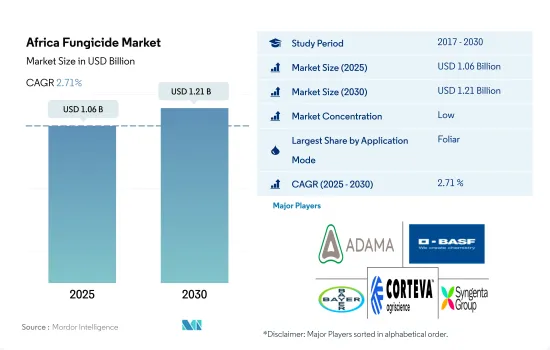
아프리카의 살균제 시장 규모는 2025년에 10억 6,000만 달러로 추정되고, 2030년에는 12억 1,000만 달러에 이를 것으로 예측되며, 예측 기간 중 2025년부터 2030년까지 CAGR 2.71%로 성장할 것으로 예측됩니다.
수율을 보호하고 병해의 만연으로 인한 작물 손실을 피하는 것에 대한 관심 증가가 시장을 견인하고 있습니다.
2022년에는 엽면 살포 분야가 큰 점유율을 차지했으며, 예측 기간 중 CAGR은 3.0%로 용도 중 가장 급성장할 것으로 전망됩니다. 이 부문의 성장의 원동력은 전신 효과와 다른 치료의 적합성에 의한 엽면 살포의 이점 증가입니다.
종자 처리는 2위 시장 점유율을 차지하였고 예측 기간(2023-2029년)의 CAGR은 2.8%를 나타낼 것으로 예측되고 있습니다. 국내 농부들은 일반적으로 종자의 성능을 향상시키고 질병으로부터 보호하기 위해 농약에 의한 종자 처리를 채택합니다.
화학 관개는 2022년 아프리카 살균제 시장액의 12.3%를 차지했습니다. 이 방법은 예측 기간 동안 CAGR 2.6%를 나타낼 것으로 예측됩니다. 아프리카에서는 농부가 관개 시스템을 채택한 결과 농업 생산성이 높아지고 있습니다. 이것은 앞으로 몇 년동안이 부문의 성장을 자극 할 가능성이 높습니다.
토양 처리법은 2023-2029년 기간에 CAGR 2.7%를 나타낼 것으로 예측됩니다. 예를 들면, 생산자는 토양 해충이나 식물의 지상부를 공격하는 해충을 침투성 살균제로 구제할 수 있는 등, 다양한 이점이 있기 때문에 이 지역의 농가 사이에서 이러한 살포 기술의 채용률이 높습니다.
연구에 따르면, 훈증제는 토양 전염성 병해를 방제함으로써 병해의 방제 및 수율 향상에 매우 효과적입니다. 예를 들어, 다조메트(DZ) 훈증은 후자리움균과 피토프트라균에 대해 89.62%-93.33%의 효과가 있는 것으로 판명되었습니다. 이러한 요인으로부터 훈증제 수요가 증가할 것으로 예상됩니다.
살균제 시장은 2023-2029년 CAGR 2.9%를 나타낼 것으로 예측됩니다. 아프리카 농부는 작물을 보호하고 최적의 수율을 보장하기 위해 다양한 방법을 채택하고 있습니다.
농작물을 보호하기 위해 살균제를 사용하는 것에 대한 농가의 의식 증가가 시장을 밀어 올립니다.
아프리카의 살균제 시장은 역사적 기간에 꾸준한 성장을 이루었고, 2022년에는 작물 보호 화학제품 시장 전체의 27.3%(금액 기준)를 차지하게 되었습니다. 만코제브, 메탈락실 및 벤즈이미다졸과 같은 침투성 살균제가 이 지역에서 가장 자주 사용되는 살균제입니다.
옥수수는 아프리카 전역에서 재배되는 가장 중요한 주식 작물이며, 주요 옥수수 생산국은 나이지리아, 남아프리카, 에티오피아입니다. 이 지역에서는 옥수수와 밀 등의 주식용 곡물의 최대 수출국 및 생산국이기 때문에 살균제는 곡물 및 곡류에 많이 사용되고 있습니다. 이 부문은 2022년 금액 기준으로 45.8%의 점유율을 차지했습니다.
마찬가지로 얌이모의 97%는 이 지역의 서아프리카 국가에서 생산됩니다. 얌이모의 탄저병은 가장 치명적인 곰팡이병으로 50-90%의 손실로 이어집니다. 얌이모 탄저병 방제에는 주로 베노밀(벤레이트), 마네브, 클로로탈로닐, 만코제브 등의 화학 살균제가 사용되며, 격주 또는월1회의 살포가 필요합니다.
살균제 내성의 발생은 효과적인 병해 관리를 위한 살균제의 선택을 좁혀 버리기 때문에 큰 과제가 되고 있습니다. 한편, 각국 정부는 새로운 병해와 그에 대응하는 살균제를 발견하기 위한 조사나 농가를 지원하는 제도에 투자하고 있습니다.
정부에 의해 시작된 이러한 정책과 농가의 의식의 고조는 농가가 작물보호 관행을 채택하도록 촉구하고 예측기간 중(2023-2029년) CAGR 2.9%를 나타낼 것으로 예측되는 시장 확대를 목표로 하고 있습니다.
아프리카 살균제 시장 동향
세미트로픽에서 세미 건조까지의 아프리카 기후 조건은 곰팡이 병원체의 증식에 유리합니다.
식물 병원균은 식물에 질병을 일으키는 곰팡이입니다. 곰팡이 감염은 식물의 전반적인 건강 상태를 약화시키고 성장 불량을 유발합니다. 감염된 식물은 풀 길이가 낮고 잎이 작아지고 가지가 줄어들 수 있습니다. 또한, 곰팡이는 식물의 호르몬 균형을 방해하고 개발과 전반적인 생산성에 영향을 미칠 수 있습니다.
아프리카의 살균제 소비량은 2022년에는 2.2kg/ha이었습니다. 아프리카는 다양한 환경 조건을 가진 대륙입니다. 기후 조건은 아열대에서 반건조까지 다양합니다. 아프리카 국가의 대부분은 여름 강우이지만 남서부 연안 지역은 주로 겨울 강우 지역입니다. 이러한 기후 변화로 인해 많은 진균병이 만연합니다.
특정 작물은 곰팡이병에 걸리기 쉽고 그 중요성은 아프리카 지역에 따라 다릅니다. 예를 들어, 옥수수는 많은 사하라 이남의 아프리카 국가의 주식 작물이며 옥수수 녹과 옥수수 반점병과 같은 질병의 영향을 받습니다. 또 다른 중요한 주식 작물인 카사바는 카사바 갈조병이나 카사바 모자이크병 등의 질병에 걸리기 쉽습니다. 또한 커피, 바나나, 토마토 및 기타 작물도 녹 및 모자이크병과 같은 다양한 균류 병원체의 영향을 받기 쉽습니다.
아프리카에서는 상업적 농업이 확대되고 있으며 대규모 농업 경영과 고가치 환금 작물 재배가 증가하고 있습니다. 상업 농부들은 농작물을 진균병으로부터 보호하고 수확량을 극대화하기 위해 살균제에 의존하는 경우가 많습니다. 이러한 요인은 예측 기간 동안 상업적 농업 산업에서 살균제 수요를 촉진할 것으로 예상됩니다.
예방적 및 치료적 병해방제 살균제의 요구와 제한된 생산 능력으로 인한 유효 성분 가격의 변동
아프리카에서는 만코제브, 아조시스트로빈, 메탈락실, 프로피네브, 질람 등의 살균제가 농업에서 중요한 역할을 합니다. 이들은 곡물, 과일, 야채, 환금 작물 등 작물에 심각한 위협을 일으키는 다양한 곰팡이 질병과 싸우는 데 널리 사용됩니다.
2022년 만코제브의 가격은 1톤당 7,793.2달러였습니다. 이 살균제는 접촉 유형의 제품으로 과일, 야채, 견과류, 농작물, 전문적으로 관리되는 잔디 등 다양한 작물에 널리 적용됩니다. 그 효과는 감자의 역병, 엽반병, 딱지, 녹병 등 수많은 진균성 병해에 효과가 있습니다.
아조시스트로빈은 침투성 및 광역 스펙트럼의 예방 살균제로, 이 지역에서 두 번째로 널리 사용되는 살균제입니다. 아조시스트로빈은 침투성과 치유 특성을 모두 보여주며 다양한 중요한 식물 병해를 효과적으로 방제하고 작물 수율을 증가시킵니다. 이 지역에서는 중국이 아조시스트로빈의 주요 공급국이며 남아프리카, 이집트, 케냐, 우간다, 지부티가 주요 수입국입니다. 이 유효성분의 가격은 1톤당 4,579.6달러로 수입관세, 규제승인, 관세 등의 요인에 의해 영향을 받아 비용 변동을 초래할 수 있습니다.
2018년부터 2022년까지 메탈락실 가격은 현저한 상승을 경험했으며, 미터당 542.20달러 상승했습니다. 현재는 톤당 4,454달러입니다. 메탈락실은 그 보호 및 치료 특성으로 알려진 침투성 살균제입니다. 식물의 잎, 줄기, 뿌리에서 흡수되어 늦은 고통, 조고병, 엽반병, 곰팡이병 등의 병해를 효과적으로 방제합니다. 유효 성분의 비용은 원료 가격의 변동에 따라 변동될 수 있습니다.
아프리카의 살균제 산업 개요
아프리카의 살균제 시장은 세분화되어 상위 5개사에서 25.63%를 차지하고 있습니다. 이 시장 주요 기업은 다음과 같습니다. ADAMA Agricultural Solutions Ltd, BASF SE, Bayer AG, Corteva Agriscience 및 Syngenta Group(알파벳순 정렬).
기타 혜택
엑셀 형식 시장 예측(ME) 시트
3개월의 애널리스트 서포트
목차
제1장 주요 요약 및 주요 조사 결과
제2장 보고서 제안
제3장 서문
조사 전제조건 및 시장 정의
조사 범위
조사 방법
제4장 주요 산업 동향
1헥타르당 농약 소비량
유효성분의 가격 분석
규제 프레임워크
남아프리카
밸류체인 및 유통채널 분석
제5장 시장 세분화
용도 모드별
화학 관개
엽면 살포
훈증
종자 처리
토양치료
작물 유형별
상업 작물
과일 및 야채
곡물
콩류 및 지방종자
잔디 및 관상용
국가별
남아프리카
기타 아프리카
제6장 경쟁 구도
주요 전략 동향
시장 점유율 분석
기업 상황
기업 프로파일(세계 수준 개요, 시장 수준 개요, 주요 사업 부문, 재무, 직원 수, 주요 정보, 시장 순위, 시장 점유율, 제품 및 서비스, 최근 동향 분석 포함)
ADAMA Agricultural Solutions Ltd
BASF SE
Bayer AG
Corteva Agriscience
FMC Corporation
Nufarm Ltd
Sumitomo Chemical Co. Ltd
Syngenta Group
UPL Limited
Wynca Group(Wynca Chemicals)
제7장 CEO에 대한 주요 전략적 질문
제8장 부록
세계의 개요
개요
Porter's Five Forces 분석 프레임워크
세계 밸류체인 분석
시장 역학(DROs)
정보원 및 참고문헌
도표 일람
주요 인사이트
데이터 팩
용어집
AJY
영문 목차
영문목차
The Africa Fungicide Market size is estimated at 1.06 billion USD in 2025, and is expected to reach 1.21 billion USD by 2030, growing at a CAGR of 2.71% during the forecast period (2025-2030).
The growing focus on protecting the yield and avoiding crop losses due to disease infestation is driving the market
In 2022, the foliar segment held a significant share, which is expected to grow the fastest among applications with a 3.0% CAGR during the forecast period. This segment's growth is driven by the increased advantages of foliar use due to its systemic effect and compatibility with other treatments.
Seed treatment holds the second-largest market share and is projected to record a 2.8% CAGR during the forecast period (2023-2029). Farmers in the country have adopted a common practice of pesticide seed treatment to improve seed performance and protect against diseases.
Chemigation accounted for 12.3% of the African fungicide market value in 2022. This method is projected to record a 2.6% CAGR during the forecast period. In Africa, farmers are experiencing growing agricultural productivity as a result of adopting an irrigation system. This is likely to stimulate the growth of this segment over the coming years.
The soil treatment method is anticipated to register a 2.7% CAGR during the period 2023-2029. The adoption of such application techniques was high among farmers in the region due to its various benefits, for instance, growers being able to control soil pests and those attacking aerial parts of the plant with a systemic fungicide.
Studies have shown that fumigants are highly effective in controlling diseases and improving yields by protecting against soil-borne diseases. For instance, dazomet (DZ) fumigation was found to be 89.62% to 93.33% effective against fusarium and phytophthora. Due to these factors, the demand for fumigants is expected to increase.
The fungicide market is projected to record a 2.9% CAGR during the period 2023-2029. African farmers are adopting different methods based on their requirements to protect crops and ensure optimal yields.
Increased awareness among farmers for using fungicides to protect crops is boosting the market
The fungicide market in Africa witnessed steady growth during the historical period, with the region occupying a share of 27.3%, by value, of the total crop protection chemical market in 2022. Mancozeb and systemic fungicides such as metalaxyl and benzimidazoles are the most frequently used fungicides in the region.
Maize is the most important staple crop cultivated throughout Africa, with leading maize-producing countries being Nigeria, South Africa, and Ethiopia. Fungicides are mostly used in grains and cereals in the region as it is the largest exporter and producer of staple grains such as maize and wheat. The segment occupied a share of 45.8%, by value, in 2022.
Similarly, 97% of yam is produced in the West African countries of the region. Anthracnose disease of yam is the most devastating fungal disease, leading to 50-90% losses. The control of yam anthracnose has been accomplished mainly with chemical fungicides such as benomyl (benlate), maneb, chlorothalonil, and mancozeb, which require biweekly or monthly applications.
The occurrence of fungicide resistance presents a big challenge as it limits fungicide choices for effective disease management. At the same time, governments of various countries are investing in research initiatives to discover new diseases and their subsequent fungicides, along with supportive schemes for farmers.
Such policies initiated by the government and a rise in awareness among farmers have further encouraged farmers to adopt crop protection practices that aim to expand the market, which is anticipated to record a CAGR of 2.9% during the forecast period (2023-2029).
Africa Fungicide Market Trends
African climatic conditions ranging from semi-tropic to semi-arid favor the proliferation of fungal pathogens
Phytopathogenic fungi are fungi that cause diseases in plants. Fungal infections can weaken the overall health of plants, leading to stunted growth. Infected plants may exhibit reduced height, smaller leaves, and fewer branches, which can directly translate into lower crop yields. Fungi can also disrupt the hormonal balance within plants, affecting their development and overall productivity.
The fungicide consumption rate in Africa was 2.2 kg/ha in the year 2022. Africa is a continent with diverse environmental conditions. The climatic conditions range from semi-tropic to semi-arid. Although the majority of African countries have summer rainfall, the southwestern coastal region is predominantly a winter rainfall area. These variations in climate allow infestation of a large number of fungal diseases.
Certain crops are more susceptible to fungal diseases, and their importance varies across regions in Africa. For example, maize is a staple crop in many Sub-Saharan African countries and is affected by diseases like maize rust and maize smut. Cassava, another crucial staple crop, is susceptible to diseases such as cassava brown streak disease and cassava mosaic disease. Additionally, coffee, bananas, tomatoes, and other crops are also susceptible to various fungal pathogens like rusts and mosaics.
Commercial farming is expanding in Africa, with larger-scale agricultural operations and increased cultivation of high-value cash crops. Commercial farmers often rely on fungicides to protect their crops from fungal diseases and maximize yields. Such factors are expected to drive the demand for fungicides in the commercial farming industry during the forecast period.
Need for preventive and curative disease control fungicides and their limited production capabilities resulting in fluctuations in the prices of active ingredients
In the African region, fungicides such as mancozeb, azoxystrobin, metalaxyl, propineb, and ziram play a crucial role in agricultural practices. They are widely utilized to combat various fungal diseases that pose significant threats to crops, including cereals, fruits, vegetables, and cash crops.
The price of mancozeb stood at USD 7,793.2 per metric ton in 2022. This fungicide is a contact-type product widely applied on various crops, including fruits, vegetables, nuts, field crops, and professionally managed turf. Its effectiveness extends to combat numerous fungal diseases, including potato blight, leaf spot, scab, and rust.
Azoxystrobin, a systemic and broad-spectrum preventive fungicide, holds the position of the second most widely used fungicide in the region. It exhibits both systemic and curative properties, effectively controlling various significant plant diseases and enhancing crop yield. China serves as the primary supplier of azoxystrobin to the region, while South Africa, Egypt, Kenya, Uganda, and Djibouti are the major importing countries. The price of this active ingredient, which was at USD 4,579.6 per metric ton, can be influenced by factors such as importing tariffs, regulatory approvals, and customs duties, leading to fluctuations in its cost.
Between 2018 and 2022, the price of metalaxyl experienced a notable rise, with an increase of USD 542.20 per metric ton. Currently, it stands at USD 4,454.0 per metric ton. Metalaxyl is a systemic fungicide known for its protective and curative properties. It is absorbed through the leaves, stems, and roots of plants, effectively controlling diseases like late blight, early blight, leaf spot, and downy mildew. The cost of the active ingredient may vary due to fluctuating raw material prices.
Africa Fungicide Industry Overview
The Africa Fungicide Market is fragmented, with the top five companies occupying 25.63%. The major players in this market are ADAMA Agricultural Solutions Ltd, BASF SE, Bayer AG, Corteva Agriscience and Syngenta Group (sorted alphabetically).
Additional Benefits:
The market estimate (ME) sheet in Excel format
3 months of analyst support
TABLE OF CONTENTS
1 EXECUTIVE SUMMARY & KEY FINDINGS
2 REPORT OFFERS
3 INTRODUCTION
3.1 Study Assumptions & Market Definition
3.2 Scope of the Study
3.3 Research Methodology
4 KEY INDUSTRY TRENDS
4.1 Consumption Of Pesticide Per Hectare
4.2 Pricing Analysis For Active Ingredients
4.3 Regulatory Framework
4.3.1 South Africa
4.4 Value Chain & Distribution Channel Analysis
5 MARKET SEGMENTATION (includes market size in Value in USD and Volume, Forecasts up to 2030 and analysis of growth prospects)
5.1 Application Mode
5.1.1 Chemigation
5.1.2 Foliar
5.1.3 Fumigation
5.1.4 Seed Treatment
5.1.5 Soil Treatment
5.2 Crop Type
5.2.1 Commercial Crops
5.2.2 Fruits & Vegetables
5.2.3 Grains & Cereals
5.2.4 Pulses & Oilseeds
5.2.5 Turf & Ornamental
5.3 Country
5.3.1 South Africa
5.3.2 Rest of Africa
6 COMPETITIVE LANDSCAPE
6.1 Key Strategic Moves
6.2 Market Share Analysis
6.3 Company Landscape
6.4 Company Profiles (includes Global level Overview, Market level overview, Core Business Segments, Financials, Headcount, Key Information, Market Rank, Market Share, Products and Services, and analysis of Recent Developments)
6.4.1 ADAMA Agricultural Solutions Ltd
6.4.2 BASF SE
6.4.3 Bayer AG
6.4.4 Corteva Agriscience
6.4.5 FMC Corporation
6.4.6 Nufarm Ltd
6.4.7 Sumitomo Chemical Co. Ltd
6.4.8 Syngenta Group
6.4.9 UPL Limited
6.4.10 Wynca Group (Wynca Chemicals)
7 KEY STRATEGIC QUESTIONS FOR CROP PROTECTION CHEMICALS CEOS