



인도네시아의 자동화 및 제어 시스템 시장은 2025년 1,193억 4,000만 달러로 평가되었으며, 2026년 1,294억 6,000만 달러에서 2031년까지 1,945억 7,000만 달러에 이를 것으로 예측됩니다.
예측기간(2026-2031년)의 CAGR은 8.49%로 예상됩니다.

이 확대는 동남아시아의 제조 거점으로서의 지위 확립을 목표로 하는 자카르타의 대처, 디지털 인프라와 산업 능력 증강의 융합, 에너지 효율적인 생산을 뒷받침하는 규제면의 지원을 반영하고 있습니다. 'Making Indonesia 4.0' 등의 정부 프로그램, 전력 부문의 대규모 설비 투자, 전기자동차에 대한 투자 급증, 현지 조달 비율의 완화로 국내 통합업체가 규모를 확대하는 한편, 세계 벤더를 위한 조달 채널이 개방되고 있습니다. 다국적 공급업체는 예지보전 소프트웨어, 사이버 보안 대책을 마련한 아키텍처, 클라우드 대응 플랫폼으로 차별화를 도모하는 한편, 현지 서비스 기업은 비용 경쟁력 있는 통합과 수명 주기 지원을 통해 기세를 늘리고 있습니다. 이러한 움직임으로 인도네시아의 자동화 및 제어 시스템 시장은 에너지 안보와 수출 경쟁력 향상을 도모하는 보다 광범위한 산업 근대화 의제의 중심에 자리잡고 있습니다.
총 51조 루피아(32억 달러)에 달하는 대규모 발전 및 송전망 프로젝트로 재생가능 에너지와 화력발전설비를 통합하는 감시 제어 및 데이터 수집(SCADA) 및 분산제어시스템(DCS)에 대한 수요가 확대되고 있습니다. 국영전력회사 PLN은 재생가능에너지의 도입률 상승에 따라 주파수 안정화를 도모하기 위해 수력 및 석탄화력발전소에서 여자시스템의 갱신과 SCADA의 전개를 진행하고 있습니다. 2024년 7월에 현지 조달률 30% 미만으로 규제가 완화됨에 따라 공급업체층이 확대되고 다국적 기업이 조달 할당량을 충족하기 위해 인도네시아 제조업체와 제휴하는 움직임이 가속화되고 있습니다. 발리섬에 있는 요코가와 전기의 수처리 SCADA 시스템과 남칼리만탄에 있는 PLN의 여자시스템 개보수 사례는 인도네시아의 자동화 및 제어 시스템 시장을 지원하는 꾸준한 이슈의 흐름을 보여줍니다.
5G의 전개와 저비용 센서의 조합으로, 공장에서는 배선 변경 없이 컨베이어, 컴프레서, 에어컨 시스템을 연결할 수 있게 되었습니다. 아스트라 다이하츠 모터사에서는 PLC 제어 모터를 무선 엣지 디바이스에 연결한 결과 팬의 에너지 사용량을 20% 줄이고 연간 122.66kWh의 전기 절약과 10.67톤 CO2의 배출 저감을 실현했습니다. 제조업체는 현재 실시간 경보를 위해 엣지 분석을 단계적으로 수행하고 있으며 발견된 패턴은 클라우드 대시보드로 오프로드됩니다. 이 구성은 섬 국가라는 인도네시아의 지역 특성에 매우 적합합니다.
노후한 시멘트, 철강 및 석유화학 플랜트에서는 고급 DCS를 도입하기 전에 제어 루프의 배선 변경과 운영자의 훈련이 필요합니다. PT Rainbow Tubulars Manufacture는 이음매 없는 파이프라인의 현대화에 3,000억 루피아(1,890만 달러)를 투자하고 있으며, 중견기업이 유사한 업그레이드를 망설이는 자금 요건을 드러냈습니다. 아날로그 I/O와 현대적인 이더넷 기반 시스템 간의 통합 문제로 인해 예산이 늘어나고 가동 중지 기간이 늘어날 수 있습니다.
2025년 PLC는 수익의 26.66%를 차지하면서 포장, 자재관리, 배치 프로세스 라인의 보급을 뒷받침했습니다. 이러한 이점은 플랜트 수준에서 인도네시아의 자동화 및 제어 시스템 시장의 견조한 규모 기반을 확고히 합니다. 그러나 산업용 로봇은 2031년까지 연평균 복합 성장률(CAGR) 9.74%로 확대가 전망되고 있습니다. 이는 미크론 단위의 재현성을 필요로 하는 신규 자동차 도장 공장이나 전자 부품의 표면 실장 라인에 대한 수요 증가에 의해 뒷받침된 것입니다. SCADA 플랫폼은 분산 자산 시각화에 관심이 있는 전력 사업자로부터 꾸준한 주문이 발생하고 있으며, DCS는 조리법의 완전성이 가장 중요한 과제인 화학 플랜트 및 식음료 플랜트에 도입되고 있습니다. HMI 설계는 커패시턴스 터치 및 모바일 미러링으로 전환하고 있으며 감독자가 원격 스테이션에서 KPI를 확인할 수 있는 기능은 인도네시아의 분산형 군도에서 필수적입니다.
보험사와 규제 당국이 SIL-3 수준의 긴급 정지 루프를 요구하는 가운데, 안전 시스템 분야의 수요가 확대되고 있어, 삼중 모듈러 중복 PLC나 스파크 탐지 어레이에 대한 수요가 높아지고 있습니다. 효율화 요청에 의해 IE1 모터에서 IE3 모터로의 이행이 진행되고 이들을 가변속 드라이브와 조합하여 에너지 비용을 줄이고, 퍼포먼스 대시보드용 데이터 활용이 가능해집니다. 이러한 추세는 하드웨어 현대화와 소프트웨어 통합이 융합되고 있음을 보여주며 인도네시아의 자동화 및 제어 시스템 시장의 규모와 깊이를 강화하고 있습니다.
2025년 매출의 61.12%를 하드웨어가 차지하였고 여기에는 모든 자동화 아키텍처의 기반이 되는 컨트롤러, 센서, 액추에이터, 보안 스위치 등이 포함됩니다. 인도네시아의 자동화 및 제어 시스템 시장에서의 설비 투자의 대부분은 자동차, EV, FMCG(일용소비재) 분야에서 신규 생산 설비를 도입하는 라인 빌더에 의해 투입되고 있습니다. 소프트웨어 수요는 기본 HMI에서 고급 분석, 히스토리안 통합 및 비정상 이벤트 감지로 성숙되고 있지만, 총 수입은 여전히 하드웨어에 뒤처지고 있습니다.
서비스 분야는 2031년까지 연평균 복합 성장률(CAGR) 9.48%로 확대될 것으로 전망됩니다. 이는 제조업체가 시스템 통합, 네트워크 재설계 및 예지보전 프로그램을 전문 기업(예 : 2025년에 580만 달러의 매출을 보고한 PT Dycom Engineering)에 위임하고 있기 때문입니다. 예비 부품, 펌웨어, 사이버 보안 패치 적용 및 운영자 교육을 포괄하는 수명 주기 계약은 사내에 첨단 엔지니어링 부문이 없는 기업에게 특히 매력적입니다. 설치 기반의 노후화에 따라 인도네시아의 자동화 및 제어 시스템 시장에서는 서비스 기업의 점유율 상승이 예상되고 수익원이 보다 지속적인 수입원으로 다양화해 나갈 것입니다.
The Indonesia automation and control system market was valued at USD 119.34 billion in 2025 and estimated to grow from USD 129.46 billion in 2026 to reach USD 194.57 billion by 2031, at a CAGR of 8.49% during the forecast period (2026-2031).
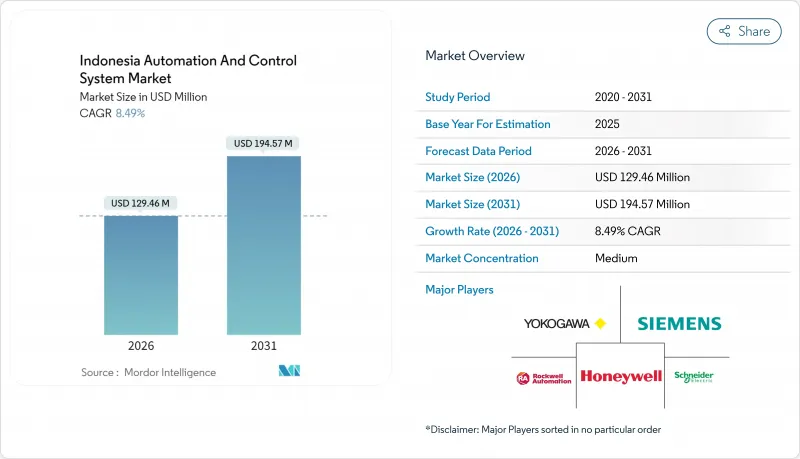
The expansion reflects Jakarta's drive to position the country as Southeast Asia's manufacturing hub, the convergence of digital infrastructure with industrial capacity additions, and regulatory tailwinds that favour energy-efficient production. Government programs such as Making Indonesia 4.0, sizable power-sector capital expenditures, surging electric-vehicle investments, and relaxed local-content thresholds are opening procurement channels for global vendors even as domestic integrators scale up. Multinational suppliers are differentiating on predictive-maintenance software, cyber-secure architectures, and cloud-enabled platforms, while local service firms gain traction through cost-competitive integration and lifecycle support. These dynamics place the Indonesia automation and control system market at the center of a broader industrial modernization agenda that also improves energy security and export competitiveness.
Massive generation and grid projects valued at IDR 51 trillion (USD 3.2 billion) are scaling demand for supervisory control and distributed control systems that coordinate renewable and thermal assets. State utility PLN is retrofitting excitation systems and deploying SCADA across hydro and coal plants to stabilize frequency as renewable penetration rises. The July 2024 decision to lower local-content rules below 30% widened the supplier pool and prompted multinationals to partner with Indonesian fabricators to meet sourcing quotas. Yokogawa's water-treatment SCADA in Bali and multiple PLN excitation retrofits in South Kalimantan illustrate the steady pipeline that supports the Indonesia automation and control system market.
5G rollout combined with lower-cost sensors is allowing factories to link conveyors, compressors, and HVAC systems without rewiring. PT Astra Daihatsu Motor cut fan energy use by 20% after connecting PLC-controlled motors to a wireless edge device, saving 122.66 kWh annually and avoiding 10.67 tCO2 emissions. Manufacturers now stage analytics at the edge for real-time alarms while offloading pattern discovery to cloud dashboards, a configuration well suited to Indonesia's archipelagic geography.
Older cement, steel, and petrochemical complexes must rewire control loops and train operators before installing advanced DCS. PT Rainbow Tubulars Manufacture is investing IDR 300 billion (USD 18.9 million) to modernize seamless pipelines, revealing the cash requirements that deter midsize firms from similar upgrades. Integration surprises between analog I/O and modern Ethernet-based systems often inflate budgets and extend shutdown windows.
Other drivers and restraints analyzed in the detailed report include:
For complete list of drivers and restraints, kindly check the Table Of Contents.
In 2025, PLCs generated 26.66% of revenue, confirming their ubiquity in packaging, material-handling, and batch-process lines. That domination secures a resilient base for the Indonesia automation and control system market size at the plant-floor level. However, Industrial Robotics is set to grow at a 9.74% CAGR through 2031, amplified by new automotive paint shops and electronics surface-mount lines that need micron-level repeatability. SCADA platforms gain steady orders from power utilities interested in distributed asset visualization, while DCS penetrates chemical and F&B plants where recipe integrity is mission-critical. HMI design is shifting toward capacitive touch and mobile mirroring, allowing supervisors to view KPIs from remote stations, an essential feature across Indonesia's dispersed archipelago.
The safety-system niche is widening as insurers and regulators insist on SIL-3 emergency-shutdown loops, boosting demand for triple-modular-redundant PLCs and flame-scanner arrays. Efficiency mandates are pushing a shift from IE1 to IE3 motors, and the pairing of these units with variable-speed drives slashes energy bills and unlocks data for performance dashboards. Together, these trends underscore how hardware modernization and software orchestration are converging, reinforcing both the scale and the depth of the Indonesia automation and control system market.
Hardware produced 61.12% of 2025 sales, encompassing controllers, sensors, actuators, and secure switches that underpin every automation architecture. Much of the capital spending in the Indonesia automation and control system market flows first into this stack as line builders outfit new capacities across automotive, EV, and FMCG verticals. Software demand is maturing from basic HMI to advanced analytics, historian integration, and anomaly detection, though it still trails hardware in total receipts.
Services will expand at a 9.48% CAGR through 2031 because manufacturers are outsourcing system integration, network re-engineering, and predictive-maintenance programs to specialists like PT Dycom Engineering, which reported USD 5.8 million revenue in 2025. Lifecycle contracts that bundle spares, firmware, cybersecurity patching, and operator training are particularly attractive to firms lacking deep in-house engineering benches. As installed bases age, the Indonesia automation and control system market share for service firms is poised to rise, diversifying revenue toward more recurring streams.
The Indonesia Automation and Control System Market Report is Segmented by Product (PLC, SCADA, DCS, HMI, Safety Systems, Industrial Robotics, Electric Motors, and Drives), Component (Hardware, Software, and Services), Deployment Mode (On-Premise, and Cloud/IIoT-Edge), End-User Industry (Oil and Gas, Power Generation, Chemical and Petrochemical, and More), and Geography. The Market Forecasts are Provided in Terms of Value (USD).