



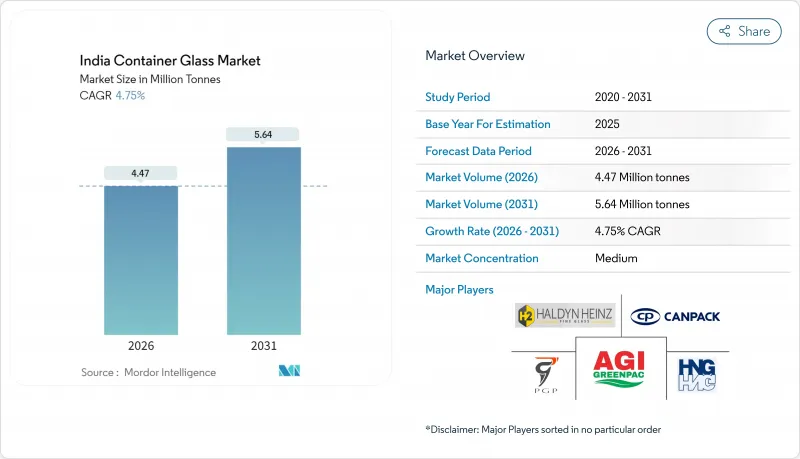
인도의 용기용 유리 시장은 2025년 427만 톤으로 평가되었으며, 2026년 447만 톤에서 2031년까지 564만 톤에 이를 것으로 예측됩니다.
예측기간(2026-2031년)의 CAGR은 4.75%로 전망되고 있습니다.
이러한 성장 궤도는 도시화와 가처분 소득 증가에 견인된 인도의 포장 식품 및 음료 소비의 확대를 반영하고, 동시에 정부 정책이 일회용 플라스틱보다 지속 가능한 포장 솔루션을 점점 더 중시하는 경향을 나타냅니다. 음료 분야는 최종 사용자 시장에서 2024년에 63.85%의 점유율을 차지하였고 인도의 크래프트 맥주 양조장 확대(2016년 45개 마이크로 브루어리에서 현재 500개 이상)와 알코올 음료 부문이 2027년까지 550억 달러 규모에 달할 것으로 예측되는 견조한 알코올 소비 성장에 의해 뒷받침되고 있습니다. 화장품 및 퍼스널케어 분야는 2025년부터 2030년에 걸쳐 CAGR 6.09%로 가장 높은 성장률을 나타내는 응용 분야로 부상하고 있습니다. 이는 플라스틱 포장보다 유리 포장을 선호하는 프리미엄화 동향과 ESG(환경, 사회 및 지배구조)에 대한 대처를 반영한 것입니다. 색상별 부문에서는 2024년 플린트 유리가 58.71% 시장 점유율을 차지하였지만, 자외선 보호를 필요로 하는 의약품이나 특수 음료 용도에 의해 호박색 유리가 5.96%의 연평균 복합 성장률(CAGR)로 성장 전망을 선도하고 있습니다.
인도의 포장 식품 및 음료 부문는 35% 이상의 도시화율과 편리성과 품질을 중시하는 중산층의 소비 확대에 견인되어 성장을 계속하고 있습니다. 식품가공용 생산연계 인센티브(PLI) 제도에 의해 171개의 수혜기업에게 1090억 루피 규모의 투자가 보장되고 있습니다. 이 투자는 국제 식품 안전 기준을 충족하는 고급 유리 포장에 대한 다운스트림 수요를 창출하고 있습니다. 의약품 등급 유리 제조 업체는 가공 식품 기업이 장기 보존성과 화학적 불활성을 필요로 하는 고급 제품을 위해 유형 I 붕규산 용기를 채택하는 움직임으로 인해 혜택을 누리고 있습니다. 업계가 수출 지향형 생산으로 이행하고 있는 점도 유리 수요를 더욱 확대하고 있습니다. 이는 많은 국제 시장에서 국내 플라스틱 대체품에 대해 일반적으로 제공하는 수준보다 높은 포장 기준이 의무화되어 있기 때문입니다.
인도의 알코올 음료 시장은 2027년까지 550억 달러 규모에 이를 전망입니다. 페르노리카사가 나그푸르에 아시아 최대급의 몰트 증류소를 1,785캐롤 루피로 건설하는 계획은 고급 증류주 시장의 성장에 대한 확신을 나타내는 것과 동시에, 제품의 품질을 보호하면서 브랜드의 고급감을 전하는 특수한 호박색 및 플린트 유리병에 대한 수요를 환기하여, 주 세무 당국에 의한 품질 관리와 위조 방지 대책의 강화가 진행되는 가운데 유리 포장은 변조 방지 캡이나 엠보싱 가공에 의한 브랜드 표시 기능에 의해 이러한 요건을 본질적으로 충족시킬 수 있습니다.
비용중심적인 분야에서는 특히 식품 응용 분야에서 유리 무게가 물류 비용을 증가시키기 때문에 연질 포장으로의 전환이 진행되고 있습니다. 첨단 배리어 필름과 다층 구조는 수송 및 취급비를 포함한 총 비용을 40-60% 절감하면서 동등한 보존 기간 보호를 실현합니다. 전자상거래의 성장이 이러한 동향을 가속화하고 있습니다. 유리 제품의 파손률은 3-5% 이상인 반면, 연질 포장에서는 1% 미만이기 때문에 가격에 민감한 시장에서는 유리의 가치 제안이 약화되고 있습니다.
화장품 및 퍼스널케어 분야는 프리미엄화와 신뢰성 및 지속가능성을 요구하는 포장에 대한 소비자의 기호에 의해 2026년부터 2031년에 걸쳐 CAGR 5.85%로 확대될 것으로 전망됩니다. 음료 부문은 2025년에 63.20%의 점유율로 시장을 선도하였습니다. 이는 2027년까지 550억 달러 규모로 확대되는 알코올 시장과 500개 이상의 맥주 양조장 증가에 의해 뒷받침되고 있습니다. 식품 가공 분야에서는 171개의 수혜기업에게 총 10,900캐롤 루피의 PLI(생산연계 인센티브)가 제공되어 수출 기준을 충족하는 의약품 등급 유리 용기에 대한 수요도 촉진되고 있습니다.
의약품 수요는 인도가 제네릭 의약품의 기지 역할을 담당함으로써 가속화되고 있습니다. 19개 주에 걸친 118개의 클러스터가 연간 약 118만 7,260톤을 생산하고 있으며, 무균 용도로는 유형 I 붕규산 유리가 요구됩니다. 향수 분야는 생산량이 적지만, 엄격한 미적 요건과 화학적 적합성 요건에 의해 프리미엄 가격이 설정되어 있습니다.
인도 용기용 유리 시장의 보고서는 최종 사용자별(음료(알코올 음료(맥주, 와인, 스피리츠, 기타 알코올 음료), 무알코올 음료(탄산음료(CSD), 유제품 음료 등)), 식품(잼 및 젤리, 조미료 및 소스 등), 화장품 및 퍼스널케어, 향수 등), 색상(플린트, 호박색, 녹색 등)별로 구분되며 시장 예측은 수량(톤) 기준으로 제공됩니다.
The India Container Glass Market was valued at 4.27 million tonnes in 2025 and estimated to grow from 4.47 million tonnes in 2026 to reach 5.64 million tonnes by 2031, at a CAGR of 4.75% during the forecast period (2026-2031).
This growth trajectory reflects India's expanding packaged food and beverage consumption, driven by urbanization and rising disposable incomes, while government policies increasingly favor sustainable packaging solutions over single-use plastics. Beverages dominate the end-user landscape with a 63.85% market share in 2024, fueled by India's craft brewery expansion from 45 microbreweries in 2016 to more than 500 today, alongside robust alcohol-consumption growth that positions India's alcoholic-beverage segment to reach USD 55 billion by 2027. The cosmetics and personal-care segment emerges as the fastest-growing application at a 6.09% CAGR for 2025-2030, reflecting premiumization trends and ESG commitments that favor glass over plastic packaging. By color segmentation, flint glass commands a 58.71% market share in 2024, while amber glass leads growth prospects at a 5.96% CAGR, driven by pharmaceutical and specialty-beverage applications requiring UV protection.
India's packaged-food and beverage sector continues to expand, driven by urbanization rates exceeding 35% and rising middle-class consumption that favors convenience and quality. The Production-Linked Incentive (PLI) scheme for food processing has attracted INR 10,900 crore in committed investments across 171 active beneficiaries.This investment creates downstream demand for premium glass packaging that meets international food-safety standards. Pharmaceutical-grade glass manufacturers benefit as processed-food companies adopt Type I borosilicate containers for premium products requiring extended shelf life and chemical inertness. The sector's shift toward export-oriented production further amplifies glass demand because many international markets mandate higher packaging standards than domestic plastic alternatives typically provide.
India's alcoholic-beverage segment is on track to reach USD 55 billion by 2027. Pernod Ricard's planned investment of INR 1,785 crore in Asia's largest malt distillery in Nagpur underscores confidence in premium-spirits growth and calls for specialized amber and flint glass bottles that protect product integrity while conveying brand prestige. State excise departments are imposing stricter quality controls and anti-counterfeiting measures that glass packaging inherently supports through tamper-evident closures and embossed-branding capabilities.
Cost-sensitive segments continue to migrate toward flexible packaging, notably in food applications where glass's weight adds logistics costs. Advanced barrier films and multilayer structures offer comparable shelf-life protection at 40-60% lower total cost, including transportation and handling. E-commerce growth amplifies the trend because glass breakage rates can exceed 3-5%, versus less than 1% for flexible alternatives, diminishing glass's value proposition in price-sensitive markets.
Other drivers and restraints analyzed in the detailed report include:
For complete list of drivers and restraints, kindly check the Table Of Contents.
The cosmetics and personal-care segment is projected to grow at a 5.85% CAGR during 2026-2031, buoyed by premiumization and consumer preference for packaging that signals authenticity and sustainability. Beverages maintain market dominance with a 63.20% share in 2025, supported by alcohol-market expansion toward USD 55 billion by 2027 and the proliferation of more than 500 microbreweries. Food-processing PLI incentives totaling INR 10,900 crore across 171 beneficiaries also spur demand for pharmaceutical-grade glass containers meeting export standards.
Pharmaceutical demand accelerates through India's role as a generics hub, with 118 clusters across 19 states producing roughly 1,187,260 tonnes annually and requiring Type I borosilicate glass for sterile applications. The perfumery niche, though smaller in tonnage, commands premium pricing because of stringent aesthetic and chemical-compatibility requirements.
India Container Glass Market Report is Segmented by End-User (Beverages [Alcoholic {Beer, Wine, Spirits, Other Alcoholic Beverages}, and Non-Alcoholic {Carbonated Drinks (CSDs), Dairy Product Based Drinks, and More}], Food [Jam and Jelly, Condiments and Sauces, and More], Cosmetics and Personal Care, Perfumery and More), Color (Flint, Amber, Green, and More). The Market Forecasts are Provided in Terms of Volume (Tonnes).