인도의 태양에너지 - 시장 점유율 분석, 산업 동향 및 통계, 성장 예측(2025-2030년)
India Solar Energy - Market Share Analysis, Industry Trends & Statistics, Growth Forecasts (2025 - 2030)
상품코드:1639549
리서치사:Mordor Intelligence
발행일:2025년 01월
페이지 정보:영문
라이선스 & 가격 (부가세 별도)
ㅁ Add-on 가능: 고객의 요청에 따라 일정한 범위 내에서 Customization이 가능합니다. 자세한 사항은 문의해 주시기 바랍니다.
ㅁ 보고서에 따라 최신 정보로 업데이트하여 보내드립니다. 배송기일은 문의해 주시기 바랍니다.
한글목차
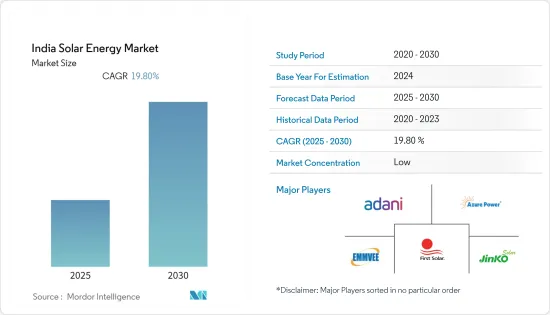
인도의 태양에너지 시장은 예측 기간 동안 19.8%의 CAGR을 기록할 것으로 예상됩니다.
인도의 태양광발전 시장은 올해 말까지 7,907만kW에 달할 것으로 예상되며, 5년 후에는 1,951만kW에 달할 것으로 예측됩니다.
주요 하이라이트
중기적으로 인도의 태양광발전 시장은 태양광발전 기술의 비용 하락, 태양광발전 시스템의 유연성 향상, 태양광발전이 환경 친화적인 발전 방식이라는 점을 배경으로 성장하고 있습니다. 또한, 신재생에너지 발전을 장려하는 신재생에너지부(MNRE)의 계획 등 정부의 정책도 시장을 부추기고 있습니다.
반면, 태양에너지 시장은 용도 및 배전 손실, 전력 공급의 연속성 예측불가능성 등의 문제로 인해 억제되고 있습니다.
인도는 일사량이 많아 일년 내내 태양 에너지를 얻을 수 있습니다. 즉, 라자스탄, 구자라트, 안드라프라데시 등 일조량이 가장 많은 지역에는 태양 에너지를 이용할 수 있는 곳이 많이 있습니다. 여기에 외국의 투자 및 기술 향상을 위한 많은 연구 개발 프로젝트가 있기 때문에 인도의 태양 에너지 시장은 성장할 기회가 많습니다.
인도의 태양에너지 시장 동향
태양광발전 부문이 시장을 장악할 것으로 예상
예측 기간 동안 태양광발전 부문이 가장 큰 시장 점유율을 차지할 것으로 예상됩니다. 이는 태양광 모듈의 비용이 감소하고 있으며, 이러한 시스템이 전기 생산 및 온수 가열과 같은 다양한 용도로 활용될 수 있기 때문입니다.
IRENA에 따르면 인도의 태양광발전 설비 용량은 2021년 49.3GW에서 2022년 약 62.8GW로 증가할 것으로 예상됩니다. 이는 전년 대비 약 31% 증가한 수치입니다. 인도는 특히 유틸리티를 위한 태양광발전 설비를 많이 투입했고, 이것이 성장의 원동력이 되었습니다. 인도 정부는 태양광발전 설비 용량을 늘릴 계획입니다.
국가화력발전공사(NTPC)는 2022년 8월 수랏의 하질라(Hajira) 인근에서 태양광발전 프로젝트를 가동했습니다. 카와스 태양광발전 프로젝트의 발전 용량은 56MW이며, 이 프로젝트를 통해 NTPC는 태양광발전의 그룹 설치 용량과 상업용 용량을 68,454MW까지 늘릴 수 있습니다. 이러한 유형의 프로젝트가 완료되면 인도 태양에너지 시장에서 태양광발전 부문의 점유율은 예측 기간 동안 확대될 것으로 예상됩니다.
2022년 1월, Reliance Industries(RIL)는 구자라트 주정부와 협약을 체결하여 10-15년 동안 구자라트 주에 806억 1,000만 달러를 투자하여 100GW의 재생에너지 발전소와 그린 수소 생태계를 구축할 예정입니다. 실용적인 규모의 재생에너지 발전소에는 태양광발전소가 포함되며, RIL은 향후 재생에너지 프로젝트를 위해 태양광 모듈, 전해조, 배터리, 연료전지 제조 시설 설립에 81억 2,000만 달러를 투자할 예정입니다.
이러한 변화로 인해 향후 몇 년 동안 인도에서는 태양광발전 부문이 가장 큰 시장 점유율을 차지할 것으로 예상됩니다.
시장을 선도하는 정부 지원책
최근 인도에서는 미래 재생에너지 발전 믹스에서 태양광발전의 비중을 늘리기 위해 정부의 다양한 노력이 계획되고 있습니다. 신재생에너지부에 따르면, 2023년 2월 현재 2022년 태양광발전 설비용량은 6,670만kW에 달합니다.
신재생에너지부(MNRE)의 국가 풍력-태양광 하이브리드 정책에 따르면, 이 정책은 대규모 계통 연계형 풍력-태양광 하이브리드 시스템을 추진하기 위한 프레임워크입니다. 이러한 시스템은 재생에너지 발전의 예측 불가능성을 줄이고, 토지 및 송전 인프라를 최대한 활용하면서 계통 안정성을 향상시킵니다.
지난 3년간 신재생에너지부(MNRE)가 시행한 다른 제도에는 솔라파크 제도, 300MW 방어 계획, 500MW VGF(Viability Gap Funding) 계획 등이 있습니다.
델리 정부는 2022년 12월에 태양광 정책 2022 계획을 승인했습니다. 이 계획은 2년간 2,000MW에서 6,000MW로 설치 용량을 늘리도록 요구하고 있습니다. 델리의 새로운 태양광 정책은 2년 내에 6,000MW의 태양광 설비를 설치하는 것을 목표로 하고 있습니다. 이를 통해 델리의 연간 전력 수요에서 태양광발전이 차지하는 비율은 3년 후 9%에서 25%로 증가할 것으로 예상됩니다.
이처럼 향후 예정된 정부 프로젝트와 지원 정책으로 인해 태양에너지 개발은 향후 몇 년 동안 인도의 태양에너지 시장을 끌어올릴 것으로 예상됩니다.
인도의 태양에너지 산업 개요
인도 태양광 시장은 단편적인 시장입니다. 이 시장에서 사업을 영위하는 주요 기업들(순서에 관계없이)로는 Adani Enterprises Ltd, Emmvee Photovoltaic Power Private Limited, Azure Power Global Limited, JinkoSolar Holdings, First Solar Inc. 등이 있습니다.
기타 혜택
엑셀 형식의 시장 예측(ME) 시트
3개월간 애널리스트 지원
목차
제1장 소개
조사 범위
시장 정의
조사 가정
제2장 주요 요약
제3장 조사 방법
제4장 시장 개요
소개
2028년까지 태양에너지 설치 용량과 예측(단위 : GW)
정부 정책 및 규정
최근 동향과 개발
시장 역학
성장 촉진요인
태양에너지 개발에 대한 정부 지원 시책
태양광발전 기술 비용 저하
성장 억제요인
전력 공급 지속의 예측 불가능성
공급망 분석
PESTLE 분석
제5장 시장 세분화
기술 부문
태양광발전(PV)
집광형 태양열발전(CSP)
제6장 경쟁 구도
M&A, 합작투자, 제휴, 협정
주요 기업의 전략
기업 개요
국내 시장 진출 기업
Adani Solar
Emmvee Solar
Mahindra Susten Pvt. Ltd.
Sterling and Wilson Pvt. Ltd.
Tata Power Solar Systems Ltd.
Vikram Solar Limited
ReNew Power Pvt. Ltd.
NTPC Ltd.
Azure Power Global Ltd.
Foreign Players
JinkoSolar Holdings Co. Ltd.
First Solar Inc.
Hanwha Q Cells Co. Ltd.
SMA Solar Technology AG
Trina Solar Limited
제7장 시장 기회와 향후 동향
솔라 기술 향상을 위한 연구개발 프로젝트 증가
ksm
영문 목차
영문목차
The India Solar Energy Market is expected to register a CAGR of 19.8% during the forecast period.
India's solar market is estimated to be at 79.07 GW by the end of this year and is projected to reach 195.11 GW after five years.
Key Highlights
Over the medium term, the Indian solar energy market is growing owing to the cost of solar power technology declining, solar systems becoming more flexible, and solar power is a greener way to make electricity. The market is also propelled by supportive government policies, particularly the Ministry of New and Renewable Energy (MNRE) plans to encourage renewable-based power generation.
On the other hand, the solar energy market is restrained by issues like transmission and distribution losses and unpredictability in the continuity of power supply.
Nevertheless, India has a lot of solar irradiance and gets solar energy all year. This means there are many places in the sunniest parts of the country, like Rajasthan, Gujarat, and Andhra Pradesh, where solar energy can be used. This, along with foreign investment and a lot of research and development projects to improve the technology, gives the Indian solar energy market a lot of chances to grow.
Solar in India Market Trends
Solar PV Segment is Expected to Dominate the Market
The solar PV segment is expected to have the biggest market share during the forecast period. This is because the cost of solar modules is decreasing, and these systems can be used for many different things, like making electricity and heating water.
As per IRENA, India's installed solar PV capacity was around 62.8 GW in 2022, up from 49.3 GW in 2021. This was an increase of approximately 31% over the year. India put in a lot of solar PV installations, especially for utility projects, which led to growth. The Government of India plans to increase the solar PV installed capacity.
The National Thermal Power Corporation Limited (NTPC) turned on a solar PV project near Hazira in Surat in August 2022. The Kawas solar PV project has a capacity of 56 MW; with this project, NTPC will increase its solar footprint to 68,454 MW of group-installed and commercial capacity. With the completion of these types of projects, the share of the solar PV segment in the Indian solar energy market is expected to increase in the forecast period.
In January 2022, Reliance Industries (RIL) signed a pact with the Gujarat government to invest USD 80.61 billion in Gujarat over ten to fifteen years to set up 100 GW of renewable energy power plants and a green hydrogen ecosystem. At the utility scale, renewable energy power plants include solar power plants. RIL is expected to invest USD 8.12 billion in setting up manufacturing facilities for solar PV modules, electrolyzers, batteries, and fuel cells for upcoming renewable projects.
Because of these changes, the solar PV segment is expected to have the biggest market share in India over the next few years.
Supportive Government Policies to Drive the Market
In Recent years, the country planned various government initiatives to increase the solar energy share of India's future renewable power generation mix. According to Ministry of New and Renewable Energy, as of February 2023, the solar energy constitutes 66.70 GW installed capacity in 2022.
According to the Ministry of New and Renewable Energy's (MNRE) national wind-solar hybrid policy, this policy is a framework for promoting large grid-connected wind-solar PV hybrid systems. These systems will reduce the unpredictability of renewable energy generation and improve grid stability while using land and transmission infrastructure best.
Some other schemes implemented by the Ministry of New and Renewable Energy (MNRE) over the last three years are the Solar Park Scheme, the 300 MW Defense Scheme, and the 500 MW VGF (Viability Gap Funding) Scheme.
The Delhi government approved its Solar Policy 2022 plan in December 2022. The plan calls for the installed capacity to go from 2,000 MW to 6,000 MW in the two years.Delhi's new solar policy aims to install 6,000 MW of solar capacity in the two years. This will likely bring the share of solar energy in Delhi's annual electricity demand from 9% to 25% in three years.
Thus, with the upcoming government projects and supportive policies, solar energy developments are expected to boost the Indian solar energy market in the coming years.
Solar in India Industry Overview
The Indian solar energy market is fragmented. Some of the major companies operating in the market (not in particular order) include Adani Enterprises Ltd., Emmvee Photovoltaic Power Private Limited, Azure Power Global Limited, JinkoSolar Holdings Co. Ltd., and First Solar Inc., among others.
Additional Benefits:
The market estimate (ME) sheet in Excel format
3 months of analyst support
TABLE OF CONTENTS
1 INTRODUCTION
1.1 Scope of the Study
1.2 Market Definition
1.3 Study Assumptions
2 EXECUTIVE SUMMARY
3 RESEARCH METHODOLOGY
4 MARKET OVERVIEW
4.1 Introduction
4.2 Solar Energy Installed Capacity and Forecast, in GW, till 2028
4.3 Government Policies and Regulations
4.4 Recent Trends and Developments
4.5 Market Dynamics
4.5.1 Drivers
4.5.1.1 Supportive Government Policies for Developing Solar Energy
4.5.1.2 Declining Cost of Solar Power Technology
4.5.2 Restraints
4.5.2.1 Unpredictability in the Continuity of Power Supply
4.6 Supply Chain Analysis
4.7 PESTLE Analysis
5 MARKET SEGMENTATION
5.1 Technology
5.1.1 Solar Photovoltaic (PV)
5.1.2 Concentrated Solar Power (CSP)
6 COMPETITIVE LANDSCAPE
6.1 Mergers and Acquisitions, Joint Ventures, Collaborations, and Agreements
6.2 Strategies Adopted by Leading Players
6.3 Company Profiles
6.3.1 Domestic Players
6.3.1.1 Adani Solar
6.3.1.2 Emmvee Solar
6.3.1.3 Mahindra Susten Pvt. Ltd.
6.3.1.4 Sterling and Wilson Pvt. Ltd.
6.3.1.5 Tata Power Solar Systems Ltd.
6.3.1.6 Vikram Solar Limited
6.3.1.7 ReNew Power Pvt. Ltd.
6.3.1.8 NTPC Ltd.
6.3.1.9 Azure Power Global Ltd.
6.3.2 Foreign Players
6.3.2.1 JinkoSolar Holdings Co. Ltd.
6.3.2.2 First Solar Inc.
6.3.2.3 Hanwha Q Cells Co. Ltd.
6.3.2.4 SMA Solar Technology AG
6.3.2.5 Trina Solar Limited
7 MARKET OPPORTUNITIES AND FUTURE TRENDS
7.1 Rising Research and Development Projects to Improve the Solar Technology