영국의 전기자동차 배터리 전해액 시장 : 점유율 분석, 산업 동향, 성장 예측(2025-2030년)
United Kingdom Electric Vehicle Battery Electrolyte - Market Share Analysis, Industry Trends & Statistics, Growth Forecasts (2025 - 2030)
상품코드:1636508
리서치사:Mordor Intelligence
발행일:2025년 01월
페이지 정보:영문
라이선스 & 가격 (부가세 별도)
ㅁ Add-on 가능: 고객의 요청에 따라 일정한 범위 내에서 Customization이 가능합니다. 자세한 사항은 문의해 주시기 바랍니다.
ㅁ 보고서에 따라 최신 정보로 업데이트하여 보내드립니다. 배송기일은 문의해 주시기 바랍니다.
한글목차
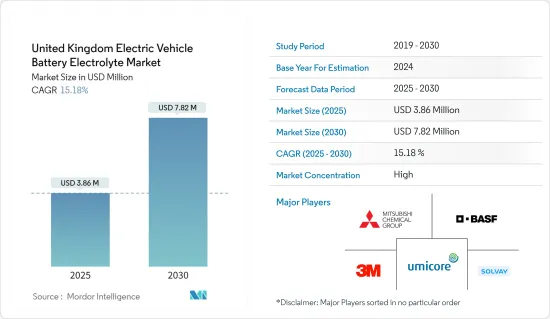
영국의 전기자동차 배터리 전해액 시장 규모는 2025년 386만 달러, 2030년 782만 달러로 추정되며, 예측 기간(2025-2030년)중 CAGR은 15.18%에 달할 것으로 예측됩니다.
주요 하이라이트
중기적으로는 전기자동차(EV) 도입 증가, 정부 지원책 등의 요인이 예측기간 동안 시장을 견인할 것으로 예상됩니다.
한편 공급망의 혼란은 예측 기간 동안 시장 성장을 저해할 것으로 보입니다.
그럼에도 불구하고 전해질 배합의 혁신은 앞으로 몇 년동안 시장에 큰 기회를 가져올 것으로 예상됩니다.
영국 전기자동차 배터리 전해액 시장 동향
전기자동차(EV) 보급 증가
영국(UK)의 전기자동차(EV) 시장은 소비자의 전력 변화가 증가함에 따라 강력한 성장을 이루고 있습니다. 국제에너지기구(IEA)는 영국의 EV 판매 대수의 현저한 급증을 보고하고 있습니다. 구체적으로 배터리 전기차 판매량은 2017년 1만 4,000대에서 2023년 31만대로 비약적으로 증가했습니다. 마찬가지로 플러그인 하이브리드 전기자동차의 판매량도 대폭 증가하여 2017년 3만 5,000대에서 2023년 14만대로 상승했습니다.
2023년 1-9월 신규 등록 대수는 145만 1,908대로 2022년 동시기에 비해 20% 증가했습니다. 특히 2023년 9월 승용차 신차 등록 대수는 전년 동월 대비 21% 증가한 27만 2,610대였습니다.
플러그인 전기자동차 부문이 시장 전체의 성장을 웃도는 가운데 자동차 제조업자 및 무역업체 협회(SMMT)는 2023년 9월 플러그인차의 신차 등록 대수가 전년 동월 대비 27% 증가한 6만 3,858대에 이른 것을 밝혔습니다. 이 플러그인 차량은 전체 시장의 23.4%를 차지했으며 전년도의 20.4%에서 상승했습니다. 비교적 젊은 시장에도 불구하고 영국의 EV 시장은 급속히 상승하고 있습니다. EV의 우위성에 대한 사회적 인지가 높아지면서 영국 도로에서 EV의 존재감은 더욱 확대될 것으로 보입니다. 게다가 2024년 3월 신차 등록 대수에서 차지하는 전기차의 비율은 15.2%에 달하고, 그 매력이 점점 높아지고 있음을 뒷받침하고 있습니다.
소비자와 기업이 이산화탄소 배출량의 억제와 정부의 의무 준수의 양면에서 점점 EV로 축발을 옮겨가면서 고성능, 효율적인 배터리에 대한 수요가 높아지고, 이에 따라 전해액의 요구도 높아지고 있습니다.
영국 정부는 EV 시장의 성장을 적극적으로 촉진하고 있으며, EV의 구매 편의성을 높이기 위해 플러그인 자동차 보조금 등의 시책을 도입하고 있습니다. 더욱이 정부는 2030년까지 가솔린차와 디젤차의 신차 판매를 중단하는 등 야심찬 목표를 내걸고 있습니다.
그러나 2023년 9월 발표에서 정부는 이 금지를 2035년으로 연기했습니다. 동시에 새로운 제로 배출 차량(ZEV)의 의무화가 발표되어 2030년까지 영국에서 판매되는 신차의 80%, 신차 밴의 70%를 제로 배출 차로 해야 하며 2035년까지 100%로 확대하는 것이 규정되었습니다. 이 전략은 제조업체와 가정의 EV 이행을 지원할 뿐만 아니라 영국의 EV 규제 프레임워크을 세계에서 가장 야심적인 하나로 자리매김해 경제 성장을 뒷받침합니다.
영국의 EV 시장이 빠르게 성장하는 것은 환경에 좋은 징조입니다. 오염물질을 배출하지 않는 EV는 대기의 질을 높이고 온실가스 배출을 억제하는 매우 중요한 역할을 합니다.
종합하면 소비자의 선호도 변화와 지원 규제 조치에 힘입어 영국 전기자동차 배터리 전해액 수요는 당분간 증가할 것으로 보입니다.
리튬 이온 배터리 부문이 시장을 독점
영국(UK)에서는 전기자동차의 급속한 보급과 전지기술의 비약적 진보에 힘입어, 리튬이온 배터리 부문이 전기자동차 배터리 전해질 시장의 매우 중요한 구성요소가 되고 있습니다.
영국 정부가 보다 환경친화적인 교통수단을 제창하고 소비자의 EV에 대한 선호도가 높아지는 가운데 효율적이고 고성능인 배터리에 대한 수요가 높아지고 있습니다. 이러한 상황에서 전해질은 전지의 성능, 안전성, 수명을 강화하는 중요한 역할을 담당하고 있습니다.
리튬 이온 배터리 분야 확장의 주요 원동력은 배터리 비용의 현저한 감소입니다. 2023년 리튬 이온 배터리의 평균 가격은 1킬로와트시(kWh)당 약 139달러까지 하락해 2013년 이후 82% 이상이라는 현저한 급락을 기록했습니다. 예측에 따르면 2025년까지 가격은 113달러/kWh 미만으로 떨어지며 2030년에는 80달러/kWh를 목표로 할 수 있습니다.
배터리 가격의 이러한 하락세는 소비자에게 전기차에 대한 접근을 넓힐 뿐만 아니라 제조업체가 최첨단 배터리 기술과 고급 전해질에 대한 투자를 촉진하고 시장 수요를 증폭시킵니다.
게다가 지속가능성은 리튬이온 배터리 분야에서 매우 중요한 힘으로 부상하고 있습니다. 환경 의식이 증가함에 따라 제조업체는 지속 가능한 재료로 만들어진 친환경 전해질 솔루션으로 중심을 옮기고 있습니다. 이 그린 시프트는 소비자의 지향에 공명할 뿐만 아니라, 배터리 생산에 있어서의 환경 실적의 억제를 목적으로 하는 규제상의 의무와도 조화를 이루고 있습니다.
정리하면 시장 상황이 변화함에 따라 고성능 전해액에 대한 수요가 급증하고 기술 혁신이 촉진되고 영국에서 전기자동차 섹터의 확대가 강화된다는 것입니다.
영국 전기자동차 배터리 전해액 산업 개요
영국의 전기자동차 배터리 전해액 시장은 반고착화되고 있습니다. 주요 기업으로는 Mitsubishi Chemical Group, 3M, Umicore, Solvay SA, BASF SE 등이 있습니다(순부동).
기타 혜택:
엑셀 형식 시장 예측(ME) 시트
3개월간의 애널리스트·지원
목차
제1장 서론
조사 범위
시장의 정의
조사의 전제
제2장 조사 방법
제3장 주요 요약
제4장 시장 개요
소개
2029년까지 시장 규모 및 수요 예측(단위: 달러)
최근 동향과 개발
정부의 규제와 정책
시장 역학
성장 촉진요인
전기자동차(EV) 보급률 상승
정부의 지원책
억제요인
공급망의 혼란
공급망 분석
PESTLE 분석
투자 분석
제5장 시장 세분화
전지 유형별
리튬 이온 배터리
납축전지
기타
전해액 유형별
액체 전해액
겔 전해액
고체 전해액
제6장 경쟁 구도
M&A, 합작사업, 제휴, 협정
주요 기업의 전략
기업 프로파일
Mitsubishi Chemical Group
3M
Ilika plc
WL Gore & Associates, Inc
Echion Technologies
BASF SE
Solvay SA
Hitachi, Ltd.
Cabot Corporation
Umicore NV
시장 랭킹/점유율 분석
기타 유명 기업 일람
제7장 시장 기회와 앞으로의 동향
전해액 배합의 혁신
JHS
영문 목차
영문목차
The United Kingdom Electric Vehicle Battery Electrolyte Market size is estimated at USD 3.86 million in 2025, and is expected to reach USD 7.82 million by 2030, at a CAGR of 15.18% during the forecast period (2025-2030).
Key Highlights
Over the medium term, factors such as the rising electric vehicle (EV) adoption and suppotive government initiatives are expected to drive the market during the forecast period.
On the other hand, supply chain disruptions are likely to hinder the market growth during the forecast period.
Nevertheless, innovations in electrolyte formulations are expected to provide significant opportunities for the market in the coming years.
United Kingdom Electric Vehicle Battery Electrolyte Market Trends
Rising Electric Vehicle (EV) Adoption
The electric vehicle (EV) market in the United Kingdom (UK) is witnessing robust growth, driven by an increasing consumer shift towards electric power. The International Energy Agency reports a notable surge in UK EV sales. Specifically, sales of battery electric vehicles jumped from 14,000 units in 2017 to an impressive 310,000 units in 2023. Similarly, sales of plug-in hybrid electric vehicles rose significantly, climbing from 35,000 units in 2017 to 140,000 units in 2023.
In the first nine months of 2023, new registrations hit 1,451,908, marking a 20% uptick compared to the same timeframe in 2022. Notably, September 2023 recorded a 21% year-over-year increase in new passenger car registrations, amounting to 272,610 vehicles.
While the plug-in electric car segment outpaced the broader market growth, the Society of Motor Manufacturers and Traders (SMMT) highlighted that September 2023 saw 63,858 new plug-in cars registered-a 27% year-over-year surge. These plug-in vehicles constituted 23.4% of the overall market, a rise from the previous year's 20.4%. Despite its relative youth, the UK EV market is on a rapid ascent. With growing public awareness of EV advantages, the presence of EVs on UK roads is set to expand further. Moreover, electric cars made up 15.2% of new car registrations in March 2024, underscoring their escalating appeal.
As consumers and businesses increasingly pivot to EVs-both to curb carbon emissions and adhere to government mandates-the demand for high-performance, efficient batteries intensifies, subsequently boosting the need for electrolytes.
The UK government is actively nurturing the EV market's growth, introducing measures like the plug-in car grant to enhance EV affordability. Moreover, the government has ambitious goals, including a 2030 deadline to halt sales of new petrol and diesel vehicles.
Yet, in a September 2023 announcement, the government pushed this ban to 2035. Concurrently, a new zero emission vehicle (ZEV) mandate was unveiled, stipulating that by 2030, 80% of new cars and 70% of new vans sold in Great Britain must be zero emission, escalating to a full 100% by 2035. This strategy not only aids manufacturers and families in the EV transition but also bolsters economic growth, positioning the UK's EV regulatory framework as one of the most ambitious worldwide.
The swift growth of the UK's EV market bodes well for the environment. With EVs emitting no pollutants, they play a pivotal role in enhancing air quality and curbing greenhouse gas emissions-an essential stride in the battle against climate change.
In summary, bolstered by shifting consumer preferences and supportive regulatory measures, the UK's demand for electric vehicle battery electrolytes is set to rise in the foreseeable future.
Lithium-Ion Batteries Segment to dominate the market
In the United Kingdom (UK), the lithium-ion battery segment stands as a pivotal component of the electric vehicle (EV) battery electrolyte market, propelled by the swift uptake of electric vehicles and breakthroughs in battery technology.
With the UK government championing greener transportation and a growing consumer preference for EVs, the appetite for efficient, high-performance batteries is on the rise. Within this landscape, electrolytes emerge as vital players, bolstering battery performance, safety, and longevity.
A key driver behind the lithium-ion battery segment's expansion is the pronounced drop in battery costs. To illustrate, in 2023, the average price of lithium-ion batteries dipped to approximately USD 139 per kilowatt-hour (kWh), marking a remarkable plunge of over 82% since 2013. Forecasts suggest prices might dip below USD 113/kWh by 2025, with a potential target of USD 80/kWh by 2030.
This downward trajectory in battery prices not only broadens the accessibility of electric vehicles for consumers but also spurs manufacturers to channel investments into cutting-edge battery technologies and premium electrolytes, amplifying market demand.
Moreover, sustainability is emerging as a pivotal force in the lithium-ion battery segment. With a surge in environmental consciousness, manufacturers are pivoting towards eco-friendly electrolyte solutions crafted from sustainable materials. This green shift not only resonates with consumer inclinations but also harmonizes with regulatory mandates aimed at curbing the environmental footprint of battery production.
In summary, as the market landscape transforms, the appetite for high-performance electrolytes is set to surge, driving innovation and bolstering the electric vehicle sector's expansion in the UK.
United Kingdom Electric Vehicle Battery Electrolyte Industry Overview
The United Kingdom electric vehicle battery electrolyte market is semi-consolidated. Some of the major players include (not in particular order) Mitsubishi Chemical Group, 3M, Umicore, Solvay SA, and BASF SE, among others.
Additional Benefits:
The market estimate (ME) sheet in Excel format
3 months of analyst support
TABLE OF CONTENTS
1 INTRODUCTION
1.1 Scope of Study
1.2 Market Definition
1.3 Study Assumptions
2 RESEARCH METHODOLOGY
3 EXECUTIVE SUMMARY
4 MARKET OVERVIEW
4.1 Introduction
4.2 Market Size and Demand Forecast in USD, till 2029
4.3 Recent Trends and Developments
4.4 Government Policies and Regulations
4.5 Market Dynamics
4.5.1 Drivers
4.5.1.1 Rising Electric Vehicle (EV) Adoption
4.5.1.2 Supportive Government Initiatives
4.5.2 Restraints
4.5.2.1 Supply Chain Disruptions
4.6 Supply Chain Analysis
4.7 PESTLE Analysis
4.8 Investment Analysis
5 MARKET SEGMENTATION
5.1 Battery Type
5.1.1 Lithium-Ion Batteries
5.1.2 Lead-Acid Batteries
5.1.3 Others
5.2 Electrolyte Type
5.2.1 Liquid Electrolyte
5.2.2 Gel Electrolyte
5.2.3 Solid Electrolyte
6 COMPETITIVE LANDSCAPE
6.1 Mergers and Acquisitions, Joint Ventures, Collaborations, and Agreements