ㅁ Add-on 가능: 고객의 요청에 따라 일정한 범위 내에서 Customization이 가능합니다. 자세한 사항은 문의해 주시기 바랍니다.
ㅁ 보고서에 따라 최신 정보로 업데이트하여 보내드립니다. 배송기일은 문의해 주시기 바랍니다.
한글목차
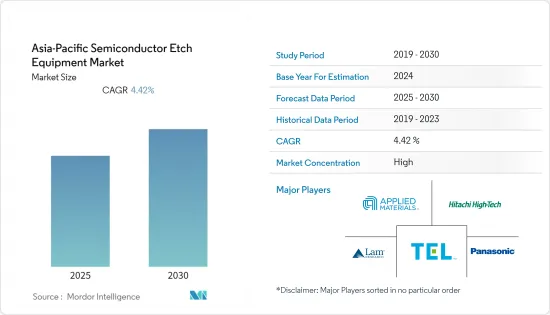
아시아태평양의 반도체 에칭 장비 시장은 예측 기간 중 CAGR 4.42%를 기록할 전망
주요 하이라이트
차량용 용도과 IoT, AI, 커넥티드 디바이스의 통합은 다양한 유형의 반도체 수요를 증가시킬 가능성이 높습니다. 이 지역에는 최신 기술을 보유한 많은 반도체 제조 기업이 있습니다. 이로 인해 아시아태평양은 반도체 에칭 장비의 세계 제조 강국이 되었습니다. 예를 들어 중국은 7nm 칩 생산의 자립에 매우 근접해 있습니다. 중국은 7nm 칩 제조 공정에서 비약적인 발전을 이루었으며, 해외 장비 및 재료 공급업체에 대한 의존도를 줄이기 위한 노력의 일환으로 제조 공정의 여러 부문에서 툴와 노하우를 개발하고 있는 것으로 알려졌습니다.
이 지역의 여러 국가들은 세제 혜택, 자금 지원, 보조금 및 기타 형태의 지원을 제공하는 정부 정책을 통해 반도체 에칭 장비 제조를 장려하는 데 주력하고 있습니다. '메이드 인 차이나 2025'와 '메이드 인 인디아' 프로그램은 이 지역의 제조업 및 기타 하이테크 비즈니스를 촉진하고 있습니다. 예를 들어 정부에 따르면 현재 150억 달러로 평가되는 인도의 반도체 부문은 2026년까지 630억 달러로 성장할 것으로 예상되고 있습니다. 반도체 제조 및 주변 부문에 대한 정부의 개입을 통해 인도는 세계 반도체 공급망을 주도하는 국가가 될 것으로 보입니다. 정부는 전 세계 기업에게 인도내 시설 설립을 검토할 것을 권유하고 있습니다.
북미와 유럽의 새로운 반도체가 각 지역에서 칩을 생산하면서 아시아태평양의 반도체 및 관련 부문의 성장에 제동이 걸렸습니다. 주요 제조 지역이자 세계 반도체 칩 공급업체인 아시아태평양은 사업 손실이라는 문제에 직면해 있습니다. 예를 들어 캐나다는 중국 최대 통신 장비 제조업체인 화웨이와 중싱통신(ZTE)의 5G 전화망 진입을 금지한다고 발표했습니다. 이러한 사업 손실은 이 지역의 반도체 에칭 장비 시장에 악영향을 미칠 것으로 보입니다.
COVID-19는 시장에 악영향을 미쳐 반도체 산업 공급망과 생산에 혼란을 초래하고 있습니다. 특히 인력 부족으로 인해 반도체 에칭 장비 제조업체에 미치는 영향은 심각합니다. 전 세계 반도체 공급망에 속한 여러 기업이 COVID-19 팬데믹으로 인해 운영을 축소하거나 중단해야 했습니다. 이 부문의 상당한 적자와 수요 증가로 인해 공급망에 큰 격차가 발생했습니다.
아시아태평양 반도체 에칭 장비 시장 동향
파워 디바이스의 성장이 기대됩니다.
전력 장비는 전력 제어 및 변환을 위해 고체 전자 장비의 기능을 활용합니다. 이러한 전자 장비는 전력을 제어하고 변환하는 전력 처리 회로에 직접 사용할 수 있습니다. 이러한 장비는 주로 회로 및 시스템의 스위치 및 정류기로 사용되며 전력 전자 기술의 핵심 컴포넌트가되었습니다.
산업, 자동차, 데이터센터, 에너지 산업 등 다양한 전자 용도에서 고전력 장비에 대한 수요가 증가함에 따라 전력 장비 제조 산업은 큰 성장이 예상됩니다.
예를 들어 2021년 3월 Toshiba Electronic Devices & Storage Corporation은 일본 Kaga Toshiba Electronics Corporation에 300mm 웨이퍼 제조 시설을 건설하여 전력 장비 생산 능력을 확대한다고 발표했습니다.
마찬가지로 2022년 2월, 독일 칩 제조업체인 인피니언 테크놀러지스(Infineon Technologies)는 말레이시아 클림에 새로운 프론트엔드 공장에 20억 유로 이상을 투자할 계획을 발표했습니다. 수요 증가를 고려하여 회사는 GaN 및 SiC 제조 능력을 확대하기 위해 투자를 늘려 파워 반도체 전 영역에서 입지를 유지하고 있습니다.
에칭은 전력 장비 제조 공정에서 중요한 단계이기 때문에 이러한 사례는 또한 조사 대상 시장에 유리한 시장 시나리오를 창출하고 있습니다. 또한 장비 제조업체들이 고객의 진화하는 수요를 충족시키기 위해 연구개발에 대한 투자를 늘리고 있는 것도 조사 시장의 기술 혁신을 촉진하고 있습니다.
아시아태평양에서 중국이 주요 시장 점유율을 차지할 것으로 예상
중국에서는 TSMC를 비롯한 다양한 기업에서 여러 투자가 이루어지고 있으며, 화웨이와 같은 현지 기업도 칩 생산에 진출하고 있습니다.
2021년 5월, TSMC는 중국에 28억 달러를 투자하여 심각한 공급 부족 속에서 자동차 칩 생산을 늘리고 난징에 새로운 시설을 건설할 예정이며, 화웨이가 45nm 제조 공정으로 칩을 생산할 의향이 있는 반면, 이 팹은 스마트폰용 솔루션은 아니지만, 2022년까지 화웨이의 5G 키트를 위한 네트워크 칩을 생산할 가능성이 있습니다.
전기자동차 수요 증가는 아시아태평양 자동차용 반도체 산업의 급속한 확장을 주도하고 있습니다. 자동차 제조업체들은 자율주행차를 지속적으로 혁신, 창조, 개발하여 주요 자동차 제조국의 다양한 고객들을 끌어들이고 있습니다.
완전자율주행차의 성장은 기술 발전, 소비자의 완전자율주행차 수용 의지, 가격 책정, 공급업체와 OEM의 자동차 안전에 대한 심각한 우려를 해결할 수 있는 능력에 따라 크게 영향을 받을 것입니다. 이러한 요인으로 인해 자동차 산업과 반도체 산업은 지속적으로 기술 강화, 원자재 가격 협상, 궁극적으로 자동차와 신뢰할 수 있는 기술의 조합에 집중하고 있습니다.
아시아태평양 반도체 에칭 장비 산업 개요
아시아태평양 반도체 에칭 장비 시장은 경쟁이 매우 치열하고 소수의 주요 기업만이 시장 점유율에 기여하고 있습니다. 이 시장에 진입하려면 많은 자본이 필요하므로 신규 진입이 어렵습니다. 다양한 기업이 시장 지배력을 높이기 위해 제품 혁신, 확장, 신흥 국가 시장 개척, 합병, 인수 등 다양한 전략을 모색하고 있습니다.
2022년 5월: 한국 ENF테크놀러지는 천안에 512억 원을 투자해 불화수소산 생산시설 설립을 준비하고 있습니다. 불화수소산은 반도체 제조시 회로 절단 및 오염물질 제거에 사용되는 불화수소 원액으로, Samsung Electronics, SK하이닉스 등 반도체 업체들이 웨이퍼 에칭 및 세정 작업에 사용하고 있습니다.
2022년 5월: 히타치는 전동화 제품에 대한 수요 증가에 대응하기 위해 미야기 제4공장(미야기현 무라타시)에서 전기자동차용 인버터의 양산을 시작했다고 발표함. 전기자동차는 정부가 탄소중립을 달성하고 탄소배출량을 줄이는 데 중요한 역할을 하므로 전 세계에서 수요가 증가하고 있으며, 히타치는 모터와 인버터 등 전기자동차 핵심 부품의 생산능력을 강화하고 제품 라인업을 확대함으로써 이러한 수요 증가에 대응할 계획이다, 이러한 수요 증가에 대응해 나갈 것입니다.
2021년 1월: 일본의 ULVAC, Inc는 성막 모듈과 에칭 모듈을 결합한 클러스터 시스템 'uGmni 시리즈'의 출시를 발표했습니다. 이를 통해 스퍼터, 에칭, CVD 등 다양한 공정 모듈을 동일한 이송 코어에 탑재할 수 있습니다. 또한 이 새로운 플랫폼을 사용한 생산 시스템 판매도 시작하였습니다.
기타 혜택
엑셀 형식의 시장 예측(ME) 시트
3개월간의 애널리스트 지원
목차
제1장 서론
조사의 성과
조사의 전제
조사 범위
제2장 조사 방법
제3장 개요
제4장 시장 역학
시장 개요
시장 성장 촉진요인
이 지역에서 스마트 전자기기의 보급 확대
이 지역에서 국내 반도체 제조을 위한 정부 주도 프로그램
시장 성장 억제요인
유럽 및 미국에서의 반도체 신규 참여
밸류체인/공급망 분석
Porter's Five Forces 분석
신규 진출업체의 위협
구매자/소비자의 교섭력
공급 기업의 교섭력
대체품의 위협
경쟁 기업 간 경쟁 강도
COVID-19가 시장에 미치는 영향
제5장 시장 세분화
제품 유형별
고밀도 에칭 장비
저밀도 에칭 장비
에칭 유형별
도체 에칭
유전체 에칭
폴리실리콘 에칭
용도별
로직과 메모리
파워 디바이스
MEMS
국가별
중국
인도
일본
한국
기타 아시아태평양
제6장 경쟁 구도
기업 개요
Applied Materials Inc
Hitachi High Technologies
Lam Research Corporation
Tokyo Electron Limited
Panasonic Corporation
Plasma-Therm
Gigalane
SUZHOU DELPHI LASER CO. LTD
NAURA Technology Group Co. Ltd
제7장 투자 분석
제8장 시장의 미래
KSA
영문 목차
영문목차
The Asia-Pacific Semiconductor Etch Equipment Market is expected to register a CAGR of 4.42% during the forecast period.
Key Highlights
Automotive applications and the integration of IoT, AI, & connected devices across multiple end-use verticals will likely increase the demand for various types of semiconductors. The region has many semiconductors manufacturing companies with the latest technologies. By this, Asia-Pacific has become a worldwide manufacturing powerhouse for semiconductor Etch Equipment. For instance, China is moving significantly closer to self-reliance in 7nm chip production. China has made breakthroughs in its 7nm chip-making process, reportedly developing tools and know-how for several segments of the manufacturing process amid efforts to reduce reliance on foreign equipment and material vendors.
Various countries in this region are focused on encouraging semiconductor etch equipment manufacturing through government policies offering tax breaks, money, subsidies, and other forms of assistance. Made in China 2025 and make in India programs promote manufacturing and other high-tech businesses in the region. For instance, according to the government, the Indian semiconductor sector, which is presently valued at USD 15 billion, is predicted to grow to USD 63 billion by 2026. Through governmental intervention in the manufacturing of semiconductors and the peripheral sector, India will become a lead country in global semiconductor supply chains. The government invites companies from all over the world to explore establishing facilities in the country.
The new semiconductor acts in North America and Europe to manufacture the chips in their regions, creating a break in the growth of the semiconductor and allied sectors in the APAC region. Being a major manufacturing region and a global supplier of semiconductor chips, Asia-Pacific faces challenges in terms of business loss. For instance, Canada has announced that two of China's largest telecom equipment manufacturers, Huawei and ZTE, will be prohibited from working on its 5G phone networks. This business loss will negatively impact the Semiconductor Etch Equipment market in the region.
COVID-19 has negatively influenced the market, causing supply chain and production disruptions in the semiconductor industry. The impact on semiconductor etch equipment makers was particularly severe because of labor shortages. Several companies in the semiconductor supply chain worldwide were forced to reduce or even discontinue operations during the pandemic. A large supply chain gap resulted from the sector's substantial deficit and rising demand.
APAC Semiconductor Etch Equipment Market Trends
Power devices is expected to grow in the market
Power devices leverages the features of solid-state electronics for the control and conversion of electric power. These electronic devices can be directly used in the power processing circuits to control or convert electric power. These devices are primarily used as switches or rectifiers in circuits and systems and have become a key component of power electronics technology.
With the demand for high-power devices increasing in several electronics applications, including the industrial, automotive, data center, and energy industries, the Power devices manufacturing industry is expected to witness significant growth.
For instance, in March 2021, Toshiba Electronic Devices & Storage Corporation announced the expansion of the production capacity for power devices with the construction of a 300-millimeter wafer fabrication facility at Kaga Toshiba Electronics Corporation in Japan.
Similarly, in February 2022, German chipmaker Infineon Technologies unveiled its plans to invest more than EUR 2 billion in a new frontend fab in Kulim, Malaysia. Considering the growing demand, the company has been increasing investments in expanding its manufacturing capacity for GaN and SiC to maintain its position across the entire range of power semiconductors.
Such instances also create a favorable market scenario for the studied market, as etching is a key step in the manufacturing process of power devices. Furthermore, it is also driving innovations in the studied market as the equipment manufacturers are increasing their investments in R&D to meet the evolving demand of their customers.
China is expected to hold the major market share in the APAC region
China is witnessing multiple investments from various companies, including TSMC, as well as local companies such as Huawei, which are entering into producing their chips as the US embargo has made it significantly difficult for Huawei to buy chips, so it has no other alternative but to develop the capability to manufacture for itself.
In May 2021, TSMC will invest USD 2.8 billion in China to ramp up auto chip production and build new Nanjing facilities amid severe shortages. Whereas Huawei intends to produce chips based on the 45nm manufacturing process, where the fab will not be a solution for its smartphones, it may make networking chips for Huawei's 5G kit by 2022.
The rising demand for electric vehicles fuels the rapid expansion of the APAC automotive semiconductor industry. Automobile manufacturers will continue to innovate, create, and develop self-driving cars, attracting various customers in key automotive manufacturing countries.
The growing fully-autonomous automobiles are heavily influenced by technological advancements, consumer willingness to accept fully-automated vehicles, pricing, and suppliers' and OEMs' capacity to address significant concerns about vehicle safety. According to these factors, the automotive and semiconductor industries are always concentrating on enhancing technologies, negotiating raw material prices, and finally combining cars with reliable technology.
APAC Semiconductor Etch Equipment Industry Overview
The Asia-Pacific semiconductor etch equipment market is very competitive, and only a few key players contribute to the significant market share. Due to the significant capital required to enter this market, it is difficult for new entrants. Various companies are exploring various strategies such as product innovation, expansions, developments, mergers, and acquisitions to enhance their market domination.
May 2022: ENF Technology, a Korean company, is preparing to establish hydrofluoric acid manufacturing facilities by investing KRW 51.2 billion in its Cheonan factory. Hydrofluoric acid is a raw hydrogen fluoride chemical used to cut circuits and eliminate contaminants during semiconductor manufacturing. Semiconductor manufacturers such as Samsung Electronics and SK Hynix use it in wafers' etching and washing operations.
May 2022: To address the growing demand for electrification goods, Hitachi announced that mass production of electric car inverters has begun at its Miyagi No.4 Plant in Murata, Miyagi Prefecture. Electric vehicles are in high demand worldwide because of their critical role in helping governments achieve carbon neutrality and reduce carbon emissions. Hitachi has increased its manufacturing capabilities and product line-up of fundamental components for electric vehicles, such as motors and inverters, to address this growing demand by forming manufacturing subsidiaries.
Jan 2021: ULVAC, Inc., a Japanese company, announced the launch of the uGmni Series cluster system that combines deposition and etch modules. This enables the customers to equip a range of process modules, including sputter, etch, CVD, and others on the same transfer core. The company has also begun to sell production systems using this new platform.
Additional Benefits:
The market estimate (ME) sheet in Excel format
3 months of analyst support
TABLE OF CONTENTS
1 INTRODUCTION
1.1 Study Deliverables
1.2 Study Assumptions
1.3 Scope of the Study
2 RESEARCH METHODOLOGY
3 EXECUTIVE SUMMARY
4 MARKET DYNAMICS
4.1 Market Overview
4.2 Market Drivers
4.2.1 The growth in adoption of smart electronic devices in the region
4.2.2 Government initiative Programs in the region for domestic semiconductor manufacturing
4.3 Market Restraints
4.3.1 New semiconductor acts in Europe and America