



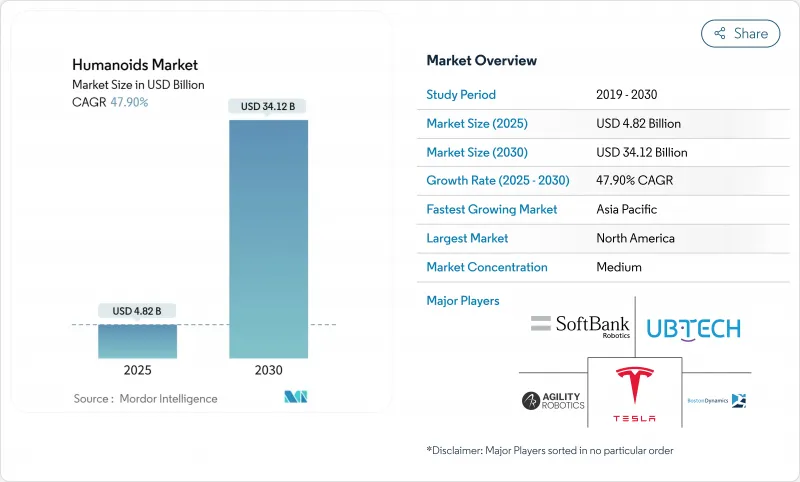
휴머노이드 시장 규모는 2025년에 48억 2,000만 달러, 2030년에는 341억 2,000만 달러에 이르고, CAGR 47.9%를 나타낼 것으로 예측됩니다.
인공지능 하드웨어의 급속한 비용 절감, G7과 중국의 인구동태 고령화, 산업의 노동력 격차 확대가 휴머노이드 로봇을 파일럿 프로젝트에서 건강 관리, 제조, 물류에서 핵심적인 운영 자산으로 밀어 올리고 있습니다. 중국과 한국의 '휴머노이드 2025' 정책과 함께 2024-2025년에 40억 달러를 넘는 벤처 투자의 흐름이 새로운 플랫폼 시장 투입까지의 시간을 앞당기고 있습니다. 기업은 기존의 툴과 인프라를 이용할 수 있는 휴먼 스케일 폼 팩터를 선호하고, 소프트웨어의 진보는 한때 고정된 기계를 적응 가능한 공동 작업자로 바꿉니다. 휴머노이드 시장은 이러한 요인들이 상호 강화됨에 따라 인적 노동력을 늘리지 않고 생산성 향상을 요구하는 국가들에게 매우 중요한 솔루션이 되고 있습니다.
일본의 65세 이상의 고령화율은 2024년에는 29.1%에 달했고, 헬스케어 종사자의 부족은 2030년에는 240만명을 넘을 가능성이 있습니다. 병원은 환자의 지속적인 모니터링, 투약, 사회적 교류를 위해 휴머노이드를 활용하여 질을 일정하게 유지하면서 운영 비용을 30-40% 삭감하고 있습니다. 혼다의 HARU 유닛은 스페인 노인 병동에서 간호사를 지원하고 국경을 넘어서는 관련성을 보여줍니다. 비슷한 노동력 부족에 직면한 소매업과 접객 사업자는 직원 수가 감소했음에도 불구하고 고객 경험을 보호하기 위해 접수 서비스 로봇을 도입하고 있습니다. 한국에서는 이미 종업원 1만명당 1,102대의 로봇이 가동되고 있으며, 이는 세계에서 가장 로봇 밀도가 높은 국가가 되고 있습니다.
스케일 메리트, 표준화된 액추에이터 및 저비용 GPU는 제조 비용을 2025년 3만 5,000달러에서 2030년 1만 3,000-1만 7,000달러로 줄입니다. 테슬라는 1대 2만-3만 달러의 Optimus를 1만대 제조할 것으로 예상하고 있으며, 이는 자동차형 처리량을 반영한 것입니다. Apptronik과 Google DeepMind의 파트너십은 대규모 언어 모델에 의한 추론과 Apollo의 운영 기술을 결합하고, 10만 달러의 서버가 필요했던 것을 에지 프로세서로 압축합니다. 배터리 팩의 가격은 전기자동차 산업 덕분에 2010년 수준에서 이미 85% 떨어졌으며 총 소유 비용은 더욱 낮아지고 있습니다.
현재, 휴머노이드의 조작 비용은 1시간당 0.75-1.25달러인 반면, 6축 코봇은 0.35-0.50달러. 고정밀 기어 박스, 25개 이상의 자유도, 풍부한 센서 어레이로 획득 비용과 유지 보수 비용이 모두 늘어납니다. 그럼에도 불구하고, 인간의 손이 닿는 범위와 내비게이션이 필요한 작업에서 코봇은 비용이 많이 드는 설비의 재설계가 필요하기 때문에 시간당 이점이 상쇄됩니다. 공장의 평균 임금이 4만 5,000달러를 넘는 선진국에서는 휴머노이드의 연간 달리기 비용 2만 5,000-3만 5,000달러의 경쟁력이 높아지고 있습니다.
휠 구동 클래스는 2024년 매출의 63%를 차지하며, 평상 공장과 풀 필먼트 센터의 에너지 효율이 높고 유지 보수가 적은 모빌리티에 대한 현재 사용자의 기호를 부각했습니다. 이 이점은 같은 해의 휴머노이드 시장 점유율에서 바퀴 유형이 가장 큰 점유율을 차지한다는 것을 의미합니다. 그러나, 2족 보행의 카테고리는 CAGR 59%로 확대되어 휴머노이드 시장이, 비용의 저하와 함께 인간과 환경의 완전한 호환성으로 축족을 옮겨가는 것을 나타내고 있습니다.
개선된 모델 예측 컨트롤러, 컴플라이언트 족관절, 전신 협조 알고리즘에 의해 에너지 소비량을 30% 삭감하면서 1.5m/s를 넘는 정상보행이 실현되고 있습니다. 하이브리드 로봇과 다각 로봇은 잔해나 기복이 있는 지형에서 바퀴를 사용할 수 없는 재해 대응을 위한 틈새 솔루션에 머물고 있습니다. AI 모션 플래너가 성숙함에 따라 구매자는 동일한 2족 보행 유닛을 여러 현장에 재배포하고 평생 가치를 높이고 소프트웨어 업데이트 및 운영 성과의 관련성을 강화할 것으로 기대하고 있습니다.
하드웨어는 2024년 휴머노이드 시장 규모의 68%를 차지하며, 액추에이터, 복합 프레임, 고해상도 센서 스택에 걸리는 다액의 설비 투자를 반영했습니다. 그러나 소프트웨어 매출은 57.34%의 연평균 복합 성장률(CAGR)을 나타내며 기계 업그레이드 사이클을 초과했습니다.
클라우드에서 향상된 비전, 자연 언어 모델 및 강화 학습 스택을 사용하면 같은 섀시에서 아침 키팅과 영업 시간 외 컨시어지 업무를 수행할 수 있습니다. 정기적인 라이선스 비용이 단일 하드웨어 마진을 초과함에 따라 공급업체는 가동 시간, 보안 패치 및 기능 저하를 보장하는 서비스 수준 계약으로 전환하고 있습니다. 이러한 스마트폰 에코시스템의 반향은 물리적인 상품의 범주라도 코드를 가장 중요한 차별화 요인으로 자리매김하고 사이버 보안과 데이터 소유권에 관한 조항에 대한 구매자의 관심을 높여주고 있습니다.
북미는 2024년 세계 매출의 38%를 차지하고 20억 달러의 벤처 라운드와 배포 위험을 줄이는 초기 규제 샌드박스가 그 요인이 되었습니다. 테슬라, 보스턴 다이내믹스, 민첩성 로보틱스 등 미국의 OEM은 2024년부터 2025년 사이에 총 12억 달러를 확보하여 상업용 툴 개발 및 시험 개발에 자금을 제공했습니다. 캐나다 대학은 컴플라이언트 액추에이터의 연구를 전문으로 하고 멕시코는 정밀한 기어 케이싱을 공급하고 있습니다.
아시아태평양은 가장 급성장하는 지역으로 2030년까지 연평균 복합 성장률(CAGR)은 55%를 나타낼 전망입니다. 중국의 100억 달러의 국가 휴머노이드 프로그램은 지방 교부금, 군 채용, 구매 범위를 조정하고, 현지 기업 6개사가 2025년의 대수 목표를 각각 1,000대 이상으로 하고 있습니다. 한국의 3조 5,000억원 경기자극책은 정책은행을 통해 민간연구소에 자금을 흘려 연구개발과 국내 컨텐츠규칙을 촉진합니다. 일본 자동차 산업의 전통은 고정밀 지주와 조인트 모듈을 만들어 내고 인도는 저비용으로 클라우드 제어 미들웨어를 공급합니다. 이러한 힘이 결합되어 생산량이 확대되고 단가가 인하되고 아시아 신흥국 전체의 휴머노이드 시장이 강화됩니다.
유럽은 정책 주도로 꾸준한 성장을 이룹니다. 독일의 Industrie 4.0 시설에서는 다품종 소량 생산의 조립을 해외화하지 않고 자국에서 실시하기 위해 휴머노이드가 채용되고 있습니다. EU의 AI 책임 지령안은 엄격한 페일 세이프 설계를 의무화하고 자격인증에 걸리는 오버헤드를 증가시키지만 장기적인 풍평 리스크는 저감시킵니다. 프랑스와 영국은 선진적인 촉각 센서의 연구 개발을 중시하고, 북유럽의 노인 간병 파일럿에서는 간병 현장에서의 로봇의 검증을 실시했습니다. 인증 취득에 시간이 걸리기 때문에 도입이 지연되는 구매자도 있지만 독일과 이탈리아에서는 기존 자동차 부품 제조업체가 서브 어셈블리 제조에 나서고 있으며 대서양을 넘어선 경쟁이 격화하고 있습니다.
The humanoids market size is valued at USD 4.82 billion in 2025 and is forecast to reach USD 34.12 billion by 2030, advancing at a 47.9% CAGR.
Rapid cost declines in artificial intelligence hardware, demographic ageing in the G7 and China, and widening industrial labour gaps are converging to push humanoid robots from pilot projects to core operational assets across healthcare, manufacturing, and logistics. Venture investment flows exceeding USD 4 billion in 2024-2025, together with China's and South Korea's "Humanoid 2025" policies, are accelerating time-to-market for new platforms. Enterprises are prioritising human-scale form factors capable of using existing tools and infrastructure, while software advances turn once-static machines into adaptable co-workers. As these factors reinforce each other, the humanoids market is becoming a pivotal solution for countries seeking productivity gains without expanding their human workforce.
Japan's population aged 65 years and older reached 29.1% in 2024, and healthcare worker deficits may exceed 2.4 million by 2030. Hospitals are turning to humanoids for continuous patient monitoring, medication rounds, and social interaction, trimming operating costs by 30-40% while keeping quality consistent. Honda's Haru units now assist nurses in Spanish geriatric wards, demonstrating cross-border relevance. Retail and hospitality operators facing similar labour gaps are introducing reception and service robots to protect customer experience despite shrinking staff levels. South Korea already operates 1,102 robots per 10,000 employees, the highest robot density worldwide.
Economies of scale, standardised actuators, and low-cost GPUs are pushing manufactured costs down from USD 35,000 in 2025 to a targeted USD 13,000-17,000 by 2030. Tesla expects to build 10,000 Optimus units priced at USD 20,000-30,000 each, reflecting automotive-style throughput. Apptronik's partnership with Google DeepMind ties large-language-model reasoning to Apollo's manipulation skills, compressing what once required USD 100,000 servers onto edge processors. Battery pack prices, already 85% lower than 2010 levels thanks to the electric-vehicle industry, further erode total cost of ownership.
Operating a humanoid costs USD 0.75-1.25 per hour today, versus USD 0.35-0.50 for six-axis cobots. Precision gearboxes, 25-plus degrees of freedom, and richer sensor arrays inflate both acquisition and maintenance outlays. Nevertheless, in tasks demanding human reach and navigation, cobots require costly re-engineering of facilities, offsetting their per-hour advantage. In developed economies where average factory wages top USD 45,000, a humanoid's USD 25,000-35,000 annual running cost is increasingly competitive.
Other drivers and restraints analyzed in the detailed report include:
For complete list of drivers and restraints, kindly check the Table Of Contents.
The wheel-drive class held 63% of 2024 revenues, underscoring current user preference for energy-efficient, low-maintenance mobility in flat-floored plants and fulfilment centres. This dominance meant the wheel cohort accounted for the largest slice of the humanoids market share that year. However, the biped category is expanding at a 59% CAGR, signalling that the humanoids market will pivot toward full human-environment compatibility as costs fall.
Improved model-predictive controllers, compliant ankle joints, and whole-body coordination algorithms are delivering steady-state walking above 1.5 m/s while cutting energy draw by 30%. Hybrid and multi-leg robots remain niche solutions for disaster response where debris or uneven terrain precludes wheels. As AI motion planners mature, buyers anticipate re-deploying the same biped unit across multiple sites, raising lifetime value and tightening the link between software updates and operational output.
Hardware captured 68% of the humanoids market size in 2024, reflecting large capital bills for actuators, composite frames, and high-resolution sensor stacks. Yet software revenue is tracking a 57.34% CAGR, outpacing any mechanical upgrade cycle.
Cloud-enhanced vision, natural-language models, and reinforcement-learning stacks enable the same chassis to perform kitting in the morning and concierge duties after hours. As recurring licence fees overtake one-off hardware margins, vendors are shifting to service-level agreements that guarantee uptime, security patches, and feature drops. This echo of the smartphone ecosystem positions code as the foremost differentiator even inside a physical-goods category, and heightens buyer focus on cybersecurity and data-ownership clauses.
The Humanoids Market Report is Segmented by Motion Type (Wheel-Drive, Biped, Hybrid/Multi-leg), Component (Hardware, Software, Services), End-User Industry (Healthcare Facilities, Retail & Shopping Centres, Manufacturing & Warehousing, and More), Form Factor (Full-Size Greater Than 140cm, Mid-Size 100-140cm, Small Less Than 100cm, and More), and Geography. The Market Forecasts are Provided in Terms of Value (USD).
North America retained 38% of global 2024 revenue, catalysed by USD 2 billion in venture rounds and early regulatory sandboxes that cut deployment risk. United States OEMs such as Tesla, Boston Dynamics, and Agility Robotics collectively secured USD 1.2 billion during 2024-2025, bankrolling commercial tooling and pilot roll-outs. Canada's universities specialise in compliant-actuator research, and Mexico supplies precision gear casings, threading NAFTA supply-chain integration into humanoid economics.
Asia-Pacific is the fastest-growing theatre, advancing at a 55% CAGR to 2030. China's USD 10 billion National Humanoid programme aligns provincial grants, military adoption, and purchasing quotas, while six local firms target >= 1,000 units each for 2025 volume. South Korea's KRW 3.5 trillion stimulus channels funds through its policy bank to private labs, fostering R&D and domestic content rules. Japan's automotive heritage yields high-precision strut and joint modules, and India supplies cloud-control middleware at lower cost. Collectively, these forces scale output and compress unit costs, bolstering the humanoids market across emerging Asian economies.
Europe posts steady, policy-led growth. Germany's Industrie 4.0 facilities adopt humanoids to keep high-mix assembly at home rather than offshoring. The EU's draft AI liability directive compels rigorous fail-safe designs, adding qualification overhead but reducing long-run reputational risk. France and the United Kingdom emphasise advanced haptic-sensor R&D, while Nordic eldercare pilots validate robots in long-term-care settings. Although certification timelines push some buyers to slower roll-outs, established automotive suppliers in Germany and Italy are lining up to build sub-assemblies, reinforcing trans-Atlantic competition.