ㅁ Add-on 가능: 고객의 요청에 따라 일정한 범위 내에서 Customization이 가능합니다. 자세한 사항은 문의해 주시기 바랍니다.
ㅁ 보고서에 따라 최신 정보로 업데이트하여 보내드립니다. 배송기일은 문의해 주시기 바랍니다.
한글목차
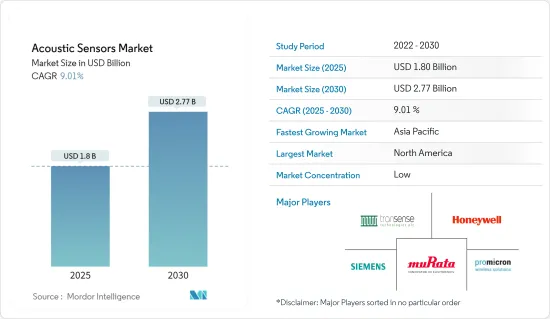
음향 센서 시장 규모는 2025년에 18억 달러로 추정되며, 예측 기간(2025-2030년) 동안 9.01%의 연평균 복합 성장률(CAGR)로 2030년에는 27억 7,000만 달러에 달할 것으로 예상됩니다.
주요 하이라이트
대부분의 사람들이 카메라 기반 센싱을 사용하고 있습니다. 조사 결과, RF 기반 접근 방식은 간편하고 침입이 적다는 점에서 주목을 받고 있으며, RFID는 배터리가 필요하지 않기 때문에 공급망 관리 및 보관과 같은 기업 업무에 자주 사용되고 있습니다. 또한, WiFi 기반 센싱 접근 방식은 실내 WiFi 인프라가 널리 보급되어 있기 때문에 스마트 홈과 직장에 센싱 기능을 통합하는 데 매우 효과적인 것으로 나타났습니다.
음향 신호는 카메라 및 RF 기반 솔루션에 더해 센싱을 위한 세 번째 차원을 설명합니다. 갤럭시 노트3와 아마존 에코는 노이즈 감소와 원거리 음성 포착을 위해 다수의 고성능 마이크를 내장하고 있습니다. 갤럭시 S9과 구글 홈에는 여러 개의 스테레오 스피커가 장착되어 있습니다. 또한 많은 모바일 기기가 오디오 애호가를 위한 고음질 녹음(예: 192kHz 등)을 제공하면서 음향 기반 감지 능력이 크게 향상되었습니다.
또한, GSMA에 따르면 2024년 1월 현재 47개 통신 사업자가 독립형(SA) 네트워크에서 상용 5G 서비스를 제공하고 있으며, 이들 사업자의 절반 이상이 5G-Advanced를 표준 출시 후 1년 이내에 구현할 것으로 예상하고 있습니다. 또한, 이들 사업자의 절반 이상이 표준 출시 후 1년 이내에 5G-Advanced를 구현할 것으로 예상하고 있으며, 2024년 5G SA 및 5G-Advanced 이니셔티브가 급증함에 따라 특히 주요 시장에서 5G 투자의 새로운 물결이 일어날 것으로 예상됩니다.
또한 음향 센서는 최근 자동차 응용 분야에서 큰 수요가 있으며, EV에 사용되는 모터의 완전한 정숙성은 부주의 한 보행자에게 위험을 초래할 수 있습니다. 따라서 최신 전기자동차 및 하이브리드 자동차에는 음향 경고 시스템이 장착되어 있어야 합니다. 따라서 교통 관리에 대한 관심이 높아지면서 시장 성장의 원동력이 될 것으로 예상되며, UBS에 따르면 자율주행차용 센서 반도체 세계 시장은 2030년까지 300억 달러에 달할 것으로 예상됩니다. 자동차 트렌드의 변화는 예측 기간 동안 자동차 음향 센서의 잠재적 성장으로 이어질 수 있습니다.
다양한 기업들이 음향 센서에 투자하는 이유는 국방 분야의 독성 및 유해 증기 환경 모니터링, 식품 분석 및 제어, 엔진 오일 노화, 미생물, 암세포 검출과 같은 의료용 등 다양한 분야에서 사용할 수 있는 스마트 장치로 확장하기 위해서입니다. 예를 들어, 2024년 7월 테슬라는 자율주행 기술 해결을 조건으로 자동 라이드 헤일링 서비스를 도입할 의사를 밝혔습니다. 테슬라의 특허에는 차량 내부 환경을 모니터링하기 위해 영상, 음향, 열, 압력, 정전 용량, 무선 주파수, 가스 센서를 포함한 첨단 센서 어레이에 대한 자세한 내용이 담겨 있습니다.
음향 센서에는 귀에 거슬리는 소리 누출, 배터리 구동 장비의 배터리 수명을 상대적으로 단축시키는 큰 전력 소비 등 많은 기술적 과제가 있습니다.
또한 현재 진행 중인 정치적 고름과 좌절은 전자산업에 큰 영향을 미칠 것으로 예상됩니다. 이 분쟁은 이미 오래전부터 업계에 영향을 미쳐온 반도체 공급망 문제와 칩 부족을 더욱 악화시키고 있습니다. 이러한 혼란은 니켈, 팔라듐, 구리, 티타늄, 알루미늄, 철광석 등 주요 원자재 가격 변동으로 나타나 재료 부족을 초래할 수 있습니다. 이는 음향센서 제조에 차질을 빚을 것으로 보입니다.
음향센서 시장 동향
시장 성장을 주도하는 소비자 전자제품
음향 센서는 가전제품, 특히 스마트폰과 노트북에 널리 사용되고 있습니다. 적절한 센서와 기술 개발은 음향 센서의 중요한 투자자이자 소비자인 가전제품의 도움을 많이 받았으며, 에릭슨에 따르면 2023년 2분기에 전 세계 5G 가입 건수가 1억 7500만 건으로 급증해 총 13억 건에 육박했습니다. 중국, 인도, 미국은 스마트폰 모바일 네트워크 가입이 가장 많습니다.
많은 소비자 및 통신 응용 분야에서 음향 센서의 사용은 RF 필터의 개발에 큰 도움이 되고 있습니다. 예를 들어, 음향 장치를 만드는 것은 비교적 간단합니다. 스마트폰 부문에서 표면파 음향 필터가 널리 사용되면서 지난 30년 동안 센서 재료의 비용이 감소했습니다.
대부분의 전화기나 이에 준하는 기기에는 마이크와 스피커가 장착되어 있어 음향 감지 응용을 용이하게 하고, 구현 비용도 상대적으로 저렴합니다.
또한, 2023년 11월 일본의 선도적인 기술 기업인 NEC Corporation은 Mastercard의 생체 인식 결제 프로그램을 아시아태평양으로 확대하기 위해 NEC와 Mastercard는 양해각서를 체결하고 NEC의 최첨단 안면 인식 및 생체 인식 기술을 이 프로그램에 통합하기로 합의했습니다.
음파 기술 기업들은 LTE, 4G, 5G 기기, 특히 5G 스마트폰의 생산량 증가로 인해 사업 확장의 큰 기회를 맞이하고 있습니다. 스마트폰이 데이터 송수신에 사용하는 여러 주파수 대역에서 무선 신호를 분리할 수 있기 때문에 RF 필터는 이러한 기기의 표준 부품으로 점점 더 많이 채택되고 있습니다.
5G 기술의 출현으로 새로운 첨단 SAW 필터는 2.7GHz 이하의 주파수 영역에서 경쟁 BAW 필터보다 더 높은 성능의 솔루션을 제공하기 때문에 개발 가능성이 높아지고 있습니다. 이러한 소비자 전자제품의 발전은 조사된 시장 성장을 더욱 촉진할 수 있습니다.
아태지역은 괄목할만한 성장률을 보임
아시아태평양은 세계 반도체 제조 산업에서 우위를 점하고 있기 때문에 예측 기간 동안 크게 성장할 것으로 예상됩니다. GSMA의 보고서에 따르면 2023년 이 지역의 모바일 인터넷 가입자는 14억 5,000만 명, 4G 연결은 20억 명에 달할 것으로 예상되며, 2024년 초까지 이 지역은 이미 3억 개의 5G 연결에 도달할 것으로 예상됩니다. 2024년 초까지 이 지역은 이미 3억 개의 5G 연결을 축적하여 가입자의 10%의 보급률을 보이고 있습니다.
GSMA는 2020-2025년 사이 아시아태평양 이동통신 사업자들이 네트워크에 4,000억 달러 이상을 투자할 것으로 예상하고 있으며, 그 중 3,000억 달러가 5G 구축에 사용될 것으로 예상하고 있습니다. 그 중 310억 달러가 5G 구축에 투자될 것으로 예상하고 있습니다.
음향 센서는 미국, 중국, 한국, 일본, 인도 등 주요 국가와 신흥국에서 스마트폰, 태블릿 및 기타 전자기기 사용 증가로 인해 예측 기간 동안 확대될 것으로 예상되며, IBEF에 따르면 2024년 1분기 인도 스마트폰 출하량은 전년 동기 대비 8% 증가한 3,530만 대에 달했습니다. 전년 동기 대비 8% 증가한 3,530만 대를 기록했습니다. 또한, 2023년 보고서에서 세계 프리미엄 스마트폰 시장은 중국, 인도, 중동 및 아프리카, 라틴아메리카에서 기록적인 판매량을 달성할 것으로 예측했습니다. 특히 인도는 세계에서 가장 빠르게 성장하는 프리미엄 시장으로 선두를 달릴 것으로 보입니다.
LG와 삼성을 포함한 대부분의 유명 스마트폰 제조업체들은 최신 5G 모델에 RF 필터를 사용하고 있으며, SAW 센서의 개발로 5G 및 4G 멀티모드 모바일 기기는 동등한 성능 지표를 가진 경쟁 상용 대체품보다 더 낮은 비용으로 더 전력 효율이 높은 RF 경로를 사용할 수 있게 되었습니다. 전력 효율이 높은 RF 경로를 사용할 수 있게 되었습니다.
소음 센서가 가전제품에 광범위하게 사용되면서 중국은 현재 아시아태평양 음향 센서 시장에서 가장 높은 점유율을 차지하고 있습니다. 자동차, 방위 및 산업 부문을 포함한 다른 중요한 최종 사용자 산업에서 음향 센서의 사용은 특히 강합니다. 국제에너지기구(IEA)에 따르면 2023년 중국의 전기자동차 신규 등록 대수는 전년 대비 35% 증가한 810만 대에 달할 것으로 예상됩니다.
음향센서 산업 개요
음향 센서 시장은 적당히 세분화되어 있으며, 여러 유력한 기업으로 구성되어 있습니다. 시장 점유율 측면에서 보면 현재 몇몇 유력한 기업들이 시장을 독점하고 있습니다. 그러나 혁신적이고 지속 가능한 기술을 통해 많은 기업들이 새로운 계약을 체결하고 새로운 시장을 개척하여 시장 입지를 넓히고 있습니다.
기타 혜택
엑셀 형식 시장 예측(ME) 시트
3개월간의 애널리스트 지원
목차
제1장 서론
조사의 전제조건과 시장의 정의
조사 범위
제2장 조사 방법
제3장 주요 요약
제4장 시장 인사이트
시장 개요
산업 매력 - Porter의 Five Forces 분석
공급 기업의 교섭력
바이어의 교섭력
신규 진출업체의 위협
경쟁 기업간 경쟁 관계
대체품의 위협
산업 밸류체인 분석
거시경제 동향 시장에 대한 영향 평가
제5장 시장 역학
시장 성장 촉진요인
시장 성장 억제요인
제6장 시장 세분화
유형별
유선
무선
파동 유형별
표면파
벌크파
센싱 파라미터별
온도
압력
토크
용도별
자동차
항공우주 및 방위
가전제품
의료
산업용
기타
지역별
북미
유럽
아시아태평양
라틴아메리카
중동 및 아프리카
제7장 경쟁 구도
기업 개요
Siemens AG
Transense Technologies PLC
Pro-micron GmbH
Honeywell Sensing and Productivity Solutions
Murata Manufacturing Co., Ltd.
Vectron International Inc.(Microchip technology Incorporated)
IFM Efector Inc.
Dytran Instruments Inc.
CTS Corporation
Campbell Scientific Inc.
API Technologies Corp.
제8장 투자 분석
제9장 향후 동향
LSH
영문 목차
영문목차
The Acoustic Sensors Market size is estimated at USD 1.80 billion in 2025, and is expected to reach USD 2.77 billion by 2030, at a CAGR of 9.01% during the forecast period (2025-2030).
Key Highlights
Most people use camera-based sensing. Research has focused on RF-based approaches for their ease and lack of intrusion. Because RFID doesn't require batteries, it is frequently used in corporate operations like supply chain management and storage. Furthermore, WiFi-based sensing approaches have been shown to be quite effective in integrating sensing functions in a smart home or workplace due to the widespread availability of indoor WiFi infrastructures.
Acoustic signals offer a third dimension for sensing in addition to camera- and RF-based solutions since microphones and speakers are increasingly often found in mobile, wearable, and smart appliance devices. For noise reduction and far-field speech pickup, the Galaxy Note 3 and Amazon Echo include numerous sophisticated microphones built into them. Both the Galaxy S9 and Google Home have multiple stereo speakers. Additionally, many mobile devices now offer high recording quality (such as 192 kHz) aimed at audiophiles, which has significantly improved acoustic-based detection capabilities.
Furthermore, advancement in the communication industry is boosting the overall acoustic sensor market. According to GSMA, As of January 2024, 47 operators have rolled out commercial 5G services on Standalone (SA) networks. Additionally, over half of these operators anticipate implementing 5G-Advanced within a year of its standard release. The surge in 5G SA and 5G-Advanced initiatives in 2024 is poised to catalyze a fresh wave of 5G investments, particularly in leading markets.
Moreover, acoustic sensors have recently seen significant demand in automotive applications. The complete silence of the motors used in EVs may pose a hazard to inattentive pedestrians. As a result, the latest electric and hybrid cars will have to be equipped with an acoustic warning system. Therefore, rising concerns regarding traffic management will drive market growth. According to UBS, the global market for sensor semiconductors in autonomous vehicles is anticipated to reach USD 30 billion by 2030. Changes in automotive trends may lead to potential growth for acoustic sensors for automotive applications during the forecast period.
Various companies are investing in Acoustic sensors due to their deployment in smart devices that can be used in diverse fields like environmental monitoring of toxic and hazardous vapors in defense applications, food analysis and control, engine oil aging, microorganism, and healthcare applications like cancer cell detection. For instance, in In July 2024, Tesla unveiled its intentions to introduce an automated ride-hailing service, contingent on resolving self-driving technology. Tesla's patent details a sophisticated sensor array, encompassing image, acoustic, thermal, pressure, capacitive, radio frequency, and gas sensors, to monitor the vehicle's interior environment. such instances are creating the demand for acoustic sensors from automotive industry.
There are many technical challenges associated with acoustic sensors, such as annoying audible sound leakage and large power consumption, which can relatively reduce the battery life of battery-powered devices, and the acoustic sensing system can affect the music play and voice calls.
Furthermore, the ongoing political pus and downs are expected to impact the electronics industry significantly. The conflict has already exacerbated the semiconductor supply chain issues and the chip shortage that have affected the industry for some time. The disruption may come in the form of volatile pricing for critical raw materials such as nickel, palladium, copper, titanium, aluminum, and iron ore, resulting in material shortages. This would obstruct the manufacturing of acoustic sensors.
Acoustic Sensors Market Trends
Consumer Electronics to Drive the Market Growth
Acoustic sensors are widely used in consumer electronics, notably smartphones and laptops. The development of the appropriate sensors and technologies was greatly aided by consumer electronics, one of the significant investors and consumers of acoustic sensors. According to Ericsson, in Q2 of 2023, global 5G subscriptions surged by 175 million, nearing a total of 1.3 billion. China, India, and the United States have the highest smartphone mobile network subscriptions.
In many consumer and communication applications, using sound sensors greatly aided the development of RF filters. For instance, the creation of acoustic devices is relatively straightforward. The cost of sensor materials has declined over the past three decades due to the widespread use of surface wave acoustic filters in the smartphone sector.
Most telephones and comparable devices are equipped with microphones and speakers that facilitate acoustic-sensing applications and have a comparatively cheap implementation cost.
Further, iIn November 2023, NEC Corporation, a leading Japanese technology firm, took the helm in expanding the Mastercard Biometric Checkout Programme across the Asia Pacific (APAC). Signing a Memorandum of Understanding, NEC and Mastercard agreed to integrate NEC's cutting-edge face recognition and liveness verification tech into the initiative, aiming to boost its uptake among APAC merchants.
Acoustic wave technology companies have a massive opportunity to expand due to the rising production of LTE, 4G, and 5G devices, particularly 5G smartphones. Due to their ability to separate radio signals from the many spectrum bands smartphones utilize to receive and send data, RF filters are increasingly employed as standard parts in these devices.
With the advent of 5G technology, new advanced SAW filters have more development potential since they provide a higher performance solution than competitive BAW filters in the sub-2.7 GHz frequency region. Such developments in consumer electronics may further propel the studied market growth.
Asia-Pacific to Witness a Significant Growth Rate
The Asia-Pacific region is anticipated to grow significantly over the forecast period due to its dominance in the global semiconductor manufacturing industry. The region is also one of the global manufacturers of consumer electronics, electric vehicles, and advanced electronic devices, among others, making it one of the significant consumers of acoustic sensors globally. In 2023, the region boasted 1.45 billion mobile internet subscribers and nearly 2 billion 4G connections, as reported by GSMA. By early 2024, the region had already amassed 300 million 5G connections, marking a 10% adoption rate among subscribers.
The region's demand for RF semiconductors is anticipated to rise due to the growing emphasis on expenditures to build infrastructure to enable 5G technology. The GSMA estimates that between 2020 and 2025, mobile operators in the Asia-Pacific region will invest more than USD 400 billion in their networks, of which USD 331 billion will go toward 5G deployments.
Acoustic sensors are anticipated to expand throughout the projected period due to the rising use of smartphones, tablets, and other electronic devices in major and emerging countries, including the United States, China, South Korea, Japan, and India. According to IBEF,In the first quarter of 2024, India's smartphone shipments surged by 8% year-on-year, hitting a total of 35.3 million units.. Further, in its 2023 report it was stated on the global premium smartphone market forecasts record-setting sales in China, India, the Middle East, Africa, and Latin America. India, in particular, is set to lead as the world's fastest-growing premium market..
Most well-known smartphone manufacturers, including LG and Samsung, use RF filters in their most recent 5G models. The development of SAW sensors also makes it possible for 5G and 4G multimode mobile devices to use more power-efficient RF pathways at a lower cost than competing commercial alternatives with comparable performance metrics.
Due to the widespread usage of acoustic sensors in consumer electronics, China now owns the highest share of the Asia-Pacific acoustic sensor market. The use of acoustic sensors in other significant end-user industries, including the automotive, defense, and industrial sectors, is particularly strong. According to international Energy Agency , In 2023, China saw a surge in new electric car registrations, hitting 8.1 million, marking a 35% rise from the previous year. such instances are playing a huge role in the growth of the studied market.
Acoustic Sensors Industry Overview
The Acoustic Sensors Market is moderately fragmented and consists of several prominent players. In terms of market share, some of the significant players currently dominate the market. However, with innovative and sustainable technologies, many organizations expand their market existence by securing new contracts and tapping new markets.
Additional Benefits:
The market estimate (ME) sheet in Excel format
3 months of analyst support
TABLE OF CONTENTS
1 INTRODUCTION
1.1 Study Assumptions and Market Definitions
1.2 Scope of the Study
2 RESEARCH METHODOLOGY
3 EXECUTIVE SUMMARY
4 MARKET INSIGHTS
4.1 Market Overview
4.2 Industry Attractiveness - Porter's Five Forces Analysis
4.2.1 Bargaining Power of Suppliers
4.2.2 Bargaining Power of Buyers
4.2.3 Threat of New Entrants
4.2.4 Intensity of Competitive Rivalry
4.2.5 Threat of Substitute Products
4.3 Industry Value Chain Analysis
4.4 Assessment of Impact of Macroeconomic Trends on the Market
5 MARKET DYNAMICS
5.1 Market Drivers
5.1.1 Growth of Telecommunications Market
5.1.2 Low Manufacturing Costs
5.2 Market Restraints
5.2.1 Technical Challenges Associated with Acoustic Sensors
6 MARKET SEGMENTATION
6.1 By Type
6.1.1 Wired
6.1.2 Wireless
6.2 By Wave Type
6.2.1 Surface Wave
6.2.2 Bulk Wave
6.3 By Sensing Parameter
6.3.1 Temperature
6.3.2 Pressure
6.3.3 Torque
6.4 By Application
6.4.1 Automotive
6.4.2 Aerospace & Defense
6.4.3 Consumer Electronics
6.4.4 Healthcare
6.4.5 Industrial
6.4.6 Other Applications
6.5 By Geography
6.5.1 North America
6.5.2 Europe
6.5.3 Asia Pacific
6.5.4 Latin America
6.5.5 Middle East & Africa
7 COMPETITIVE LANDSCAPE
7.1 Company Profiles
7.1.1 Siemens AG
7.1.2 Transense Technologies PLC
7.1.3 Pro-micron GmbH
7.1.4 Honeywell Sensing and Productivity Solutions
7.1.5 Murata Manufacturing Co., Ltd.
7.1.6 Vectron International Inc. (Microchip technology Incorporated)