ㅁ Add-on 가능: 고객의 요청에 따라 일정한 범위 내에서 Customization이 가능합니다. 자세한 사항은 문의해 주시기 바랍니다.
ㅁ 보고서에 따라 최신 정보로 업데이트하여 보내드립니다. 배송기일은 문의해 주시기 바랍니다.
한글목차
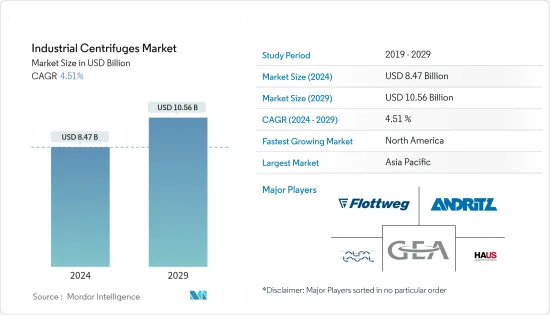
세계 산업용 원심분리기 시장 규모는 2024년 84억 7,000만 달러에 달하고, 2024-2029년 예측 기간 동안 연평균 4.51% 성장하여 2029년에는 105억 6,000만 달러에 달할 것으로 예상됩니다.
장기적으로 화학 산업의 수요 증가는 산업용 원심분리기의 성장을 촉진할 것으로 예상됩니다. 화학 산업과 제조업에 대한 투자 증가는 시장 성장을 촉진할 것으로 예상됩니다.
한편, 원심분리기의 높은 자본 비용과 기술적 단점은 예측 기간 동안 시장 성장에 걸림돌이 될 것으로 예상됩니다.
그러나, 사용되는 에너지가 비용과 장기적인 환경 문제에 대한 관심이 높아짐에 따라 산업 공정의 각 단계에서 에너지 효율적인 원심분리기에 대한 수요가 증가하고 있습니다. 따라서 에너지 원과 에너지 소비 감소에 대한 고객의 요구가 증가함에 따라 원심분리기의 기술 발전은 예측 기간 동안 시장 플레이어에게 충분한 기회를 창출할 것으로 예상됩니다.
아시아태평양이 시장을 지배할 가능성이 높으며, 예측 기간 동안 가장 높은 CAGR을 기록할 것으로 예상됩니다. 이러한 성장은 가공 식품, 제약 및 폐수 처리 산업의 투자 및 수요 증가에 기인합니다.
산업용 원심분리기 시장 동향
시장을 독식하는 화학산업
화학 산업에서 산업용 원심분리기는 다양한 공정의 효율성과 품질에 기여하는 다양한 용도를 가진 필수적인 도구입니다. 주요 용도 중 하나는 화학 제조의 기본 공정인 혼합물에서 화학제품을 분리하는 것입니다.
화학 산업에서 산업용 원심분리기의 또 다른 중요한 역할은 정화 및 정제입니다. 원심분리기는 불순물, 오염 물질 또는 원치 않는 입자를 제거하여 화학 용액을 정화 및 정제합니다. 산업용 원심분리기는 분자량 및 입자 크기와 같은 물리적 특성에 따라 서로 다른 성분을 분리하여 화학제품의 정제를 돕습니다.
화학 산업의 급속한 발전과 함께 화학 원심분리기의 분리 기술도 발전하고 있습니다. 예를 들어 2023년 3월, GEA는 화학그룹 Albemarle로부터 원심분리기 설치 주문을 받았는데, 원심분리기 2대 패키지의 주문 금액은 약 2,555만 달러에 달합니다. 구체적으로 디캔터 원심분리기, 스크린 스크류 원심분리기, 푸셔 원심분리기, 필러 원심분리기 등 4종류의 원심분리기를 각 정유공장의 공정 라인에 공급합니다.
화학 산업은 세계 경제와 공급망 네트워크에서 중요한 역할을 하고 있습니다. 미국화학공업협회(American Chemistry Council)에 따르면 2022년 화학산업의 세계 총수입은 5조 7,200억 달러에 달할 것으로 예상되며, 2022년 화학산업의 수입은 지난 15년 동안 최고치를 기록할 것으로 예상됩니다.
제약, 농업, 제조업 등 다양한 산업에서 세계 화학제품 수요가 증가함에 따라 생산 수요 증가에 대응하기 위한 인프라 투자를 촉진하고 있습니다. 예를 들어, 2023년 9월 사천강보생물기술유한공사는 8억 달러를 투자해 자와종합산업항구단지(JIIPE)에 화학제품 생산시설을 설립할 것이라고 발표했습니다. 완공되면 탄산나트륨과 염화암모늄의 연간 생산능력은 60만 톤, 글리포세이트의 생산능력은 20만 톤에 달할 것으로 예상됩니다.
화학 처리 용량이 증가함에 따라 더 많은 양의 화학제품을 처리하고 제품의 품질과 순도를 보장하기 위해 원심분리기와 같은 분리 및 정제 기술에 대한 요구가 증가하고 있습니다. 그 결과, 원심분리기 제조업체는 세계 화학 산업에서 확대되는 비즈니스 기회의 혜택을 누릴 수 있는 위치에 있습니다.
이러한 요인으로 인해 화학 분야의 산업용 원심분리기에 대한 수요는 예측 기간 동안 화학제품의 제조 및 생산량을 충족시키기 위해 증가할 것입니다.
예측 기간 동안 아시아태평양이 시장을 장악할 것으로 예상
아시아태평양은 화학 및 제조, 제약, 폐수 처리 산업에서 가장 높은 수요를 보이는 중국의 존재로 인해 가장 빠르게 성장하는 원심분리기 시장 중 하나입니다. 또한 인도, 인도네시아, 말레이시아와 같은 남아시아 국가에서는 인구 급증과 산업 확대로 인해 전력 수요가 급증하고 있습니다.
중국은 세계 2위의 경제대국이자 전력, 제약, 화학, 제조, 식음료 등 다양한 산업을 선도하는 국가 중 하나입니다. 이러한 요인으로 인해 중국은 세계 산업용 원심분리기 시장에서 큰 점유율을 차지하고 있습니다.
GDP로 볼 때 중국은 세계 2위의 경제대국으로 2023년 GDP는 17조 6,600억 달러에 달할 것으로 예상됩니다. 고령화, 제조업에서 서비스업으로, 대외 수요에서 내수로, 투자에서 소비로 경제가 재조정되면서 중국의 성장은 점차 둔화되고 있습니다.
중국 국가에너지국(NEA)은 지난 10년간 중국의 청정에너지 계획의 야심을 높일 가능성을 검토하고 있으며, NEA는 중국이 2030년까지 전력의 40%를 원자력과 재생에너지로 충당하고, 2030년까지 원자력발전 용량을 120-150 기가와트까지 확대하는 목표를 세우고 있습니다. 이러한 정부의 정책과 목표는 향후 몇 년 동안 중국의 원자력발전소 개발을 지원하여 산업용 원심분리기 시장에 큰 기회를 제공할 것으로 예상됩니다.
마찬가지로 인도는 아시아태평양에서 산업용 원심분리기의 가장 큰 시장 중 하나이며, 이는 다양한 산업 분야의 개발 활동이 증가했기 때문입니다.
인도에서는 석유화학 사업에 대한 투자도 활발히 진행되고 있어 산업용 원심분리기에 대한 수요 확대가 예상됩니다. 예를 들어, 2024년 4월 Chatterjee Group(TCG)은 과반수 지분을 보유한 석유화학회사 Haldia Petrochemicals Ltd(HPL)와 현지 및 세계 기업들과 협력하여 인도 남부에 100억 달러 이상의 프로젝트를 건설할 계획을 발표했습니다. 이 사모펀드는 2028-2029년 타밀나두 주 카다롤에 연간 350만 톤의 에틸렌과 프로필렌을 생산할 수 있는 석유에서 화학제품으로 전환하는 프로젝트를 계획하고 있습니다.
아시아태평양의 정제 부문은 지난 10년 동안 눈에 띄게 증가했으며, 산업용 원심분리기는 정제 공정에서 매우 중요한 역할을하고 있으며, World Energy Data Statistical Review에 따르면 2022년 아시아태평양의 정유소 용량은 일일 3,618 만 배럴로 2013 년 대비 8.9% 증가한 3,000 만 배럴입니다. 9,000 배럴로 2013년 대비 8.9% 증가할 것으로 예상됩니다. 이 수치는 향후 몇 년 동안 많은 프로젝트가 시작될 것이기 때문에 예측 기간 동안 크게 증가할 것입니다.
따라서 아시아태평양의 다양한 최종사용자 산업의 수요가 증가하고 있으며, 예측 기간 동안 아시아태평양이 시장을 주도할 가능성이 높습니다.
산업용 원심분리기 산업 개요
세계 산업용 원심분리기 시장은 상당히 세분화되어 있습니다. 주요 기업으로는 Andritz AG, HAUS Centrifuge Technologies, Alfa Laval AB, GEA Group, Flottweg SE 등이 있습니다(무순서).
기타 혜택:
엑셀 형식의 시장 예측(ME) 시트
3개월간 애널리스트 지원
목차
제1장 소개
조사 범위
시장 정의
조사 가정
제2장 조사 방법
제3장 주요 요약
제4장 시장 개요
소개
시장 규모·수요 예측, 달러, -2029년
최근의 동향과 전개
정부 규제와 정책
시장 역학
성장 촉진요인
다양한 최종 이용 산업으로부터의 수요 증가
성장 억제요인
자본 비용과 운영 비용 상승
공급망 분석
Porter's Five Forces 분석
공급 기업의 교섭력
소비자의 협상력
신규 참여업체의 위협
대체품의 위협
경쟁 기업 간의 경쟁 관계
제5장 시장 세분화
유형
침전
클러리파이어/시크너 원심분리기
디캔터형 원심분리기
디스크 스택 원심분리기
하이드로 사이클론
기타 침전 원심분리기
여과
바스켓형 원심분리기
스크롤 스크린형 원심분리기
필러형 원심분리기
푸셔형 원심분리기
기타 여과 원심분리기
설계
수평형 원심분리기
수직형 원심분리기
조작 모드
배치
연속
산업
식품·음료
제약
상하수도 처리
화학
금속·광업
전력
펄프·제지
기타 산업
지역
북미
미국
캐나다
기타 북미
유럽
독일
프랑스
영국
이탈리아
스페인
러시아
노르딕
터키
기타 유럽
아시아태평양
중국
인도
일본
호주
한국
말레이시아
태국
인도네시아
베트남
기타 아시아태평양
남미
브라질
아르헨티나
칠레
콜롬비아
기타 남미
중동 및 아프리카
아랍에미리트
사우디아라비아
카타르
남아프리카공화국
나이지리아
이집트
기타 중동 및 아프리카
제6장 경쟁 상황
인수합병, 합작투자, 제휴, 협정
주요 기업의 전략
기업 개요
MSE Hiller
Andritz AG
Alfa Laval AB
GEA Group AG
Multotec Pty Ltd
Thomas Broadbent & Sons Ltd
Flottweg SE
Ferrum Ltd
HAUS Centrifuge Technologies
시장 점유율 분석
제7장 시장 기회와 향후 동향
에너지 효율적 산업용 원심분리기에 대한 수요 증가
ksm
영문 목차
영문목차
The Industrial Centrifuges Market size is estimated at USD 8.47 billion in 2024, and is expected to reach USD 10.56 billion by 2029, growing at a CAGR of 4.51% during the forecast period (2024-2029).
Over the long term, the growing demand from the chemical industry is expected to stimulate the growth of industrial centrifuges. Increasing investments in the chemical and manufacturing industry are expected to drive the growth of the market.
On the other hand, centrifuges' high capital costs and technical drawbacks are expected to hamper the growth of the market during the forecast period.
However, there is increased demand for energy-efficiency centrifuges in every step of the industrial process, with the growing trend that energy used is both a cost and a long-term environmental issue. Hence, depending on the energy sources and increased customer need for lower energy consumption, technical advancements in centrifuges are expected to create ample opportunities for the market players during the forecast period.
Asia-Pacific will likely dominate the market and is expected to register the highest CAGR during the forecast period. This growth is attributed to the increasing investments and demands from the processed food, pharmaceutical, and wastewater treatment industries.
Industrial Centrifuges Market Trends
The Chemical Industry to Dominate the Market
In the chemical industry, industrial centrifuges are indispensable tools with many applications that contribute to the efficiency and quality of various processes. One primary application lies in separating chemicals from mixtures, a fundamental process in chemical manufacturing.
Another critical role of industrial centrifuges in the chemical industry is clarification and purification. They clarify and purify chemical solutions by removing impurities, contaminants, or unwanted particles. Industrial centrifuges aid in refining chemical products by separating different components based on their physical properties, such as molecular weight or particle size.
Chemical centrifuges' separation technology has also increased with the chemical industry's rapid development. For instance, in March 2023, GEA received an order from the chemical group Albemarle to install centrifuges. The order value for the two centrifuge packages is approximately USD 25.55 million. Specifically, GEA is going to supply four different types of centrifuges: decanter centrifuges, screen screw centrifuges, pusher centrifuges, and peeler centrifuges, and for the processing lines of each refinery.
The chemical industry plays a significant role in the global economy and supply chain network. According to the American Chemistry Council, in 2022, the chemical industry's total worldwide revenue stood at USD 5.72 trillion. In 2022, the chemical industry revenue reached the highest value in the last 15 years.
Rising global demand for chemicals across various industries, including pharmaceuticals, agriculture, and manufacturing, is prompting investments in infrastructure to meet increasing production needs. For instance, in September 2023, Sichuan Hebang Biotechnology Co. announced a significant investment of USD 800 million to establish a chemical production facility within the Java Integrated Industrial and Port Estate (JIIPE). Upon completion, the facility is expected to achieve an annual production capacity of 600,000 tons of sodium carbonate and ammonium chloride, with a glyphosate production capacity estimated at 200,000 tons.
As chemical processing capacities grow, there is a greater need for separation and purification technologies like centrifuges to handle larger volumes of chemicals and ensure product quality and purity. As a result, centrifuge manufacturers stand to benefit from the growing opportunities in the global chemical industry.
Owing to this factor, the demand for industrial centrifuges in the chemical sector will increase during the forecast period to meet the manufacturing and production quantities of chemicals.
Asia-Pacific to Dominate the Market During the Forecast Period
Asia-Pacific is one of the fastest growing centrifuges markets, owing to the presence of China, which has one of the highest demands from the chemical and manufacturing, pharmaceutical, and wastewater treatment industries. Additionally, the electricity demand is growing rapidly in South Asian countries like India, Indonesia, and Malaysia due to a surge in population and industrial expansion.
China is the second largest economy globally and one of the leaders in numerous power, pharmaceutical, chemical, manufacturing, food, and beverage industries. Due to these factors, China accounts for a significant share of the global industrial centrifuges market.
In terms of GDP, China is the second-largest economy in the world. In 2023, the country's GDP reached USD 17.66 trillion. The growth in the country is gradually diminishing as the aging population, manufacturing to services, and external to internal demand, and the economy is rebalancing from investment to consumption.
China's National Energy Administration (NEA) is examining the possibility of increasing the ambition of the country's clean energy programs this decade. The NEA proposes that China obtain 40% of its electricity from nuclear and renewable sources by 2030 and set its nuclear capacity target to 120-150 gigawatts by 2030. Such government policies and targets aid the country's development of nuclear power plants in the coming years and are anticipated to provide significant opportunities for the industrial centrifuges market.
Similarly, India is one of the largest markets for industrial centrifuges in Asia-Pacific, owing to the increasing development activities in various industries.
India is also investing in its petrochemical business, which is anticipated to create a rising demand for industrial centrifuges. For instance, in April 2024, the Chatterjee Group (TCG) announced plans to partner with local and global companies with its majority-owned petrochemical firm Haldia Petrochemicals Ltd (HPL) to build a more than USD 10 billion project in southern India. The private equity firm plans to make the oil-to-chemical project, capable of producing 3.5 million metric tons per year of ethylene and propylene, at Cuddalore in Tamil Nadu from 2028 to 2029.
The refinery sector of Asia-Pacific has risen significantly over the last 10 years, and industrial centrifuge is vitally used during the refinery process. According to Statistical Review of World Energy Data, in 2022, the refinery capacity of Asia-Pacific was 36,189 thousand barrels daily, increased by 8.9 % compared to 2013. The number rises significantly during the forecast period, as many projects will start in the coming years.
Therefore, with increasing demand from various end-user industries in the region, Asia-Pacific will likely be a market leader during the forecast period.
Industrial Centrifuges Industry Overview
The global industrial centrifuges market is moderately fragmented. Some of the major players in the market (in no particular order) include Andritz AG, HAUS Centrifuge Technologies, Alfa Laval AB, GEA Group, and Flottweg SE.
Additional Benefits:
The market estimate (ME) sheet in Excel format
3 months of analyst support
TABLE OF CONTENTS
1 INTRODUCTION
1.1 Scope of the Study
1.2 Market Definition
1.3 Study Assumptions
2 RESEARCH METHODOLOGY
3 EXECUTIVE SUMMARY
4 MARKET OVERVIEW
4.1 Introduction
4.2 Market Size and Demand Forecast in USD, till 2029
4.3 Recent Trends and Developments
4.4 Government Policies and Regulations
4.5 Market Dynamics
4.5.1 Drivers
4.5.1.1 Increasing Demand from Various End-user Industries
4.5.2 Restraints
4.5.2.1 Higher Capital and Operational Cost
4.6 Supply Chain Analysis
4.7 Porter's Five Forces Analysis
4.7.1 Bargaining Power of Suppliers
4.7.2 Bargaining Power of Consumers
4.7.3 Threat of New Entrants
4.7.4 Threat of Substitutes Products and Services
4.7.5 Intensity of Competitive Rivalry
5 MARKET SEGMENTATION
5.1 Type
5.1.1 Sedimentation
5.1.1.1 Clarifier/Thickener Centrifuges
5.1.1.2 Decanter Centrifuges
5.1.1.3 Disc Stack Centrifuges
5.1.1.4 Hydrocyclones
5.1.1.5 Other Sedimentation Centrifuges
5.1.2 Filtering
5.1.2.1 Basket Centrifuges
5.1.2.2 Scroll Screen Centrifuges
5.1.2.3 Peeler Centrifuges
5.1.2.4 Pusher Centrifuges
5.1.2.5 Other Filtering Centrifuges
5.2 Design
5.2.1 Horizontal Centrifuges
5.2.2 Vertical Centrifuges
5.3 Operation Mode
5.3.1 Batch
5.3.2 Continuous
5.4 Industry
5.4.1 Food and Beverages
5.4.2 Pharmaceutical
5.4.3 Water and Wastewater Treatment
5.4.4 Chemical
5.4.5 Metal and Mining
5.4.6 Power
5.4.7 Pulp and Paper
5.4.8 Other Industries
5.5 Geography
5.5.1 North America
5.5.1.1 United States
5.5.1.2 Canada
5.5.1.3 Rest of North America
5.5.2 Europe
5.5.2.1 Germany
5.5.2.2 France
5.5.2.3 United Kingdom
5.5.2.4 Italy
5.5.2.5 Spain
5.5.2.6 Russia
5.5.2.7 NORDIC
5.5.2.8 Turkey
5.5.2.9 Rest of Europe
5.5.3 Asia-Pacific
5.5.3.1 China
5.5.3.2 India
5.5.3.3 Japan
5.5.3.4 Australia
5.5.3.5 South Korea
5.5.3.6 Malaysia
5.5.3.7 Thailand
5.5.3.8 Indonesia
5.5.3.9 Vietnam
5.5.3.10 Rest of the Asia-Pacific
5.5.4 South America
5.5.4.1 Brazil
5.5.4.2 Argentina
5.5.4.3 Chile
5.5.4.4 Colombia
5.5.4.5 Rest of South America
5.5.5 Middle East and Africa
5.5.5.1 United Arab Emirates
5.5.5.2 Saudi Arabia
5.5.5.3 Qatar
5.5.5.4 South Africa
5.5.5.5 Nigeria
5.5.5.6 Egypt
5.5.5.7 Rest of the Middle East and Africa
6 COMPETITIVE LANDSCAPE
6.1 Mergers and Acquisitions, Joint Ventures, Collaborations, and Agreements
6.2 Strategies Adopted by Leading Players
6.3 Company Profiles
6.3.1 MSE Hiller
6.3.2 Andritz AG
6.3.3 Alfa Laval AB
6.3.4 GEA Group AG
6.3.5 Multotec Pty Ltd
6.3.6 Thomas Broadbent & Sons Ltd
6.3.7 Flottweg SE
6.3.8 Ferrum Ltd
6.3.9 HAUS Centrifuge Technologies
6.4 Market Share Analysis
7 MARKET OPPORTUNITIES AND FUTURE TRENDS
7.1 Rising Demand for the Energy-efficient Industry Centrifuges