


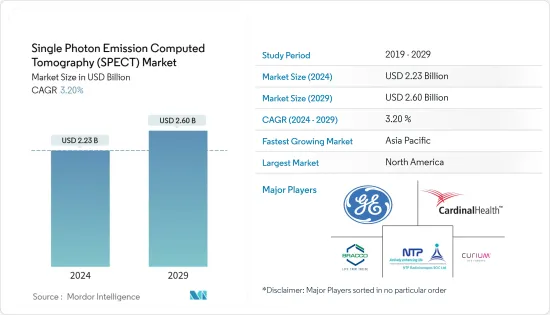
단일광자방출 컴퓨터 단층촬영(SPECT) 시장 규모는 2024년 22억 3,000만 달러로 추정되고, 2029년까지 26억 달러에 이를 것으로 예측되며, 예측기간(2024-2029년) 동안 3.20%의 연평균 복합 성장률(CAGR)로 성장할 전망입니다.

COVID-19는 환자가 불요불급으로 분류된 핵영상 검사를 자발적으로 취소하게 되고, 환자에게 큰 영향을 미쳤습니다. 이 팬데믹은 병원과 의사의 업무에 영향을 미쳤습니다. 병원과 의사는 수술을 선호하고 많은 예정 수술과 방사선 치료를 연기했기 때문에 관련 SPECT 스캔 수요가 감소했습니다. COVID-19의 악영향에 더해, 이 분야의 기업이 신제품을 발매하거나 임상 연구를 진행함으로써 존재감을 확립할 기회도 태어났습니다. 예를 들어, 2020년 11월, NanoMab Technology Limited는 NM-01 제품의 2상 임상시험을 수행하기 위해 의약품 의료 제품 규제청(MHRA)으로부터 CTA 승인을 받았습니다. 이 연구에서는 SPECT/ CT 방사성 추적자로 99mTc-NM-01을 사용한 프로그램 죽음 리간드 1(PD-L1) 발현과 생검 진단 표본에서 일상 면역 조직 화학(IHC) 검사를 기반으로 한 PD-L1 발현 결과와의 상관성을 평가합니다.
단일광자방출 컴퓨터 단층촬영(SPECT)은 장기 및 세포의 기능 및 대사 정보를 기반으로 질병 과정을 평가하는 데 사용됩니다. 가장 널리 사용되는 SPECT 시스템은 앵거 감마 카메라를 기반으로 하며 일반적으로 환자 주위를 회전하는 2개의 검출기를 갖추고 있습니다. 영상 분야에서는 하이브리드 장비와 융합 기술 응용의 중요성이 커지고 있습니다. 이러한 방법의 가장 중요한 장점 중 하나는 여러 가지 양식을 동시에 사용할 수 있다는 점에서 다양한 질병의 형태학적, 기능적, 분자적 변화에 대한 데이터를 동시에 얻을 수 있다는 것입니다.
유방암이나 전립선암 등 암의 유병률 상승으로 미래에 시장 성장이 크게 촉진될 수 있습니다. 예를 들어, 미국 암 협회의 보고서에 따르면 2021년 미국에서 새롭게 암으로 진단된 환자 수는 1,898,160명, 암에 의한 사망자 수는 608,570명으로 추정되고 있습니다.
X선 컴퓨터 단층촬영(CT)을 SPECT에 통합하는 것은 최근 해부학적 세부사항에서 기능 및 대사 정보를 묘사할 수 있는 의료 영상 처리에 있어서 필수적인 진단 도구로 부상했습니다. 예를 들어 2022년 1월 미국 물리학자 협회에서 발표된 '99mTc 전신 SPECT/CT 화질 최적화 : 팬텀 연구'라는 제목의 조사에 따르면 단일광자방출 컴퓨터 단층촬영(SPECT)과 X-방사선 컴퓨터 단층촬영(SPECT/CT)은 생리학(SPECT)과 해부학(CT) 모두에 대한 정보를 제공합니다.
또한 장비의 진단 능력을 강화하기 위해 듀얼 모달리티 시스템과 장기별 시스템이 증가하는 경향이 있습니다. 최근 몇 년간 PET/CT의 이용이 증가하고 있습니다. 이는 이 조사 방법에 의해 생성된 기능적 및 형태학적 상관 영상이 진단 정확도를 향상시키기 때문이며, 이는 SPECT 장치의 시장 성장을 방해하는 요인 중 하나이기 때문입니다. 그러나 방사성 동위 원소의 반감기가 짧고 엄격한 규제 지침이 시장 성장을 방해하는 몇 가지 시장 성장 억제요인이 되었습니다. 그러나 위의 모든 요인은 시장이 예측 기간 동안 만족스러운 성장을 보일 것으로 예상했습니다.
갈륨 67 방사성 동위원소는 급성 및 만성 감염 모두의 염증과 호지킨병, 림프종(림프구성 제외), 간세포암, 기관지원성 암과 같은 종양의 진단에 사용됩니다. 주로 뼈 조영제로 사용됩니다.
갈륨 67은 종양 진단과 병기 분류의 골드 표준입니다. Ga-67 SPECT/CT를 사용한 하이브리드 이미징은 림프종 병변의 정확한 위치 지정을 가능하게 합니다. Ga-67은 금속 트랜스페린 복합체로서 염증 영역에 비특이적으로 축적되고 또한 트랜스페린 수용체에 결합하는 능력이 있기 때문에 염증의 이미징에 일반적으로 사용되는 약물입니다. 구연산 갈륨 GA-67을 제공하는 시장 기업은 Lantheus Medical Imaging 및 Mallinckrodt Nuclear를 포함합니다.
국제암 조사기관(IARC)에 따르면 2040년까지 새로운 암 증례는 2,750만명으로 증가할 것으로 추정되고 있습니다. 또한 세계 암 부담은 향후 20년간 70% 증가할 것으로 예상됩니다. 이러한 암의 부담의 증대에 의해 질환의 진단과 치료에 있어서 방사성 동위 원소의 필요성이 생겨, 시장 부문의 성장을 가속합니다.
따라서 다양한 골질환과 암의 유병률 상승 및 갈륨-67과 관련된 이점으로 인해 시장은 예측기간 동안 높은 성장률을 보일 것으로 예상됩니다.
미국의 SPECT 시장은 하이브리드 이미징, 진단을 위한 새로운 방사성 의약품의 도입, 분자 이미징 개발 등 기술의 발전으로 성장하고 있습니다. 테크네튬 99m(TC-99m)는 다용도로 가장 널리 사용되는 조영제입니다.
2020년 세계암 관측소(글로보칸)에 따르면 미국은 암 이환수가 세계에서 두 번째로 많은 나라입니다. 2020년 전 연령층의 이환 환자수는 총 2,281,658명이었습니다. 미국에서는 암 질환의 조사와 치료에 대한 투자도 증가하고 있습니다. 미국 질병 관리 예방 센터(CDC)의 국립 보건 통계 센터(NCHS)가 발표한 데이터에 따르면, 암에 대한 투자는 2021년 최대 71억 7,600만 달러에 달할 것으로 추정되고 있습니다. 이것은 2020년부터 현저하게 증가했습니다. 70억 3,500만 달러라는 숫자입니다.
또한, 시장에 새로운 제품의 도입이 이 지역 시장 성장을 가속하고 있습니다. 예를 들어 2020년 7월 Spectrum Dynamics Medical은 D-SPECT Vista라는 디지털 고체 카드뮴 아연 텔루라이드(CZT) 기반 심장 SPECT 시스템을 도입했습니다. 이 시스템은 심근 관류 이미징에 사용할 수 있습니다. 2020년 9월, 지멘스 헬스니아스는 심장 핵의학 전용 시스템 c.cam의 새로운 버전을 미국 시장에 도입했습니다. 이 단일광자방출 컴퓨터 단층촬영(SPECT) 스캐너는 리클라이닝 환자 의자를 갖추고 있으며 심장 핵의학 제공업체에게 낮은 총 소유 비용, 설치 용이성 및 높은 수준의 화질을 제공합니다. 또한 2020년 3월 큐륨은 미국 식품의약국에서 풀모텍 MAA 승인을 받았습니다. 이것은 폐 영상화 및 폐 관류를 평가하는 데 사용되는 SPECT 에이전트입니다. 따라서 이러한 요인으로 인해 시장은 미래에 성장할 수 있습니다.
단일광자방출 컴퓨터 단층촬영(SPECT) 시장은 경쟁력이 강화되고 있으며, 주로 Koninklijke Philips NV, Siemens AG, GE Healthcare(GE Company) 등 세계 기업들로 구성되어 있습니다. 다양한 질병에서 SPECT의 중요성은 조사 대상 시장에 진입할 것으로 예상되는 기업이 거의 없습니다.
The Single Photon Emission Computed Tomography Market size is estimated at USD 2.23 billion in 2024, and is expected to reach USD 2.60 billion by 2029, growing at a CAGR of 3.20% during the forecast period (2024-2029).
COVID-19 has a huge impact on the patients as they became self-selective in a way that they canceled their nuclear imaging procedures, which were categorized as nonessential. This pandemic affected the operations of hospitals and doctors, as they were also prioritizing their procedures and postponed a number of elective surgeries and radiation treatments, due to which there was a decrease in the demand for related SPECT scans. Besides the negative impact of COVID-19, it has created opportunities for players in this field to establish their presence by launching new products or progressing clinical studies in this field. For instance, in November 2020, NanoMab Technology Limited received CTA Acceptance from the Medicines Healthcare products Regulatory Agency (MHRA) to carry out a Phase II clinical Study for its NM-01 product. This study will assess the programmed death-ligand 1 (PD-L1) expression using 99mTc-NM-01 as a SPECT/CT radiotracer and its correlation to PD-L1 expression results based on routine immunohistochemical (IHC) testing in biopsy diagnostic specimens.
Single-photon emission computed tomography (SPECT) is used in the evaluation of disease processes based on functional and metabolic information of organs and cells. The most widely used SPECT systems are based on the anger gamma camera, usually involving dual detectors that rotate around the patient. The application of hybrid equipment and fused techniques has increasing importance in the field of imaging diagnostics. One of the most significant advantages of these methods is the simultaneous use of several modalities, which can give data about the morphological, functional, and molecular changes of the different diseases at the same time.
The rising prevalence of cases of cancer, such as breast cancer and prostate cancer, is likely to enhance the market growth significantly in the future. For instance, as per the report of the American Cancer Society, in 2021, there were an estimated 1,898,160 new cancer cases diagnosed and 608,570 cancer deaths in the United States.
The integration of X-ray computed tomography (CT) into SPECT recently emerged as an essential diagnostic tool in medical imaging, where anatomical details may delineate functional and metabolic information. For instance, according to research published in January 2022 in the American Association of Physicists in Medicine titled "Optimization of 99mTc whole-body SPECT/CT image quality: A phantom study," single-photon emission computed tomography (SPECT) combined with X-ray computed tomography (SPECT/CT) yields information on both physiology (SPECT) and anatomy (CT).
Furthermore, there is an increasing trend of dual-modality systems and organ-specific systems to enhance the diagnostic capability of the equipment. In the past several years, there has been growing utilization of PET/CT, owing to the fact that functional and morphologic correlative images produced by this methodology improve diagnostic accuracy, and it is one of the factors that can impede the growth of the SPECT equipment market. However, the shorter half-life of radioisotopes and stringent regulatory guidelines are a few market restraints that hinder the growth of the market. However, owing to all factors mentioned above, the market is expected to witness satisfactory growth over the forecast period.
Gallium-67 radioisotope is used for diagnosing inflammation, both acute and chronic infection, and tumors, such as Hodgkin's disease, lymphoma (except for lymphocytic), hepatoma, and bronchogenic carcinoma. Mostly, it is used as a bone imaging agent.
Gallium-67 is the gold standard for tumor diagnosis and staging. Hybrid imaging using Ga-67 SPECT/CT enables the correct localization of lymphoma lesions. Ga-67 is a commonly used agent for the imaging of inflammation because of its ability to accumulate non-specifically in inflamed areas as a metal-transferrin complex, followed by further binding to transferrin receptors. Some of the market players which provide Gallium Citrate GA-67 are Lantheus Medical Imaging and Mallinckrodt Nuclear.
According to the International Agency for Research on Cancer (IARC), by 2040, it is estimated that new cases of cancer to grow to 27.5 million. In addition, the global cancer burden is anticipated to increase by 70% in the next 20 years. such growing burden of cancer generates the need for the radioisotopes in diagnosis and treatment of the disease and thus drives the growth of the market segment
Thus, owing to the rising prevalence of various bone disorders and cancers and the benefits associated with Gallium-67, the market is expected to witness a high growth rate over the forecast period.
The SPECT market in the United States is growing propelled by advancements in technology, including hybrid imaging, the introduction of new radiopharmaceuticals for diagnosis, and the development of molecular imaging. Technetium 99m (TC-99m) is the most widely used imaging agent due to its versatility.
According to the Global Cancer Observatory (Globocan) 2020, the United States has the second largest number of prevalent cases of cancer in the world. The total prevalent cases of all ages accounted for 2,281,658 in 2020. There is also increasing investment in cancer disease research and treatment in the United States. According to data published by the National Center for Health Statistics (NCHS) at the Centers for Disease Control and Prevention (CDC), the investments for cancer were estimated to reach up to USD 7,176 million in 2021. This was a marked increase from the 2020 figures of USD 7,035 million.
Additionally, the introduction of new products in the market is also boosting the growth of the market in the region. For instance, in July 2020, Spectrum Dynamics Medical introduced a digital solid-state cadmium zinc telluride (CZT)-based cardiac SPECT system called D-SPECT Vista. The system can be used for myocardial perfusion imaging. In September 2020, Siemens Healthineers introduced a new version of its c.cam dedicated cardiac nuclear medicine system to the US market. This single-photon emission computed tomography (SPECT) scanner with a reclining patient chair offers nuclear cardiology providers a low total cost of ownership, ease of installation, and a high level of image quality. Also, in March 2020, Curium received United States Food and Drug Administration approval for Pulmotech MAA. It is a SPECT agent used in lung imaging and evaluating pulmonary perfusion. Hence, owing to these factors, the market is likely to grow in the future.
The single photon emission computed tomography (SPECT) market is consolidated competitive and consists mostly of global players such as Koninklijke Philips NV, Siemens AG, GE Healthcare (GE Company), etc. With the growing burden of chronic diseases across the globe and the rising significance of SPECT in various diseases, few companies are expected to enter the market studied.