


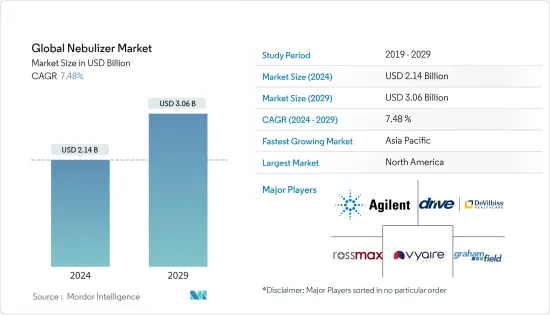
세계 네뷸라이저 시장 규모는 2024년에 21억 4,000만 달러로 추정되고, 2029년에는 30억 6,000만 달러에 이를 것으로 예측되며, 예측 기간 중(2024-2029년) 복합 연간 성장률(CAGR) 7.48%로 성장한다 전망입니다.

COVID-19의 큰 유행은 세계 네뷸라이저 시장에 큰 영향을 미쳤습니다. 2022년 1월에 발표된 "Impact of COVID-19 on people with asthma: a mixed methods analysis from a UK-wide survey(천식 환자에 대한 COVID-19의 영향: 영국 전체 조사에서 혼합법 분석)" 라는 논문에서는 COVID-19를 보고하지 않은 환자와 비교하여 COVID-19를 보고한 환자에서는 흡입기 사용량이 증가하여 천식 관리가 악화되었습니다고 합니다. 또한 2021년 1월 PubMed Central에 'Guidance on nebulization during the current COVID-19 pandemic'이라는 제목으로 게재된 논문에는 SARS-CoV-2의 공기 감염 가능성을 인식하고 있기 때문에 바이러스 감염이나 면역억제의 원인이 될 수 있다고 생각되는 흡입제의 이용을 환자가 주저하고 있다고 기재되어 있었습니다. 그러나 천식이나 만성 폐색성 폐질환(COPD) 환자는 모든 흡입제를 지시대로 복용해야 합니다. 네뷸라이저에 의한 치료가 비말핵이나 에어로졸에 의한 감염 전파의 리스크를 높일 가능성을 부정하지 않는 연구자도 있지만, 가압식 정량 흡입기(pMDI), 드라이 파우더 흡입기(DPI), 소프트 미스트 흡입기(SMI) 같은 흡입기는 오염의 위험이 낮은 것 같습니다. 따라서 COVID-19는 네뷸라이저 시장에 현저한 영향을 미쳤습니다.
만성 호흡기 질환의 이환율 증가, 가정 건강 관리 장비 수요 증가, 노인 인구 증가 등 특정 요인이 시장 성장을 뒷받침하고 있습니다. 담배 흡연은 세계 호흡기 질환 증가의 주요 원인 중 하나입니다. 세계보건기구(WHO)의 2022년 5월 갱신에 따르면 2020년에는 전 세계 22.3%의 사람이 담배를 사용했으며, 그 중 36.7%가 남성, 7.8%가 여성으로 보고되었습니다. 또한 천식 유병률과 발병률이 크게 증가함에 따라 환자 수가 증가하고 있습니다. 예를 들어, 미국 질병 예방관리센터(CDC)가 관리하는 국가 및 주 감시 시스템의 데이터에 따르면, 2022년 5월, 2020년 천식 유병률은 25,257,138명이었습니다. 또한 미국암협회는 2022년 미국에서 폐암 및 기관지암의 이환율을 236,740명으로 추정하고 있습니다. 이러한 폐암, 천식 및 기타 호흡기 질환의 높은 부담은 네뷸라이저의 필요성을 만들어 시장의 성장을 가속합니다.
게다가, 세계 여러 지역에서 기술적으로 첨단 네뷸라이저가 출시되고 있는 것도 시장 성장을 뒷받침하고 있습니다. 예를 들어, 2020년 12월, AireHealth는 VitalMed라는 브랜드 이름의 연결 네뷸라이저에 대해 미국 식품의약국(FDA)에서 510(k) 클리어런스를 취득했습니다. 이 장치는 환자가 가정 내외에서 흡입하는 액체 약물을 네뷸라이저로 분무하도록 설계된 휴대용 전자 진동 메쉬 네뷸라이저입니다. 이러한 승인이 시장 성장을 뒷받침하고 있습니다.
따라서 위의 요인으로 인해 시장은 예측 기간 동안 성장할 것으로 예상됩니다. 그러나 약물 전달의 약물 손실은 시장 조사의 주요 억제요인이되었습니다.
네뷸라이저는 약제를 액체에서 안개로 바꿉니다. 제트 네뷸라이저는 압축 가스를 사용하여 에어로졸(공기 내의 약물의 미립자)을 만듭니다. 제트 네뷸라이저는 액체 약물을 미세한 안개로 만들고 환자가 얼굴 마스크와 마우스 피스를 통해 흡입 할 수있게하는 기계입니다. 제트 네뷸라이저의 주요 장점은 그 효과와 단순한 조수 호흡만을 필요로한다는 것입니다. 또한 제트 네뷸라이저는 복용량을 변경하고 복용량을 혼합 할 수 있습니다.
천식의 유병률과 발병률이 크게 증가하면 환자 수가 증가하여 이러한 약물에 대한 수요가 증가하고 있습니다. 세계보건기구(WHO)의 2021년판 사실 시트에 따르면 천식은 소아와 성인에 영향을 미치는 주요 비감염성 질환(NCD)입니다. 이 자료에 따르면 천식은 세계에서 약 2 억 6,200 만 명에 영향을 미쳤습니다. 따라서 천식의 부담이 크므로 치료를 위해 제트 네뷸라이저의 필요성이 발생하여이 부문의 성장을 이끌고 있습니다.
또한, 초음파 네뷸라이저보다 제트 네뷸라이저의 채용이 증가하고 있는 것은 초음파 네뷸라이저와 비교하여 그 편리성과 비용 효과 때문입니다. 예상됩니다. Healthline의 2021년 11월 기사에 따르면 초음파 네뷸라이저는 특정 COPD 치료제를 전달할 수 없습니다. 그러나 모든 COPD 치료제는 제트 네뷸라이저로 투여할 수 있습니다. 따라서 제트 네뷸라이저의 장점은 또한이 부문의 성장에 기여합니다.
따라서 위의 요인으로 제트 네뷸라이저는 시장 성장을 가속할 것으로 예상됩니다.
북미의 네뷸라이저 시장은 네뷸라이저 분야의 지속적인 기술 혁신으로 성장할 것으로 예상됩니다. 이 지역의 인구가 눈부시게 변화하는 라이프 스타일을 따르기 때문에 환자는 천식이나 기타기도 질환을 가진 환자가 필요할 때 쉽게 이동할 수있는 휴대성이 뛰어난 네뷸라이저 장비를 찾고 있습니다.
미국은 북미에서 가장 큰 시장입니다. 미국에서는 결핵, COPD, 수면 무호흡 증후군과 같은 호흡기 질환 부담이 증가하고 있으며, 이는 국가 전체의 네뷸라이저 수요를 촉진하고 있습니다. 미국 질병 예방관리센터(CDC)에 의한 전미 천식 유병률 2020에 따르면 미국에서는 25,257,138명이 천식을 앓고 있으며, 그 중 18세 미만의 소아는 4,226,659명, 18세 이상의 성인은 21,030,479명이었습니다. 따라서 천식의 유병률은 높아 시장 성장을 가속할 것으로 예상됩니다.
게다가 시장 진출 기업에 의한 여러 합병, 인수, 제휴, 제품 출시도 시장 전체의 성장에 긍정적인 영향을 미칩니다. 예를 들어, 2020년 6월, 레스피라 테크놀로지스는 휴대용, 핸드헬드 진동 메쉬 네뷸라이저인 RespiRx 약물전달 디바이스 플랫폼의 의약품에 특화된 상업 개발 프로그램의 시작을 발표했습니다. 또한 2020년6월레노비온은 비 낭포 성 섬유증 기관지 확장증 및 낭포 성 섬유증 환자에서 점액을 제거하고 염증을 억제하는 실험적 네뷸라이저 요법 인 ARINA-1(아스코르브 산)의 임상 개발 위해 810만 달러의 자금을 조달했습니다.
따라서 위의 요인은 북미에서 네뷸라이저 시장의 성장을 뒷받침할 것으로 예상됩니다.
네뷸라이저 시장은 경쟁이 치열하며 여러 대형 기업으로 구성되어 있습니다. 시장 점유율 측면에서 현재 소수의 대기업이 시장을 독점하고 있습니다. M&A, 제품 승인, 계약 등 다양한 전략이 자사 제품의 아웃리치를 확대하고 제품 포트폴리오를 강화하기 위해 이러한 주요 시장 기업에 의해 채택되었습니다. 시장 진출 기업으로는 Agilent Technologies, VYAIRE MEDICAL, INC, Drive DeVilbiss Healthcare, Rossmax International Ltd., GF Health Products Inc. 등이 있습니다.
The Global Nebulizer Market size is estimated at USD 2.14 billion in 2024, and is expected to reach USD 3.06 billion by 2029, growing at a CAGR of 7.48% during the forecast period (2024-2029).
The COVID-19 pandemic had a significant impact on the nebulizer market globally. The article titled "Impact of COVID-19 on people with asthma: a mixed methods analysis from a UK-wide survey" published in January 2022 stated that there was an increased inhaler use and worse asthma management in patients with COVID-19, compared with those not reporting COVID-19. Moreover, the article published in PubMed Central under the title "Guidance on nebulization during the current COVID-19 pandemic" in January 2021 stated that patients were hesitant about utilizing inhalation drugs that were thought to be possible sources of viral transmission and immunosuppression because they were aware of the possibility of airborne transmission of SARS-CoV-2. Patients with asthma or chronic obstructive pulmonary disease (COPD), however, should continue taking all inhaled drugs as directed. While some researchers do not rule out the possibility that nebulizer treatments may increase the risk of infection transmission via droplet nuclei and aerosols, it appears that inhalers, including pressurized metered-dose inhalers (pMDI), dry powder inhalers (DPI), or soft mist inhalers (SMIs), have a low risk of contamination. Thus, COVID-19 had a notable impact on the nebulizer market.
Certain factors are driving the market growth, which includes rising incidences of chronic respiratory diseases, increasing demand for home healthcare devices, and a rising geriatric population base. Tobacco smoking is one of the primary causes of the increase in respiratory diseases worldwide. As per the World Health Organization, May 2022 update, in 2020, 22.3% of people worldwide used tobacco, of which 36.7% reported were men and 7.8% reported were women. Additionally, the substantial increase in the prevalence and incidence of asthma has led to an increase in the patient population. For instance, as per the data from national and state surveillance systems administered by the Centers for Disease Control and Prevention (CDC), in May 2022, the prevalence of asthma was 25,257,138 in 2020. Furthermore, the American Cancer Society estimated that lung and bronchus cancer incidence in the United States in 2022 was 236,740. Such a high burden of lung cancer, asthma, and other respiratory diseases creates a need for nebulizers and hence drives the growth of the market.
Additionally, the launch of technically advanced nebulizers in different parts of the world is also propelling the growth of the market. For instance, in December 2020, AireHealth received 510(k) clearance from the United States Food and Drug Administration (FDA) for its connected nebulizer branded as VitalMed. The device is a portable, electronic vibrating mesh nebulizer designed to nebulize liquid medications for inhalation by a patient in and out of the home. Such approvals are propelling the growth of the market.
Thus, owing to the abovementioned factors, the market is expected to project growth over the forecast period. However, drug loss during drug delivery is the major restraining factor for the market studied.
A nebulizer changes medication from a liquid to a mist. Jet nebulizers use compressed gas to make an aerosol (tiny particles of medication in the air). A jet nebulizer is a machine that turns liquid medicine into a fine mist that a patient can breathe in through a face mask or mouthpiece. The major advantage of jet nebulizers is their effectiveness and requirement for only simple, tidal breathing. Moreover, in jet nebulizers, dose modification and dose compounding are possible.
The substantial increase in prevalence and incidence of asthma has led to an increase in the patient population, which has, in turn, increased the demand for these drugs. According to the World Health Organization (WHO) 2021 factsheet, asthma is a major noncommunicable disease (NCD) affecting children and adults. According to the same source, asthma affected approximately 262 million people worldwide. Thus, such a high burden of asthma creates the need for the jet nebulizer for the treatment and thus drives the growth of the segment.
Moreover, the rising adoption of jet nebulizers over ultrasound nebulizers is due to their convenience and cost-effectiveness compared to ultrasound nebulizers, which is expected to influence the segment's growth positively. According to the November 2021 article from Healthline, ultrasonic nebulizers can't deliver certain COPD medications. However, all COPD medications can be delivered through jet nebulizers. Thus, the advantages of jet nebulizers also contribute to the growth of the segment.
Hence, owing to the above-mentioned factors, jet nebulizers are expected to boost market growth.
The North American nebulizer market is expected to grow due to continuous technological innovations in the field of nebulizers. As the population in the region follows a fast-moving lifestyle, patients are looking for more portable nebulizer devices that can be transferred easily in a time of need for patients with asthma and other airway diseases.
The United States is the largest market in the North American region. The burden of respiratory diseases, such as tuberculosis, COPD, and sleep apnea, is increasing in the United States, which is fueling the demand for nebulizers across the country. As per the National Asthma Prevalence 2020 by the Centers for Disease Control and Prevention (CDC), 25,257,138 people were affected by asthma in the United States, of which 4,226,659 were children aged less than 18 and 21,030,479 were adults aged above 18. Thus, such a high prevalence of asthma is expected to propel the growth of the market.
Moreover, several mergers, acquisitions, partnerships, and product launches by the market players also positively influence overall market growth. For example, in June 2020, Respira Technologies announced the launch of a pharmaceutical-focused commercial development program for its RespiRx drug-delivery device platform, which is a portable, handheld vibrating mesh nebulizer. Additionally, in June 2020, the company Renovion raised USD 8.1 million in funding for the clinical development of ARINA-1 (ascorbic acid), which is an experimental nebulizer therapy to clear mucus and reduce inflammation in people with non-cystic fibrosis bronchiectasis and cystic fibrosis.
Thus, the abovementioned factors are expected to boost the growth of the nebulizer market in North America.
The nebulizer market is highly competitive and consists of several major players. In terms of market share, a few of the major players currently dominate the market. Various strategies, such as mergers and acquisitions, product approvals, and agreements, are being adopted by these key market players to increase the outreach of their products and strengthen their product portfolios. Some of the market players are Agilent Technologies, VYAIRE MEDICAL, INC, Drive DeVilbiss Healthcare, Rossmax International Ltd., and GF Health Products Inc., among others.