지능형 빌딩 자동화 기술 시장 : 제공별, 기술별, 최종 용도별, 지역별 - 세계 예측(-2030년)
Intelligent Building Automation Technologies Market by Solution (Facility Management, Security & Access Control, Building Energy Management), Technology (Sensors, Actuators, Connectivity, Computing) - Global Forecast to 2030
상품코드:1963146
리서치사:MarketsandMarkets
발행일:2026년 02월
페이지 정보:영문 394 Pages
라이선스 & 가격 (부가세 별도)
ㅁ Add-on 가능: 고객의 요청에 따라 일정한 범위 내에서 Customization이 가능합니다. 자세한 사항은 문의해 주시기 바랍니다.
한글목차
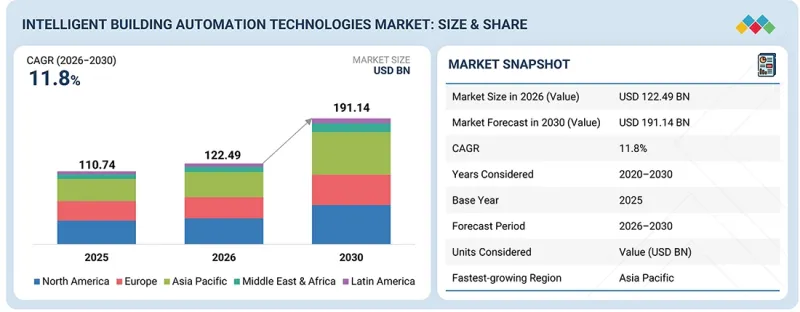
지능형 빌딩 자동화 시장 규모는 2026년에서 2030년까지 CAGR 11.8%로 성장하여 1,224억 9,000만 달러에서 1,911억 4,000만 달러에 달할 것으로 예측됩니다.
이러한 성장은 건물 성능 최적화, 운영 비용 절감, 거주자 편의성 향상에 대한 니즈에 의해 주도되고 있습니다. 건물 소유주와 운영자는 점유 패턴, 에너지 수요, 환경 변수 등 실시간 상황에 적응하는 자동화 솔루션을 점점 더 많이 도입하고 있습니다.
조사 범위
조사 대상 기간
2020-2030년
기준 연도
2025년
예측 기간
2026-2030년
대상 단위
달러(10억)
부문
제공별, 기술별, 최종 용도별, 지역별
대상 지역
북미, 유럽, 아시아태평양, 중동 및 아프리카, 라틴아메리카
상업, 산업, 공공 부문의 기업들은 고립된 빌딩 시스템에서 중앙 집중식 모니터링과 지능형 제어가 가능한 통합 자동화 플랫폼으로 전환하고 있습니다. 클라우드 기반 빌딩 관리 시스템, 첨단 분석 기술, 커넥티드 센서의 도입 확대로 빌딩 운영 전반에 대한 가시성이 향상되어 데이터에 기반한 의사결정을 지원하고 있습니다. 이러한 요인들이 복합적으로 작용하여 다양한 빌딩 환경에서 에너지 효율성, 운영 안정성, 장기적인 인프라 지속가능성을 지원하는 확장 가능한 자동화 솔루션에 대한 수요가 증가하고 있습니다.
건물이 센서, 컨트롤러 및 중앙 관리 플랫폼 간의 원활한 통신에 점점 더 의존함에 따라 지능형 빌딩 자동화 시장에서 연결 기술이 가장 빠르게 성장할 것으로 예상됩니다. 첨단 유무선 통신 프로토콜의 채택은 시스템 통합을 가속화하고, 상호 운용성을 향상시키며, 신축 및 리노베이션 프로젝트 전반에 걸쳐 유연성을 높입니다. 특히 무선 연결 솔루션은 도입 간소화와 확장 가능한 자동화 아키텍처 지원으로 주목받고 있습니다. 지능형 빌딩이 실시간 데이터 생성량을 증가시키는 가운데, 자동화, 분석, 시스템 반응성을 실현하기 위해서는 신뢰성과 안전성을 겸비한 연결 인프라가 필수적입니다. 따라서 통신 기술의 지속적인 발전으로 연결성은 전체 시장에서 주요 촉진요인으로 자리매김하고 있습니다.
온도 센서는 난방, 환기 및 공조(HVAC) 시스템에서 광범위하게 사용되어 센서 기술 부문에서 가장 큰 점유율을 차지할 것으로 예상됩니다. 이러한 센서는 건물 환경 전반의 열적 쾌적성 유지, 에너지 사용 최적화, 효율적인 HVAC 작동을 보장하는 데 중요한 역할을 합니다. 건물 관리 및 에너지 관리 플랫폼과의 통합을 통해 실내외 환경에 따른 실시간 조정이 가능합니다. 온도 센서는 신규 설치 및 개조 프로젝트 모두에서 중요한 역할을 하기 때문에 지능형 빌딩 자동화 시스템에서 가장 널리 도입된 센싱 기술 중 하나입니다.
아시아태평양은 예측 기간 동안 가장 빠른 성장을 기록할 것으로 예상됩니다. 이는 주로 이 지역 주요 경제권의 지속적인 도시 확장 및 대규모 인프라 개발에 기인합니다. 중국, 인도, 일본, 호주 및 여러 동남아시아 시장을 포함한 여러 국가에서 상업용 건물, 산업시설, 공공 인프라에 빌딩 자동화 시스템 도입이 증가하고 있습니다. 정부 주도의 스마트 시티 계획, 보다 엄격한 에너지 효율 요건, 디지털 빌딩 관리 플랫폼의 보급 확대가 이러한 추세를 뒷받침하고 있습니다. 이 지역의 성장은 주로 레거시 시스템의 업데이트보다는 신규 개발(그린필드 개발)과 자동화 기술의 초기 단계 통합에 의해 주도되고 있습니다.
주요 조사 대상 내역
지능형 빌딩 자동화 시장의 주요 기업으로는 Honeywell International Inc.(미국), Johnson Controls International plc(아일랜드), Siemens AG(독일), Schneider Electric SE(프랑스), ABB Ltd.(스위스), Eaton Corporation(아일랜드), Trane Technologies plc(아일랜드), Carrier Global Corporation(미국), Rockwell Automation(미국), Emerson Electric Co.(미국), Azbil Corporation(일본), Legrand(프랑스), Mitsubishi Electric(일본), Lutron Electronics(미국), Delta Electronics(대만), Robert Bosch GmbH(독일), Current Lighting Solutions(미국), Verdigris Technologies(미국), 75F(미국), BuildingIQ(호주), KMC Controls(미국), Spaceti(체코), Softdel(미국) 등이 있습니다. 이들 기업은 지능형 빌딩 자동화 기술의 사업 기반을 확대하기 위해 파트너십, 계약 및 협업, 신제품 출시, 제품 강화, 인수 등 다양한 성장 전략을 채택하고 있습니다.
조사 범위
본 시장 조사에서는 지능형 빌딩 자동화 시장 규모를 다양한 부문별로 분석하고 있습니다. 제공 내용, 기술, 최종 용도, 지역 등 각 부문의 시장 규모와 성장 가능성을 추정하는 것을 목적으로 하고 있습니다. 주요 시장 기업의 상세한 경쟁 분석, 기업 개요, 제품 및 사업 제공에 대한 주요 관찰 사항, 최근 동향, 시장 전략도 조사 대상에 포함되어 있습니다.
본 보고서 구매의 주요 이점
이 보고서는 시장 리더와 신규 진입자에게 세계 지능형 빌딩 자동화 시장 및 하위 부문의 수익에 대한 가장 정확한 추정치를 제공합니다. 이해관계자들이 경쟁 상황을 이해하고, 비즈니스를 보다 효과적으로 포지셔닝하고, 적절한 시장 진입 전략을 수립할 수 있는 인사이트를 얻을 수 있도록 돕습니다. 또한, 시장 동향에 대한 인사이트와 주요 시장 촉진요인, 억제요인, 과제 및 기회에 대한 정보를 제공합니다.
이 보고서는 다음 사항에 대한 인사이트를 제공합니다:
주요 촉진요인 분석(에너지 절약 및 규제 준수 건물에 대한 수요)
지능형 빌딩 자동화 시장 성장에 영향을 미치는 지속가능성 및 에너지 보고 요건, 제약(단편화된 레거시 빌딩 인프라, 고도의 통합 및 리노베이션 복잡성), 기회(데이터 기반 시설 최적화, 스마트 리노베이션 및 빌딩 현대화 프로젝트), 과제(데이터 보안, 시스템 안정성, 숙련된 인력 및 시스템 준비성) 보안 및 시스템 신뢰성, 숙련된 인력 및 운영 준비태세)
제품 개발/혁신 : 지능형 빌딩 자동화 시장의 향후 기술 동향, 연구개발 활동, 신제품 및 서비스 출시에 대한 상세 분석
시장 개발 : 수익성 높은 시장에 대한 종합적인 정보 - 이 보고서는 다양한 지역의 지능형 빌딩 자동화 시장을 분석합니다.
시장 다각화 : 지능형 빌딩 자동화 시장의 신제품 및 서비스, 미개척 지역, 최근 동향, 투자에 관한 종합적인 정보
경쟁사 평가 - Honeywell International Inc.(미국), Johnson Controls International plc(아일랜드), Siemens AG(독일), Schneider Electric SE(프랑스), ABB Ltd. Eaton Corporation(아일랜드), Trane Technologies plc(아일랜드), Carrier Global Corporation(미국), Rockwell Automation(미국), Emerson Electric Co. Azbil Corporation(일본), Legrand(프랑스), Mitsubishi Electric(일본), Lutron Electronics(미국), Delta Electronics(대만), Robert Bosch GmbH(독일), Current Lighting Solutions(미국), Verdigris Technologies(미국), 75F(미국), BuildingIQ(호주), KMC Controls(미국), Spaceti(체코), Softdel(미국)
목차
제1장 소개
제2장 주요 요약
제3장 주요 인사이트
제4장 시장 개요
제5장 업계 동향
제6장 기술의 진보, AI에 의한 영향, 특허, 혁신, 향후 응용
제7장 규제 상황과 지속가능성에 관한 대처
제8장 고객 상황과 구매 행동
제9장 지능형 빌딩 자동화 기술 시장(제공별)
제10장 지능형 빌딩 자동화 기술 시장(기술별)
제11장 지능형 빌딩 자동화 기술 시장(최종 용도별)
제12장 지능형 빌딩 자동화 기술 시장(지역별)
제13장 경쟁 구도
제14장 기업 개요
제15장 조사 방법
제16장 부록
KSM
영문 목차
영문목차
The intelligent building automation market is estimated to range from USD 122.49 billion to USD 191.14 billion at a CAGR of 11.8% from 2026 to 2030. This growth is driven by the need to optimize building performance, reduce operational costs, and enhance occupant comfort. Building owners and operators are increasingly deploying automation solutions that adapt to real-time conditions, including occupancy patterns, energy demand, and environmental variables.
Scope of the Report
Years Considered for the Study
2020-2030
Base Year
2025
Forecast Period
2026-2030
Units Considered
USD (Billion)
Segments
By offering, technology type, end use (residential, commercial, industrial, transportation infrastructure, public & government buildings)
Regions covered
North America, Europe, Asia Pacific, Middle East & Africa, Latin America
Enterprises across commercial, industrial, and institutional sectors are transitioning from isolated building systems to integrated automation platforms that enable centralized monitoring and intelligent control. The rising adoption of cloud-based building management systems, advanced analytics, and connected sensors is improving visibility across building operations and supporting data-driven decision-making. Together, these factors are driving demand for scalable automation solutions that support energy efficiency, operational reliability, and long-term infrastructure sustainability across diverse building environments.
"Connectivity technology is projected to register the highest CAGR during the forecast period."
Connectivity technology is expected to grow fastest within the intelligent building automation market as buildings increasingly rely on seamless communication among sensors, controllers, and centralized management platforms. The adoption of advanced wired and wireless communication protocols is accelerating system integration, improving interoperability, and increasing flexibility across new construction and retrofit projects. Wireless connectivity solutions are gaining particular traction for simplifying deployment and supporting scalable automation architectures. As intelligent buildings generate growing volumes of real-time data, reliable and secure connectivity infrastructure is becoming essential for enabling automation, analytics, and system responsiveness. Continuous advancements in communication technologies are therefore positioning connectivity as a key growth driver in the overall market.
During the forecast period, the temperature sensor segment will hold the largest share in the intelligent building automation market.
Temperature sensors are expected to account for the largest share of the sensor technology segment due to their extensive use in heating, ventilation, and air conditioning (HVAC) systems. These sensors play a critical role in maintaining thermal comfort, optimizing energy use, and ensuring efficient HVAC operation across building environments. Their integration with building and energy management platforms enables real-time adjustments based on indoor and outdoor conditions. Given their essential role in both new installations and retrofit projects, temperature sensors remain among the most widely deployed sensing technologies in intelligent building automation systems.
"Asia Pacific will register the highest growth rate during the forecast period."
Asia Pacific is expected to record the fastest growth during the forecast period, primarily due to continued urban expansion and large-scale infrastructure development across major economies in the region. Countries including China, India, Japan, Australia, and several Southeast Asian markets are seeing increased deployment of building automation systems in commercial buildings, industrial facilities, and public infrastructure. Government-led smart city programs, stricter energy-efficiency requirements, and higher adoption of digital building management platforms are supporting this trend. Growth in the region is largely driven by greenfield developments and early-stage integration of automation technologies rather than the replacement of legacy systems.
Breakdown of primaries
The study includes insights from various industry experts, ranging from solution vendors to Tier 1 companies. The breakdown of the primary respondents is as follows:
By Company Type: Tier 1 - 35%, Tier 2 - 45%, and Tier 3 - 20%
By Designation: C-level -35%, D-level - 25%, and Others - 40%
By Region: North America - 30%, Europe - 300%, Asia Pacific - 25%, Middle East & Africa- 10%, and Latin America - 5%
The major players in the intelligent building automation market include Honeywell International Inc. (US), Johnson Controls International plc (Ireland), Siemens AG (Germany), Schneider Electric SE (France), ABB Ltd. (Switzerland), Eaton Corporation (Ireland), Trane Technologies plc (Ireland), Carrier Global Corporation (US), Rockwell Automation (US), Emerson Electric Co. (US), Azbil Corporation (Japan), Legrand (France), Mitsubishi Electric (Japan), Lutron Electronics (US), Delta Electronics (Taiwan), Robert Bosch GmbH (Germany), Current Lighting Solutions (US), Verdigris Technologies (US), 75F (US), BuildingIQ (Australia), KMC Controls (US), Spaceti (Czech Republic), and Softdel (US). These players have adopted various growth strategies, including partnerships, agreements & collaborations, new product launches, product enhancements, and acquisitions, to expand their footprint in intelligent building automation technologies.
Research Coverage
The market study covers the size of the intelligent building automation market across different segments. It aims to estimate market size and growth potential across various segments, including offering, technology, end use, and region. The study includes an in-depth competitive analysis of leading market players, their company profiles, key observations on product and business offerings, recent developments, and market strategies.
Key Benefits of Buying the Report
The report will provide market leaders and new entrants with the closest available estimates of the global intelligent building automation market's revenue and subsegments. It will help stakeholders understand the competitive landscape and gain insights to position their businesses more effectively and plan suitable go-to-market strategies. Moreover, the report will provide insights into the market's pulse and information on key market drivers, restraints, challenges, and opportunities.
The report provides insights on the following pointers:
Analysis of key drivers (demand for energy-efficient and compliant buildings)
sustainability and energy reporting requirements, restraints (fragmented legacy building infrastructure, high integration and retrofit complexity), opportunities (data-driven facility optimization, smart retrofit and building modernization projects), and challenges (data security and system reliability, skilled workforce and operational readiness), influencing the growth of the intelligent building automation market
Product Development/Innovation: Detailed insights on upcoming technologies, research and development activities, and new product and service launches in the intelligent building automation market
Market Development: Comprehensive information on lucrative markets - the report analyzes intelligent building automation markets across various regions.
Market Diversification: Exhaustive information about new products and services, untapped geographies, recent developments, and investments in the intelligent building automation market
Competitive Assessment: In-depth assessment of market share, growth strategies, and service offerings of leading players such as Honeywell International Inc. (US), Johnson Controls International plc (Ireland), Siemens AG (Germany), Schneider Electric SE (France), ABB Ltd. (Switzerland), Eaton Corporation (Ireland), Trane Technologies plc (Ireland), Carrier Global Corporation (US), Rockwell Automation (US), Emerson Electric Co. (US), Azbil Corporation (Japan), Legrand (France), Mitsubishi Electric (Japan), Lutron Electronics (US), Delta Electronics (Taiwan), Robert Bosch GmbH (Germany), Current Lighting Solutions (US), Verdigris Technologies (US), 75F (US), BuildingIQ (Australia), KMC Controls (US), Spaceti (Czech Republic), and Softdel (US).
TABLE OF CONTENTS
1 INTRODUCTION
1.1 STUDY OBJECTIVES
1.2 MARKET DEFINITION
1.3 STUDY SCOPE
1.3.1 MARKET SEGMENTATION
1.3.2 INCLUSIONS AND EXCLUSIONS
1.3.3 YEARS CONSIDERED
1.4 CURRENCY CONSIDERED
1.5 STAKEHOLDERS
1.6 SUMMARY OF CHANGES
2 EXECUTIVE SUMMARY
2.1 MARKET HIGHLIGHTS AND KEY INSIGHTS
2.2 KEY MARKET PARTICIPANTS: MAPPING OF STRATEGIC DEVELOPMENTS
2.3 DISRUPTIVE TRENDS IN INTELLIGENT BUILDING AUTOMATION TECHNOLOGIES MARKET
2.4 HIGH-GROWTH SEGMENTS
2.5 REGIONAL SNAPSHOT: MARKET SIZE, GROWTH RATE, AND FORECAST
3 PREMIUM INSIGHTS
3.1 ATTRACTIVE OPPORTUNITIES FOR PLAYERS IN INTELLIGENT BUILDING AUTOMATION TECHNOLOGIES MARKET
3.2 NORTH AMERICA: INTELLIGENT BUILDING AUTOMATION TECHNOLOGIES MARKET, BY OFFERING AND END USE
3.3 INTELLIGENT BUILDING AUTOMATION TECHNOLOGIES MARKET, BY SOLUTION
3.4 INTELLIGENT BUILDING AUTOMATION TECHNOLOGIES MARKET, BY TECHNOLOGY
3.5 INTELLIGENT BUILDING AUTOMATION TECHNOLOGIES MARKET, BY END USE
4 MARKET OVERVIEW
4.1 INTRODUCTION
4.2 MARKET DYNAMICS
4.2.1 DRIVERS
4.2.1.1 Growing adoption of energy-efficient and sustainability-oriented building systems
4.2.1.2 Urbanization and smart infrastructure initiatives
4.2.1.3 Advancements in wireless protocols and wireless sensor technologies
4.2.1.4 Developments in sensing, connectivity, and data-enabled building operations
4.2.2 RESTRAINTS
4.2.2.1 High implementation costs
4.2.2.2 Concerns regarding cyberattacks and data breaches
4.2.2.3 Integration complexity with legacy building infrastructure
4.2.3 OPPORTUNITIES
4.2.3.1 Expansion of intelligent building automation through large-scale retrofit activities
4.2.3.2 Increasing reliance on automation to address operational labor constraints
4.2.3.3 Increasing government initiatives for developing connected infrastructure
4.2.3.4 Growing focus on integrated building information modeling solutions
4.2.4 CHALLENGES
4.2.4.1 Rising cybersecurity exposure in highly connected building environments
4.2.4.2 Lack of standardized communication protocols
4.3 INTERCONNECTED MARKETS AND CROSS-SECTOR OPPORTUNITIES
4.3.1 INTERCONNECTED MARKETS
4.3.2 CROSS-SECTOR OPPORTUNITIES
4.4 STRATEGIC MOVES BY TIER-1/2/3 PLAYERS
5 INDUSTRY TRENDS
5.1 PORTER'S FIVE FORCES ANALYSIS
5.1.1 THREAT OF NEW ENTRANTS
5.1.2 THREAT OF SUBSTITUTES
5.1.3 BARGAINING POWER OF SUPPLIERS
5.1.4 BARGAINING POWER OF BUYERS
5.1.5 INTENSITY OF COMPETITIVE RIVALRY
5.2 MACROECONOMIC OUTLOOK
5.2.1 INTRODUCTION
5.2.2 GDP TRENDS AND FORECAST
5.2.3 TRENDS IN INTELLIGENT BUILDING AUTOMATION TECHNOLOGIES MARKET
5.3 SUPPLY CHAIN ANALYSIS
5.3.1 HARDWARE AND SENSOR MANUFACTURERS
5.3.2 CONNECTIVITY AND NETWORK INFRASTRUCTURE PROVIDERS
5.3.3 AUTOMATION PLATFORM AND SOFTWARE PROVIDERS
5.3.4 SYSTEM INTEGRATORS AND MANAGED SERVICE PROVIDERS
5.3.5 END USERS
5.4 ECOSYSTEM ANALYSIS
5.5 PRICING ANALYSIS
5.5.1 AVERAGE SELLING PRICE OF KEY PLAYERS, BY HVAC & LIGHTING CONTROLS
5.5.2 INDICATIVE PRICING ANALYSIS OF KEY PLAYERS, BY SOLUTION
5.6 TRADE ANALYSIS
5.6.1 EXPORT SCENARIO OF REGULATING OR CONTROLLING INSTRUMENTS AND APPARATUS (9032)
5.6.2 IMPORT SCENARIO OF REGULATING OR CONTROLLING INSTRUMENTS AND APPARATUS (9032)
5.7 KEY CONFERENCES AND EVENTS, 2026-2027
5.8 TRENDS/DISRUPTIONS IMPACTING CUSTOMER BUSINESS
5.9 INVESTMENT AND FUNDING SCENARIO
5.10 CASE STUDY ANALYSIS
5.10.1 CASE STUDY 1: LEGRAND'S ELECTRICAL SOLUTIONS FOR A PREMIUM RESIDENTIAL PROJECT IN INDIA
5.10.2 CASE STUDY 2: ABB SMART BUILDING TECHNOLOGY ENSURED BUSINESS CONTINUITY, REDUCED ENERGY USAGE, AND IMPROVED COMFORT
5.10.3 CASE STUDY 3: EATON'S EMERGENCY LIGHTING SYSTEM WITH REMOTE MONITORING ENSURED SAFETY FOR NEW RESEARCH CENTER AT UNIVERSITY OF WARWICK
5.10.4 CASE STUDY 4: AZBIL'S ENERGY OPTIMIZATION SOLUTION FOR LUXURY HOTEL IN THAILAND
5.10.5 CASE STUDY 5: DESIGO CC SOLUTION - MAKING BUILDINGS SMARTER USING INTEGRATED AUTOMATION PLATFORM AND HIGH-PERFORMING INFRASTRUCTURE
5.11 IMPACT OF 2025 US TARIFF - INTELLIGENT BUILDING AUTOMATION TECHNOLOGIES MARKET
5.11.1 INTRODUCTION
5.11.2 KEY TARIFF RATES
5.11.3 PRICE IMPACT ANALYSIS
5.11.3.1 Strategic shifts and emerging trends
5.11.4 IMPACT ON COUNTRIES/REGIONS
5.11.4.1 US
5.11.4.2 China
5.11.4.3 Europe
5.11.4.4 Asia Pacific (excluding China)
5.11.5 IMPACT ON END-USER INDUSTRIES
5.11.5.1 Commercial and institutional buildings
6 TECHNOLOGICAL ADVANCEMENTS, AI-DRIVEN IMPACT, PATENTS, INNOVATIONS, AND FUTURE APPLICATIONS
6.1 KEY TECHNOLOGIES
6.1.1 IOT SENSORS
6.1.2 EDGE COMPUTING
6.1.3 MACHINE LEARNING ALGORITHMS
6.2 COMPLEMENTARY TECHNOLOGIES
6.2.1 5G CONNECTIVITY
6.2.2 DIGITAL TWINS
6.3 TECHNOLOGY ROADMAP
6.3.1 SHORT-TERM (2026-2027) | SYSTEM MODERNIZATION & RETROFIT ENABLEMENT