Nuclear Medicine Market by Type, Application (Oncology, Cardiology, Neurology), Procedure, End User (Imaging Center, Hospital), and Region - Global Forecast to 2030
상품코드:1963141
리서치사:MarketsandMarkets
발행일:2026년 01월
페이지 정보:영문 536 Pages
라이선스 & 가격 (부가세 별도)
ㅁ Add-on 가능: 고객의 요청에 따라 일정한 범위 내에서 Customization이 가능합니다. 자세한 사항은 문의해 주시기 바랍니다.
한글목차
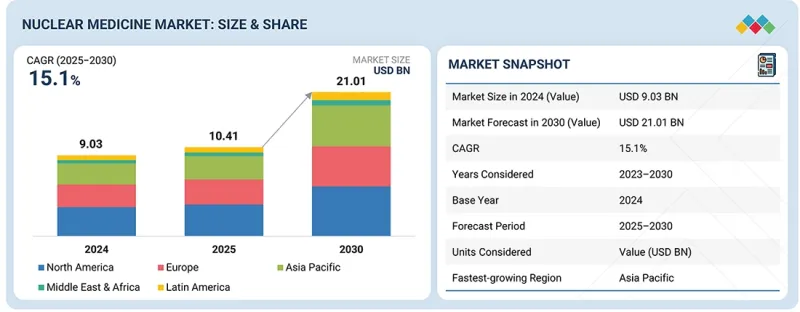
세계의 핵의학 시장 규모는 2025년 104억 1,000만 달러에서 2030년까지 210억 1,000만 달러에 이를 것으로 예측되며, 예측 기간에 CAGR 15.1%의 성장이 전망됩니다.
이는 종양학, 심장학, 신경학 분야의 진단/치료용 방사성의약품 및 의료용 방사성동위원소에 대한 수요 증가에 따른 것으로 분석됩니다.
조사 범위
조사 대상 기간
2024-2030년
기준 연도
2024년
예측 기간
2025-2030년
단위
10억 달러
부문
유형, 용도, 건수 평가, 최종사용자, 지역
대상 지역
북미, 유럽, 아시아태평양, 중남미, 중동 및 아프리카
또한, 표적 방사성 핵종 치료의 사용 증가, 사이클로트론 및 원자로 기반 방사성 동위원소 생산의 성장, 핵약학 네트워크를 통한 이들 제품의 가용성 증가는 시장 성장을 가속하고 있습니다. 또한, 새로운 방사성의약품이 지속적으로 개발되고 규제 당국의 승인을 받음에 따라 전 세계적으로 방사성의약품의 사용이 크게 증가하고 있습니다. 이러한 방사성의약품의 사용 증가는 시장 성장을 더욱 촉진하고 있습니다.
"병원 부문이 예측 기간 동안 가장 큰 점유율을 차지할 것으로 예측됩니다. "
최종 사용자별로는 병원 부문이 예측 기간 동안 핵의학 시장에서 가장 큰 점유율을 차지할 것으로 예측됩니다. 이 예측은 병원의 복잡한 과정을 통해 방사성의약품을 준비하고 투여할 수 있는 능력, 방사성 동위원소를 취급할 수 있는 허가된 시설이 갖추어져 있고, 핵의학 전문가가 존재한다는 점을 근거로 하고 있습니다. 또한, 병원의 많은 환자 수, 진단 및 치료 서비스, 확립된 상환 시스템이 향후 몇 년 동안 이 부문의 성장을 더욱 촉진할 것으로 예측됩니다.
"예측 기간 동안 치료용 제품 부문이 진단용 제품 부문보다 더 높은 성장률을 나타낼 것으로 예측됩니다. "
치료용 부문은 예측 기간 동안 진단용 부문보다 더 높은 성장률을 보일 것으로 예측됩니다. 이러한 예측은 특히 세라믹 분야에서 암 치료에 표적 방사성의약품 치료와 방사성동위원소 활용이 확대되고 있기 때문입니다. 방사성 핵종 치료의 임상적 효능이 향상되고 치료용 방사성 동위원소 생산에 대한 규제 승인과 투자가 증가함에 따라 각 의료기관에서 방사성 핵종 치료의 수용성이 높아지고 있습니다.
"아시아태평양이 예측 기간 동안 가장 높은 성장률을 나타낼 것으로 예측됩니다. "
아시아태평양은 예측 기간 동안 핵의학 시장에서 가장 높은 성장률을 나타낼 것으로 예측됩니다. 이는 암 발병률 증가, 병원 시설 확충, 핵의학 서비스 접근성 확대 등의 요인으로 인해 방사성의약품 및 방사성 동위원소 수요가 증가했기 때문입니다. 또한, 정부의 방사성 동위원소 생산, 규제 인프라 및 공급망 강화도 이 지역 시장 성장을 가속화하고 있습니다. 또한, 의료비 증가와 조기 진단 및 특이적 치료에 대한 인식이 높아지면서 핵의학 시술 건수 증가에 기여하고 있습니다.
세계의 핵의학(Nuclear Medicine) 시장에 대해 조사 분석했으며, 주요 촉진요인 및 억제요인, 제품 개발 및 혁신, 경쟁 구도에 대해 조사 분석하여 전해드립니다.
목차
제1장 서론
제2장 주요 요약
제3장 중요 지견
제4장 시장 개요
제5장 업계 동향
제6장 기술, 특허, 디지털, AI 채택에 의한 전략적 파괴
제7장 규제 상황
제8장 고객 현황과 구매 행동
제9장 핵의학 시장 : 유형별
제10장 핵의학 시장 : 용도별
제11장 핵의학 시장 : 시술 건수 평가
제12장 핵의학 시장 : 최종사용자별
제13장 핵의학 시장 : 지역별
제14장 경쟁 구도
제15장 기업 개요
제16장 조사 방법
제17장 부록
LSH
영문 목차
영문목차
The global nuclear medicine market is projected to reach USD 21.01 billion by 2030, growing from USD 10.41 billion in 2025 at a CAGR of 15.1% during the forecast period. This projection is driven by the growing demand for diagnostic and therapeutic radiopharmaceuticals and medical radioisotopes in the oncology, cardiology, and neurology fields.
Scope of the Report
Years Considered for the Study
2024-2030
Base Year
2024
Forecast Period
2025-2030
Units Considered
Value (USD billion)
Segments
Type, Application, Volume Assessment, End User, and Region
Regions covered
North America, Europe, APAC, LATAM, MEA
Additionally, the increased utilization of targeted radionuclide therapies, growth in cyclotron and reactor-based production of radioisotopes, and enhanced availability of these products through nuclear pharmacy networks are enhancing the growth of the market. Moreover, there is a significant increase in the use of radiopharmaceuticals across the globe as new ones are constantly developed and approved by regulatory bodies. This increased use of radiopharmaceuticals is further driving the growth of the market.
"The hospitals segment is projected to account for the largest share during the forecast period."
By end user, the hospitals segment is projected to account for the largest share of the nuclear medicine market during the forecast period. This projection is based on the capability of hospitals in preparing and administering radiopharmaceuticals through complex processes, available licensed facilities to deal with radioisotopes, and the presence of specialized nuclear medicine experts. Additionally, the presence of large volumes of patients, combined with diagnostic and therapeutic services, and well-established reimbursement systems in hospitals, is further expected to drive the growth of the segment in the coming years.
"The therapeutic applications segment is projected to register a higher growth than the diagnostic applications segment during the forecast period."
The therapeutic applications segment is projected to register a higher growth than the diagnostics applications segment during the forecast period. This projection is driven by the rising application of targeted radiopharmaceutical therapies and radioisotopes in treating cancer, especially in theranostics. Increasing clinical efficacy of radionuclide therapies and growing regulatory approval and investment in the production of therapeutic radioisotopes are boosting the acceptance across healthcare providers.
"Asia Pacific is projected to witness the highest growth rate during the forecast period."
Asia Pacific is projected to register the highest growth in the nuclear medicine market over the forecast period. This is due to the rising demand for radiopharmaceuticals and radioisotopes because of factors like increasing cancer prevalence, hospital facilities expansion, and growing access to nuclear medicine services. Additionally, the production of radioisotopes and the enhancement of regulatory infrastructure and supply chains by the governments are also increasing the growth of the markets in the region faster. Moreover, the growing healthcare spending and the rising awareness of early diagnosis and specific treatments are contributing to the rise in the number of nuclear medicine procedures.
In-depth interviews were conducted with chief executive officers (CEOs), directors, and other executives from various key organizations operating in the authentication and brand protection marketplace.
The breakdown of primary participants is mentioned below:
By Company Type - Tier 1 - 64%; Tier 2 - 23%; and Tier 3 - 13%
By Designation - C Level - 35%; Director Level - 25%; and Others - 40%
By Region - North America - 44%; Europe - 23%; Asia Pacific - 28%; Latin America - 3%; Middle East & Africa - 2%
Key Players in the Nuclear Medicine Market
The key players operating in the nuclear medicine market include GE HealthCare (US), Cardinal Health (US), Curium (France), Bayer AG (Germany), Lantheus Holdings, Inc. (US), Novartis AG (Switzerland), Jubilant Pharmova Limited (India), Bracco Imaging S.P.A (Italy), Pharmalogic Holdings Corp. (US), NTP Radioisotopes SOC Ltd. (South Africa), Nordion Inc. (Canada), Siemens Healthineers AG (Germany), NorthStar Medical Radiosiotopes, LLC (US), Eckert & Ziegler (Germany), Isotope JSC (Russia), Global Medical Solutions (US), Telix Pharmaceuticals Limited (Australia), PDRadiopharma Inc. (Japan), ITM Isotope Technologies Munich SE (Germany), BWX Technologies Inc. (US), SHINE Technologies, LLC (US), Isotopia (Israel), Institutes of Isotopes (Hungary), China Isotope & Radiation Corporation (China), and IRE Elit (Turkey).
Research Coverage
The report analyzes the nuclear medicine market and aims to estimate the market size and future growth potential of various market segments by type, application, volume assessment, end user, and region. The report provides a competitive analysis of the key players operating in this market, along with their company profiles, product offerings, recent developments, and key market strategies.
Reasons to Buy the Report
This report will enrich established firms as well as new entrants/smaller firms to gauge the pulse of the market, which, in turn, would help them garner a greater share of the market. Firms purchasing the report could use one or a combination of the following strategies to strengthen their positions in the market.
This report provides insights into:
Analysis of key drivers (Increasing incidence and prevalence of target conditions, development of alpha-radioimmunotherapy-based targeted cancer treatments, initiatives to reduce demand and supply gap of Mo-99), restraints (Short half-life of radiopharmaceuticals), opportunities (Use of radiopharmaceuticals in neurological applications, growth opportunities in emerging economies), challenges (Hospital budget cuts and high equipment costs) influencing the growth of the nuclear medicine market
Product Development/Innovation: Detailed insights into upcoming technologies, research & development activities, and product launches in the nuclear medicine market
Market Development: Comprehensive information on the lucrative emerging markets (based on type, application, volume assessment, and end user) across regions
Market Diversification: Exhaustive information about the product portfolios, growing geographies, recent developments, and investments in the nuclear medicine market
Competitive Assessment: In-depth assessment of market share, growth strategies, product offerings, and capabilities of the leading players [GE HealthCare (US), Cardinal Health (US), Curium (France), Bayer AG (Germany), and Lantheus Holdings, Inc. (US)] operating in the nuclear medicine market
TABLE OF CONTENTS
1 INTRODUCTION
1.1 STUDY OBJECTIVES
1.2 MARKET DEFINITION
1.3 STUDY SCOPE
1.3.1 MARKET SEGMENTATION & REGIONAL SCOPE
1.3.2 REGIONAL SCOPE
1.3.3 INCLUSIONS & EXCLUSIONS
1.3.4 YEARS CONSIDERED
1.4 CURRENCY CONSIDERED
1.5 LIMITATIONS
1.6 STAKEHOLDERS
1.7 SUMMARY OF CHANGES
2 EXECUTIVE SUMMARY
2.1 MARKET HIGHLIGHTS & KEY INSIGHTS
2.2 KEY MARKET PARTICIPANTS: MAPPING OF STRATEGIC DEVELOPMENTS
2.3 DISRUPTIVE TRENDS IN NUCLEAR MEDICINE MARKET
2.4 HIGH-GROWTH SEGMENTS
2.5 REGIONAL SNAPSHOT: MARKET SIZE, GROWTH RATE, AND FORECAST
3 PREMIUM INSIGHTS
3.1 NUCLEAR MEDICINE MARKET OVERVIEW
3.2 NORTH AMERICA: NUCLEAR MEDICINE MARKET, BY TYPE & COUNTRY
3.3 NUCLEAR MEDICINE MARKET: GEOGRAPHIC SNAPSHOT
3.4 NUCLEAR MEDICINE MARKET: DEVELOPED VS. EMERGING ECONOMIES
4 MARKET OVERVIEW
4.1 INTRODUCTION
4.2 MARKET DYNAMICS
4.2.1 DRIVERS
4.2.1.1 Increasing incidence and prevalence of target conditions
4.2.1.2 Rapid expansion of radioligand & targeted radionuclide therapy
4.2.1.3 Strategic entry of large pharma & capital inflows
4.2.1.4 Initiatives to reduce demand and supply gap of Mo-99
4.2.2 RESTRAINTS
4.2.2.1 Short half-life of radiopharmaceuticals
4.2.2.2 Structural isotope supply fragility
4.2.3 OPPORTUNITIES
4.2.3.1 Development of alpha-radioimmunotherapy-based targeted cancer treatments
4.2.3.2 Use of radiopharmaceuticals in neurological applications
4.2.3.3 Growth opportunities in emerging economies and expanding PET Infrastructure
4.2.4 CHALLENGES
4.2.4.1 High capital intensity of nuclear medicine infrastructure and hospital budget cuts