드라이브 바이 와이어(DBW) 시장(-2032년) : 유형(Steer by Wire, Brake by Wire, Shift by Wire, Park by Wire, Throttle by Wire), 자율주행차, 지역별
Drive By Wire Market by Type (Steer by Wire, Brake by Wire, Shift by Wire, Park by Wire, Throttle by Wire), Autonomous Vehicle, and Region - Global Forecast To 2032
상품코드:1950788
리서치사:MarketsandMarkets
발행일:2026년 02월
페이지 정보:영문 351 Pages
라이선스 & 가격 (부가세 별도)
ㅁ Add-on 가능: 고객의 요청에 따라 일정한 범위 내에서 Customization이 가능합니다. 자세한 사항은 문의해 주시기 바랍니다.
한글목차
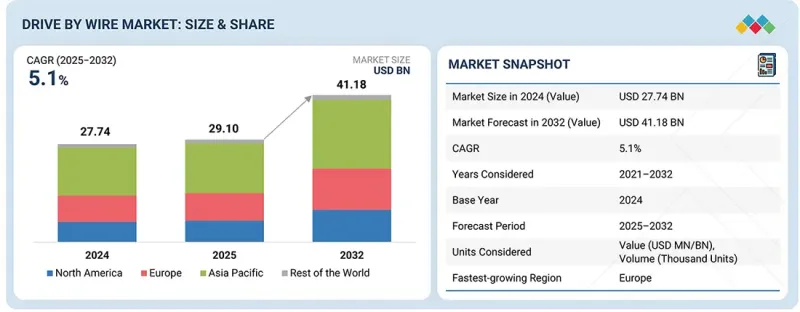
드라이브 바이 와이어(DBW) 시장 규모는 2025년 291억 달러에서 2032년까지 411억 8,000만 달러에 이를 것으로 예측되며, CAGR은 5.1%로 전망되고 있습니다.
시프트 바이 와이어와 스로틀 바이 와이어는 규정 준수 요구사항이 낮고 기능적, 비용적, 아키텍처 측면에서 즉각적인 이점을 제공하기 때문에 가장 널리 채택되는 드라이브 바이 와이어(DBW) 용도으로 남을 것으로 예측됩니다.
조사 범위
조사 대상 기간
2021-2032년
기준 연도
2024년
예측 기간
2025-2032년
단위
금액(달러), 수량
부문
Steer by Wire, Brake by Wire, Shift by Wire, Park by Wire, Throttle by Wire, Application
대상 지역
북미, 아시아태평양, 유럽, 기타 지역
스로틀 바이 와이어는 배출가스 규제 요건, 토크 관리, ADAS 통합, 전자식 파워트레인과의 호환성을 보장하기 위해 내연기관차, 하이브리드 자동차, 전기자동차에 모두 사용되고 있습니다. 자동변속기와 전기자동차가 시프트 바이 와이어의 채택을 주도하고 있습니다. 전자식 기어 선택은 컴팩트한 패키징, 간소화된 인테리어, 향상된 안전성, 자동 주차 기능 및 원격 제어 기능과의 완벽한 통합을 가능하게 합니다. 이러한 시스템은 OEM 제조업체에게 소프트웨어 정의 차량 개발 및 플랫폼 표준화를 위한 가장 빠른 경로를 제공하는 동시에 제조 비용 증가, 복잡한 안전 백업, 국가별 인증 획득과 같은 문제를 피할 수 있습니다.
"BEV(배터리 전기차)가 드라이브 바이 와이어(DBW) 시스템에 대한 가장 큰 수요를 창출할 것으로 전망"
BEV는 엔진, 기계식 기어 링크 메커니즘, 진공식 브레이크 시스템이 필요하지 않기 때문에 전자 제어가 표준 선택이 될 것이며, 드라이브 바이 와이어(DBW) 시스템에 대한 수요가 가장 높을 것으로 예측됩니다. 스로틀 바이 와이어, Brake-by-wire, 시프트 바이 와이어는 내연기관 차량보다 평평한 바닥 구조와 중앙 집중식 전기 시스템에 통합하기가 더 쉽습니다. BEV의 기술적 진화는 드라이브 바이 와이어(DBW) 시스템에 대한 수요를 더욱 창출하고 있습니다. BEV 아키텍처는 완전 전자식 브레이크를 지원하며, 정밀한 브레이크 제어와 효율적인 회생 제동 조합을 가능하게 합니다. 이러한 차량에서 중앙 집중식 컴퓨팅과 구역별 E/E 아키텍처를 통해 조향, 브레이크, 스로틀, 변속 조작을 기계적인 링크가 아닌 소프트웨어 기능으로 제어해야 합니다. 또한, BEV는 소프트웨어 정의 플랫폼으로 개발되어 주행 모드, 에너지 관리, ADAS 기능 등이 무선으로 업데이트됩니다. 이는 바이와이어 시스템을 통해서만 가능한 일입니다. 이러한 플랫폼 수준의 변화는 기계식 제어가 BEV의 설계 목표와 양립할 수 없게 만들었고, 드라이브 바이 와이어(DBW)의 채택을 가속화하고 있습니다.
"유럽은 드라이브 바이 와이어(DBW) 시스템에서 가장 빠르게 성장하는 시장이 될 것으로 예측됩니다."
유럽은 규제 중심의 전동화 및 프리미엄 OEM의 리더십에 힘입어 예측 기간 동안 시장에서 가장 빠른 성장을 보일 것으로 예측됩니다. 이 지역에서 드라이브 바이 와이어(DBW)의 급속한 보급은 제약이 많은 패키징 환경 내에서 플랫폼 아키텍처 최적화의 필요성과 소프트웨어 정의 기능 안전 및 전자 제어 브레이크 시스템에 대한 강력한 제도적 준비에 의해 촉진되고 있습니다. 이 환경은 Brake-by-wire 아키텍처의 대규모 도입을 조기에 지원할 수 있습니다. 반면, 스티어 바이 와이어 도입은 패키징, 충돌 통합, 시스템 레벨의 이점이 추가 검증 및 중복성의 복잡성을 정당화할 수 있는 경우에만 선택적으로 진행됩니다. 시장 전망의 관점에서 볼 때, 유럽이 모듈형 차량 아키텍처와 소프트웨어 중심 안전 검증에서 선도적인 위치에 있기 때문에 드라이브 바이 와이어(DBW) 시스템은 중기적으로 평균보다 높은 성장률을 보일 것으로 예측됩니다. OEM의 투자는 Brake-by-wire 플랫폼을 기반 기술로 우선시할 가능성이 높으며, 이를 통해 대량 생산 부문의 대규모 도입이 가능해지고, 규제 준수 및 플랫폼 재사용이라는 목표도 달성할 수 있습니다.
세계의 드라이브 바이 와이어(DBW)(Drive-by-Wire) 시장을 조사했으며, 시장 개요, 시장 성장에 영향을 미치는 각종 영향요인 분석, 기술 및 특허 동향, 법 및 규제 환경, 사례 분석, 시장 규모 추이 및 예측, 각종 부문별/지역별/주요 국가별 상세 분석, 경쟁 구도, 주요 기업 개요 등의 정보를 정리하여 전해드립니다.
목차
제1장 서론
제2장 주요 요약
제3장 프리미엄 인사이트
제4장 시장 개요
제5장 업계 동향
제6장 바이와이야 기술 통합
제7장 기술 진보, AI의 영향, 특허, 혁신, 향후 응용
제8장 규제 상황
제9장 Brake-by-Wire : 추진 구분·컴포넌트별
제10장 Park by Wire : 추진 구분·컴포넌트별
제11장 Shift by Wire : 추진 구분·컴포넌트별
제12장 Steer-by-Wire : 추진 구분·컴포넌트별
제13장 Throttle by Wire : 추진 구분·컴포넌트별
제14장 자율주행차용 드라이브 바이 와이어(DBW) 시장 : 용도별
제15장 드라이브 바이 와이어(DBW) 시장 : 지역별
제16장 경쟁 구도
제17장 기업 개요
제18장 조사 방법
제19장 부록
LSH
영문 목차
영문목차
The drive by wire market is projected to reach USD 41.18 billion by 2032, from USD 29.10 billion in 2025, with a CAGR of 5.1%. Shift by wire and throttle by wire are expected to remain the most widely adopted drive by wire applications because they deliver immediate functional, cost, and architectural benefits with low regulatory compliance requirements.
Scope of the Report
Years Considered for the Study
2021-2032
Base Year
2024
Forecast Period
2025-2032
Units Considered
Value (USD MN/BN), Volume (Thousand Units)
Segments
Steer by Wire, Brake by Wire, Shift by Wire, Park by Wire, Throttle by Wire, Application
Regions covered
North America, Asia Pacific, Europe, Rest of the World
Throttle by wire is used across ICE, hybrid, and electric vehicles due to emission control requirements, torque management, ADAS integration, and to ensure compatibility with the electronic powertrain. Shift by wire adoption is led by automatic and electric vehicles, where electronic gear selection enables compact packaging, simplified interiors, improved safety, and seamless integration with autonomous parking and remote-control features. Together, these systems offer OEMs the fastest path to developing software-defined vehicles and platform standardization, while avoiding higher manufacturing costs, complex safety backups, and country-specific certifications.
"BEVs are expected to generate the highest demand for drive by wire systems."
BEVs are expected to generate the highest demand for drive by wire systems, as they lack engines, mechanical gear linkages, or vacuum-based brake systems, making electronic control the default choice for these vehicles. Throttle by wire, brake by wire, and shift by wire can be integrated easily into flat-floor architectures and centralized electrical systems than in ICE-derived vehicles. Technological changes in BEVs are further creating demand for drive by wire systems. BEV architectures support fully electronic braking, enabling accurate brake control and efficient regenerative braking blending. Centralized computing and zonal E/E architectures in these vehicles require steering, braking, throttle, and shifting to be controlled as software functions rather than mechanical linkages. Additionally, BEVs are developed as software-defined platforms, with drive modes, energy management, and ADAS features updated over the air, which is only feasible with by-wire systems. These platform-level changes make mechanical controls incompatible with BEVs' design goals, accelerating drive by wire adoption.
"Europe is expected to be the fastest-growing market for drive by wire systems."
Europe is expected to see the fastest growth in the drive by wire market during the forecast period, driven by regulation-driven electrification and premium OEM leadership. The region's rapid adoption of drive by wire is primarily driven by the need to optimize platform architectures within tightly constrained packaging environments and by strong institutional readiness for software-defined functional safety and electronically controlled braking systems. This environment supports earlier large-scale deployment of brake by wire architectures, with steer by wire adoption advancing selectively where packaging, crash integration, and system-level benefits justify the added validation and redundancy complexity. From a market-outlook perspective, Europe's leadership in modular vehicle architectures and software-centric safety validation is expected to translate into above-average growth rates for drive by wire systems over the medium term. OEM investments are likely to prioritize brake by wire platforms as a foundation technology, enabling large-scale deployment across high-volume segments while supporting regulatory compliance and platform reuse objectives.
In-depth interviews were conducted with CEOs, marketing directors, other innovation and strategy directors, and executives from various key organizations operating in the drive by wire market.
By Company Type: Supply-side - 70%, Demand-side - 30%
By Designation: C level - 25%, Director Level - 30%, Others - 45%
By Region: Asia Pacific - 55%, Europe - 15%, North America - 20%, Rest of the World - 10%
Research Coverage
The report details the drivers, restraints, opportunities, and challenges in the drive by wire market and forecasts the market through 2032. It also provides a qualitative and quantitative description of different market segments. The report provides a detailed market overview across four regions: North America, Europe, Asia Pacific, and the Rest of the World.
Key Benefits of Buying this Report:
The report will help market leaders/new entrants with information on the closest approximations of revenue numbers for the overall drive by wire market and its subsegments.
This report will help stakeholders understand the competitive landscape and gain more insights to position their businesses better and plan suitable go-to-market strategies.
The report will also help stakeholders understand the market pulse and provide information on key market drivers, restraints, challenges, and opportunities.
The report provides insight into the following pointers:
Analysis of key drivers (shift toward software-defined vehicle architectures, high operational accuracy and reduced mechanical losses, electrification of commercial and public transport fleets) restraints (legal liability in absence of mature fail-operational precedents, threat of cyberattacks and compliance costs), opportunities (Integration with AI, V2X, and OTA-enabled safety functions, advancements in autonomous vehicles), and challenges (integration challenges in off-highway equipment, electronic failures and rapid developments in automotive electronics)
Product Development/Innovation: Detailed insights into upcoming technologies and R&D activities in the drive by wire market
Market Development: Comprehensive information about lucrative markets across varied regions
Market Diversification: Exhaustive information about untapped geographies, recent developments, and investments in the drive by wire market
Competitive Assessment: In-depth assessment of market share, growth strategies, and product offerings of leading players, such as Robert Bosch GmbH (Germany), ZF Friedrichshafen AG (Germany), Continental AG (Germany), Nexteer Automotive (US), and Curtiss-Wright Corporation (US)
TABLE OF CONTENTS
1 INTRODUCTION
1.1 STUDY OBJECTIVES
1.2 MARKET DEFINITION
1.3 STUDY SCOPE
1.3.1 MARKETS COVERED AND REGIONAL SCOPE
1.3.2 INCLUSIONS AND EXCLUSIONS
1.3.3 YEARS CONSIDERED
1.4 CURRENCY CONSIDERED
1.5 UNIT CONSIDERED
1.6 STAKEHOLDERS
1.7 SUMMARY OF CHANGES
2 EXECUTIVE SUMMARY
2.1 MARKET HIGHLIGHTS AND KEY INSIGHTS
2.2 KEY MARKET PARTICIPANTS: MAPPING OF STRATEGIC DEVELOPMENTS
2.3 DISRUPTIVE TRENDS IN DRIVE BY WIRE MARKET
2.4 HIGH-GROWTH SEGMENTS
2.5 REGIONAL SNAPSHOT: MARKET SIZE, GROWTH RATE, AND FORECAST
3 PREMIUM INSIGHTS
3.1 ATTRACTIVE OPPORTUNITIES FOR PLAYERS IN DRIVE BY WIRE MARKET
3.2 L2 AUTONOMOUS VEHICLE DRIVE BY WIRE MARKET, BY APPLICATION
3.3 THROTTLE BY WIRE MARKET, BY ICE VEHICLE TYPE
3.4 THROTTLE BY WIRE MARKET, BY EV TYPE
3.5 BRAKE BY WIRE MARKET, BY ICE VEHICLE TYPE
3.6 BRAKE BY WIRE MARKET, BY EV TYPE
3.7 STEER BY WIRE MARKET, BY ICE VEHICLE TYPE
3.8 STEER BY WIRE MARKET, BY EV TYPE
3.9 SHIFT BY WIRE MARKET, BY ICE VEHICLE TYPE
3.10 SHIFT BY WIRE MARKET, BY EV TYPE
3.11 PARK BY WIRE MARKET, BY ICE VEHICLE TYPE
3.12 PARK BY WIRE MARKET, BY EV TYPE
3.13 DRIVE BY WIRE MARKET, BY REGION
4 MARKET OVERVIEW
4.1 INTRODUCTION
4.2 MARKET DYNAMICS
4.2.1 DRIVERS
4.2.1.1 Transition to software-defined vehicle architectures
4.2.1.1.1 Shift toward zonal architectures
4.2.1.2 High operational accuracy and reduced mechanical losses
4.2.1.3 Electrification of public transport and commercial fleets
4.2.2 RESTRAINTS
4.2.2.1 Legal liability due to absence of mature fail-operational precedents
4.2.2.2 Threat of cyberattacks and compliance costs
4.2.3 OPPORTUNITIES
4.2.3.1 Integration with AI, V2X, and OTA-enabled safety functions
4.2.3.2 Advancements in autonomous vehicles
4.2.4 CHALLENGES
4.2.4.1 Integration challenges in off-highway equipment
4.2.4.2 Electronic failures and rapid developments in automotive electronics
4.3 UNMET NEEDS AND WHITE SPACES
4.4 INTERCONNECTED MARKETS AND CROSS-SECTOR OPPORTUNITIES
4.5 STRATEGIC MOVES BY TIER-1/2/3 PLAYERS
5 INDUSTRY TRENDS
5.1 ECOSYSTEM ANALYSIS
5.1.1 RAW MATERIAL SUPPLIERS
5.1.2 ACTUATOR AND SENSOR MANUFACTURERS
5.1.3 TIER-1 SUPPLIERS/COMPONENT MANUFACTURERS
5.1.4 DISTRIBUTORS
5.1.5 OEMS
5.2 TRENDS/DISRUPTIONS IMPACTING CUSTOMER BUSINESS
5.3 CASE STUDY ANALYSIS
5.3.1 FKA'S STEER BY WIRE SYSTEMS
5.3.2 CONTINENTAL'S MK C1 INTELLIGENT BRAKING SYSTEM
5.3.3 NEXTEER AUTOMOTIVE'S STEER BY WIRE SYSTEM
5.4 PRICING ANALYSIS
5.5 SUPPLY CHAIN ANALYSIS
5.6 COST-BENEFIT ANALYSIS
5.6.1 THROTTLE BY WIRE
5.6.2 SHIFT BY WIRE
5.6.3 PARK BY WIRE
5.6.4 BRAKE BY WIRE
5.6.5 STEER BY WIRE
5.7 KEY CONFERENCES AND EVENTS
6 INTEGRATION OF BY-WIRE TECHNOLOGIES
6.1 SMART ACTUATORS
6.1.1 OVERVIEW
6.1.2 KEY SUPPLIERS
6.2 ELECTRIC MOTORS
6.2.1 OVERVIEW
6.2.2 KEY SUPPLIERS
6.3 INTEGRATED CHASSIS SYSTEMS
6.3.1 OVERVIEW
6.3.2 KEY SUPPLIERS
6.4 SYNERGIES WITH ADAS/AUTONOMY
6.5 TRADITIONAL SYSTEMS VS. BY-WIRE SYSTEMS
6.6 FEATURE ANALYSIS OF BY-WIRE TECHNOLOGIES
7 TECHNOLOGICAL ADVANCEMENTS, AI-DRIVEN IMPACT, PATENTS, INNOVATIONS, AND FUTURE APPLICATIONS
7.1 KEY TECHNOLOGIES
7.1.1 ADVANCED SENSOR TECHNOLOGIES
7.1.2 ELECTRICAL/ELECTRONIC ARCHITECTURES
7.1.3 CYBERSECURITY IN DRIVE BY WIRE NETWORKS
7.2 IMPACT OF AI/GEN AI
7.3 PATENT ANALYSIS
7.4 FUTURE APPLICATIONS
7.4.1 INTEGRATION WITH ADAS AND AUTONOMOUS DRIVING PLATFORMS
8 REGULATORY LANDSCAPE
8.1 REGIONAL REGULATIONS AND COMPLIANCE
8.1.1 REGULATORY BODIES, GOVERNMENT AGENCIES, AND OTHER ORGANIZATIONS
8.1.2 DRIVE BY WIRE STANDARDS, BY COUNTRY
9 BRAKE BY WIRE, BY PROPULSION AND COMPONENT
9.1 INTRODUCTION
9.2 TYPES
9.2.1 PEDAL-BASED BRAKE BY WIRE
9.2.2 ELECTRO-HYDRAULIC BRAKE BY WIRE
9.2.3 ELECTRO-MECHANICAL BRAKE BY WIRE
9.3 CONVENTIONAL BRAKING SYSTEMS VS. BRAKE BY WIRE SYSTEMS
9.4 KEY FEATURES
9.5 MARKET UPTAKE - BY OEM
9.6 MARKET SIZING AND FORECAST
9.6.1 BY ICE VEHICLE TYPE
9.6.1.1 Passenger car
9.6.1.2 Light commercial vehicle
9.6.1.3 Truck
9.6.1.4 Bus
9.6.2 BY EV TYPE
9.6.2.1 BEV
9.6.2.2 PHEV
9.6.2.3 FCEV
9.6.3 BY SENSOR TYPE
9.6.3.1 Brake pedal sensor
9.6.4 BY COMPONENT
9.6.4.1 Actuator
9.6.4.2 ECU
9.7 PRIMARY INSIGHTS
10 PARK BY WIRE, BY PROPULSION AND COMPONENT
10.1 INTRODUCTION
10.2 TYPES
10.2.1 TRANSMISSION PARK BY WIRE
10.2.2 REDUNDANT PARK BY WIRE
10.2.3 ELECTRIC PARKING BRAKE
10.3 CONVENTIONAL PARKING SYSTEMS VS. PARK BY WIRE SYSTEMS
10.4 KEY FEATURES
10.5 MARKET UPTAKE - BY OEM
10.6 MARKET SIZING AND FORECAST
10.6.1 BY ICE VEHICLE TYPE
10.6.1.1 Passenger car
10.6.1.2 Light commercial vehicle
10.6.1.3 Truck
10.6.1.4 Bus
10.6.2 BY EV TYPE
10.6.2.1 BEV
10.6.2.2 PHEV
10.6.2.3 FCEV
10.6.3 BY SENSOR TYPE
10.6.3.1 Park sensor
10.6.4 BY COMPONENT
10.6.4.1 Actuator
10.6.4.2 ECU
10.6.4.3 Parking pawl
10.7 PRIMARY INSIGHTS
11 SHIFT BY WIRE, BY PROPULSION AND COMPONENT
11.1 INTRODUCTION
11.2 TYPES
11.2.1 ELECTRONIC GEAR SELECTOR
11.2.2 PUSH-BUTTON SHIFT BY WIRE
11.2.3 LEVER-BASED SHIFT BY WIRE
11.3 CONVENTIONAL SHIFTING SYSTEMS VS. SHIFT BY WIRE SYSTEMS
11.4 KEY FEATURES
11.5 MARKET UPTAKE - BY OEM
11.6 MARKET SIZING AND FORECAST
11.6.1 BY ICE VEHICLE TYPE
11.6.1.1 Passenger car
11.6.1.2 Light commercial vehicle
11.6.1.3 Truck
11.6.1.4 Bus
11.6.2 BY EV TYPE
11.6.2.1 BEV
11.6.2.2 PHEV
11.6.2.3 FCEV
11.6.3 BY SENSOR TYPE
11.6.3.1 Gear shift position sensor
11.6.4 BY COMPONENT
11.6.4.1 Actuator
11.6.4.2 ECU
11.6.4.3 ETCU
11.7 PRIMARY INSIGHTS
12 STEER BY WIRE, BY PROPULSION AND COMPONENT
12.1 INTRODUCTION
12.2 TYPES
12.2.1 PINION
12.2.2 COLUMN
12.2.3 RACK
12.3 CONVENTIONAL STEERING SYSTEMS VS. STEER BY WIRE SYSTEMS
12.4 KEY FEATURES
12.5 MARKET UPTAKE - BY OEM
12.6 MARKET SIZING AND FORECAST
12.6.1 BY ICE VEHICLE TYPE
12.6.1.1 Passenger car
12.6.1.2 Light commercial vehicle
12.6.1.3 Truck
12.6.1.4 Bus
12.6.2 BY EV TYPE
12.6.2.1 BEV
12.6.2.2 PHEV
12.6.2.3 FCEV
12.6.3 BY SENSOR TYPE
12.6.3.1 Hand wheel angle sensor
12.6.3.2 Pinion angle sensor
12.6.4 BY COMPONENT
12.6.4.1 Actuator
12.6.4.2 ECU
12.6.4.3 Feedback motor
12.7 PRIMARY INSIGHTS
13 THROTTLE BY WIRE, BY PROPULSION AND COMPONENT
13.1 INTRODUCTION
13.2 TYPES
13.2.1 PEDAL-BASED THROTTLE BY WIRE
13.2.2 MOTOR-TORQUE THROTTLE BY WIRE
13.2.3 DRIVE-MODE ADAPTIVE THROTTLE BY WIRE
13.3 CONVENTIONAL THROTTLE SYSTEMS VS. THROTTLE BY WIRE SYSTEMS
13.4 KEY FEATURES
13.5 MARKET UPTAKE - BY OEM
13.6 MARKET SIZING AND FORECAST
13.6.1 BY ICE VEHICLE TYPE
13.6.1.1 Passenger car
13.6.1.2 Light commercial vehicle
13.6.1.3 Truck
13.6.1.4 Bus
13.6.2 BY EV TYPE
13.6.2.1 BEV
13.6.2.2 PHEV
13.6.2.3 FCEV
13.6.3 BY SENSOR TYPE
13.6.3.1 Throttle pedal sensor
13.6.3.2 Throttle position sensor
13.6.4 BY COMPONENT
13.6.4.1 Actuator
13.6.4.2 ECU
13.6.4.3 ECM
13.6.4.4 ETCM
13.7 PRIMARY INSIGHTS
14 AUTONOMOUS VEHICLE DRIVE BY WIRE MARKET, BY APPLICATION
14.1 INTRODUCTION
14.2 L2 AUTONOMOUS VEHICLE
14.3 L3 AUTONOMOUS VEHICLE
14.4 L4/L5 AUTONOMOUS VEHICLE
14.5 PRIMARY INSIGHTS
15 DRIVE BY WIRE MARKET, BY REGION
15.1 INTRODUCTION
15.2 ASIA PACIFIC
15.2.1 CHINA
15.2.1.1 Growing popularity of electronic vehicle control to drive market
15.2.2 INDIA
15.2.2.1 Rising penetration of automatic transmissions to drive market
15.2.3 JAPAN
15.2.3.1 Product innovations by domestic manufacturers to drive market
15.2.4 SOUTH KOREA
15.2.4.1 Regulatory and technology alignment to drive market
15.2.5 THAILAND
15.2.5.1 Surge in EV sales and localization of electronics to drive market
15.2.6 REST OF ASIA PACIFIC
15.3 EUROPE
15.3.1 GERMANY
15.3.1.1 Strong premium vehicle base and presence of major by-wire suppliers to drive market
15.3.2 FRANCE
15.3.2.1 High demand for premium vehicles and stringent emission rules to drive market
15.3.3 RUSSIA
15.3.3.1 Rise of premium vehicle sales to drive market
15.3.4 SPAIN
15.3.4.1 Increasing consumer demand for luxury brands to drive market
15.3.5 UK
15.3.5.1 Mature automotive R&D ecosystem to drive market
15.3.6 TURKEY
15.3.6.1 Expanding presence of foreign luxury automakers to drive market
15.3.7 ITALY
15.3.7.1 Ongoing technology partnerships to drive market
15.3.8 REST OF EUROPE
15.4 NORTH AMERICA
15.4.1 CANADA
15.4.1.1 Elevated demand for premium and advanced vehicles to drive market
15.4.2 MEXICO
15.4.2.1 Robust cross-border supply chains to drive market
15.4.3 US
15.4.3.1 Strong technology adoption to drive market
15.5 REST OF THE WORLD
15.5.1 BRAZIL
15.5.1.1 Localization of advanced components and export-oriented production to drive market
15.5.2 IRAN
15.5.2.1 Preference for manual transmissions to impede market
15.5.3 ARGENTINA
15.5.3.1 Reduced import duties to drive market
15.5.4 SOUTH AFRICA
15.5.4.1 New premium vehicle launches to drive market
15.5.5 OTHERS
16 COMPETITIVE LANDSCAPE
16.1 INTRODUCTION
16.2 KEY PLAYER STRATEGIES/RIGHT TO WIN, 2021-2025
16.3 MARKET SHARE ANALYSIS, 2024
16.4 REVENUE ANALYSIS, 2020-2024
16.5 COMPANY VALUATION AND FINANCIAL METRICS
16.6 COMPANY EVALUATION MATRIX: KEY PLAYERS, 2024
16.6.1 STARS
16.6.2 EMERGING LEADERS
16.6.3 PERVASIVE PLAYERS
16.6.4 PARTICIPANTS
16.6.5 COMPANY FOOTPRINT
16.6.5.1 Company footprint
16.6.5.2 Region footprint
16.6.5.3 Component footprint
16.6.5.4 Application footprint
16.7 COMPANY EVALUATION MATRIX: START-UPS/SMES, 2024
16.7.1 PROGRESSIVE COMPANIES
16.7.2 RESPONSIVE COMPANIES
16.7.3 DYNAMIC COMPANIES
16.7.4 STARTING BLOCKS
16.7.5 COMPETITIVE BENCHMARKING
16.7.5.1 List of start-ups/SMEs
16.7.5.2 Competitive benchmarking of start-ups/SMEs
16.8 COMPETITIVE SCENARIO
16.8.1 PRODUCT LAUNCHES/DEVELOPMENTS
16.8.2 DEALS
16.8.3 EXPANSIONS
16.8.4 OTHER DEVELOPMENTS
17 COMPANY PROFILES
17.1 KEY PLAYERS
17.1.1 ROBERT BOSCH GMBH
17.1.1.1 Business overview
17.1.1.2 Products offered
17.1.1.3 Recent developments
17.1.1.3.1 Product launches/developments
17.1.1.3.2 Deals
17.1.1.3.3 Other deveopments
17.1.1.4 MnM view
17.1.1.4.1 Key strengths/Right to win
17.1.1.4.2 Strategic choices
17.1.1.4.3 Weaknesses and competitive threats
17.1.2 CONTINENTAL AG
17.1.2.1 Business overview
17.1.2.2 Products offered
17.1.2.3 Recent developments
17.1.2.3.1 Product launches/developments
17.1.2.3.2 Deals
17.1.2.3.3 Expansions
17.1.2.3.4 Other deveopments
17.1.2.4 MnM view
17.1.2.4.1 Key strengths/Right to win
17.1.2.4.2 Strategic choices
17.1.2.4.3 Weaknesses and competitive threats
17.1.3 ZF FRIEDRICHSHAFEN AG
17.1.3.1 Business overview
17.1.3.2 Products offered
17.1.3.3 Recent developments
17.1.3.3.1 Product launches/developments
17.1.3.3.2 Deals
17.1.3.3.3 Other deveopments
17.1.3.4 MnM view
17.1.3.4.1 Key strengths/Right to win
17.1.3.4.2 Strategic choices
17.1.3.4.3 Weaknesses and competitive threats
17.1.4 NEXTEER AUTOMOTIVE
17.1.4.1 Business overview
17.1.4.2 Products offered
17.1.4.3 Recent developments
17.1.4.3.1 Product launches/developments
17.1.4.3.2 Deals
17.1.4.3.3 Expansions
17.1.4.4 MnM view
17.1.4.4.1 Key strengths/Right to win
17.1.4.4.2 Strategic choices
17.1.4.4.3 Weaknesses and competitive threats
17.1.5 HITACHI, LTD.
17.1.5.1 Business overview
17.1.5.2 Products offered
17.1.5.3 Recent developments
17.1.5.3.1 Product launches/developments
17.1.5.3.2 Deals
17.1.5.4 MnM view
17.1.5.4.1 Key strengths/Right to win
17.1.5.4.2 Strategic choices
17.1.5.4.3 Weaknesses and competitive threats
17.1.6 HL MANDO CORP.
17.1.6.1 Business overview
17.1.6.2 Products offered
17.1.6.3 Recent developments
17.1.6.3.1 Deals
17.1.6.3.2 Other developments
17.1.7 JTEKT CORPORATION
17.1.7.1 Business overview
17.1.7.2 Products offered
17.1.7.3 Recent developments
17.1.7.3.1 Product launches/developments
17.1.7.3.2 Deals
17.1.7.3.3 Expansions
17.1.7.3.4 Other developments
17.1.8 THYSSENKRUPP AG
17.1.8.1 Business overview
17.1.8.2 Products offered
17.1.8.3 Recent developments
17.1.8.3.1 Deals
17.1.9 FICOSA INTERNATIONAL SA
17.1.9.1 Business overview
17.1.9.2 Products offered
17.1.10 KONGSBERG AUTOMOTIVE
17.1.10.1 Business overview
17.1.10.2 Products offered
17.1.10.3 Recent developments
17.1.10.3.1 Other developments
17.1.11 CURTISS-WRIGHT CORPORATION
17.1.11.1 Business overview
17.1.11.2 Products offered
17.1.11.3 Recent developments
17.1.11.3.1 Product launches/developments
17.1.11.3.2 Deals
17.1.11.3.3 Expansions
17.1.11.3.4 Other deveopments
17.2 OTHER PLAYERS
17.2.1 SCHAEFFLER TECHNOLOGIES AG & CO. KG
17.2.2 KSR INTERNATIONAL INC.
17.2.3 CTS CORPORATION
17.2.4 HYUNDAI MOBIS
17.2.5 FORVIA
17.2.6 NIDEC CORPORATION
17.2.7 NISSAN CORPORATION
17.2.8 INFINEON TECHNOLOGIES AG
17.2.9 BREMBO S.P.A.
17.2.10 DENSO CORPORATION
17.2.11 NXP SEMICONDUCTORS NV
17.2.12 SNT MOTIV CO., LTD.
17.2.13 LEM EUROPE GMBH
17.2.14 ALLIED MOTION TECHNOLOGIES INC.
17.2.15 DURA AUTOMOTIVE SYSTEMS
18 RESEARCH METHODOLOGY
18.1 RESEARCH DATA
18.1.1 SECONDARY DATA
18.1.1.1 List of secondary sources
18.1.1.2 Key data from secondary sources
18.1.2 PRIMARY DATA
18.1.2.1 Primary interviewees from demand and supply sides