Process Oil Market by Type (Aromatic, Paraffinic, Naphthenic, Non-Carcinogenic), Application (Tire & Rubber, Polymer, Personal Care, Textile), Function (Extender Oil, Plasticizer, Solvent, Defoamer), and Region - Global Forecast to 2030
상품코드:1950786
리서치사:MarketsandMarkets
발행일:2026년 02월
페이지 정보:영문 272 Pages
라이선스 & 가격 (부가세 별도)
ㅁ Add-on 가능: 고객의 요청에 따라 일정한 범위 내에서 Customization이 가능합니다. 자세한 사항은 문의해 주시기 바랍니다.
한글목차
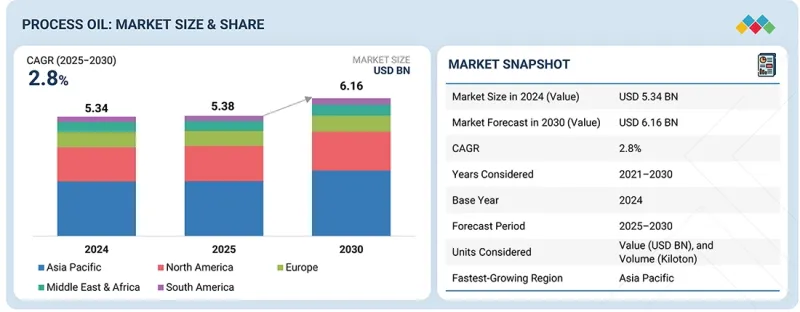
세계의 프로세스 오일 시장 규모는 2025년 53억 8,000만 달러에서 2030년까지 61억 6,000만 달러에 이를 것으로 예측되며, 예측 기간에 CAGR 2.8%의 성장이 전망되고 있습니다.
프로세스 오일은 다양한 산업에서 재료의 성능, 유연성, 가공성을 향상시키는 데 중요한 역할을 합니다. 용도별로는 타이어/고무, 폴리머, 퍼스널케어, 섬유, 기타 용도로 분류됩니다.
조사 범위
조사 대상 기간
2021-2030년
기준 연도
2024년
예측 기간
2025-2030년
단위
100만 달러, 킬로톤
부문
유형, 용도, 기능, 생산기술, 원료, 최종사용자
대상 지역
북미, 아시아태평양, 유럽, 중동 및 아프리카, 남미
오일은 타이어, 산업용 고무 제품 등의 제품의 탄성, 내구성, 가공성을 향상시킵니다. 폴리머의 경우, 소비재, 산업 부품, 포장재의 가소화와 가공성을 높입니다. 퍼스널케어에서는 크림, 로션, 화장품의 텍스처, 연화제, 보습성 개선에 공정 오일이 사용됩니다. 섬유에서는 섬유 및 직물의 윤활제 및 마감제 역할을 합니다. 접착제, 코팅, 페인트, 잉크와 같은 다른 응용 분야에서는 가공성과 성능을 최적화합니다. 시장 성장은 자동차 및 소비재 산업 수요 증가, 안전한 비발암성 오일에 대한 규제 강화, GTL(Gas To Liquid) 및 바이오 오일과 같은 고순도 및 지속 가능한 대안을 제공하는 기술 혁신에 의해 촉진되고 있습니다.
"유형별로는 비발암성 부문이 예측 기간 동안 금액 기준으로 두 번째 점유율을 차지할 것으로 예측됩니다. "
비발암성 공정유는 기존 방향족 오일에 따른 건강 위험을 최소화하면서 높은 성능을 발휘하는 정제유입니다. 유형별로는 비발암성 공정유가 예측 기간 동안 세계 공정유 시장에서 두 번째 점유율을 차지했으며, 이는 산업 전반에 걸쳐 광범위하게 사용되고 있음을 반영합니다. 타이어, 고무, 폴리머 등의 용도에 적용되어 탄성, 내구성, 가공성을 향상시킵니다. 타이어 및 고무의 경우, 비발암성 공정 오일은 타이어 및 산업용 고무 제품의 성능과 유연성을 향상시킵니다. 폴리머 응용 분야에서는 엔지니어링 플라스틱 및 범용 플라스틱의 가소성, 유연성, 가공성을 지원합니다. 시장 성장은 안전한 화학물질에 대한 규제적 관심, 자동차 및 소비재에서의 채택 확대, 노동 안전에 대한 인식 증가, 고순도 및 무독성 오일의 기술 발전 등에 의해 촉진되고 있습니다.
"용도별로는 폴리머 부문이 예측 기간 동안 두 번째로 큰 시장 점유율을 차지할 것으로 예측됩니다. "
용도별로는 폴리머 부문이 예측 기간 동안 전 세계 공정유 시장에서 두 번째 점유율을 차지할 것으로 예측됩니다. 이 부문의 공정 오일은 폴리머 소재의 유연성, 가소성, 부드러움, 가공성을 향상시키고, 제조 효율과 완제품의 품질을 개선하는 데 사용됩니다. 폴리머 응용 분야에서 이 오일은 소비재, 산업 부품 및 포장재용 플라스틱 생산을 지원하여 완성된 재료가 견고하고 취급이 용이하며 성능 요구 사항을 충족하도록 보장합니다. 폴리머 부문의 성장은 고성능 플라스틱에 의존하는 산업에서 안정적인 수요를 창출하여 전체 공정유 시장을 주도하고 있습니다. 또한, 규제 준수, 재료 안전성, 고순도 및 지속 가능한 공정 오일의 기술적 진보에 대한 관심이 높아짐에 따라 시장 채택이 더욱 강화되고 있습니다.
"예측 기간 동안 북미가 두 번째 시장 점유율을 차지할 것으로 예측됩니다. "
북미는 예측 기간 동안 세계 공정유 시장에서 두 번째 점유율을 차지할 것으로 예측됩니다. 이 지역 수요는 타이어 및 고무, 폴리머, 퍼스널케어, 섬유 및 기타 응용 분야에 걸쳐 광범위하게 사용되고 있으며, 각 응용 분야에서 공정유는 재료의 유연성, 내구성, 가소성 및 가공성을 향상시키는 데 기여하고 있습니다. 타이어 및 고무의 경우, 오일은 타이어 및 산업용 고무 제품의 탄성과 성능을 향상시킵니다. 폴리머 응용 분야에서 공정유는 소비재, 포장재, 산업용 부품에 사용되는 플라스틱의 연화, 가소성, 가공성을 지원합니다. 퍼스널케어 분야에서는 텍스처 개선, 연화제 특성 강화, 제품 성능 향상에 기여하고, 섬유 분야에서는 윤활제 및 마감제 역할을 합니다. 다른 용도로는 접착제, 코팅, 페인트, 잉크, 페인트, 잉크 등이 있으며, 이들 분야에서 공정 오일은 가공성과 품질 최적화에 기여합니다. 북미 시장의 성장은 자동차, 제조 및 소비재 부문의 활발한 산업 활동과 비발암성 및 지속 가능한 유지에 대한 규제 강화로 인해 촉진되고 있습니다. 고순도 바이오 오일 및 지방의 기술 발전은 그 채택을 더욱 촉진하여 제조업체가 성능, 안전 및 환경 요구 사항을 효율적으로 충족시킬 수 있도록 합니다.
세계의 프로세스 오일(Process Oil) 시장에 대해 조사 분석했으며, 주요 촉진요인 및 저해요인, 제품 개발 및 혁신, 경쟁 구도에 대해 조사 분석하여 전해드립니다.
목차
제1장 서론
제2장 주요 요약
제3장 중요 지견
제4장 시장 개요
제5장 업계 동향
제6장 기술 진보, AI의 영향, 특허, 혁신, 향후 용도
제7장 규제 상황과 지속가능성에 관한 대처
제8장 고객 현황과 구매 행동
제9장 프로세스 오일 시장 : 원료별
제10장 프로세스 오일 시장 : 최종사용자별
제11장 프로세스 오일 시장 : 유형별
제12장 프로세스 오일 시장 : 생산기술별
제13장 프로세스 오일 시장 : 기능별
제14장 프로세스 오일 시장 : 용도별
제15장 프로세스 오일 시장 : 지역별
제16장 경쟁 구도
제17장 기업 개요
제18장 조사 방법
제19장 부록
LSH
영문 목차
영문목차
The global process oil market is projected to grow from USD 5.38 billion in 2025 to USD 6.16 billion in 2030, at a CAGR of 2.8% during the forecast period. Process oils play a vital role in enhancing the performance, flexibility, and processability of materials across multiple industries. By application, the market is segmented into tire & rubber, polymer, personal care, textile, and other applications.
Scope of the Report
Years Considered for the Study
2021-2030
Base Year
2024
Forecast Period
2025-2030
Units Considered
Value (USD Million), and Volume (Kiloton)
Segments
Type, Application, Function, Production Technology, Feedstock, and End User
Regions covered
North America, Asia Pacific, Europe, Middle East & Africa, and South America
Oils improve elasticity, durability, and processing of products such as tires and industrial rubber goods. In polymers, they enhance plasticization and processability for consumer goods, industrial components, and packaging materials. Personal care uses process oils to improve texture, emollient properties, and moisturization in creams, lotions, and cosmetics. In textiles, they act as lubricants and finishing agents for fibers and fabrics; in other applications, such as adhesives, coatings, paints, and inks, oils optimize workability and performance. Market growth is driven by rising demand from the automotive and consumer goods industries, regulatory focus on safer non-carcinogenic oils, and technological innovations such as gas-to-liquid (GTL) and bio-based oils, offering high purity and sustainable alternatives.
"By type, the non-carcinogenic segment is expected to account for the second-largest share during the forecast period, in terms of value."
Non-carcinogenic process oils are refined oils that deliver high performance while minimizing health risks associated with conventional aromatic oils. By type, Non-Carcinogenic process oils account for the second-largest share of the global process oil market during the forecast period, reflecting their widespread use across industries. They are applied in Tire & Rubber, Polymer, and Other Applications, enhancing elasticity, durability, and processability. In Tire & Rubber, Non-Carcinogenic process oils improve the performance and flexibility of tires and industrial rubber products. In Polymer applications, they aid in plasticization, softness, and handling of engineering and commodity plastics. Market growth is driven by regulatory emphasis on safe chemicals, rising adoption in automotive and consumer goods, growing awareness of occupational safety, and technological advancements in high-purity, non-toxic oils.
"By application, the polymer segment will account for the second-largest market share during the forecast period."
The polymer segment, by application, accounts for the second-largest share of the global process oil market during the forecast period. Process oils in this segment are used to enhance flexibility, plasticization, softness, and processability of polymer materials, improving manufacturing efficiency and the quality of finished products. In polymer applications, these oils support the production of plastics for consumer goods, industrial components, and packaging, ensuring that the resulting materials are durable, easy to handle, and meet performance requirements. The growth of the Polymer segment drives the overall process oil market by creating consistent demand from industries that rely on high-performance plastics. Additionally, increased focus on regulatory compliance, material safety, and technological advancements in high-purity, sustainable process oils is further strengthening market adoption.
"North America is projected to account for the second-largest market share during the forecast period."
North America accounts for the second-largest share of the global process oil market during the forecast period. The region's demand is supported by extensive applications across Tire & Rubber, Polymer, Personal Care, Textile, and Other Applications, where process oils enhance flexibility, durability, plasticization, and processability of materials. In tire & rubber, oils improve the elasticity and performance of tires and industrial rubber products. In Polymer applications, they aid in softening, plasticization, and handling of plastics used in consumer goods, packaging, and industrial components. Personal Care applications benefit from oils that improve texture, enhance emollient properties, and enhance product performance, while in textile applications, they serve as lubricants and finishing agents for fibers and fabrics. Other applications include adhesives, coatings, paints, and inks, where oils optimize workability and quality. Market growth in North America is driven by strong industrial activity in the automotive, manufacturing, and consumer goods sectors, combined with increased regulatory focus on non-carcinogenic, sustainable oils. Technological advancements in high-purity, bio-based oils further strengthen adoption, enabling manufacturers to meet performance, safety, and environmental requirements efficiently.
Profile break-up of primary participants for the report:
By Company Type: Tier 1 - 65%, Tier 2 - 20%, and Tier 3 - 15%
By Designation: Directors - 25%, Managers - 30%, and Others - 45%
By Region: North America - 30%, Asia Pacific - 40%, Europe - 20%, Middle East & Africa - 7%, and South America - 3%
Exxon Mobil Corporation (US), Chevron Corporation (US), Shell (UK), Petroliam Nasional Berhad (PETRONAS) (Malaysia), and Idemitsu Kosan Co., Ltd. (Japan) are some of the major players operating in the process oil market.
Research Coverage:
The report segments the process oil market based on type, application, function, production technology, feedstock, end user, and region. It provides detailed information on the major factors influencing the market's growth, including drivers, restraints, opportunities, and challenges. It strategically profiles process oil manufacturers, comprehensively analyzing their market shares and core competencies.
Reasons to Buy the Report:
The report is expected to help market leaders/new entrants by providing the closest approximations of revenue figures for the process oil market and its segments. This report is also expected to help stakeholders gain a better understanding of the market's competitive landscape, develop insights to improve their businesses' positions, and develop suitable go-to-market strategies. It also enables stakeholders to understand the market's pulse and provides information on key market drivers, restraints, challenges, and opportunities.
The report provides insights into the following pointers:
Analysis of critical Drivers (Growth in tire production and polymer-processing industries supporting steady demand for process oils; and Industrialization and urban growth increasing the use of plastics, adhesives, and other materials that rely on process oils), Restraints (Regulations limiting high-PAH aromatic oils reducing the use of certain traditional grades; and Increasing shift toward vegetable oils and synthetic alternatives in select applications), Opportunities (Rising demand for low-PAH, hydrotreated, and eco-friendly process oils), and Challenges (Crude-oil price volatility posing ongoing challenges to cost stability and production planning)
Product Development/Innovation: Detailed insights on upcoming technologies and research & development activities in the process oil market
Market Development: Comprehensive information about lucrative markets - the report analyses the process oil market across varied regions.
Competitive Assessment: In-depth assessment of market shares, growth strategies, and product offerings of leading players such as Exxon Mobil Corporation (US), Chevron Corporation (US), Shell (UK), Petroliam Nasional Berhad (PETRONAS) (Malaysia), and Idemitsu Kosan Co., Ltd. (Japan) in the process oil market
TABLE OF CONTENTS
1 INTRODUCTION
1.1 STUDY OBJECTIVES
1.2 MARKET DEFINITION
1.3 MARKET SCOPE
1.3.1 MARKET SEGMENTATION AND REGIONAL SCOPE
1.3.2 INCLUSIONS AND EXCLUSIONS
1.3.3 YEARS CONSIDERED
1.3.4 CURRENCY CONSIDERED
1.3.5 UNITS CONSIDERED
1.4 STAKEHOLDERS
1.5 SUMMARY OF CHANGES
2 EXECUTIVE SUMMARY
2.1 MARKET HIGHLIGHTS AND KEY INSIGHTS
2.2 KEY MARKET PARTICIPANTS: MAPPING OF STRATEGIC DEVELOPMENTS
2.3 DISRUPTIVE TRENDS IN PROCESS OIL MARKET
2.4 HIGH GROWTH SEGMENTS
2.5 REGIONAL SNAPSHOT: MARKET SIZE, GROWTH RATE, AND FORECAST
3 PREMIUM INSIGHTS
3.1 ATTRACTIVE OPPORTUNITIES FOR PLAYERS IN PROCESS OIL MARKET
3.2 PROCESS OIL MARKET, BY FUNCTION AND REGION
3.3 PROCESS OIL MARKET, BY APPLICATION
3.4 PROCESS OIL MARKET, BY TYPE
3.5 PROCESS OIL MARKET, BY COUNTRY
4 MARKET OVERVIEW
4.1 INTRODUCTION
4.2 MARKET DYNAMICS
4.2.1 DRIVERS
4.2.1.1 Growth in tire production and polymer-processing industries supporting steady demand for process oils
4.2.1.2 Extensive use of plastics, adhesives, and other materials to increase demand
4.2.2 RESTRAINTS
4.2.2.1 Regulations limiting high-PAH aromatic oils, reducing use of certain traditional grades
4.2.2.2 Increasing shift toward vegetable oils and synthetic alternatives in select applications
4.2.3 OPPORTUNITIES
4.2.3.1 Rising demand for low-PAH, hydrotreated, and eco-friendly process oils
4.2.4 CHALLENGES
4.2.4.1 Impact on cost and production planning due to crude oil price volatility
4.3 UNMET NEEDS AND WHITE SPACES
4.3.1 UNMET NEEDS IN PROCESS OIL MARKET
4.3.2 WHITE SPACE OPPORTUNITIES
4.4 INTERCONNECTED MARKETS AND CROSS-SECTOR OPPORTUNITIES
4.4.1 INTERCONNECTED MARKETS
4.4.2 CROSS-SECTOR OPPORTUNITIES
4.5 STRATEGIC MOVES BY TIER-1/2/3 PLAYERS
4.5.1 KEY MOVES AND STRATEGIC FOCUS
5 INDUSTRY TRENDS
5.1 PORTER'S FIVE FORCES ANALYSIS
5.1.1 BARGAINING POWER OF SUPPLIERS
5.1.2 BARGAINING POWER OF BUYERS
5.1.3 THREAT OF NEW ENTRANTS
5.1.4 THREAT OF SUBSTITUTES
5.1.5 INTENSITY OF COMPETITIVE RIVALRY
5.2 GLOBAL MACROECONOMIC OUTLOOK
5.2.1 INTRODUCTION
5.2.2 GDP TRENDS AND FORECAST
5.2.3 TRENDS IN GLOBAL PROCESS OIL INDUSTRY
5.3 SUPPLY CHAIN ANALYSIS
5.4 ECOSYSTEM ANALYSIS
5.5 PRICING ANALYSIS
5.5.1 AVERAGE SELLING PRICE TREND OF PROCESS OIL, BY REGION, 2022-2025
5.5.2 AVERAGE SELLING PRICE OF PROCESS OIL TYPE, BY KEY PLAYERS, 2025
5.6 TRADE ANALYSIS
5.6.1 IMPORT SCENARIO (HS CODE 2709)
5.6.2 EXPORT SCENARIO (HS CODE 2709)
5.7 KEY CONFERENCES AND EVENTS, 2025-2026
5.8 TRENDS/DISRUPTIONS IMPACTING CUSTOMER BUSINESS
5.9 INVESTMENT AND FUNDING SCENARIO
5.10 CASE STUDY ANALYSIS
5.10.1 RRII(RUBBER RESEARCH INSTITUTE)-INDIAN OIL COLLABORATION ON ADVANCED PROCESS OIL APPLICATIONS
5.10.2 REPSOL'S BIOEXTENSOIL - A CIRCULAR AND HIGH-PERFORMANCE ALTERNATIVE TO MINERAL PROCESS OILS