리튬 이온 배터리 재료 시장 : 배터리 화학별, 재료별, 용도별, 지역별 - 예측(-2030년)
Lithium-Ion Battery Materials Market by Battery Chemistry (LFP, LCO, NMC, NCA, LMO), Material (Cathode, Anode, Electrolyte), Application (Portable Device, Electric Vehicle, Industrial, Power Tool, Medical Device) & Region - Global Forecast to 2030
상품코드:1950783
리서치사:MarketsandMarkets
발행일:2026년 02월
페이지 정보:영문 258 Pages
라이선스 & 가격 (부가세 별도)
ㅁ Add-on 가능: 고객의 요청에 따라 일정한 범위 내에서 Customization이 가능합니다. 자세한 사항은 문의해 주시기 바랍니다.
한글목차
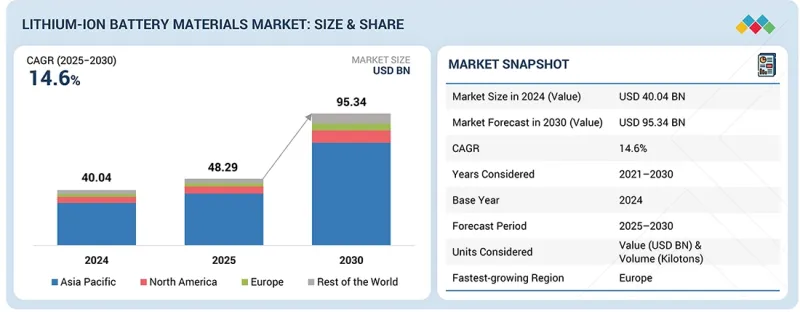
세계의 리튬 이온 배터리 재료 시장 규모는 2025년 482억 9,000만 달러에서 2030년까지 953억 4,000만 달러에 이를 것으로 예측되며, 예측 기간에 CAGR 14.6%의 성장이 전망되고 있습니다.
전기화가 진행됨에 따라 대량의 양극재, 음극재, 전해질, 기타 첨단 소재를 필요로 하는 전기자동차 수요가 증가함에 따라 리튬이온전지 소재 시장은 꾸준히 성장하고 있습니다.
조사 범위
조사 대상 기간
2021-2030년
기준 연도
2024년
예측 기간
2025-2030년
단위
금액(100만/10억 달러), 킬로톤
부문
배터리 재료, 배터리 화학, 용도, 지역
대상 지역
아시아태평양, 유럽, 북미, 기타 지역
저공해 운송 시스템을 지원하는 정부 정책, 재생에너지 저장 솔루션, 가전제품에 대한 수요 증가로 인해 니켈이 풍부한 양극과 실리콘 강화 음극을 포함한 리튬 이온 배터리 부품에 대한 수요가 증가하고 있습니다. 배터리 기술 개발 시장 기회는 에너지 저장 용량, 가동 시간, 안전성을 향상시키는 고체 전해질 및 차세대 음극 재료를 통해 현재 범위를 넘어 확장되고 있습니다. 향후 10년간 시장 확대는 새로운 고지에 도달할 것으로 예측됩니다. 기업들은 환경문제에 대응하는 동시에 리튬, 코발트, 니켈 등 불안정한 공급원에 대한 의존도를 낮추기 위해 재활용 방안과 지속 가능한 공급망 구축에 대한 투자를 강화할 것으로 보입니다.
"배터리 재료별로는 전해질 부문이 예측 기간 동안 리튬 이온 배터리 재료 시장에서 금액 기준으로 가장 빠른 성장을 기록할 것으로 예측됩니다. "
전해질 부문은 예측 기간 동안 리튬 이온 배터리 재료 시장에서 가장 빠르게 성장할 것으로 예측됩니다. 이는 배터리의 작동을 결정하는 중요한 구성요소이며, 신기술을 통해 시장 성장을 가속하고 있기 때문입니다. 양극과 음극 사이의 이온 이동을 위해서는 전해질의 기능이 필요하며, 리튬 이온 배터리의 에너지 용량, 안전 기준, 작동 지속 시간을 결정하는 충방전 과정을 가능하게 합니다. 전기자동차, 휴대용 전자기기, 에너지 저장 시스템에 대한 긴급한 수요로 인해 제조업체들은 차세대 배터리 기술과 호환되고 더 높은 이온 전도도와 열 안정성을 제공하는 새로운 전해질 제품을 개발해야 합니다. 고체 전해질 기술은 기존 액체 전해질보다 안전성과 에너지 밀도가 뛰어나며, 자동차 및 배터리 제조업체들이 상업용 제품을 지속적으로 개발함에 따라 이 분야의 성장이 가속화되고 있습니다. 생산 능력의 확대와 R&D 예산 증가에 따라 전해질 부문은 전체 배터리 재료 시장의 금액 성장을 가속할 것입니다.
"배터리 화학 분야에서는 리튬인산철(LFP) 부문이 예측 기간 동안 리튬 이온 배터리 재료 시장에서 가장 빠르게 성장할 것으로 예측됩니다. "
리튬인산철(LFP) 화학 부문은 니켈-망간-코발트(NMC) 및 리튬 코발트 산염과 같은 리튬 이온 배터리 화학 물질보다 저렴한 비용으로 우수한 성능과 안전성을 제공하기 때문에 예측 기간 동안 가장 빠른 성장을 달성할 것으로 예측됩니다. 전기자동차(EV)와 에너지 저장 시스템에서 LFP 배터리는 우수한 열 안정성, 긴 수명, 낮은 생산 비용으로 인해 채택이 확대되고 있으며, 안전성과 수명 주기 경제성을 중시하는 대중 시장용 EV 및 그리드 저장 용도에 적합합니다. 아시아태평양 국가들의 정부 전기화 정책과 제조업의 성장은 자금 수요를 창출하고 LFP의 생산과 채택을 확대할 수 있는 여건을 조성하고 있습니다. 리튬 이온 배터리 시장 부문은 배터리 재료 산업이 예상하는 바와 같이 예측 기간 동안 큰 성장 기회를 제공할 것으로 예측됩니다.
"용도별로는 전기자동차 부문이 예측 기간 동안 리튬 이온 배터리 재료 시장에서 가장 빠르게 성장할 것으로 예측됩니다. "
리튬 이온 배터리 재료 시장의 전기자동차(EV) 응용 분야는 예측 기간 동안 가장 빠른 성장세를 보일 것으로 예측됩니다. 이는 전동화 모빌리티의 보급과 탄소배출 저감 규제가 시장 수요를 증가시킬 것으로 예상되기 때문입니다. 자동차 산업은 첨단 배터리 재료(리튬, 니켈, 코발트 등)와 새로운 양극 및 음극 설계를 요구하고 있습니다. 이는 전기차 수요가 승용차에서 상용차로 확대되고 있고, 자동차 제조업체들이 새로운 전기차 모델을 생산하기 시작했기 때문입니다. 정부 보조금, 배출 규제 강화, 친환경 운송에 대한 소비자 수요 증가가 결합하여 EV 시장의 지속적인 확장을 촉진하고 있으며, 이는 예측 기간 동안 리튬 이온 배터리 재료의 소비를 촉진할 것입니다.
세계의 리튬이온배터리 재료 시장에 대해 조사 분석했으며, 주요 촉진요인 및 저해요인, 제품 개발 및 혁신, 경쟁 구도에 대해 조사 분석하여 전해드립니다.
목차
제1장 서론
제2장 주요 요약
제3장 중요 지견
제4장 시장 개요
제5장 업계 동향
제6장 기술 진보, AI의 영향, 특허, 혁신, 향후 용도
제7장 지속가능성과 규제 상황
제8장 고객 현황과 구매 행동
제9장 리튬 이온 배터리 재료 시장 : 재료별
제10장 리튬 이온 배터리 재료 시장 : 배터리 화학별
제11장 리튬 이온 배터리 재료 시장 : 용도별
제12장 리튬 이온 배터리 재료 시장 : 지역별
제13장 경쟁 구도
제14장 기업 개요
제15장 조사 방법
제16장 부록
LSH
영문 목차
영문목차
The global lithium-ion battery materials market is projected to grow from USD 48.29 billion in 2025 to USD 95.34 billion by 2030, at a CAGR of 14.6% during the forecast period. The lithium-ion battery materials market is growing steadily as electrification drives demand for electric vehicles that require large amounts of cathode and anode materials, electrolytes, and other advanced materials.
Scope of the Report
Years Considered for the Study
2021-2030
Base Year
2024
Forecast Period
2025-2030
Units Considered
Value (USD Million/Billion) and Volume (Kiloton)
Segments
Battery Material, Battery Chemistry, Application, and Region
Regions covered
Asia Pacific, Europe, North America, and the Rest of the World
Government policies that support low-emission transportation systems, together with renewable energy storage solutions and rising demand for consumer electronics products, create a greater need for lithium-ion battery components, including nickel-rich cathodes and silicon-enhanced anodes. The market opportunities for battery technology development extend beyond their current reach through solid-state electrolytes and next-generation anode materials, which enhance energy storage capacity, operational duration, and safety. The market expansion will reach new heights over the next 10 years as businesses invest in recycling initiatives and sustainable supply chain development to reduce their reliance on unstable sources of lithium, cobalt, and nickel while addressing environmental issues.
"By battery materials, the electrolyte segment is estimated to register the fastest growth, in terms of value, of the lithium-ion battery materials market during the forecast period."
The electrolyte segment of the lithium-ion battery materials market will experience the fastest growth during the forecast period, as it is a vital component that determines battery operation and is driving market development through new technologies. The movement of ions between the cathode and anode requires electrolytes to perform their function, as they enable charging and discharging processes that determine the energy capacity, safety standards, and operational duration of lithium-ion batteries. The urgent need for electric vehicles, portable electronics, and energy storage systems drives manufacturers to develop new electrolyte products that deliver higher ionic conductivity and thermal stability, compatible with upcoming battery technologies. The segment experiences growth acceleration as solid-state electrolyte technology receives more funding, offering better safety and higher energy density than conventional liquid electrolytes, and as automotive companies and battery manufacturers continue to develop commercial products. The electrolyte segment will drive value growth across the entire battery materials market because production capacity expands and research and development budgets increase.
"By battery chemistry, the lithium iron phosphate (LFP) segment is estimated to be the fastest-growing segment of the lithium-ion battery materials market during the forecast period."
The lithium iron phosphate (LFP) chemistry segment will achieve the fastest growth during the forecast period because LFP delivers better performance and safety features at lower cost than nickel-manganese-cobalt (NMC) and lithium cobalt oxide lithium-ion battery chemistries. Electric vehicles (EVs) and energy storage systems increasingly adopt LFP batteries because of their superior thermal stability, extended cycle life, and lower production costs, making them suitable for mass-market EVs and grid storage applications that prioritize safety and lifecycle economics. Government electrification policies and manufacturing growth in Asia-Pacific countries have created a funding demand that enables LFP production and adoption to increase. The lithium-ion batteries market segment will offer considerable growth opportunities throughout the forecast period, as envisaged for the battery materials industry.
"By application, the electric vehicle segment is estimated to be the fastest-growing segment of the lithium-ion battery materials market during the forecast period."
The electric vehicle (EV) application segment in the lithium-ion battery materials market will experience the fastest growth during the forecast period, according to estimates, as electrified mobility adoption and carbon-emission reduction regulations are expected to increase market demand. The automotive industry needs advanced battery materials, which include lithium, nickel, and cobalt, and new cathode and anode designs, because EV demand currently extends from passenger cars to commercial vehicles, and automakers are starting to produce new electrified vehicle models. The combination of government incentives, stricter emissions regulations, and growing consumer demand for environmentally friendly transportation options drives continuous market expansion for EVs, which in turn drives lithium-ion battery material consumption throughout the forecast period.
"The lithium-ion battery materials market in Europe is projected to register the fastest growth, in terms of value, during the forecast period."
The European region will achieve the highest market value growth for lithium-ion battery materials during the forecast period due to three driving factors: strategic policy support, rapid development of electric transportation, and increased domestic battery manufacturing. European governments and the European Union have implemented ambitious decarbonization and electrification targets that are stimulating demand for electric vehicles (EVs) and energy storage systems, thereby boosting demand for lithium-ion battery materials. The establishment and expansion of gigafactories, along with major investments by global battery manufacturers to localize production in countries such as Germany and Hungary, are boosting the region's market momentum as Europe seeks to strengthen its supply chain and reduce dependence on imports. Regulatory frameworks that support "made in Europe" supply chains, together with incentives for clean energy technologies, create conditions that drive this expansion forward. The European market for lithium-ion battery materials will experience rapid expansion as industrial companies in the region seek essential raw materials and battery technology continues to advance.
Profile break-up of primary participants for the report:
By Company Type: Tier 1 - 45%, Tier 2 - 22%, and Tier 3 - 33%
By Designation: C-Level Executives- 50%, Directors- 10%, and Others - 40%
By Region: North America - 17%, Asia Pacific - 17%, Europe - 33%, and Rest of the World - 33%
Leading players operating in the lithium-ion battery materials market include Umicore (Belgium), Sumitomo Metal Mining Co., Ltd. (Japan), BASF (Germany), POSCO Future M (South Korea), Resonac Holdings Corporation (Japan), and others. These key players are significant contributors to the lithium-ion battery materials market. These players have adopted various strategies, including agreements, joint ventures, and expansions, to increase their market share and business revenue.
Research Coverage:
The report defines segments and projects the size of the lithium-ion battery materials market based on type, group, application, and region. It strategically profiles the key players and comprehensively analyzes their market share and core competencies. It also tracks and analyzes competitive developments, such as expansions, partnerships, and acquisitions undertaken by them in the market.
Reasons to Buy the Report:
The report is expected to help market leaders/new entrants by providing the closest approximations of revenue for the lithium-ion battery materials market and its segments. This report is also expected to help stakeholders gain a deeper understanding of the market's competitive landscape, acquire valuable insights to enhance their business positions, and develop effective go-to-market strategies. It also enables stakeholders to understand the market's pulse and provides information on key market drivers, restraints, challenges, and opportunities.
The report provides insights into the following pointers:
Analysis of drivers (increasing adoption of electric vehicles, surging demand for consumer electronics), restraints (safety concerns related to gadgets with lithium-ion batteries, supply concentration of lithium, cobalt, and natural graphite create procurement risk, availability of substitutes), opportunities (declining lithium-ion battery prices, growing R&D to upgrade lithium-ion batteries, recycling and second-life material recovery, creating circular supply opportunities), and challenges (fluctuating raw materials prices) are influencing the growth of the lithium-ion battery materials market.
Product Development/Innovation: Detailed insights into upcoming technologies, research & development activities in the lithium-ion battery materials market.
Market Development: Comprehensive information about lucrative markets - the report analyzes the lithium-ion battery materials market across varied regions.
Market Diversification: Exhaustive information about new products, various types, untapped geographies, recent developments, and investments in the lithium-ion battery materials market.
Competitive Assessment: In-depth assessment of market shares, growth strategies, and product offerings of leading players such as Umicore (Belgium), Sumitomo Metal Mining Co., Ltd. (Japan), BASF (Germany), POSCO Future M (South Korea), Tanaka Chemical Corporation (Japan), Toda Kogyo Corp. (Japan), Resonac Holdings Corporation (Japan), LANDF Corp (China), JFE Chemical Corporation (China), 3M (US), SGL Carbon (Germany), NEI Corporation (US), BTR New Materials Group Co., Ltd. (China), UBE Corporation (Japan), Kuraray Co., Ltd. (Japan), Shenzhen Dynanonic Co., Ltd. (China), Huayou Cobalt Co., Ltd. (China), American Elements (US), and Morita Chemical Industries Co., Ltd. (Japan) are the key players in lithium-ion battery materials market.
TABLE OF CONTENTS
1 INTRODUCTION
1.1 STUDY OBJECTIVES
1.2 MARKET DEFINITION
1.3 STUDY SCOPE
1.3.1 MARKETS COVERED AND REGIONAL SCOPE
1.3.2 INCLUSIONS AND EXCLUSIONS
1.3.3 YEARS CONSIDERED
1.3.4 CURRENCY CONSIDERED
1.3.5 UNIT CONSIDERED
1.4 RESEARCH LIMITATIONS
1.5 STAKEHOLDERS
1.6 SUMMARY OF CHANGES
2 EXECUTIVE SUMMARY
2.1 KEY INSIGHTS AND MARKET HIGHLIGHTS
2.2 KEY MARKET PARTICIPANTS: INSIGHTS AND STRATEGIC DEVELOPMENTS
2.3 DISRUPTIVE TRENDS SHAPING THE MARKET
2.4 HIGH-GROWTH SEGMENTS & EMERGING FRONTIERS
2.5 SNAPSHOT: GLOBAL MARKET SIZE, GROWTH RATE, AND FORECAST
3 PREMIUM INSIGHTS
3.1 ATTRACTIVE OPPORTUNITIES FOR PLAYERS IN LITHIUM-ION BATTERY MATERIALS MARKET
3.2 LITHIUM-ION BATTERY MATERIALS MARKET, BY MATERIAL
3.3 LITHIUM-ION BATTERY MATERIALS MARKET, BY BATTERY CHEMISTRY
3.4 LITHIUM-ION BATTERY MATERIALS MARKET, BY APPLICATION
3.5 LITHIUM-ION BATTERY MATERIALS MARKET, BY REGION
3.6 LITHIUM-ION BATTERY MATERIALS MARKET, BY COUNTRY
4 MARKET OVERVIEW
4.1 INTRODUCTION
4.2 MARKET DYNAMICS
4.2.1 DRIVERS
4.2.1.1 Increasing adoption of electric vehicles
4.2.1.2 Surging demand for consumer electronics
4.2.2 RESTRAINTS
4.2.2.1 Safety concerns related to gadgets with lithium-ion batteries
4.2.2.2 Availability of substitutes
4.2.2.3 Supply concentration of lithium, cobalt, and natural graphite creating procurement risk
4.2.3 OPPORTUNITIES
4.2.3.1 Growing R&D to upgrade lithium-ion batteries
4.2.3.2 Declining lithium-ion battery prices
4.2.3.3 Recycling and second-life material recovery, creating circular supply opportunities
4.2.4 CHALLENGES
4.2.4.1 Fluctuating raw material prices
4.3 UNMET NEEDS AND WHITE SPACES
4.3.1 UNMET NEEDS IN LITHIUM-ION BATTERY MATERIALS MARKET
4.3.2 WHITE SPACE OPPORTUNITIES
4.4 INTERCONNECTED MARKETS AND CROSS-SECTOR OPPORTUNITIES
4.4.1 INTERCONNECTED MARKETS
4.4.2 CROSS-SECTOR OPPORTUNITIES
4.5 EMERGING BUSINESS MODELS AND ECOSYSTEM SHIFTS
4.5.1 EMERGING BUSINESS MODELS
4.5.2 ECOSYSTEM SHIFTS
4.6 STRATEGIC MOVES BY TIER-1/2/3 PLAYERS
4.6.1 KEY MOVES AND STRATEGIC FOCUS
5 INDUSTRY TRENDS
5.1 PORTER'S FIVE FORCES ANALYSIS
5.1.1 BARGAINING POWER OF SUPPLIERS
5.1.2 BARGAINING POWER OF BUYERS
5.1.3 THREAT OF NEW ENTRANTS
5.1.4 THREAT OF SUBSTITUTES
5.1.5 INTENSITY OF COMPETITIVE RIVALRY
5.2 MACROECONOMIC OUTLOOK
5.2.1 INTRODUCTION
5.2.2 GDP TRENDS AND FORECAST
5.2.3 TRENDS IN GLOBAL LITHIUM-ION BATTERY MATERIALS INDUSTRY
5.3 VALUE CHAIN ANALYSIS
5.3.1 RESEARCH & DEVELOPMENT
5.3.2 RAW MATERIAL
5.3.3 MANUFACTURING
5.3.4 DISTRIBUTION NETWORK
5.3.5 END-USE INDUSTRIES
5.4 ECOSYSTEM ANALYSIS
5.5 PRICING ANALYSIS
5.5.1 AVERAGE SELLING PRICE TREND OF NATURAL GRAPHITE, BY REGION
5.5.2 AVERAGE SELLING PRICE OF LITHIUM-ION BATTERY MATERIALS, BY ANODE MATERIAL
5.5.3 AVERAGE SELLING PRICE OF LITHIUM CARBONATE, BY KEY PLAYERS
5.5.4 AVERAGE SELLING PRICE TREND OF COBALT, BY REGION
5.5.5 AVERAGE SELLING PRICE TREND OF NICKEL, BY REGION
5.6 TRADE DATA
5.6.1 IMPORT SCENARIO (HS CODE 850650)
5.6.2 EXPORT SCENARIO (HS CODE 850650)
5.7 KEY CONFERENCES AND EVENTS
5.8 TRENDS/DISRUPTIONS IMPACTING CUSTOMER BUSINESS
5.9 INVESTMENT AND FUNDING SCENARIO
5.10 CASE STUDY ANALYSIS
5.10.1 HITACHI'S LESS-VOLATILE ELECTROLYTE ELIMINATES NEED FOR COOLING SYSTEMS IN BATTERIES
5.10.2 PALL CASE STUDY: LIQUID ELECTROLYTES IN HIGH ENERGY DENSITY EV BATTERY PRODUCTION
5.10.3 PALL CASE STUDY: LIQUID ELECTROLYTES IN ELECTRIC VEHICLE (EV) BATTERY PRODUCTION
5.11 US TARIFF IMPACT ON LITHIUM-ION BATTERY MATERIALS MARKET
5.11.1 KEY TARIFF RATES IMPACTING THE MARKET
5.11.2 PRICE IMPACT ANALYSIS
5.11.3 IMPACT ON KEY COUNTRIES/REGIONS
5.11.3.1 US
5.11.3.2 Europe
5.11.3.3 Asia Pacific
5.11.4 IMPACT ON END-USE INDUSTRIES OF LITHIUM-ION BATTERY MATERIALS
5.11.4.1 Portable devices
5.11.4.2 Electric vehicles (EVs)
5.11.4.3 Industrial
5.11.4.4 Others
6 TECHNOLOGICAL ADVANCEMENTS, AI-DRIVEN IMPACT, PATENTS, INNOVATIONS, AND FUTURE APPLICATIONS
6.1 KEY TECHNOLOGIES
6.1.1 HIGH-NICKEL CATHODE
6.2 COMPLEMENTARY TECHNOLOGIES
6.2.1 LITHIUM METAL BATTERIES
6.3 TECHNOLOGY/PRODUCT ROADMAP
6.3.1 SHORT-TERM (2025-2027) | PROCESS OPTIMIZATION & SUPPLY CHAIN SECURITY
6.3.2 MID-TERM (2027-2030) | SUSTAINABLE MATERIAL INNOVATION & PERFORMANCE ENHANCEMENT