Mold Release Agents Market by Type (Water-based, Solvent-based), Application (Die-casting, Rubber Molding, Plastic Molding, Concrete, PU Molding, Wood Composite & Panel Pressing, Composite Molding, Others), & Region - Global Forecast to 2030
상품코드:1931747
리서치사:MarketsandMarkets
발행일:2026년 01월
페이지 정보:영문 243 Pages
라이선스 & 가격 (부가세 별도)
ㅁ Add-on 가능: 고객의 요청에 따라 일정한 범위 내에서 Customization이 가능합니다. 자세한 사항은 문의해 주시기 바랍니다.
한글목차
이형제 시장 규모는 2025년 23억 9,000만 달러에서 2030년까지 32억 5,000만 달러로 성장하여 2025년부터 2030년까지 연평균 성장률(CAGR) 6.32%로 예측됩니다.
조사 범위
조사 대상 기간
2020-2030년
기준 연도
2024년
예측 기간
2025-2030년
대상 단위
금액(100만 달러) 및 킬로톤
부문
유형별, 용도별, 지역별
대상 지역
북미, 유럽, 아시아태평양, 중동 및 아프리카, 남미
"규제 준수와 제조 효율화에 대한 요구가 이형제 시장 성장을 견인"
환경 안전 및 배출가스 관련 규제가 강화됨에 따라 이형제 시장은 지속적으로 성장하고 있습니다. 각 제조업체들은 이러한 요구사항을 충족시키기 위해 수계 및 저배출형 배합을 단계적으로 채택하고 있습니다. 이러한 전환은 최종사용자 산업에서 생산 효율성 향상, 표면 품질 개선, 금형 내구성 강화에 대한 관심이 높아지는 것과도 일치합니다. 그 결과, 고성능 이형제는 이러한 산업 운영에 필수적인 요소로 자리 잡았습니다.
2024년, PU 성형 부문은 전체 이형제 시장에서 세 번째 점유율을 차지했습니다. 이러한 추세는 예측 기간 동안 지속될 것으로 예상됩니다. 시장의 성장은 자동차 부품, 단열재, 가구, 건축자재 등 다양한 분야에서 폴리우레탄이 광범위하게 사용되고 있기 때문입니다. 또한, 유연성 폼 및 경질 폼의 수요 증가와 생산량 확대는 효과적인 이형제의 필요성을 뒷받침하고 있습니다. 또한, 표면 마감 개선, 사이클 시간 단축, 생산 효율성 향상에 대한 요구는 PU 성형 응용 분야에서 이형제의 수요를 더욱 증가시키고 있습니다.
수성 이형제 부문은 예측 기간 동안 가치 기준으로 가장 빠르게 성장할 것으로 예상됩니다. 이러한 성장은 휘발성유기화합물(VOC) 배출을 줄이기 위한 정부 규제 강화에 의해 촉진되고 있습니다. 환경 보호에 대한 인식이 높아짐에 따라 제조업체들은 환경 친화적일 뿐만 아니라 가공이 용이하고 다재다능한 수성 이형제를 점점 더 많이 채택하고 있습니다. 또한, 배합 기술의 발전으로 이형 성능과 내구성이 더욱 향상되어 솔벤트 기반 제품을 대체할 수 있는 상업적으로 실현 가능한 대안이 되었습니다.
북미는 2024년 기준 세계 3위의 이형제 시장 규모를 자랑했습니다. 자동차, 건설, 고무/플라스틱, 복합재료 산업과 같은 기존 최종사용자 시장이 이 지역의 성장을 주도하고 있습니다. 또한, 이 지역에는 고급 성형 기술 채택률이 높고, 품질과 공정 개선에 중점을 둔 기존 제조 부문이 존재하며, 이는 성장에 기여하고 있습니다. 또한, 환경 및 안전 요인에 대한 엄격한 정부 규제로 인해 첨단 이형제가 더욱 성장하고 있습니다.
본 보고서에서 다룬 주요 기업 프로필에는 Freudenberg Group(독일), Daikin Industries, Ltd.(일본), Henkel AG & Co. KGaA(독일), LANXESS AG(독일), Shin-Etsu Chemical(일본), Dow Inc(미국), Michelman, Inc.(미국), Marbocote Ltd.(영국), McGee Industries, Inc.(미국), Miller-Stephenson, Inc.(미국) 등이 포함됩니다.
조사 범위
이 보고서는 이형제 시장을 유형, 용도, 지역별로 세분화하고 있습니다. 각 지역의 시장 규모 추정치(100만 달러)를 제공하고, 주요 산업 플레이어에 대한 상세한 분석과 함께 각 회사의 사업 개요, 서비스, 이형제 시장과 관련된 주요 전략에 대한 인사이트를 제공합니다.
본 보고서 구매 이유
본 조사 보고서는 산업 분석(업계 동향), 주요 기업의 기업 점유율 분석, 기업 개요 등 다양한 수준의 분석에 초점을 맞추고 있습니다. 이를 종합하여 경쟁 상황, 이형제 시장의 신흥 및 고성장 부문, 고성장 지역, 시장 촉진요인, 억제요인, 성장 기회에 대한 종합적인 견해를 제공합니다.
이 보고서는 다음 사항에 대한 인사이트를 제공합니다:
시장 침투 현황 : 세계 시장에서 주요 기업이 제공하는 이형제에 대한 종합적인 정보
주요 촉진요인 분석:(자동차 및 건설 산업의 급성장, 자동차 및 가구용 수요 증가), 억제요인(용제형 이형제에 대한 엄격한 규제, 금형에 대한 논스틱 코팅 사용 증가), 기회(신흥 경제국의 인프라 개발), 도전 과제(원자재 가격 변동) 등 이형제 시장 성장에 영향을 미치는 요소
제품 개발 및 혁신 : 이형제 시장의 신기술 동향, 연구개발 활동, 제품 및 서비스 출시에 대한 상세 분석
시장 개발 : 지역별로 수익성 높은 신흥 시장에 대한 종합적인 정보 제공
시장 다각화 : 제품, 미개척 지역 및 세계 이형제 시장의 최근 동향에 대한 종합적인 정보를 제공합니다.
경쟁 평가 : 이형제 시장 내 주요 기업의 시장 점유율, 전략, 제품, 생산능력에 대한 상세 분석
목차
제1장 소개
제2장 주요 요약
제3장 주요 인사이트
제4장 시장 개요
시장 역학
성장 촉진요인
성장 억제요인
기회
과제
상호 접속된 시장과 분야 횡단적인 기회
티어1/2/3플레이어 전략적 활동
제5장 업계 동향
Porter's Five Forces 분석
거시경제 지표
공급망 분석
생태계 분석
가격 분석
무역 분석
2026년의 주요 회의와 이벤트
고객 비즈니스에 영향을 미치는 동향/혼란
투자와 자금 조달 시나리오
사례 연구 분석
2025년 미국 관세의 영향
제6장 기술의 진보, AI에 의한 영향, 특허, 혁신
주요 기술
보완적 기술
기술/제품 로드맵
특허 분석
AI/생성형 AI의 영향
제7장 규제 상황과 지속가능성에 관한 대처
지역 규제와 컴플라이언스
규제기관, 정부기관, 기타 조직
업계 표준
지속가능성에 대한 영향과 규제 정책의 대처
안전 프로토콜
지속가능한 개발
표준화
인증, 라벨, 환경기준
제8장 고객 상황과 구매 행동
의사결정 프로세스
구매 프로세스의 주요 이해관계자와 그 평가 기준
채용 장벽과 내부 과제
응용에서 미충족 수요
제9장 이형제 시장(유형별)
수성
용제형
기타
제10장 이형제 시장(용도별)
다이캐스팅
PU성형
고무 성형
복합 성형
플라스틱 성형
목질 복합재 및 패널 프레스
콘크리트
기타
제11장 이형제 시장(지역별)
아시아태평양
중국
일본
인도
한국
북미
미국
캐나다
멕시코
유럽
독일
프랑스
영국
러시아
이탈리아
스페인
튀르키예
중동 및 아프리카
GCC
남아프리카공화국
남미
브라질
아르헨티나
제12장 경쟁 구도
주요 진출 기업의 전략/강점, 2022-2025년
시장 점유율 분석, 2024년
매출 분석, 2020-2024년
기업 평가 매트릭스 : 주요 진출 기업, 2024년
기업 평가 매트릭스 : 스타트업/중소기업, 2024년
브랜드/제품 비교
기업 평가와 재무 지표
경쟁 시나리오
제13장 기업 개요
주요 진출 기업
FREUDENBERG GROUP
DAIKIN INDUSTRIES, LTD.
HENKEL AG & CO. KGAA
LANXESS AG
SHIN-ETSU CHEMICAL CO., LTD.
DOW INC.
MICHELMAN, INC.
MARBOCOTE LTD.
MCGEE INDUSTRIES, INC.
MILLER-STEPHENSON, INC.
기타 기업
TAG CHEMICALS GMBH
PARKER-HANNIFIN CORPORATION
AGC INC.
AMPACET CORPORATION
POLYTEK DEVELOPMENT CORP.
CHUKYO YUSHI HOLDINGS CO., LTD.
CRESSET CHEMICAL
ILLINOIS TOOL WORKS INC.
CSW INDUSTRIALS, INC.
KAO CORPORATION
MORESCO CORPORATION
PERI SE
SIKA AG
SUMICO LUBRICANT CO., LTD.
MOMENTIVE PERFORMANCE MATERIALS, INC.
제14장 조사 방법
제15장 부록
KSM
영문 목차
영문목차
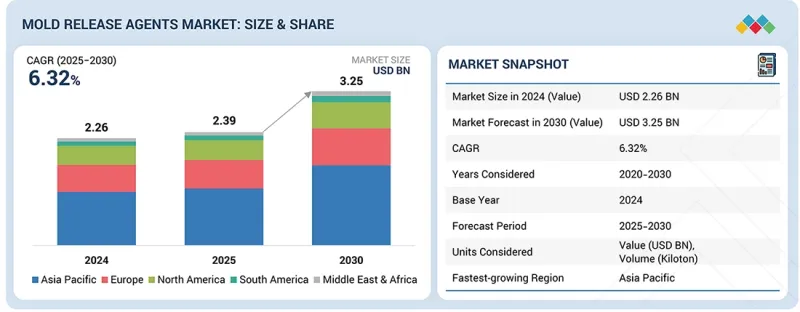
The mold release agents market is projected to grow from USD 2.39 billion in 2025 to USD 3.25 billion by 2030, at a CAGR of 6.32% between 2025 and 2030.
Scope of the Report
Years Considered for the Study
2020-2030
Base Year
2024
Forecast Period
2025-2030
Units Considered
Value (USD Million) and Volume (Kiloton)
Segments
Type, Application, and Region
Regions covered
North America, Europe, Asia Pacific, the Middle East & Africa, and South America
"Regulatory compliance and manufacturing efficiency requirements to drive the mold release agents market's growth"
The mold release agents market is growing due to the increasing regulations related to environmental safety and emissions. Manufacturers are progressively adopting water-based and low-emission formulations to comply with these requirements. The shift also aligns with end-use industries' heightened focus on achieving high production efficiency, improved surface quality, and enhanced mold durability. As a result, high-performance mold release agents have become essential for their operations.
"By application, the PU molding segment is projected to account for the third-largest market share during the forecast period."
In 2024, the PU molding segment accounted for the third-largest share of the overall mold release agents market. And this trend is expected to continue during the forecast period. The growth of the market is due to the widespread use of polyurethane in various sectors, including automotive parts, insulation materials, furniture, and construction products. Additionally, the increasing demand for flexible and rigid foams, along with rising production volumes, has sustained the need for effective mold release agents. Moreover, the desire to improve surface finish, reduce cycle times, and enhance production efficiency is further boosting the demand for mold release agents in PU molding applications.
"By type, the water-based mold release agents segment is projected to be the fastest-growing segment during the forecast period."
The water-based mold release agents segment is projected to be the fastest-growing type in terms of value during the forecast period. This growth is driven by stricter government regulations aimed at reducing VOC emissions. As awareness of environmental protection increases, manufacturers are increasingly adopting water-based mold release agents, which are not only environmentally friendly but also easy to process and versatile. Additionally, advancements in formulation technology have further improved their release performance and durability, making them a commercially viable alternative to solvent-based products.
"North America accounted for the third-largest share in the global mold release agents market, in terms of value, in 2024."
North America was the third-largest mold release agents market in 2024. The established end user markets, such as the automotive, construction, rubber & plastic, and composite industries, drive growth in the region. Additionally, the region has a well-established manufacturing sector, with a high adoption of advanced molding technology and a strong emphasis on quality and process improvements, which is also contributing to its growth. Moreover, strict government regulations with respect to the environment and safety factors are favoring advanced mold release agents, which is further propelling growth.
By Company Type: Tier 1 - 55%, Tier 2 - 25%, and Tier 3 - 20%
By Designation: Directors - 50%, Managers - 30%, and Others - 20%
By Region: North America - 40%, Europe - 35%, Asia Pacific - 20%, RoW - 5%
The key players profiled in the report include Freudenberg Group (Germany), Daikin Industries, Ltd. (Japan), Henkel AG & Co. KGaA (Germany), LANXESS AG (Germany), Shin-Etsu Chemical Co., Ltd. (Japan), Dow Inc. (US), Michelman, Inc. (US), Marbocote Ltd. (UK), McGee Industries, Inc. (US), and Miller-Stephenson, Inc. (US).
Study Coverage
This report segments the mold release agents market based on type, application, and region. It provides estimations of value (USD million) for the overall market size across various regions. A detailed analysis of key industry players has also been conducted to provide insights into their business overviews, services, and key strategies associated with the mold release agents market.
Reasons to Buy this Report
This research report is focused on various levels of analysis-industry analysis (industry trends), market share analysis of top players, and company profiles. They together provide an overall view of the competitive landscape; emerging and high-growth segments of the mold release agents market; high-growth regions; and market drivers, restraints, and opportunities.
The report provides insights into the following points:
Market Penetration: Comprehensive information on mold release agents offered by top players in the global market
Analysis of key drivers: (Rapid growth of automotive and construction industries, increasing demand from automotive and furniture applications), restraints (Stringent regulations on solvent-based mold release agents, rising use of non-stick coatings on molds), opportunities (infrastructure development in emerging economies), and challenges (fluctuating raw material prices), influencing the growth of the mold release agents market
Product Development/Innovation: Detailed insights into upcoming technologies, research & development activities, and product & service launches in the mold release agents market
Market Development: Comprehensive information about lucrative emerging markets across regions
Market Diversification: Exhaustive information about products, untapped regions, and recent developments in the global mold release agents market
Competitive Assessment: In-depth assessment of market shares, strategies, products, and manufacturing capabilities of leading players in the mold release agents market
TABLE OF CONTENTS
1 INTRODUCTION
1.1 STUDY OBJECTIVES
1.2 MARKET DEFINITION
1.3 STUDY SCOPE
1.3.1 MARKETS COVERED AND REGIONAL SCOPE
1.3.2 INCLUSIONS AND EXCLUSIONS
1.3.3 YEARS CONSIDERED
1.4 CURRENCY CONSIDERED
1.5 UNIT CONSIDERED
1.6 STAKEHOLDERS
1.7 SUMMARY OF CHANGES
2 EXECUTIVE SUMMARY
2.1 MARKET HIGHLIGHTS AND KEY INSIGHTS
2.2 KEY MARKET PARTICIPANTS: MAPPING OF STRATEGIC DEVELOPMENTS
2.3 DISRUPTIVE TRENDS IN MOLD RELEASE AGENTS MARKET
2.4 HIGH-GROWTH SEGMENTS
2.5 REGIONAL SNAPSHOT: MARKET SIZE, GROWTH RATE, AND FORECAST
3 PREMIUM INSIGHTS
3.1 ATTRACTIVE OPPORTUNITIES FOR PLAYERS IN MOLD RELEASE AGENTS MARKET
3.2 MOLD RELEASE AGENTS MARKET, BY APPLICATION AND REGION
3.3 MOLD RELEASE AGENTS MARKET, BY TYPE
3.4 MOLD RELEASE AGENTS MARKET, BY COUNTRY
4 MARKET OVERVIEW
4.1 INTRODUCTION
4.2 MARKET DYNAMICS
4.2.1 DRIVERS
4.2.1.1 Rapid growth of automotive and construction industries
4.2.1.2 Increased consumption in high-performance manufacturing applications
4.2.2 RESTRAINTS
4.2.2.1 Stringent regulations on solvent-based mold release agents
4.2.2.2 Extensive use of non-stick coatings on molds
4.2.3 OPPORTUNITIES
4.2.3.1 Infrastructure development in emerging economies
4.2.4 CHALLENGES
4.2.4.1 Fluctuating raw material prices
4.3 INTERCONNECTED MARKETS AND CROSS-SECTOR OPPORTUNITIES
4.3.1 INTERCONNECTED MARKETS
4.3.2 CROSS-SECTOR OPPORTUNITIES
4.4 STRATEGIC MOVES BY TIER-1/2/3 PLAYERS
5 INDUSTRY TRENDS
5.1 PORTER'S FIVE FORCES ANALYSIS
5.1.1 THREAT OF NEW ENTRANTS
5.1.2 THREAT OF SUBSTITUTES
5.1.3 BARGAINING POWER OF SUPPLIERS
5.1.4 BARGAINING POWER OF BUYERS
5.1.5 INTENSITY OF COMPETITIVE RIVALRY
5.2 MACROECONOMIC INDICATORS
5.2.1 INTRODUCTION
5.2.2 GDP TRENDS AND FORECAST
5.2.3 TRENDS IN GLOBAL AUTOMOTIVE INDUSTRY
5.3 SUPPLY CHAIN ANALYSIS
5.3.1 RAW MATERIALS
5.3.2 MANUFACTURING
5.3.3 DISTRIBUTION
5.3.4 APPLICATION
5.4 ECOSYSTEM ANALYSIS
5.5 PRICING ANALYSIS
5.5.1 AVERAGE SELLING PRICE OF KEY PLAYERS, BY APPLICATION, 2024
5.5.2 AVERAGE SELLING PRICE TREND, BY REGION, 2022-2025
5.6 TRADE ANALYSIS
5.6.1 IMPORT SCENARIO (HS CODE 340399)
5.6.2 EXPORT SCENARIO (HS CODE 340399)
5.7 KEY CONFERENCES AND EVENTS, 2026
5.8 TRENDS/DISRUPTIONS IMPACTING CUSTOMER BUSINESS
5.9 INVESTMENT AND FUNDING SCENARIO
5.10 CASE STUDY ANALYSIS
5.10.1 OPTIMIZING AUTOMOTIVE SEATING FOAM PRODUCTION WITH SPRAYIQ AND ADVANCED RELEASE AGENT
5.10.2 REDUCING COSTS AND ENHANCING EFFICIENCY WITH ADVANCED RELEASE AGENTS
5.10.3 TRANSFORMING DENTAL MANUFACTURING WITH RELEASYS ECO-W
5.11 IMPACT OF 2025 US TARIFF
5.11.1 KEY TARIFF RATES
5.11.2 PRICE IMPACT ANALYSIS
5.11.3 IMPACT ON COUNTRY/REGION
5.11.3.1 US
5.11.3.2 Europe
5.11.3.3 Asia Pacific
5.11.4 IMPACT ON APPLICATIONS
6 TECHNOLOGICAL ADVANCEMENTS, AI-DRIVEN IMPACT, PATENTS, AND INNOVATIONS
6.1 KEY TECHNOLOGIES
6.1.1 TECHNOMELT LOW-PRESSURE MOLDING TECHNOLOGY
6.1.2 FLUORO TECHNOLOGY
6.2 COMPLEMENTARY TECHNOLOGIES
6.2.1 NANOMOLD TECHNOLOGY
6.3 TECHNOLOGY/PRODUCT ROADMAP
6.3.1 SHORT-TERM (2025-2027): COST OPTIMIZATION AND PROCESS CONSISTENCY
6.3.2 MID-TERM (2027-2030): PERFORMANCE ENHANCEMENT AND APPLICATION EXPANSION
6.3.3 LONG-TERM (2030-2035+): SUSTAINABILITY, DIGITALIZATION, AND INTEGRATION
6.4 PATENT ANALYSIS
6.4.1 APPROACH
6.4.2 DOCUMENT TYPES
6.4.3 TOP APPLICANTS
6.4.4 JURISDICTION ANALYSIS
6.5 IMPACT OF AI/GEN AI
6.5.1 TOP USE CASES AND MARKET POTENTIAL
6.5.2 BEST PRACTICES
6.5.3 CASE STUDIES OF AI IMPLEMENTATION
6.5.4 INTERCONNECTED ECOSYSTEM AND IMPACT ON MARKET PLAYERS
6.5.5 CLIENTS' READINESS TO ADOPT GEN AI
7 REGULATORY LANDSCAPE AND SUSTAINABILITY INITATIVES
7.1 REGIONAL REGULATIONS AND COMPLIANCE
7.1.1 REGULATORY BODIES, GOVERNMENT AGENCIES, AND OTHER ORGANIZATIONS
7.1.2 INDUSTRY STANDARDS
7.2 SUSTAINABILITY IMPACT AND REGULATORY POLICY INITIATIVES
7.2.1 SAFETY PROTOCOLS
7.2.2 SUSTAINABLE DEVELOPMENT
7.2.3 STANDARDIZATION
7.3 CERTIFICATIONS, LABELING, AND ECO-STANDARDS
8 CUSTOMER LANDSCAPE AND BUYER BEHAVIOR
8.1 DECISION-MAKING PROCESS
8.2 KEY STAKEHOLDERS IN BUYING PROCESS AND THEIR EVALUATION CRITERIA
8.2.1 KEY STAKEHOLDERS IN BUYING PROCESS
8.2.2 BUYING CRITERIA
8.3 ADOPTION BARRIERS AND INTERNAL CHALLENGES
8.4 UNMET NEEDS FROM APPLICATIONS
9 MOLD RELEASE AGENTS MARKET, BY TYPE
9.1 INTRODUCTION
9.2 WATER-BASED
9.2.1 EXTENSIVE USE IN DIE CASTING AND CONCRETE PRODUCTS
9.3 SOLVENT-BASED
9.3.1 STRICT GOVERNMENT REGULATIONS IMPEDING LARGE-SCALE ADOPTION
9.4 OTHER TYPES
10 MOLD RELEASE AGENTS MARKET, BY APPLICATION
10.1 INTRODUCTION
10.2 DIE CASTING
10.2.1 HIGH DEMAND FROM AUTOMOTIVE, MARINE, AND AEROSPACE INDUSTRIES
10.3 PU MOLDING
10.3.1 LARGE-SCALE ADOPTION IN INSULATION BACKING FOAMS AND VISCOELASTIC PU PRODUCTS
10.4 RUBBER MOLDING
10.4.1 PREDOMINANCE IN TIRE, GASKET, AND SEAL PRODUCTION
10.5 COMPOSITE MOLDING
10.5.1 RISING NEED FOR CONSISTENT RELEASE PERFORMANCE AND REDUCED CYCLE TIME
10.6 PLASTIC MOLDING
10.6.1 EMPHASIS ON REDUCING CONTAMINATION AND PREVENTING CHEMICAL DEPLETION
10.7 WOOD COMPOSITE & PANEL PRESSING
10.7.1 HEIGHTENED DEMAND FROM CONSTRUCTION INDUSTRY
10.8 CONCRETE
10.8.1 SIGNIFICANCE OF STAMPED CONCRETE IN ARCHITECTURAL APPLICATIONS
10.9 OTHER APPLICATIONS
11 MOLD RELEASE AGENTS MARKET, BY REGION
11.1 INTRODUCTION
11.2 ASIA PACIFIC
11.2.1 CHINA
11.2.1.1 Ongoing industrialization to drive market
11.2.2 JAPAN
11.2.2.1 Robust automotive industry to drive market
11.2.3 INDIA
11.2.3.1 Growing infrastructure development to drive market
11.2.4 SOUTH KOREA
11.2.4.1 Demand from diverse industrial applications to drive market
11.3 NORTH AMERICA
11.3.1 US
11.3.1.1 Extensive utilization in automotive, construction, and aerospace & defense industries to drive market
11.3.2 CANADA
11.3.2.1 Expansion of domestic manufacturing capabilities to drive market
11.3.3 MEXICO
11.3.3.1 Rapid development and shift of key industries from US to drive market
11.4 EUROPE
11.4.1 GERMANY
11.4.1.1 High automotive production volumes to drive market
11.4.2 FRANCE
11.4.2.1 Economic dynamism and robust industrial hubs to drive market
11.4.3 UK
11.4.3.1 Substantial investments in automotive and chemical industries to drive market
11.4.4 RUSSIA
11.4.4.1 Prominence of die casting application to drive market
11.4.5 ITALY
11.4.5.1 Steady growth of manufacturing industry to drive market
11.4.6 SPAIN
11.4.6.1 Significant presence of automotive manufacturers and suppliers to drive market
11.4.7 TURKEY
11.4.7.1 Large-scale manufacturing of building materials to drive market
11.5 MIDDLE EAST & AFRICA
11.5.1 GCC
11.5.1.1 Saudi Arabia
11.5.1.1.1 Strategic initiatives aimed at diversifying economy to drive market
11.5.2 SOUTH AFRICA
11.5.2.1 Increasing demand from construction and automotive industries to drive market
11.6 SOUTH AMERICA
11.6.1 BRAZIL
11.6.1.1 Rising production of commercial and defense aircraft to drive market
11.6.2 ARGENTINA
11.6.2.1 Heightened demand for rubber products to drive market
12 COMPETITIVE LANDSCAPE
12.1 INTRODUCTION
12.2 KEY PLAYER STRATEGIES/RIGHT TO WIN, 2022-2025
12.3 MARKET SHARE ANALYSIS, 2024
12.4 REVENUE ANALYSIS, 2020-2024
12.5 COMPANY EVALUATION MATRIX: KEY PLAYERS, 2024
12.5.1 STARS
12.5.2 EMERGING LEADERS
12.5.3 PERVASIVE PLAYERS
12.5.4 PARTICIPANTS
12.5.5 COMPANY FOOTPRINT: KEY PLAYERS, 2024
12.5.5.1 Company footprint
12.5.5.2 Region footprint
12.5.5.3 Type footprint
12.5.5.4 Application footprint
12.6 COMPANY EVALUATION MATRIX: START-UPS/SMES, 2024