광(레이저) 위성 통신 시장(-2030년) : 레이저 유형(반도체 다이오드, 파이버 및 고체) 및 데이터 속도 등급(2.5Gbps 미만, 2.5-10Gbps, 10Gbps 초과), 플랫폼, 용도, 컴포넌트, 지역별
Optical (laser) Satellite Communication Market by Laser Type (Semiconductor Diode, Fiber, Solid-state), Data Rate (< 2.5, 2.5-10, > 10 GBPs), Platform, Application, Component and Region - Global Forecast To 2030
상품코드:1923695
리서치사:MarketsandMarkets
발행일:2026년 01월
페이지 정보:영문 284 Pages
라이선스 & 가격 (부가세 별도)
ㅁ Add-on 가능: 고객의 요청에 따라 일정한 범위 내에서 Customization이 가능합니다. 자세한 사항은 문의해 주시기 바랍니다.
한글목차
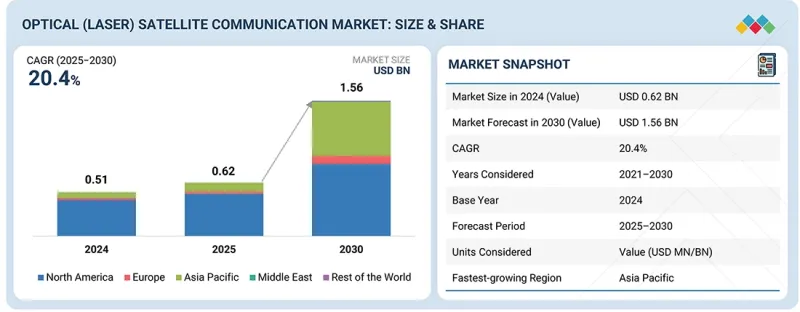
광(레이저) 위성 통신 시장 규모는 레이저 위성간 링크의 채택 확대와 저궤도(LEO) 및 다궤도 위성 네트워크 간의 대용량 및 안전한 데이터 전송에 대한 수요 증가를 배경으로 2025년의 6억 2,000만 달러로 평가되었고, 2030년까지 15억 6,000만 달러에 이를 것으로 예측되며 CAGR은 20.4%를 나타낼 전망입니다.
조사 범위
조사 대상 기간
2021-2030년
기준 연도
2024년
예측 기간
2025-2030년
대상 단위
금액(달러)
부문
유형, 데이터 범위, 용도, 지역별
대상 지역
북미, 유럽, 아시아태평양 및 기타 지역
"플랫폼별로는 항공기 부문이 예측 기간 동안 가장 높은 연평균 복합 성장률(CAGR)을 기록할 것으로 전망"
플랫폼별로는 항공기 부문이 예측 기간 동안 가장 높은 연평균 복합 성장률(CAGR)을 기록할 것으로 예상되며, 이는 ISR 항공기, 무인항공기(UAV), 고고도 플랫폼에서 대용량 및 저탐지 가능성 통신 수요 증가에 힘입은 것입니다. 광학 링크는 실시간 정보 및 센서 데이터 공유를 위한 안전한 항공-위성 및 항공-항공 간 데이터 전송을 가능하게 합니다. 소형화되고 진동에 강한 레이저 단말기의 개선 또한 항공 플랫폼에의 통합을 용이하게 하고 있습니다.
"용도별로는 네트워크 백본 및 중계 통신 부문이 예측 기간 동안 가장 우세한 위치를 차지할 것으로 전망"
용도별로는 네트워크 백본 및 중계 통신 부문이 우주 기반 광학 메쉬 네트워크로의 전환에 힘입어 예측 기간 동안 가장 우세한 위치를 차지할 것으로 전망됩니다. 이러한 네트워크는 멀티 기가비트급 위성 간 데이터 라우팅을 지원하고 지상국 의존도를 낮추며 지속적인 글로벌 커버리지를 가능하게 합니다. 이는 광대역 위성군 및 시간 민감형 국방 통신에 매우 중요합니다.
"예측 기간 동안 아시아태평양이 가장 빠르게 성장하는 시장이 될 전망"
아시아태평양 지역은 중국, 인도, 일본, 한국의 위성 군집 확장 및 국가 우주 프로그램에 힘입어 예측 기간 동안 가장 빠르게 성장하는 시장이 될 것으로 예상됩니다. 안전한 위성 통신 및 지역 광학 단말기 개발에 대한 정부 지출 증가가 해당 지역 전반에 걸친 채택을 가속화하고 있습니다.
본 보고서에서는 세계의 광(레이저) 위성통신 시장을 조사했으며, 시장 개요, 시장 성장에 대한 각종 영향요인 분석, 기술 및 특허 동향, 법규제 환경, 사례 연구, 시장 규모 추이와 예측, 각종 구분 및 지역/주요 국가별 상세 분석, 경쟁 구도, 주요 기업 프로파일 등을 정리했습니다.
목차
제1장 서론
제2장 주요 요약
제3장 중요 인사이트
제4장 시장 개요
시장 역학
성장 촉진요인
억제요인
기회
과제
시장 시나리오 분석
미충족 요구와 화이트 스페이스
관련 시장 및 이업종과의 분야 횡단적 기회
Tier 1/2/3 기업의 전략적 움직임
제5장 업계 동향
생태계 분석
밸류체인 분석
무역 분석
관세 데이터
사례 연구 분석
주요 회의 및 이벤트
투자 및 자금조달 시나리오
고객사업에 영향을 주는 동향/혼란
가격 분석
거시경제 전망
제6장 고객 환경 및 구매행동
의사결정 공정
이해관계자와 구매평가기준
채택 장벽과 내부 과제
다양한 최종 사용자 산업의 미충족 요구
시장 수익성
제7장 기술의 진보, AI에 의한 영향, 특허, 혁신, 장래의 응용
주요 기술
포인팅, 획득 및 추적(PAT) 시스템
자유 공간 광통신(FSO) 통신 단말기
고속 변조 및 인코딩(코히런트 모뎀)
WDM/DWDM 광다중화
보완적 기술
하이브리드 RF-광 네트워크 아키텍처
AI 구동형 네트워크 오케스트레이션과 날씨를 고려한 라우팅
우주광 스위칭 및 라우팅(광 메쉬 네트워크)
양자 통신 및 QKD 통합
기술 로드맵
특허 분석
미래의 응용
AI/생성형 AI의 영향
성공 사례와 실세계에의 응용
제8장 지속가능성과 규제상황
지역 규제 및 규정 준수
지속가능성에 대한 노력
인증, 라벨, 환경 기준
제9장 광위성 통신 시장 : 플랫폼별
데이터 링크 유형별 광 위성 통신의 분류
우주-우주
우주-지상
우주-공중
위성 통신 단말
소형 위성
중형 위성
대형 위성
지상국 터미널
고정형
휴대용
공중 터미널
군용기
무인 항공기(UAV)
제10장 광위성 통신 시장 : 용도별
네트워크 백본 및 중계 통신
지구관측(EO) 및 원격 감지
과학연구 및 탐사
제11장 광위성 통신 시장 : 컴포넌트별
광학 프론트 엔드
송신 모듈
수신 모듈
포인팅, 획득 및 추적(PAT) 모듈
베이스밴드 모뎀 및 처리 일렉트로닉스
기타
제12장 광위성 통신 시장 : 레이저 유형별
동작 파장별 광 위성 통신의 분류
C 밴드/1550 NM 밴드
근적외선 1064 NM 밴드
보조 비콘 파장(850-1000 nm)
깊은 우주 최적화 하이브리드 파장(1550/1064 NM)
반도체 다이오드 레이저
파이버 레이저
고체 레이저
기타
제13장 광위성 통신 시장 : 데이터 속도 등급별
저속/전술적(2.5GBPS 이하)
고속(2.5-10GBPS)
초고속/차세대(10GBPS 초과)
제14장 광위성 통신 시장 : 지역별
북미
미국
캐나다
유럽
영국
독일
프랑스
스페인
이탈리아
아시아태평양
일본
인도
중국
호주
중동
GCC 국가
기타
세계 기타 지역
라틴아메리카
아프리카
제15장 경쟁 구도
주요 진입기업의 전략, 강점
수익 분석
시장 점유율 분석
기업 평가 매트릭스 : 주요 기업
기업평가 매트릭스 : 스타트업, 중소기업
기업평가와 재무재표
브랜드/제품 비교
경쟁 시나리오
제16장 기업 프로파일
주요 기업
SPACEX
MYNARIC AG
BRIDGECOMM INC.
THALES ALENIA SPACE
TESAT-SPACECOM GMBH & CO. KG
BAE SYSTEMS
HONEYWELL INTERNATIONAL INC.
MITSUBISHI ELECTRIC CORPORATION
SONY SPACE COMMUNICATIONS
AAC CLYDE SPACE
NEC SPACE TECHNOLOGIES
SKYLOOM GLOBAL
GENERAL ATOMICS
SPACE MICRO
NORTHROP GRUMMAN
SAFRAN
기타 기업
WARPSPACE
SITAEL
ASTROGATE LABS
ARCHANGEL LIGHTWORKS
TRANSCELESTIAL
CAILABS
OLEDCOMM
HENSOLDT
ASTROLIGHT
QINETIQ
제17장 조사 방법
제18장 부록
HBR
영문 목차
영문목차
The optical (laser) satellite communication market is projected to grow from USD 0.62 billion in 2025 to USD 1.56 billion by 2030, at a CAGR of 20.4%, driven by the increasing adoption of laser intersatellite links and rising demand for high-capacity, secure data transmission across LEO and multi-orbit satellite networks.
Scope of the Report
Years Considered for the Study
2021-2030
Base Year
2024
Forecast Period
2025-2030
Units Considered
Value (USD Billion)
Segments
By Type, Data Range, Application and Region
Regions covered
North America, Europe, APAC, RoW
"By platform, the airborne segment is projected to grow at the highest CAGR during the forecast period."
By platform, the airborne segment is expected to grow at the highest CAGR during the forecast period, driven by rising demand for high-throughput, low-probability-of-intercept communications on ISR aircraft, UAVs, and high-altitude platforms. Optical links enable secure air-to-satellite and air-to-air data transfer for real-time intelligence and sensor data sharing. Improvements in compact, vibration-tolerant laser terminals are also facilitating easier integration on airborne platforms.
"By application, the network backbone & relay communications segment is projected to be the most dominant during the forecast period."
By application, the Network Backbone and Relay Communications segment is projected to be the most dominant during the forecast period, driven by the shift toward space-based optical mesh networks. These networks support multi-Gbps inter-satellite data routing, reduce reliance on ground stations, and enable persistent global coverage. This is critical for broadband constellations and time-sensitive defense communications.
"The Asia Pacific is projected to be the fastest growing market during the forecast period."
The Asia Pacific region is expected to be the fastest-growing market during the forecast period, supported by expanding satellite constellations and national space programs in China, India, Japan, and South Korea. Increased government spending on secure satellite communications and local optical terminal development is accelerating adoption across the region.
The breakdown of profiles for primary participants in the Optical (laser) Satellite Communication Market is provided below:
By Company Type: Tier 1 - 40%, Tier 2 - 30%, and Tier 3 - 30%
By Designation: Directors - 20%, Managers - 10%, and Others - 70%
By Region: North America - 40%, Europe - 20%, Asia Pacific - 20%, Middle East - 10% Rest of the World (RoW) - 10%
Research Coverage:
This market study covers the optical (laser) satellite communications market across various segments and subsegments. It aims to estimate the market size and growth potential across different regions. This study also includes an in-depth competitive analysis of the key players in the market, their company profiles, key observations on their products and business offerings, recent developments, and key market strategies they adopted.
Reasons to buy this report:
The report will provide market leaders and new entrants with the most accurate available estimates of revenue for the overall optical (laser) satellite communication market. It will also help stakeholders understand the competitive landscape and gain insights to position their businesses more effectively and plan suitable go-to-market strategies. The report will also help stakeholders understand the market pulse and provide information on key market drivers, restraints, challenges, and opportunities.
The report provides insights into the following pointers:
Market Drivers (Expansion of LEO Broadband Constellations Requiring High-Capacity Optical Inter-Satellite Backbones, Growth in Earth Observation Data Volumes Requiring High-Speed Optical Downlinks), Restraints (Atmospheric Turbulence and Cloud Cover Affecting Space-to-Ground Optical Link Availability, Higher Optical Ground Station Density Increasing Capital and Operational Complexity), Opportunities (Emergence of Space-to-Air Optical Links Enabling Airborne Communication Nodes, RF Spectrum Congestion Supporting Adoption of Spectrum-Independent Optical Transport Links), Challenges Technology Readiness, Production Scale-Up, and Qualification Timelines Across Constellations, Pointing, Acquisition, and Tracking Precision Requirements for Mobile and Multi-Orbit Architectures.
Market Penetration: Comprehensive information on Optical (laser) Satellite Communication offered by the top players in the market
Product Development/Innovation: Detailed insights on upcoming technologies, research & development activities, and product launches in the Optical (laser) Satellite Communication Market
Market Development: Comprehensive information about lucrative markets across varied regions
Market Diversification: Exhaustive information about new products, untapped geographies, recent developments, and investments in the Optical (laser) Satellite Communication Market
Competitive Assessment: In-depth assessment of market share, growth strategies, products, and manufacturing capabilities of leading players in the Optical (laser) Satellite Communication Market
TABLE OF CONTENTS
1 INTRODUCTION
1.1 STUDY OBJECTIVES
1.2 MARKET DEFINITION
1.3 STUDY SCOPE
1.3.1 MARKETS COVERED AND REGIONAL SCOPE
1.3.2 INCLUSIONS AND EXCLUSIONS
1.3.3 YEARS CONSIDERED
1.4 CURRENCY CONSIDERED
1.5 STAKEHOLDERS
1.6 SUMMARY OF CHANGES
2 EXECUTIVE SUMMARY
2.1 KEY INSIGHTS AND MARKET HIGHLIGHTS
2.2 KEY MARKET PARTICIPANTS: MAPPING OF STRATEGIC DEVELOPMENTS
2.3 HIGH-GROWTH SEGMENTS
2.4 REGIONAL SNAPSHOT: MARKET SIZE, GROWTH RATE, AND FORECAST
2.5 BILL OF MATERIALS
2.6 TOTAL COST OF OWNERSHIP
2.7 BUSINESS MODELS
2.7.1 SPACE LASER TERMINAL OEM SALES FOR LEO AND DEFENSE CONSTELLATIONS
2.7.2 VERTICALLY INTEGRATED OPTICAL MESH NETWORKS BY CONSTELLATION OPERATORS
2.7.3 DATA RELAY AS A SERVICE USING OPTICAL LINKS
2.7.4 OPTICAL GROUND STATION NETWORK AND MANAGED SERVICES (OGSAAS)
3 PREMIUM INSIGHTS
3.1 ATTRACTIVE OPPORTUNITIES FOR PLAYERS IN OPTICAL SATELLITE COMMUNICATION MARKET
3.2 OPTICAL SATELLITE COMMUNICATION MARKET, BY APPLICATION
3.3 OPTICAL SATELLITE COMMUNICATION MARKET, BY LASER TYPE
3.4 OPTICAL SATELLITE COMMUNICATION MARKET, BY COMPONENT
4 MARKET OVERVIEW
4.1 INTRODUCTION
4.2 MARKET DYNAMICS
4.2.1 DRIVERS
4.2.1.1 Expansion of LEO broadband constellations requiring high-capacity optical inter-satellite backbones
4.2.1.2 Growth in Earth observation (EO) data volumes requiring high-speed optical downlinks
4.2.1.3 Demand for resilient, low-intercept space networking in defense industry
4.2.1.4 Defense-led space programs accelerating adoption and industrialization of optical satellite communication
4.2.2 RESTRAINTS
4.2.2.1 Atmospheric turbulence and cloud cover affecting space-to-ground optical link availability
4.2.2.2 Higher optical ground station density increasing capital and operational complexity
4.2.3 OPPORTUNITIES
4.2.3.1 Emergence of space-to-air optical links enabling airborne communication nodes
4.2.3.2 RF spectrum congestion supporting adoption of spectrum-independent optical transport links
4.2.4 CHALLENGES
4.2.4.1 Technology readiness, production scale-up, and qualification timelines across constellations
4.2.4.2 Pointing, acquisition, and tracking precision requirements for mobile and multi-orbit architectures
4.3 MARKET SCENARIO ANALYSIS
4.3.1 MARKET PERSPECTIVE OF OPTICAL SATELLITE TERMINAL COUNT IN DIFFERENT SCENARIOS
4.4 UNMET NEEDS AND WHITE SPACES
4.4.1 LACK OF GLOBALLY STANDARDIZED OPTICAL COMMUNICATION PROTOCOLS
4.4.2 LIMITED AVAILABILITY OF AFFORDABLE OPTICAL GROUND STATION NETWORKS
4.4.3 NEED FOR COMPACT AND LOW-POWER TERMINALS WITH PRECISION POINTING
4.4.4 WEATHER-RELATED AVAILABILITY LIMITATIONS
4.4.5 GAPS IN END-TO-END INFORMATION SECURITY FOR OPTICAL NETWORKS
4.4.6 ABSENCE OF MULTI-ORBIT OPTICAL RELAY INFRASTRUCTURE
4.4.7 LIMITED INTEGRATION BETWEEN OPTICAL COMMUNICATION AND ONBOARD PROCESSING
4.5 INTERCONNECTED MARKETS AND CROSS-SECTOR OPPORTUNITIES