무세포 단백질 합성(CFPS) 시장(-2030년) : 제공 구분(세포 추출 시스템, 키트, 기기, 서비스), 워크플로우, 방법, 용도별
Cell-free Protein Synthesis Market by Offering (Cell Extract Systems, Kits, Instruments, Services), Workflow, Method, Application - Global Forecast to 2030
상품코드:1876444
리서치사:MarketsandMarkets
발행일:2025년 10월
페이지 정보:영문 309 Pages
라이선스 & 가격 (부가세 별도)
ㅁ Add-on 가능: 고객의 요청에 따라 일정한 범위 내에서 Customization이 가능합니다. 자세한 사항은 문의해 주시기 바랍니다.
한글목차
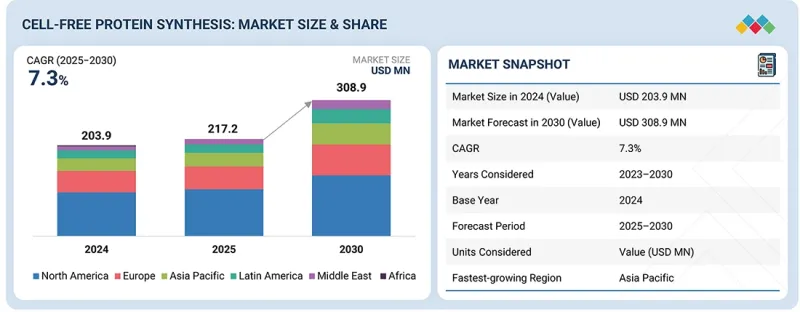
세계의 무세포 단백질 합성(CFPS) 시장 규모는 2025년 2억 1,720만 달러에서 예측 기간 동안 CAGR 7.3%로 추이하고, 2030년까지 3억 890만 달러에 달할 것으로 예측되고 있습니다.
조사 범위
조사 대상 기간
2024-2033년
기준 연도
2024년
예측 기간
2025-2030년
단위
금액(달러)
부문
제공 구분, 워크플로우, 방법, 용도, 최종 사용자
대상 지역
북미, 유럽, 아시아태평양, 라틴아메리카, 중동 및 아프리카
이 시장의 성장은 신속하고 효율적인 단백질 생산에 대한 수요 증가, 재구성된 무세포 시스템의 채용 확대, 합성 생물학 및 신약개발 분야의 용도 확대, 독성이 있는 단백질과 발현이 어려운 단백질의 발현 요구, 발현 시스템을 최적화하기 위한 AI/ML의 통합에 의해 견인되고 있습니다.
"제공 구분별로는 CFPS 서비스 부문이 예측 기간 동안 최대 성장을 보일 전망"
이 부문은 예측 기간 동안 맞춤형 단백질 생산 솔루션에 대한 수요 증가, 신속한 프로토타이핑의 필요성, 학술기관 및 생명공학 기업의 아웃소싱 채택 확대로 최대 성장을 보여줄 전망입니다. 이러한 서비스를 통해 연구자들은 고가의 인프라나 전문 지식에 대한 투자 없이 첨단 CFPS 기술을 활용할 수 있습니다. 신약, 합성 생물학, 백신 개발, 단백질체학에서 수탁형 단백질 발현에 대한 관심 증가가 수요를 이끌고 있습니다. 게다가 독성이 있는 단백질, 불안정한 단백질, 막 단백질 등 단백질 타겟의 복잡화가 진행되고 있기 때문에 고품질의 단백질을 빠르고 효율적으로 제공할 수 있는 전문 서비스 제공업체에의 요구가 증가하고 있습니다.
"효소 공학이 무세포 단백질 합성의 주요 용도이며 CFPS 시장을 견인"
2024년에는 합성 생물학, 경로 프로토타이핑, 지향성 진화, 항체 개발 등의 연구 분야에서의 광범위한 이용에 의해 효소 공학이 CFPS 시장을 견인했습니다. CFPS는 생세포를 필요로 하지 않고 효소의 신속한 시험 및 최적화를 가능하게 해, 성능, 안정성, 특이성을 향상시킨 효소 설계에 최적입니다. 또한 신규 생체 촉매의 창출, 대사 경로의 개선, 창약의 가속을 지원합니다. 제약, 생명공학 및 기타 분야에서 신속, 확장성, 유연성을 갖춘 단백질 생산에 대한 수요 증가로 인해 효소공학은 CFPS 시장의 주요 촉진요인으로 지속될 전망입니다.
"예측 기간 동안 아시아태평양이 가장 높은 CAGR을 나타낼 전망"
아시아태평양은 생명공학 연구에 대한 투자 증가, 의약품 제조 확대, 이 지역의 합성 생물학 및 정밀의료에 대한 관심 증가를 배경으로 예측 기간 동안 가장 높은 CAGR을 나타낼 것으로 예측됩니다. 중국, 일본, 한국, 인도 등의 국가들은 정부 자금, 관민 연계, 국제 협력을 통해 연구 개발 능력을 대폭 강화하고 있으며, CFPS 기술에 대한 강한 수요를 창출하고 있습니다. 신약, 백신 개발, 진단 분야에서 높은 처리량 단백질 생산, 효소 엔지니어링, 신속한 프로토 타이핑의 채택 확대가 시장 성장을 지속적으로 견인하고 있습니다. 게다가 이 지역은 풍부한 숙련 노동력, 낮은 생산 비용, 확대하는 수탁 연구기관(CRO), 연구 인프라의 개선 등의 이점을 가지고 있으며, 높은 성장 가능성을 지닌 시장이 되고 있습니다.
본 보고서에서는 세계의 무세포 단백질 합성(CFPS) 시장을 조사했으며, 시장 개요, 시장 성장에 대한 각종 영향요인 분석, 기술 및 특허 동향, 법규제 환경, 사례 연구, 시장 규모 추이와 예측, 각종 구분 및 지역/주요 국가별 상세 분석, 경쟁 구도, 주요 기업 프로파일 등을 정리했습니다.
목차
제1장 서론
제2장 조사 방법
제3장 주요 요약
제4장 중요 인사이트
세계의 무세포 단백질 합성 시장 현황
북미 : 무세포 단백질 합성 시장, 용도 및 국가별
무세포 단백질 합성 시장 : 지리적 성장 기회
미충족 수요와화이트 스페이스
상호접속된 시장과 분야 횡단적인 기회
새로운 비즈니스 모델과 생태계의 변화
제5장 시장 개요
시장 역학
성장 촉진요인
기존 생세포와 CFPS 시스템의 비교
억제요인
기회
과제
업계 동향
고객의 사업에 영향을 주는 동향/혁신
가격 분석
기술 분석
기술/제품 로드맵
지속가능성에 대한 노력
밸류체인 분석
생태계 분석
Porter's Five Forces 분석
특허 분석
규제 상황
주요 회의 및 이벤트
고객정세와 구매행동
투자/자금 조달 활동
AI/생성형 AI가 무세포 단백질 합성 시장에 미치는 영향
트럼프 관세가 무세포 단백질 합성 시장에 미치는 영향
제6장 무세포 단백질 합성 시장 : 제공 구분별
제품
키트 및 시약
세포 추출물 및 발현 시스템
기기
서비스
제7장 무세포 단백질 합성 시장 : 워크플로우별
반응 설정
전사 및 번역
단백질 폴딩/번역 후 변형(PTMS)
템플릿 준비
회복 및 정제
검증 및 해석
제8장 무세포 단백질 합성 시장 : 방법별
결합형 전사/번역(TX-TL)
전사 및 번역
제9장 무세포 단백질 합성 시장 : 용도별
효소공학
고처리량 생산
단백질간 상호작용
단백질 라벨링
단백질 정제
제10장 무세포 단백질 합성 시장 : 최종 사용자별
제약 및 바이오테크놀러지 기업
학술연구기관
CRO 및 CDMO
진단회사
제11장 무세포 단백질 합성 시장 : 지역별
북미
미국
캐나다
유럽
독일
영국
프랑스
이탈리아
스페인
기타
아시아태평양
중국
일본
인도
호주
한국
기타
라틴아메리카
브라질
멕시코
기타
중동
GCC 국가
기타
아프리카
제12장 경쟁 구도
주요 진입기업의 전략/강점
수익 분석
시장 점유율 분석
기업평가 매트릭스 : 주요 기업
기업평가 매트릭스: 스타트업/중소기업
기업평가 및 재무지표
브랜드/제품 비교
경쟁 시나리오
제13장 기업 프로파일
주요 기업
NEW ENGLAND BIOLABS
PROMEGA CORPORATION
THERMO FISHER SCIENTIFIC INC.
GENSCRIPT
TAKARA BIO INC.
LENIOBIO GMBH
CREATIVE BIOLABS
JENA BIOSCIENCE GMBH
BIOTECHRABBIT
BIODISCOVERY LLC
BIONEER CORPORATION
SINO BIOLOGICAL, INC.
KANEKA CORPORATION
GENECOPOEIA, INC.
CELLFREE SCIENCES CO., LTD.
기타 기업
VECTORBUILDER INC.
EXCELLGEN, INC.
CD BIOSYNSIS
CREATIVE BIOGENE
CUSABIO TECHNOLOGY
PROFACGEN
CAYMAN CHEMICAL
CAMBRIDGE ISOTOPE LABORATORIES, INC.
SYNTHELIS BIOTECH
SYNBIO TECHNOLOGIES
AMSBIO
제14장 부록
JHS
영문 목차
영문목차
The cell-free protein synthesis market is projected to reach USD 308.9 million by 2030, up from USD 217.2 million in 2025, with a CAGR of 7.3% during the forecast period.
Scope of the Report
Years Considered for the Study
2024-2033
Base Year
2024
Forecast Period
2025-2030
Units Considered
Value (USD million)
Segments
Offering, Workflow, Method, Application, and End User
Regions covered
North America, Europe, Asia Pacific, Latin America, the Middle East, and Africa
Growth in this market is driven by increasing demand for rapid and efficient protein production, rising adoption of reconstituted cell-free systems, expanding applications in synthetic biology and drug discovery, the need to express toxic and difficult-to-express proteins, and the integration of AI/ML to optimize expression systems.
The cell-free protein synthesis services experienced the fastest growth during the forecast period of 2025 to 2030.
The cell-free protein synthesis market is divided into offerings such as products-like expression systems, reagents, and instruments-and services. During the forecast period, cell-free protein synthesis services are expected to grow the fastest due to increasing demand for customized protein production solutions, the need for quick prototyping, and the rising adoption of outsourcing by academic institutions and biotech companies. These services enable researchers to access advanced CFPS technologies without investing in expensive infrastructure or expertise. Growing interest in contract-based protein expression for drug discovery, synthetic biology, vaccine development, and proteomics is fueling demand. Additionally, the increasing complexity of protein targets, including toxic, unstable, or membrane proteins, is encouraging more organizations to turn to specialized service providers who can deliver high-quality proteins quickly and efficiently.
Enzyme engineering is a key application of cell-free protein synthesis, dominating the CFPS market.
The CFPS market, categorized by application, includes enzyme engineering, high-throughput protein production, protein labeling, protein purification, and studies of protein-protein interactions. In 2024, enzyme engineering dominated the CFPS application market due to its extensive use in research areas like synthetic biology, pathway prototyping, directed evolution, and therapeutic antibody development. CFPS enables researchers to rapidly test and optimize enzymes without the need for living cells, making it ideal for designing enzymes with enhanced performance, stability, and specificity. Additionally, it supports the creation of new biocatalysts, improves metabolic pathways, and accelerates drug discovery. The increasing demand for faster, scalable, and flexible protein production in pharmaceuticals, biotechnology, and other sectors ensures that enzyme engineering will remain the primary growth driver in the CFPS market.
The Asia Pacific region will experience the highest CAGR in the cell-free protein synthesis market during the forecast period of 2025 to 2030.
Asia Pacific is projected to have the highest CAGR in the cell-free protein synthesis market during the forecast period, fueled by increasing investments in biotechnology research, growing pharmaceutical manufacturing, and a rising focus on synthetic biology and precision medicine in the region. Countries such as China, Japan, South Korea, and India are significantly boosting their R&D capabilities through government funding, public-private partnerships, and international collaborations, creating strong demand for CFPS technologies. The growing adoption of high-throughput protein production, enzyme engineering, and rapid prototyping in drug discovery, vaccine development, and diagnostics continues to drive market growth. Additionally, the region benefits from a large, skilled workforce, lower production costs, expanding contract research organizations (CROs), and improving research infrastructure, establishing Asia Pacific as a high-potential growth market for cell-free protein synthesis.
The primary interviews conducted for this report can be categorized as follows:
By Company Type: Tier 1- 44%, Tier 2- 32%, and Tier 3- 24%
By Designation: (Managers) - 45%, (CXOs, Directors)- 30%, and (Executives) - 25%
By Region: North America- 40%, Europe - 25%, Asia Pacific - 20%, Rest of the World - 15%
Promega Corporation (US), New England Biolabs (US), Thermo Fisher Scientific Inc. (US), Genscript (US), and Takara Bio Inc. (Japan) are among the major players in the cell-free protein synthesis market.
The study provides a detailed competitive analysis of these key players in the cell-free protein synthesis market, including their company profiles, recent updates, and main market strategies.
Research Coverage:
This research report categorizes the cell-free protein synthesis market by offering (products such as Expression Systems, Reagents, and Instruments), services, workflow stages (Template preparation, Reaction setup, Transcription and translation, Protein folding and post-translational modification, Recovery and purification, Validation and analysis), method (Coupled Transcription-Translation, Only Translation), application (Enzyme Engineering, High-Throughput Production, Protein Labeling, Protein Purification, Protein-Protein Interaction), end user (academic and research institutes, pharmaceutical and biotechnology companies, others), and region (North America, Europe, Asia Pacific, Latin America, Middle East, and Africa).
The report offers detailed information on key factors affecting the growth of the cell-free protein synthesis market, including drivers, trends, challenges, and opportunities. A comprehensive analysis of major industry players has been conducted to provide insights into their business profiles, products or services offered, key strategies, collaborations, partnerships, and agreements. The report also covers recent developments such as new product launches and acquisitions within the cell-free protein synthesis market.
Key Benefits of Buying the Report:
The report will assist market leaders and newcomers by offering close estimates of revenue figures for the overall cell-free protein synthesis market and its segments. It will also help stakeholders better understand the competitive landscape and gain insights to more effectively position their business and develop appropriate go-to-market strategies. This report will allow stakeholders to grasp the market's current state and provide information on key drivers, restraints, opportunities, and challenges.
The report provides insights into the following pointers:
Analysis of key drivers (Increasing demand for rapid protein synthesis in research and pharma, growing demand for toxic and difficult-to-express proteins, integration of AI/ML for protein engineering using CFPS), restraints (high cost of essential reagents), opportunities (integration of cell-free technology in biosensors development, commercial-scale validation of cell-free protein expression) and challenges (Inability to fully replicate complex mammalian post-translational modifications) influencing the growth of the market.
Product Development/Innovation: Detailed insights on newly launched products/services in the cell-free protein synthesis market
Market Development: Comprehensive information about lucrative markets - the report analyzes the market across varied regions.
Market Diversification: Exhaustive information about new products, untapped geographies, recent developments, and investments in the cell-free protein synthesis market
Competitive Assessment: In-depth assessment of market share, growth strategies of leading players like New England Biolabs (US), Thermo Fisher Scientific Inc. (US), Takara Bio, Inc. (Japan), and Promega Corporation (US), among others, in the cell-free protein synthesis market
TABLE OF CONTENTS
1 INTRODUCTION
1.1 STUDY OBJECTIVES
1.2 MARKET DEFINITION
1.3 STUDY SCOPE
1.3.1 MARKET SEGMENTATION AND REGIONAL SCOPE
1.3.2 INCLUSIONS AND EXCLUSIONS
1.3.3 YEARS CONSIDERED
1.4 CURRENCY CONSIDERED
1.5 STAKEHOLDERS
2 RESEARCH METHODOLOGY
2.1 RESEARCH DATA
2.1.1 SECONDARY DATA
2.1.1.1 Key sources of secondary data
2.1.1.2 Key objectives of secondary research
2.1.2 PRIMARY DATA
2.1.2.1 Breakdown of primaries
2.1.2.2 Key objectives of primary research
2.2 MARKET SIZE ESTIMATION
2.2.1 GLOBAL CELL-FREE PROTEIN SYNTHESIS MARKET ESTIMATION, 2024
2.2.1.1 Company revenue analysis (bottom-up approach)
8.2.1 METHOD ENABLING SIMULTANEOUS SYNTHESIS OF MRNA AND PROTEIN IN SINGLE REACTION
8.3 TRANSCRIPTION & TRANSLATION
8.3.1 TWO-STEP APPROACH SHORTENED DESIGN-TO-DATA PROCESS WHILE PROVIDING TIGHTER CONTROL OVER PRODUCT QUALITY
9 CELL-FREE PROTEIN SYNTHESIS MARKET, BY APPLICATION
9.1 INTRODUCTION
9.2 ENZYME ENGINEERING
9.2.1 RISING DEMAND FOR GREENER CHEMISTRIES TO AID GROWTH
9.3 HIGH THROUGHPUT PRODUCTION
9.3.1 HT CFPS SET TO BECOME THE DEFAULT ENGINE FOR PARALLEL PROTOTYPING AND RAPID METHOD TRANSFER INTO DOWNSTREAM MANUFACTURING
9.4 PROTEIN-PROTEIN INTERACTION
9.4.1 GROWING STUDIES DEMANDING PPI UNDERSTANDING AND COMPATIBILITY OF CFPS WITH MULTIPLEXED FORMATS TO AID GROWTH
9.5 PROTEIN LABELING
9.5.1 DEMAND FOR SITE-SPECIFIC TAGS, AND RAPID ANALYTICS TO ACCELERATE ADOPTION
9.6 PROTEIN PURIFICATION
9.6.1 RISE IN DEMAND FOR RAPID ACCESS TO PURIFIED PROTEINS TO SUPPORT GROWTH
10 CELL-FREE PROTEIN SYNTHESIS MARKET, BY END USER
10.1 INTRODUCTION
10.2 PHARMACEUTICAL & BIOTECHNOLOGY COMPANIES
10.2.1 GROWING DEMAND FOR COMPRESSING TIMELINES AND EXPANDING COMPLEX BIOLOGICS TO DRIVE GROWTH
10.3 ACADEMIC RESEARCH INSTITUTES
10.3.1 INCREASING DEMAND FOR INNOVATIVE RESEARCH SOLUTIONS TO SUPPORT GROWTH
10.4 CROS AND CDMOS
10.4.1 FASTER STUDY CYCLES, AND STREAMLINING STUDY STARTS TO DRIVE SEGMENT
10.5 DIAGNOSTIC COMPANIES
10.5.1 GROWING INTEREST IN CFPS-BASED DIAGNOSTICS FOR PATHOGEN OR BIOMARKER DETECTION TO SUPPORT GROWTH
11 CELL-FREE PROTEIN SYNTHESIS MARKET, BY REGION
11.1 INTRODUCTION
11.2 NORTH AMERICA
11.2.1 US
11.2.1.1 Rising approvals of protein-based therapies and increasing investments in R&D to support growth
11.2.2 CANADA
11.2.2.1 Government funding for research and innovation to support market growth
11.3 EUROPE
11.3.1 GERMANY
11.3.1.1 Presence of major research institutes and pharmaceutical companies to support growth
11.3.2 UK
11.3.2.1 Strong commercial support for research & development work by government, especially in life sciences, to drive growth
11.3.3 FRANCE
11.3.3.1 Rise in proteomics research in France to support growth
11.3.4 ITALY
11.3.4.1 Growth in Italian market to be driven by increase in life science research projects
11.3.5 SPAIN
11.3.5.1 Presence of established network of research centers and universities, with collaborations in biomedicine & health and physical sciences & engineering, to support growth
11.3.6 REST OF EUROPE (ROE)
11.4 ASIA PACIFIC
11.4.1 CHINA
11.4.1.1 Growth in proteomics R&D and growing pharmaceutical industry to support growth
11.4.2 JAPAN
11.4.2.1 Increasing protein-based research to support market growth
11.4.3 INDIA
11.4.3.1 Increasing drug development outsourcing to support market growth
11.4.4 AUSTRALIA
11.4.4.1 Growing precision medicine research to offer significant growth opportunities in Australia
11.4.5 SOUTH KOREA
11.4.5.1 Advancements in biopharmaceutical research and the development of novel therapies to support market growth
11.4.6 REST OF ASIA PACIFIC (ROAPAC)
11.5 LATIN AMERICA
11.5.1 BRAZIL
11.5.1.1 Industrial investment in protein sector to support market growth
11.5.2 MEXICO
11.5.2.1 Growth in biotechnology and pharmaceutical sectors to support growth
11.5.3 REST OF LATIN AMERICA
11.6 MIDDLE EAST
11.6.1 GCC COUNTRIES
11.6.2 REST OF MIDDLE EAST
11.6.3 AFRICA
11.6.3.1 Government investments in healthcare to drive market growth in region
12 COMPETITIVE LANDSCAPE
12.1 INTRODUCTION
12.2 KEY PLAYER STRATEGIES/RIGHT TO WIN
12.2.1 OVERVIEW OF STRATEGIES ADOPTED BY KEY PLAYERS IN CELL-FREE PROTEIN SYNTHESIS MARKET
12.3 REVENUE ANALYSIS, 2022-2024
12.4 MARKET SHARE ANALYSIS, 2024
12.5 COMPANY EVALUATION MATRIX: KEY PLAYERS, 2024
12.5.1 STARS
12.5.2 EMERGING LEADERS
12.5.3 PERVASIVE PLAYERS
12.5.4 PARTICIPANTS
12.5.5 COMPANY FOOTPRINT: KEY PLAYERS
12.5.5.1 Company footprint
12.5.5.2 Regional footprint
12.5.5.3 Offering footprint
12.5.5.4 Method footprint
12.6 COMPANY EVALUATION MATRIX: STARTUPS/SMES, 2024
12.6.1 PROGRESSIVE COMPANIES
12.6.2 RESPONSIVE COMPANIES
12.6.3 DYNAMIC COMPANIES
12.6.4 STARTING BLOCKS
12.6.5 COMPETITIVE BENCHMARKING
12.6.5.1 Detailed list of key startups/SMEs
12.6.5.2 Competitive benchmarking of startups/SMEs