세계의 제조 실행 시스템(MES) 시장 규모는 2024년에 55억 달러에 달했습니다. 예측에 따르면 2031년까지 87억 달러 규모에 이를 것으로 예측됩니다. 데이터에 따르면 중소 제조업체의 54.4%가 여전히 펜과 종이 및 스프레드시트와 같은 수작업 방식에 의존하고 있습니다. 사용자가 모듈형 MES 아키텍처로 소규모로부터 도입해, 요구의 변화에 따라 확장할 수 있게 됨으로써, 종래의 기술이 대체되고 있습니다.
본 보고서에서는 IT/OT 융합에 의해 가능해진 모듈형 MES 아키텍처로의 마이그레이션을 상세하게 설명합니다. 생성형 AI, 통합 네임스페이스(UNS), 디지털 트윈 통합 등을 비롯한 11개의 새로운 기능을 정의하고 있습니다.
샘플 미리보기
경쟁 구도 및 시장 구조 :
시장은 여전히 세분화되어 있으며 300개 이상 공급업체가 있습니다. 리더 기업은 산업 분야에 따라 다릅니다.
제약 업계 : Korber
자동차 및 식음료 : Rockwell Automation
전자 기기 : Siemens
반도체 : Applied Materials
샘플 미리보기
주요 동향 및 투자 이익률(ROI) :
수동 시스템을 최신 MES 플랫폼으로 대체한 제조업체는 수율과 효율성에서 두 자릿수 향상을 달성했습니다. 이 보고서의 사례 연구에서는 CEAT(폐기율 46% 절감), TDK Electronics, Sonaca 등 도입 전략을 상세하게 설명하고 있습니다. 또한 디지털 변환의 주요 추진 역할을 하는 기본 기능(작업 지시서, 스케줄링, 추적, OEE)에 대해서도 분석했습니다.
주요 고려사항 :
MES란 무엇인가(정의 등), MOM과의 비교, 진화의 경위
MES 기술 스택의 핵심 구성 요소 및 새로운 추가 요소
MES의 도입 옵션 및 향후 등장하는 아키텍처
세계의 MES 시장 규모
주요 MES 벤더 및 각각 시장 점유율
향후 수년간 MES 시장을 형성하는 주요 동향
현재의 MES 벤더 및 사용자가 직면하는 주된 과제
MES 벤더 및 사용자 모두에게 유익한 실천적 제안
게재 기업 :
본 보고서에 언급된 기업의 일부
ABB
Applied Materials
AVEVA
Critical Manufacturing
Dassault Systemes
DigiwinSoft
Emerson
GE Vernova
Honeywell
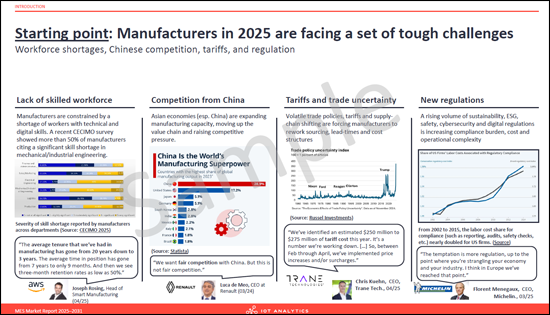
The global Manufacturing Execution Systems (MES) market reached $5.5 billion in 2024. Forecasts indicate a valuation of $8.7 billion by 2031. Data indicates that 54.4% of small- and medium-sized manufacturers rely on manual methods, such as pen and paper or spreadsheets. Legacy methods are being replaced as users can now start small with modular MES architectures and scale as their needs evolve.
This report details the transition to modular MES architectures enabled by IT/OT convergence. It defines 11 novel capabilities, foremost among them Generative AI (GenAI), Unified Namespace (UNS), and Digital Twin integration.
Sample preview
Competitive Landscape & Market Structure:
The market remains fragmented, comprising over 300 vendors. Leadership varies by industry vertical:
Pharmaceuticals: Korber
Automotive & Food/Beverage: Rockwell Automation
Electronics: Siemens
Semiconductors: Applied Materials
Sample preview
Key Trends & ROI:
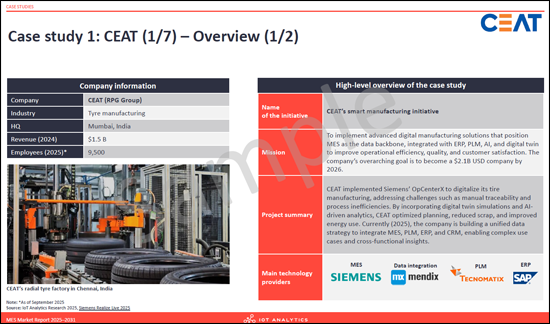
Manufacturers replacing manual systems with modern MES platforms demonstrate double-digit gains in yield and efficiency. Case studies in this report detail implementation strategies, including CEAT (46% scrap reduction), TDK Electronics, and Sonaca. Additionally, the analysis outlines the foundational functions (Work Orders, Scheduling, Tracking, OEE) serving as the primary enablers for digital transformation.
Key Questions Addressed:
What is MES (e.g., definition), how does it compare to MOM and how has it evolved?
What are the core components and new additions in the MES tech stack?
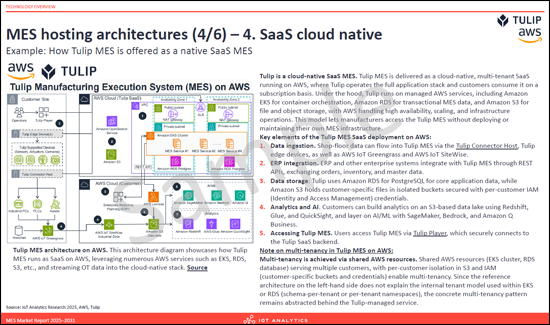
What MES deployment options exist and what are some of the upcoming architectures?
What is the global MES market size
Who are the leading MES vendors and what are their market shares?
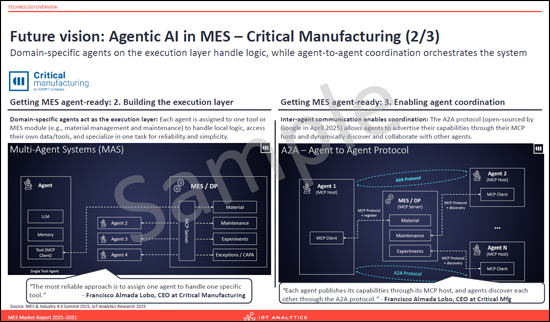
What major trends are shaping the MES market in the years to come?
What are the key challenges for MES vendors and MES users today?
What actionable recommendations can benefit MES vendors and users?
Companies mentioned:
A selection of companies mentioned in the report.
ABB
Applied Materials
AVEVA
Critical Manufacturing
Dassault Systemes
DigiwinSoft
Emerson
GE Vernova
Honeywell
iBase-t
Infor
iTAC Software
Korber
MachineMetrics
MasterControl
MPDV
Oracle
PSI
Rockwell Automation
SAP
Schneider Electric
Sepasoft
Siemens
Tulip
Yokogawa
Table of Contents
1. Executive summary
Executive summary (5 parts)
Analyst opinion: 5 things that stood out in our research
Introduction: Chapter overview and key takeaways
Starting point: Manufacturers in 2025 are facing a set of tough challenges
MES is a key tool in helping tackle each of these challenges
A steady increase in MES/MOM search volume shows rising interest
Generally, manufacturers recognize that MES is important for 6 key aspects
Example: The crucial role of an MES for product safety
MES is just one small puzzle piece in the industrial software market
The following slides look at 3 aspects of MES/MOM
2. Introduction
Definition of MES/MOM (3 parts)
Basics of MOM (7 parts)
Basics of MES (4 parts)
3. Technology overview
Technology overview: Chapter overview and key takeaways
MES vendors today have split their offerings into individual capabilities
MES reference technology stack - Overview
MES reference technology stack - Definitions
A more simplified view of MES systems: "The core 4"
11 novel capabilities of modern MES (4 parts)
Comparing MES with PLM/ERP/SCADA (2 parts)
Comparing MES with complementary software solutions
MES hosting architectures (6 parts)
Likely migration paths away from on-prem MES/spreadsheets
Future vision: Agentic AI in MES-Critical Manufacturing (3 parts)
4. Market size & outlook
Market size & outlook: Chapter overview and key takeaways
Global MES market - Overview
Why our MES market sizing differs from other published estimates
The effect of Industrial AI on the MES market
MES adoption by type
The total addressable market (TAM) for MES
Global MES market-Top 20 vendors (2024)
Global MES market-Top vendors in each industry (2024)
Global MES market - By industry
Discrete manufacturing MES market - By detailed industry
Hybrid manufacturing MES market - By detailed industry
Process manufacturing MES market - By detailed industry
Global MES market - By region
East Asia & Pacific MES market - By country
North America MES market - By country
Europe & Central Asia MES market - By country
5. Competitive landscape
Competitive landscape: Chapter overview and key takeaways
Competitive Landscape - Overview
Key company profile - Siemens (2 parts)
Key company profile - Rockwell (2 parts)
Key company profile - Dassault Systemes (2 parts)
Key company profile - Critical Manufacturing (2 parts)
Key company profile - Sepasoft (3 parts)
6. Case studies
Case studies: Chapter overview and key takeaways
Analyst opinion-5 things that stand out from MES case studies
Case study 1: CEAT (7 parts)
Case study 2: TDK Electronics (7 parts)
Case study 3: SPM (5 parts)
Case study 4: Sonaca (6 parts)
Other adoption insights (2 parts)
The vendor selection process (2 parts)
7. Trends
Trends: Chapter overview and key takeaways
Trend 1
Trend 2 (2 parts)
Trend 3
Trend 4
Trend 5
Trend 6
Trend 7
8. Challenges
Challenges: Chapter overview and key takeaways
Analyst opinion-6 MES challenges that stand out
MES vendor challenges (3 parts)
MES user challenges (6 parts)
9. Recommendations
Background: IoT Analytics collected 17 actionable recommendations from industry experts
Recommendations: Chapter overview and key takeaways