



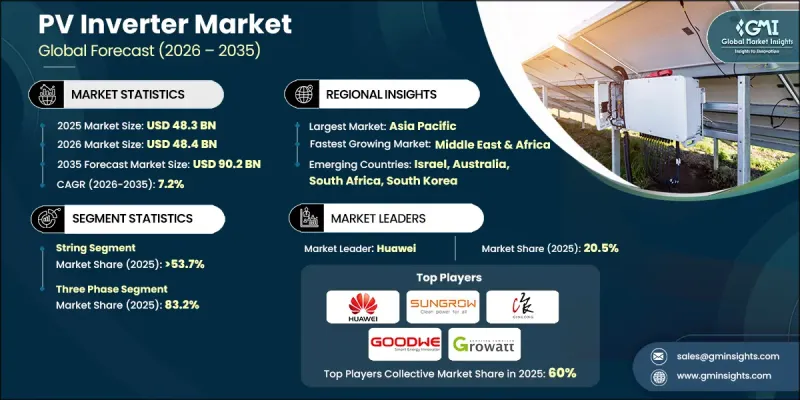
세계의 태양광 인버터 시장은 2025년에 483억 달러로 평가되었고, 2035년까지 연평균 복합 성장률(CAGR) 7.2%로 성장하여 902억 달러에 이를 것으로 예측됩니다.

시장 성장은 고효율 변환, 엄격한 계통 동기화 및 점점 더 고도화되는 스마트 그리드 지원 기능을 필요로 하는 대규모 발전소, 상업용 옥상 및 주거용 시스템에서 태양광 발전 도입의 가속화에 의해 뒷받침되고 있습니다. 태양광 발전의 보급이 확대됨에 따라 인버터는 단순한 변환 하드웨어가 아니라 전압 및 주파수 거동 관리, 전력 품질 향상, 원격 진단, 태양광 발전과 에너지 저장을 결합한 하이브리드 구성 지원 등 현대 태양광 발전 시스템의 제어 계층 역할을 담당하게 되었습니다. 역할을 담당하고 있습니다. 이러한 변화로 인해 고객은 초기 비용뿐만 아니라 장기적인 신뢰성, 컴플라이언스, 수명주기 성능, 특히 그리드 코드 및 안전 요구사항이 지속적으로 강화됨에 따라 장기적인 신뢰성, 컴플라이언스, 라이프사이클 성능을 우선시하게 되었습니다.
| 시장 범위 | |
|---|---|
| 개시 연도 | 2025년 |
| 예측 연도 | 2026-2035년 |
| 개시 연도 가치 | 483억 달러 |
| 예측 금액 | 902억 달러 |
| CAGR | 7.2% |
주요 성장 동력은 디지털화와 IoT를 활용한 모니터링으로의 빠른 전환입니다. 개발자와 자산 소유자는 인버터 성능에 대한 실시간 가시성을 확보하고, 예지보전 트리거를 설정하고, 신속한 문제 해결을 통해 다운타임을 최소화하고 발전량을 최대화하고자 합니다. 이와 함께 기업 및 가정이 백업 전원, 피크 차단, 자가 소비율 향상을 통해 탄력성과 우수한 에너지 경제성을 추구하는 가운데, 하이브리드 태양광 및 축전 시스템의 보급이 시장을 견인하고 있습니다. 이러한 추세에 따라 제조업체들은 보다 강력한 그리드 형성/그리드 지원 기능, 개선된 통신 프로토콜, 소프트웨어 기반 최적화 기능을 갖춘 인버터 제공을 추진하고 있으며, 재생에너지 비율이 높은 환경에서도 네트워크 안정화에 기여할 수 있는 그리드 인터랙티브 디바이스로 진화하고 있습니다.
스트링 인버터 부문은 2025년 53.7%의 점유율을 차지했습니다. 주거용 및 소규모 상업용 시설의 비용 효율적인 설치에 주력하는 한편, 출력 등급 향상, 멀티 MPPT 설계, 안전 및 모니터링 기능 강화로 대규모 옥상 설치 및 분산형 프로젝트로 확대되고 있습니다. 지붕 설치가 확대되는 시장에서 개발자가 성능을 희생하지 않고 BOS 비용을 최적화하는 설계를 요구하는 가운데, 스트링 인버터는 효율성, 시스템 설계의 유연성, 관리 가능한 유지보수성의 균형을 갖춘 제품을 원하는 구매자로부터 지속적으로 주목을 받고 있습니다.
삼상 부문은 2025년 83.2%의 점유율을 차지할 것으로 예상되며, 2026년부터 2035년까지 연평균 복합 성장률(CAGR) 7.5%로 성장할 것으로 전망됩니다. 상업시설, 산업시설, 주거용 태양광 발전설비의 도입 확대가 삼상 PV 인버터의 채택을 촉진하고 있으며, 이러한 시스템에서는 더 큰 부하와 지속적인 에너지 소비에 대응하기 위해 균형 잡힌 전력 분배, 고효율, 안정적인 계통 성능이 요구되고 있습니다. 또한, 강화되는 계통연계 기준 준수와 전력 품질 기준의 향상으로 다상 인버터에 대한 수요가 증가하고 있습니다. 다상 인버터는 전압 조정 능력 향상, 고조파 왜곡 감소, 주파수 안정성 향상을 실현하여 분산형 태양광 발전을 지역 송배전망에 원활하게 통합할 수 있습니다.
미국 태양광 인버터 시장은 2025년 98.8%의 점유율을 차지하며 2035년까지 90억 달러 규모로 성장할 것으로 예측됩니다. 연방 세액공제, 주정부 차원의 재생에너지 목표, 풍부한 프로젝트 파이프라인이 주택, 상업 및 유틸리티 태양광 부문 전반에 걸쳐 효율적이고 계통 연계형 전력 변환 솔루션에 대한 수요를 주도하고 있으며, 미국 전역에 걸쳐 대규모 태양광 및 분산형 태양광 발전 설비의 급속한 확대로 인해 PV 인버터의 채택을 촉진하고 있습니다. 주요 업계 기업의 존재와 이 지역의 첨단 제품 포트폴리오를 도입하기 위한 지속적인 노력은 지속적인 시장 확대를 더욱 촉진할 것으로 예측됩니다.
The Global PV Inverter Market was valued at USD 48.3 billion in 2025 and is estimated to grow at a 7.2% CAGR to reach USD 90.2 billion by 2035.
Market growth is supported by accelerating solar PV deployments across utility-scale parks, commercial rooftops, and residential systems that require high-efficiency conversion, tight grid synchronization, and increasingly smart grid-support functionality. As solar penetration increases, inverters are no longer viewed as simple conversion hardware; they are becoming the control layer for modern PV systems, managing voltage and frequency behavior, improving power quality, enabling remote diagnostics, and increasingly supporting hybrid configurations that combine PV with energy storage. This shift is pushing customers to prioritize long-term reliability, compliance, and lifecycle performance, not just upfront pricing, especially where grid codes and safety requirements continue to tighten.
| Market Scope | |
|---|---|
| Start Year | 2025 |
| Forecast Year | 2026-2035 |
| Start Value | $48.3 Billion |
| Forecast Value | $90.2 Billion |
| CAGR | 7.2% |
A major growth pillar is the rapid movement toward digitalization and IoT-enabled monitoring, where developers and asset owners want real-time visibility of inverter performance, predictive maintenance triggers, and faster troubleshooting to minimize downtime and maximize yields. In parallel, the market is benefiting from the rise of hybrid solar and storage systems as businesses and households seek resilience and better energy economics through backup power, peak shaving, and improved self-consumption. These trends are encouraging manufacturers to deliver inverters with stronger grid-forming / grid-support capabilities, improved communication protocols, and software-driven optimization, turning the inverter into a grid-interactive device that helps stabilize networks under high renewable penetration.
The string inverters segment held 53.7% share in 2025, as they remain the workhorse for cost-effective deployments in residential and smaller commercial installations while also scaling into larger rooftop and distributed projects with improved power ratings, multi-MPPT designs, and enhanced safety and monitoring features. String inverters continue to attract buyers looking for a strong balance of efficiency, system design flexibility, and manageable maintenance in markets where rooftops are expanding, and developers want designs that optimize BOS costs without sacrificing performance.
The three-phase segment captured 83.2% share in 2025 and is projected to grow at a CAGR of 7.5% between 2026 and 2035. The expanding deployment of commercial, industrial, and multi-unit residential solar installations is driving the adoption of three-phase PV inverters, as these systems demand balanced power distribution, higher efficiency, and stable grid performance to handle larger loads and sustained energy consumption. Additionally, stricter grid-code compliance and rising power-quality standards are boosting the demand for multi-phase inverters, which provide enhanced voltage regulation, reduced harmonic distortion, and improved frequency stability, enabling smooth integration of distributed solar generation into regional transmission and distribution networks.
U.S. PV Inverter Market held 98.8% share in 2025 and is projected to generate USD 9 billion by 2035. Rapid growth of utility-scale and distributed solar installations across the country is fueling PV inverter adoption, as federal tax credits, state-level renewable energy targets, and extensive project pipelines drive demand for efficient, grid-compliant power conversion solutions across residential, commercial, and utility solar sectors. The presence of major industry players and their continued initiatives to introduce advanced product portfolios in the region are further expected to support sustained market expansion.
Key players involved in the Global PV Inverter Market include Huawei Technologies, Sungrow Power Supply, Ginlong Solis, Growatt, Enphase Energy, SolarEdge Technologies, SMA Solar Technology, GoodWe, Delta Electronics, Siemens, Schneider Electric, TMEIC, GE Vernova, Fronius International, Canadian Solar, Altenergy Power System (APsystems), Eaton, Panasonic, SINENG, Hitachi Hi-Rel Power Electronics, DARFON, MA Solar Italy, SOFARSOLAR, TABUCHI ELECTRIC. Companies are strengthening their foothold by pushing technology differentiation, grid-support inverters with reactive power control, voltage regulation, and advanced compliance features that make approvals smoother and performance more bankable. They are investing heavily in digital platforms (cloud monitoring, remote diagnostics, predictive maintenance) to reduce downtime and create recurring revenue through subscriptions, extended warranties, and lifecycle services. Another common strategy is expanding hybrid and storage-ready inverter portfolios to capture the fast-growing solar-plus-storage demand across residential and C&I sites.