Aeroderivative Sensor Market Opportunity, Growth Drivers, Industry Trend Analysis, and Forecast 2026 - 2035
상품코드:1959647
리서치사:Global Market Insights Inc.
발행일:2026년 02월
페이지 정보:영문 165 Pages
라이선스 & 가격 (부가세 별도)
ㅁ Add-on 가능: 고객의 요청에 따라 일정한 범위 내에서 Customization이 가능합니다. 자세한 사항은 문의해 주시기 바랍니다.
한글목차
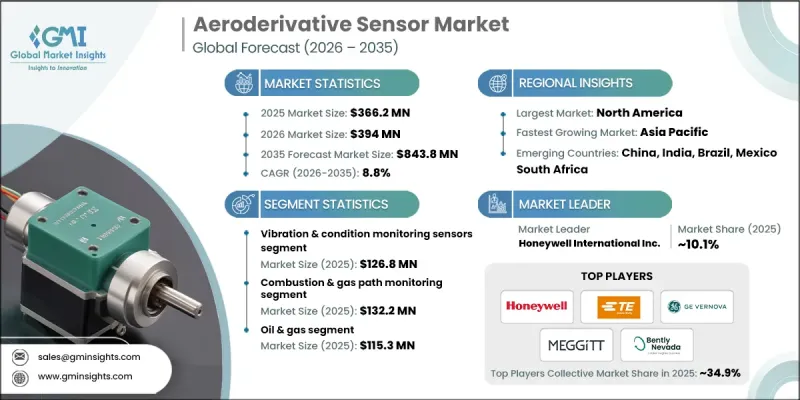
세계의 항공기 파생 센서 시장은 2025년에 3억 6,620만 달러로 평가되었고, 2035년까지 연평균 복합 성장률(CAGR) 8.8%로 성장하여 8억 4,380만 달러에 이를 것으로 예측됩니다.
시장 확대는 국방 및 민간 항공 분야에서 항공우주 플랫폼의 지속적인 발전과 밀접한 관련이 있습니다. 항공기 파생 센서는 항공기 시스템의 모니터링, 제어, 최적화에 필수적이며, 가혹한 조건에서도 안전하고 효율적인 운항을 지원합니다. 항공기 시스템이 점점 더 복잡해지고 성능이 중요해짐에 따라, 높은 정확도, 장기적인 신뢰성, 가혹한 작동 환경에서의 내성을 갖춘 센서에 대한 수요가 증가하고 있습니다. 업계가 운항 안전, 성능 최적화, 연료 효율에 초점을 맞추고 있는 것이 센서 도입에 박차를 가하고 있습니다. 규제 준수와 자동화된 항공기 운항에 대한 관심이 높아지면서 수요가 더욱 증가하고 있습니다. 지속적인 기술 발전으로 센서의 소형화, 고정밀화, 고내구성화가 진행되어 차세대 항공우주 플랫폼 전반에 걸쳐 폭넓은 통합을 지원하고 있습니다. 이러한 요인들이 복합적으로 작용하여 항공 시스템이 더 높은 효율성과 신뢰성 기준을 향해 진화함에 따라 항공기 파생 센서 시장은 지속적으로 성장할 것으로 예측됩니다.
시장 범위
개시 연도
2025년
예측 연도
2026-2035년
개시 연도 가치
3억 6,620만 달러
예측 금액
8억 4,380만 달러
CAGR
8.8%
진동 및 상태 모니터링 센서 부문은 2025년 1억 2,680만 달러 시장 규모를 형성하며 시장에서 가장 큰 부문 중 하나를 차지할 것으로 예측됩니다. 이러한 확고한 지위는 회전 부품 및 터빈 시스템의 건전성을 지속적으로 평가하는 데 있어 그 중요성을 반영합니다. 이 센서는 고온 및 고부하 환경에서 작동하면서 고장을 조기에 감지하고 예기치 않은 정지를 최소화하여 전체 시스템의 신뢰성을 향상시킵니다.
연소 및 가스 경로 모니터링 센서 부문은 2025년 1억 3,220만 달러로 용도 부문 중 가장 큰 점유율을 차지할 것으로 예측됩니다. 그 중요성은 항공기 파생 시스템에서 효율성, 출력 안정성, 연료 최적화, 배출가스 성능에 직접적으로 영향을 미치는 중요한 운전 파라미터를 추적하는 역할에서 비롯됩니다.
북미 항공기 파생 센서 시장은 2025년 39.4%의 점유율을 차지하며 지역별로 선두를 유지하고 있습니다. 이 지역 시장 성장은 지능형 터빈 기술 도입 확대, 예지보전 실천, 디지털 통합 모니터링 시스템 등이 뒷받침하고 있습니다. 자동화, 운전 안전, 규제 대응형 모니터링에 대한 투자가 첨단 항공기 파생 센서에 대한 수요를 지속적으로 견인하고 있습니다.
목차
제1장 조사 방법과 범위
제2장 주요 요약
제3장 업계 인사이트
제4장 경쟁 구도
제5장 시장 추산 및 예측 : 센서 유형별, 2022-2035
제6장 시장 추산 및 예측 : 시스템 통합 포인트별, 2022-2035
제7장 시장 추산 및 예측 : 인터페이스별, 2022-2035
제8장 시장 추산 및 예측 : 판매채널별, 2022-2035
제9장 시장 추산 및 예측 : 용도별, 2022-2035
제10장 시장 추산 및 예측 : 지역별, 2022-2035
제11장 기업 개요
LSH
영문 목차
영문목차
The Global Aeroderivative Sensor Market was valued at USD 366.2 million in 2025 and is estimated to grow at a CAGR of 8.8% to reach USD 843.8 million by 2035.
Market expansion is linked to the continued advancement of aerospace platforms across both defense and commercial aviation. Aeroderivative sensors are essential for monitoring, controlling, and optimizing aircraft systems, supporting safe and efficient operation under demanding conditions. As aircraft systems become more complex and performance-driven, demand is rising for sensors that deliver high accuracy, long-term reliability, and resilience in extreme operating environments. Industry focus on operational safety, performance optimization, and fuel efficiency is accelerating sensor adoption. Increased attention to regulatory compliance and automated aircraft operations is further strengthening demand. Ongoing technological progress is enabling sensors to become smaller, more precise, and more durable, supporting broader integration across next-generation aerospace platforms. These factors collectively position the aeroderivative sensor market for sustained growth as aviation systems continue to evolve toward higher efficiency and reliability standards.
Market Scope
Start Year
2025
Forecast Year
2026-2035
Start Value
$366.2 Million
Forecast Value
$843.8 Million
CAGR
8.8%
The vibration and condition monitoring sensors segment generated USD 126.8 million in 2025, representing one of the largest segments in the market. Their strong position reflects their importance in continuously assessing the health of rotating components and turbine systems. These sensors support early fault detection, minimize unplanned outages, and enhance overall system reliability while operating under high thermal and mechanical stress.
The combustion and gas path monitoring sensors segment accounted for USD 132.2 million in 2025, holding the largest share among application segments. Their importance stems from their role in tracking critical operating parameters that directly influence efficiency, output stability, fuel optimization, and emissions performance within aeroderivative systems.
North America Aeroderivative Sensor Market accounted for 39.4% share in 2025, maintaining its leading regional position. Market growth in the region is supported by rising adoption of intelligent turbine technologies, predictive maintenance practices, and digitally integrated monitoring systems. Investments in automation, operational safety, and compliance-driven monitoring continue to drive demand for advanced aeroderivative sensors.
Key companies operating in the Global Aeroderivative Sensor Market include Honeywell International Inc., GE Vernova / GE Aviation, TE Connectivity Ltd., Woodward Inc., AMETEK Inc., Meggitt SA, Bently Nevada (Baker Hughes), Kulite Semiconductor Products Inc., Kistler Instrument Corp., PCB Piezotronics Inc., Sensirion AG, Thermocoax Inc., Conax Technologies, Scanivalve Corporation, Unison LLC, Columbia Research Labs Inc., and Smith Systems Inc. Companies in the aeroderivative sensor market are reinforcing their market position through continuous investment in precision engineering, product reliability, and advanced manufacturing capabilities. Many players are focusing on developing sensors with enhanced durability and longer service life to meet stringent aerospace requirements. Strategic partnerships with aircraft and turbine system manufacturers are helping to integrate sensors at early design stages. Firms are also expanding customization capabilities to address specific operational needs. Emphasis on certification readiness, after-sales support, and lifecycle services is improving customer retention.
Table of Contents
Chapter 1 Methodology and Scope
1.1 Market scope and definition
1.2 Research design
1.2.1 Research approach
1.2.2 Data collection methods
1.3 Data mining sources
1.3.1 Global
1.3.2 Regional/Country
1.4 Base estimates and calculations
1.4.1 Base year calculation
1.4.2 Key trends for market estimation
1.5 Primary research and validation
1.5.1 Primary sources
1.6 Forecast model
1.7 Research assumptions and limitations
Chapter 2 Executive Summary
2.1 Industry 360° synopsis, 2022 - 2035
2.2 Key market trends
2.2.1 Sensor type trends
2.2.2 System Integration trends
2.2.3 Interface trends
2.2.4 Sales channel trends
2.2.5 End use trends
2.2.6 Regional trends
2.3 TAM analysis, 2025-2035
2.4 CXO perspectives: Strategic imperatives
2.4.1 Executive decision points
2.4.2 Critical success factors
2.5 Future outlook and strategic recommendations
Chapter 3 Industry Insights
3.1 Industry ecosystem analysis
3.1.1 Supplier landscape
3.1.2 Profit margin analysis
3.1.3 Cost structure
3.1.4 Value addition at each stage
3.1.5 Factor affecting the value chain
3.1.6 Disruptions
3.2 Industry impact forces
3.2.1 Growth drivers
3.2.1.1 Increasing demand for advanced aerospace systems
3.2.1.2 Drone safety and regulations are driving demand for real-time aeroderivative sensors