



세계의 배터리 팩 시장은 2025년에 1,611억 달러로 평가되었고, 2035년까지 연평균 복합 성장률(CAGR) 12.1%로 성장하여 5,216억 달러에 이를 것으로 예측됩니다.

시장 성장은 탄소 배출량을 줄이고 전기화 및 청정 에너지 시스템으로의 전환을 가속화하는 데 초점을 맞춘 세계 정책 이니셔티브에 의해 주도되고 있습니다. 각 지역 정부는 에너지 저장 시스템 도입을 적극적으로 지원하고 있으며, 이는 첨단 배터리 기술에 대한 지속적인 투자를 촉진하고 있습니다. 배터리 화학 및 설계의 지속적인 개선으로 에너지 밀도, 안전성, 충전 효율, 작동 수명 등의 성능 파라미터가 향상되고 있습니다. 이러한 발전은 비용 효율성과 신뢰성을 향상시켜 다양한 응용 분야에서 배터리 팩의 실용성을 점점 더 높이고 있습니다. 전기화가 운송 분야에서 산업 시스템, 에너지 저장 및 소비자 기술로 확장됨에 따라 배터리 팩은 현대 인프라의 핵심 부품이 되고 있습니다. 또한, 차세대 저장 기술에 대한 신뢰가 높아지고 세계 가치사슬 전반에서 에너지 복원력, 효율성, 지속가능성을 위한 필수 도구로 배터리가 널리 받아들여지고 있는 것도 시장 성장에 도움이 되고 있습니다. 배터리 팩은 여러 개의 배터리 셀을 보호 하우징, 열 제어, 전기 인터페이스, 제어 전자 장치와 결합한 통합 에너지 저장 시스템으로 정의됩니다. 안정적인 전력 공급, 작동 상태 모니터링, 안전성 확보, 그리고 가전제품, 자동차 플랫폼, 산업용 장비, 대규모 에너지 저장 시스템에서 안정적인 에너지 공급을 실현하도록 설계되어 있습니다. 개인용 전자기기의 보급 확대에 따라 경량화, 소형화, 고성능 배터리 팩에 대한 수요가 증가하고 있습니다. 제품 교체 주기의 단축, 가동 시간 연장, 급속 충전에 대한 기대, 제조업체는 첨단 배터리 솔루션의 통합을 요구하고 있습니다.
| 시장 범위 | |
|---|---|
| 개시 연도 | 2025년 |
| 예측 연도 | 2026-2035년 |
| 개시 연도 가치 | 1,611억 달러 |
| 예측 금액 | 5,216억 달러 |
| CAGR | 12.1% |
니켈-망간-코발트 화학 부문은 2025년 61.1%의 점유율을 차지할 것으로 예상되며, 2035년까지 연평균 11.7%의 성장률을 보일 것으로 전망됩니다. 고에너지 밀도 솔루션에 대한 강한 수요로 인해 성능, 중량 효율, 출력의 균형, 제한된 공간, 고 수요 용도에 적합한 이 화학 성분의 채택이 촉진되고 있습니다.
유틸리티 규모의 응용 분야는 재생에너지 발전의 통합 가속화에 힘입어 2035년까지 연평균 12.8%의 성장률을 보일 것으로 예측됩니다. 전력 공급의 변동성 관리, 송전망의 신뢰성 향상, 부하 분산 최적화를 위해 에너지 저장 시스템이 점점 더 많이 필요해지면서 대형 배터리 팩에 대한 수요 증가를 주도하고 있습니다.
북미 배터리 팩 시장은 2025년 94.4%의 점유율을 차지하며 2035년까지 675억 달러 규모로 성장할 것으로 예측됩니다. 이러한 성장은 전기차 보급 확대, 정책적 인센티브, 국내 제조 역량 강화, 공급망 탄력성 강화 및 장기적인 시장 확대를 촉진하고 있습니다.
The Global Battery Pack Market was valued at USD 161.1 billion in 2025 and is estimated to grow at a CAGR of 12.1% to reach USD 521.6 billion by 2035.
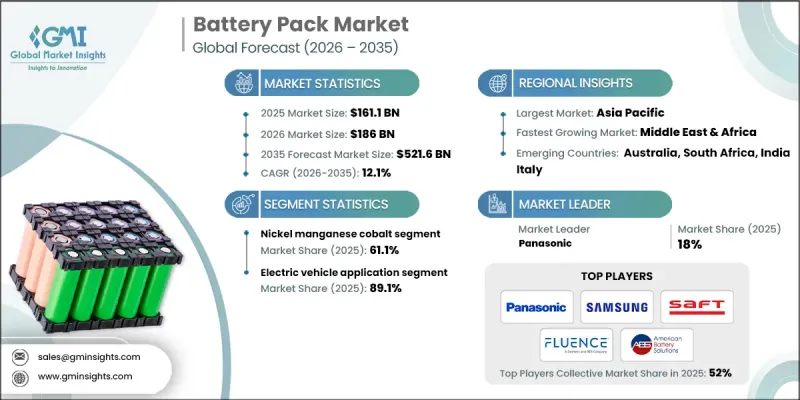
Market growth is driven by worldwide policy initiatives focused on lowering carbon emissions and accelerating the transition toward electrification and clean energy systems. Governments across regions are actively supporting energy storage deployment, which is encouraging sustained investment in advanced battery technologies. Continuous improvements in battery chemistry and design are enhancing performance parameters such as energy density, safety, charging efficiency, and operational life. These advancements are improving cost-effectiveness and reliability, making battery packs increasingly viable across a wide range of applications. As electrification expands beyond transportation into industrial systems, energy storage, and consumer technologies, battery packs are becoming a core component of modern infrastructure. The market is also benefiting from growing confidence in next-generation storage technologies and broader acceptance of batteries as essential tools for energy resilience, efficiency, and sustainability across global value chains. A battery pack is defined as an integrated energy storage system that combines multiple battery cells with protective housing, thermal regulation, electrical interfaces, and control electronics. It is designed to deliver stable power output, monitor operating conditions, ensure safety, and support reliable energy delivery across consumer electronics, automotive platforms, industrial equipment, and large-scale energy storage systems. Rising adoption of personal electronic devices is strengthening demand for lightweight, compact, and high-performance battery packs. Shorter product replacement cycles, longer operating time expectations, and rapid charging requirements are encouraging manufacturers to integrate advanced battery solutions.
| Market Scope | |
|---|---|
| Start Year | 2025 |
| Forecast Year | 2026-2035 |
| Start Value | $161.1 Billion |
| Forecast Value | $521.6 Billion |
| CAGR | 12.1% |
The nickel manganese cobalt chemistry segment accounted for 61.1% share in 2025 and is expected to grow at a CAGR of 11.7% through 2035. Strong demand for high-energy density solutions is driving adoption of this chemistry, which offers a balance of performance, weight efficiency, and power output suitable for space-constrained and high-demand applications.
The utility-scale applications segment is forecast to grow at a CAGR of 12.8% by 2035, supported by the accelerating integration of renewable power generation. Energy storage systems are increasingly required to manage variability in power supply, improve grid reliability, and optimize load distribution, driving higher demand for large-format battery packs.
North America Battery Pack Market held 94.4% share in 2025 and is projected to generate USD 67.5 billion by 2035. Growth is supported by rising electric vehicle adoption, policy incentives, and strengthening domestic manufacturing capabilities, which are reinforcing supply chain resilience and long-term market expansion.
Key companies operating in the Global Battery Pack Market include Panasonic, Samsung, SK Innovation, Saft, Fluence Energy, Powin Energy, Rivian, VARTA, Inventus Power, American Battery Solutions, Dynapack International Technology, Amara Raja Energy & Mobility, FRIWO, PMBL Limited, AGreatE, Blue Line Battery, Emerging Power, Apex Mobile Power, Rapport, and Omnitron Bulgaria OOD. Companies in the battery pack market are strengthening their competitive position through capacity expansion, technology innovation, and strategic localization of manufacturing. Many players are investing heavily in next-generation chemistries and modular pack designs to improve scalability and reduce production costs. Vertical integration across cell manufacturing, pack assembly, and energy management software is helping improve efficiency and supply security. Firms are also forming long-term partnerships with end users to co-develop application-specific solutions.