



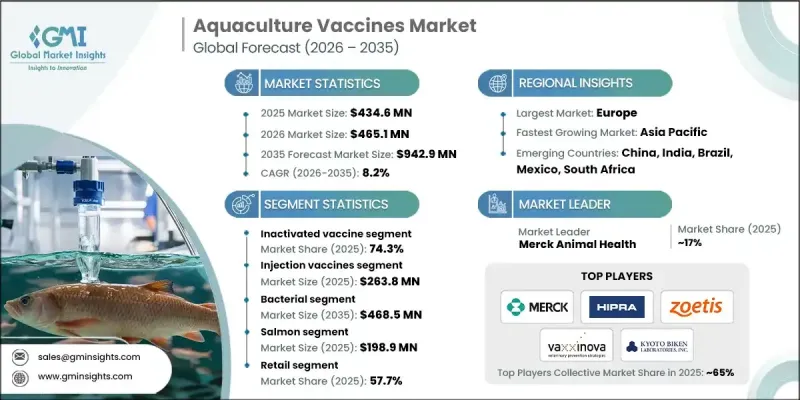
세계의 양식용 백신 시장은 2025년에 4억 3,460만 달러로 평가되었고, 2035년까지 연평균 복합 성장률(CAGR) 8.2%로 성장하여 9억 4,290만 달러에 이를 것으로 예측됩니다.
시장 성장은 전 세계 양식 생산의 확대와 어류 수요 증가에 의해 주도되고 있습니다. 비브리오, 에어로모나스, 기타 병원균에 의한 감염을 포함한 세균 및 바이러스 감염의 빈번한 발생으로 인해 사망률을 낮추고 생산성을 향상시키는 백신의 필요성이 대두되고 있습니다. 양식용 백신은 어류, 갑각류 등 수생동물의 면역체계를 자극하여 특정 병원균에 대한 저항력을 제공하는 생물학적 제제입니다. 주사, 침지, 경구 투여 등의 경로로 투여되는 이들 백신은 질병 발생을 최소화하고 항생제 사용량을 줄이며, 지속가능한 양식업을 촉진하는 데 기여합니다. 아시아태평양과 라틴아메리카를 중심으로 한 신흥 시장이 성장에 기여하고 있으며, 경구 및 침습 백신 투여 기술에 대한 연구개발 투자도 증가하고 있습니다. 제조업체와 양식업체와의 협력을 통해 혁신적인 솔루션의 빠른 상용화와 광범위한 보급이 가능해졌습니다.
| 시장 범위 | |
|---|---|
| 개시 연도 | 2025년 |
| 예측 연도 | 2026-2035년 |
| 개시 연도 가치 | 4억 3,460만 달러 |
| 예측 금액 | 9억 4,290만 달러 |
| CAGR | 8.2% |
불활성화 백신 부문은 74.3%의 점유율을 차지하며 2035년까지 연평균 복합 성장률(CAGR) 8.1%를 나타낼 것으로 예측됩니다. 안전성, 광범위한 보호 효과, 안정성으로 인해 생산자들 사이에서 매우 선호되고 있습니다. 이 백신은 다양한 양식 품종에 광범위하게 사용되며, 병원성으로 되돌아갈 위험 없이 일관된 면역 반응을 제공합니다. 주사제, 침지제 등 다양한 투여 형태를 사용할 수 있어 운영상의 유연성을 제공합니다. 비생백신 제제를 권장하는 규제 기준, 무항생제 수산물에 대한 소비자 수요 증가, 집약적 양식 시스템에서 바이오 보안에 대한 관심 증가는 비생백신 제제의 채택을 더욱 촉진하고 있습니다.
주사 백신 분야는 2025년 2억 6,380만 달러 시장 규모를 기록할 것으로 예상되며, 2035년까지 연평균 복합 성장률(CAGR) 8.1%로 확대될 것으로 전망됩니다. 주사 백신은 어류에 정확한 용량을 직접 투여하여 우수한 효능과 지속적인 면역력을 제공하며, 박테리아 및 바이러스성 병원체에 대한 최적의 방어력을 보장합니다. 자동 백신 접종 시스템 및 인체공학적 장비의 혁신으로 투여가 간소화되고, 동물의 스트레스를 줄여 부화장과 양식장 전체에서 업무 효율성이 향상되었습니다.
유럽 양식 백신 시장은 선진화된 양식 산업, 질병 예방에 대한 강력한 규제, 백신 프로그램의 조기 도입으로 인해 2025년 43%의 점유율을 차지할 것으로 예측됩니다. 예방적 항생제 사용에 대한 규제 제한이 백신으로의 전환을 가속화하고 있으며, 확립된 콜드체인 유통망, 숙련된 수의사 지원, 주요 백신 제조업체의 존재가 지속적인 성장에 기여하고 있습니다.
The Global Aquaculture Vaccines Market was valued at USD 434.6 million in 2025 and is estimated to grow at a CAGR of 8.2% to reach USD 942.9 million by 2035.
Market growth is driven by the expansion of global aquaculture production and the rising demand for fish. Frequent bacterial and viral outbreaks, including infections caused by Vibrio, Aeromonas, and other pathogens, have increased the need for vaccines that reduce mortality and improve productivity. Aquaculture vaccines are biological preparations that stimulate the immune system of aquatic animals, such as fish and crustaceans, providing resistance to specific pathogens. Administered via injection, immersion, or oral routes, these vaccines help minimize disease outbreaks, reduce antibiotic use, and promote sustainable fish farming. Emerging markets, particularly in Asia-Pacific and Latin America, are contributing to growth, alongside rising investments in R&D for oral and immersion vaccine delivery. Collaborations between manufacturers and aquaculture companies are enabling faster commercialization and broader access to innovative solutions.
| Market Scope | |
|---|---|
| Start Year | 2025 |
| Forecast Year | 2026-2035 |
| Start Value | $434.6 Million |
| Forecast Value | $942.9 Million |
| CAGR | 8.2% |
The inactivated vaccines segment held a 74.3% share and is expected to grow at a CAGR of 8.1% through 2035. Their safety profile, broad-spectrum protection, and stability make them highly preferred among producers. These vaccines are widely used across various aquaculture species and provide consistent immune responses without the risk of reverting to virulence. They are available in multiple delivery formats, including injectable and immersion, offering operational flexibility. Regulatory standards favoring non-live formulations, increasing consumer demand for antibiotic-free seafood, and a focus on biosecurity in intensive farming systems further support their adoption.
The injection vaccines segment accounted for USD 263.8 million in 2025 and is projected to grow at a CAGR of 8.1% through 2035. Injectable vaccines offer superior efficacy and long-lasting immunity by delivering precise doses directly to fish, ensuring optimal protection against bacterial and viral pathogens. Innovations in automated vaccination systems and ergonomic devices have simplified administration, reduced stress on animals, and increased operational efficiency across hatcheries and grow-out farms.
Europe Aquaculture Vaccines Market held a 43% share in 2025, driven by its advanced aquaculture industry, strong regulatory emphasis on disease prevention, and early adoption of vaccination programs. Regulatory restrictions on prophylactic antibiotic use have accelerated the shift toward vaccines, while a well-established cold-chain distribution network, skilled veterinary support, and the presence of leading vaccine manufacturers contribute to sustained growth.
Key players in the Global Aquaculture Vaccines Market include Cavac, CIBA, HIPRA, Kemin Industries, Kyoritsu Seiyaku, Kyoto Biken Laboratories, Merck Animal Health, Nisseiken, Phibro Animal Health, Tecnovax, Vaxxinova International, Veterquimica, Virbac, Zoetis. Companies in the Global Aquaculture Vaccines Market are strengthening their positions by investing in research and development of oral and immersion-based delivery systems, expanding manufacturing capacity, and forming strategic alliances with aquaculture operators for faster commercialization. They are also focusing on emerging markets, enhancing cold-chain logistics, offering value-added services such as technical support and training, and ensuring regulatory compliance to build trust and maintain market leadership.