Particulate Matter Monitoring Market Opportunity, Growth Drivers, Industry Trend Analysis, and Forecast 2026 - 2035
상품코드:1959620
리서치사:Global Market Insights Inc.
발행일:2026년 02월
페이지 정보:영문 180 Pages
라이선스 & 가격 (부가세 별도)
ㅁ Add-on 가능: 고객의 요청에 따라 일정한 범위 내에서 Customization이 가능합니다. 자세한 사항은 문의해 주시기 바랍니다.
한글목차
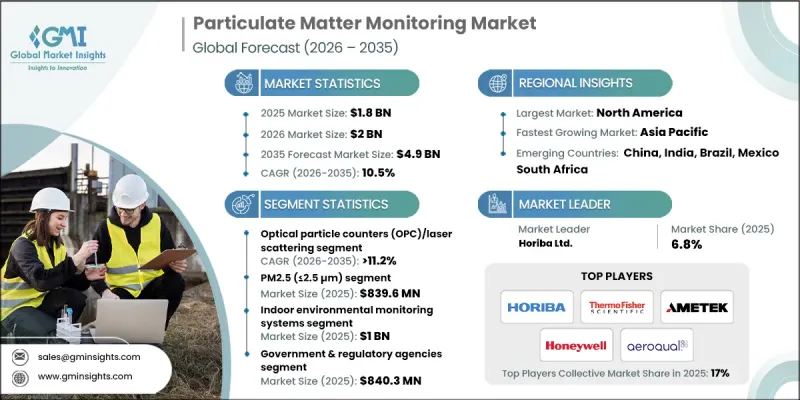
세계의 미세먼지 모니터링 시장은 2025년에 18억 달러로 평가되었고, 2035년까지 연평균 복합 성장률(CAGR) 10.5%로 성장하여 49억 달러에 이를 것으로 예측됩니다.
이 시장은 대기 중 부유 고체 입자와 물방울(먼지, 매연, 연기 등)의 검출에 초점을 맞추고 있으며, 특히 PM2.5와 PM10 수준에 주목하여 대기질을 평가합니다. 고정밀 기준 관측소, 실시간 연결 기능을 갖춘 휴대용 AI 지원 센서, IoT 기반 장치 등 실내 및 실외 환경에서 첨단 모니터링 솔루션이 점점 더 많이 도입되고 있습니다. 이러한 시스템은 공중 보건 위험 평가, 규제 준수 및 오염 관리 조치에 있어 매우 중요합니다. 전 세계 도시화 및 산업화의 진전과 더욱 엄격해지는 대기질 규제는 정확한 PM 모니터링에 대한 수요를 촉진하고 있습니다. 정부 및 환경기관은 정책 수립, 도시 계획, 공중 보건 보호를 위한 신뢰할 수 있는 데이터를 제공하기 위해 모니터링 인프라와 분석 플랫폼에 많은 투자를 하고 있습니다. 기술 발전과 규제 압력의 시너지 효과로 인해 전 세계적으로 PM 모니터링 시스템의 도입이 가속화되고 있습니다.
시장 범위
개시 연도
2025년
예측 연도
2026-2035년
개시 연도 가치
18억 달러
예측 금액
49억 달러
CAGR
10.5%
광학 입자 계수기(OPC)/레이저 산란 부문은 2035년까지 연평균 복합 성장률(CAGR) 11.2%를 나타낼 것으로 예측되며, 현재 시장을 독점하고 있습니다. 그 장점은 높은 측정 정확도, 실시간 모니터링 기능, 광범위한 입자 크기 감지 능력에서 비롯됩니다. 이러한 시스템은 대기 환경의 질과 배출량을 추적하고 규제 준수를 보장하기 위해 널리 활용되고 있습니다. 레이저 산란 및 OPC 기술의 지속적인 발전은 센서 감도 향상, 교정 안정성 향상, 적은 장비로 종합적인 데이터 분석과 같은 새로운 기회를 창출하고 있습니다. 제조업체들은 산업, 도시 및 실내 용도에서 정밀하고 효율적인 모니터링 솔루션에 대한 수요 증가에 대응하기 위해 이러한 개선에 초점을 맞추었습니다.
PM2.5(2.5마이크로미터 이하) 부문은 2025년 8억 3,960만 달러로 미립자 물질 모니터링 시장에서 가장 큰 점유율을 차지할 것으로 예측됩니다. 이러한 우위는 PM2.5 노출과 호흡기 질환, 심혈관 질환 등 건강 위험과의 강한 연관성이 뒷받침하고 있습니다. PM2.5 데이터에 대한 인식 개선, 공중보건 정책, 도시 계획 및 오염 저감 프로그램 활용이 모니터링 시스템 수요를 견인하고 있습니다. 제조업체들은 규제 준수를 지원하고 산업, 도시 및 실내 환경에서의 보급 확대를 위해 작고 유지보수가 적은 PM2.5 장치를 우선적으로 개발하여 디지털 대기질 네트워크에 통합하고 있습니다.
미국 미립자 물질 모니터링 시장은 2025년 7억 1,930만 달러에 달할 것으로 예측됩니다. 공중보건, 도시 대기오염 완화, 스마트시티 계획에 대한 관심이 높아지면서 이 지역은 계속해서 업계를 선도하고 있습니다. 대기질 인프라에 대한 연방 정부의 강력한 투자, 엄격한 환경 규제, 주요 산업 기업의 존재는 북미 시장 지배력을 뒷받침하고 있습니다. 미국 제조업체들은 기술 혁신, 정부 기관과의 협력, 클라우드 기반 분석을 활용하여 모니터링 효율성과 시스템 상호운용성을 향상시키기 위해 확장성, 정확성, 실용성을 겸비한 PM 모니터링 솔루션 개발에 주력하고 있습니다.
목차
제1장 조사 방법과 범위
제2장 주요 요약
제3장 업계 인사이트
제4장 경쟁 구도
제5장 미세먼지 모니터링 시장 추산 및 예측 : 감시 기술별, 2022-2035
제6장 시장 추산 및 예측 : 미세먼지 사이즈별, 2022-2035
제7장 시장 추산 및 예측 : 제품 유형별 규모, 2022-2035
제8장 시장 추산 및 예측 : 용도별, 2022-2035
제9장 시장 추산 및 예측 : 최종사용자 산업별, 2022-2035
제10장 미세먼지 모니터링 시장 추산 및 예측 : 지역별, 2022-2035
제11장 기업 개요
LSH
영문 목차
영문목차
The Global Particulate Matter Monitoring Market was valued at USD 1.8 billion in 2025 and is estimated to grow at a CAGR of 10.5% to reach USD 4.9 billion by 2035.
The market focuses on detecting suspended solid particles and liquid droplets in the air, including dust, soot, and smoke, with particular attention to PM2.5 and PM10 levels to assess air quality. Advanced monitoring solutions, including high-precision reference stations, portable AI-enabled sensors with real-time connectivity, and IoT-based devices, are increasingly deployed in indoor and outdoor environments. These systems are critical for public health risk evaluation, regulatory compliance, and pollution management initiatives. Rising global urbanization, industrialization, and stricter air quality regulations are fueling demand for accurate PM monitoring. Governments and environmental agencies are investing heavily in monitoring infrastructure and analytics platforms to provide reliable data for policymaking, urban planning, and public health protection. The combination of technological advancements and regulatory pressure is driving faster adoption of PM monitoring systems worldwide.
Market Scope
Start Year
2025
Forecast Year
2026-2035
Start Value
$1.8 Billion
Forecast Value
$4.9 Billion
CAGR
10.5%
The optical particle counter (OPC)/laser scattering segment is projected to grow at 11.2% CAGR through 2035 and currently dominates the market. Its prominence stems from its high measurement accuracy, real-time monitoring capability, and ability to detect a wide range of particle sizes. These systems are extensively used to track ambient air quality, emissions, and ensure regulatory compliance. The ongoing advancement of laser scattering and OPC technology is creating new opportunities by enhancing sensor sensitivity, improving calibration stability, and enabling more comprehensive data analysis from fewer devices. Manufacturers are focusing on these improvements to meet the rising demand for precise and efficient monitoring solutions in industrial, urban, and indoor applications.
The PM2.5 (<=2.5 µm) segment accounted for USD 839.6 million in 2025 and holds the largest share of the particulate matter monitoring market. This dominance is driven by the strong link between PM2.5 exposure and health risks such as respiratory and cardiovascular diseases. Increasing awareness, public health initiatives, and the use of PM2.5 data in urban planning and pollution reduction programs are fueling demand for monitoring systems. Manufacturers are prioritizing the development of compact, low-maintenance PM2.5 devices, with integration into digital air quality networks to support regulatory compliance and broaden adoption across industrial, urban, and indoor environments.
U.S. Particulate Matter Monitoring Market reached USD 719.3 million in 2025. The region continues to lead the industry due to heightened focus on public health, urban air pollution mitigation, and smart city programs. Strong federal investments in air quality infrastructure, stringent environmental regulations, and the presence of major industry players contribute to North America's dominant market position. Manufacturers in the U.S. are emphasizing scalable, accurate, and actionable PM monitoring solutions, leveraging technological innovations, partnerships with governmental organizations, and cloud-based analytics to improve monitoring efficiency and system interoperability.
Key players operating in the Global Particulate Matter Monitoring Market include Enviro Technology Services plc, ACOEM Group, Met One Instruments, Inc., 3M Company, GrayWolf Sensing Solutions, Thermo Fisher Scientific, Inc., Aeroqual Group Limited, Siemens AG, Beckman Coulter, Inc., Rupprecht & Patashnick Co., Inc. (R&P), Palas GmbH, TSI Incorporated, Opsis AB, Kanomax USA, Inc., PCE Instruments, Horiba Ltd., AMETEK, Inc., Honeywell International Inc., Ecotech Pty Ltd, and Terra. Companies in the particulate matter monitoring market are pursuing several strategies to strengthen their market presence. They are investing heavily in R&D to enhance sensor sensitivity, reduce maintenance requirements, and integrate AI and IoT capabilities. Strategic partnerships with governments, municipalities, and environmental agencies help secure long-term contracts and support infrastructure expansion. Firms are also focusing on product diversification, offering solutions for urban, industrial, and indoor monitoring.
Table of Contents
Chapter 1 Methodology and Scope
1.1 Market scope and definition
1.2 Research design
1.2.1 Research approach
1.2.2 Data collection methods
1.3 Data mining sources
1.3.1 Global
1.3.2 Regional/Country
1.4 Base estimates and calculations
1.4.1 Base year calculation
1.4.2 Key trends for market estimation
1.5 Primary research and validation
1.5.1 Primary sources
1.6 Forecast model
1.7 Research assumptions and limitations
Chapter 2 Executive Summary
2.1 Industry snapshot
2.2 Key market trends
2.2.1 Monitoring Technology trends
2.2.2 Particulate Matter Size trends
2.2.3 Product Type trends
2.2.4 Application trends
2.2.5 End-User Industry trends
2.2.6 Regional trends
2.3 TAM Analysis, 2026-2035 (USD Billion)
2.4 CXO perspectives: Strategic imperatives
2.4.1 Executive decision points
2.4.2 critical success factors
2.5 Future outlook and strategic recommendations
Chapter 3 Industry Insights
3.1 Industry ecosystem analysis
3.1.1 Supplier Landscape
3.1.2 Profit Margin
3.1.3 Cost structure
3.1.4 Value addition at each stage
3.1.5 Factor affecting the value chain
3.1.6 Disruptions
3.2 Industry impact forces
3.2.1 Growth drivers
3.2.1.1 Increasing government laws and standards for monitoring air quality
3.2.1.2 Monitoring of ambient air quality is becoming more important
3.2.1.3 Rising demand of particulate matter levels in automotive and transportation sectors
3.2.1.4 Increasing awareness about the health risks associated of particulate matter
3.2.1.5 Ongoing advancements in PM monitoring systems
3.2.2 Industry pitfalls and challenges
3.2.2.1 Installing and maintaining PM monitoring devices can be difficult
3.2.2.2 Delays in underdeveloped nations in implementing PM monitoring solutions
3.2.3 Market opportunities
3.2.3.1 Expansion of smart cities and digital environmental infrastructure
3.2.3.2 Growing demand for indoor air quality monitoring