



세계의 산업용 기어박스 시장은 2025년에 321억 달러로 평가되었고, 2035년까지 연평균 복합 성장률(CAGR) 5.1%로 성장하여 521억 달러에 이를 것으로 예측됩니다.

시장 성장은 제조 공정 전반에 걸쳐 정밀한 토크 전달과 제어된 기계적 동작을 필요로 하는 산업 자동화 및 인더스트리 4.0 기술의 급속한 보급에 의해 주도되고 있습니다. 자동화 된 생산 라인은 일관된 속도와 부하를 유지하고 원활한 작동을 보장하기 위해 산업용 기어 박스에 의존합니다. 커넥티드 팩토리와 스마트 제조 솔루션이 확대됨에 따라 기계적 스트레스를 처리하고 장기적인 내구성을 보장하는 데 있어 산업용 기어박스의 중요성이 점점 더 커지고 있습니다. 각 제조업체들은 또한 예지보전 및 원격 모니터링을 지원하는 기어박스를 우선적으로 채택하고 있으며, 이를 통해 로봇 시스템 및 자동화 기계의 효율적인 운영이 가능해졌습니다. 자동화가 고도화됨에 따라 신뢰할 수 있는 모션 제어 및 에너지 절약 솔루션에 대한 수요가 증가함에 따라 자동차, 식품 가공, 포장, 중장비 생산 등의 분야에서 산업용 기어박스의 도입률이 크게 증가하고 있습니다. 이러한 추세는 보다 스마트하고 효율적인 제조 생태계로의 광범위한 전환을 반영하고 있습니다.
| 시장 범위 | |
|---|---|
| 개시 연도 | 2025년 |
| 예측 연도 | 2026-2035년 |
| 개시 연도 가치 | 321억 달러 |
| 예측 금액 | 521억 달러 |
| CAGR | 5.1% |
헬리컬 기어박스 부문은 2025년 110억 달러를 차지할 것으로 예상되며, 2026년부터 2035년까지 4.6%의 연평균 복합 성장률(CAGR)을 나타낼 전망입니다. 헬리컬 기어박스는 부드러운 동력 전달, 진동 감소, 다른 기어박스 유형에 비해 조용한 작동으로 인해 산업 환경에서 선호되고 있습니다. 각진 톱니 모양으로 토크 분산성이 향상되어 중장비 및 가공 설비에 최적입니다. 높은 부하 처리 능력과 긴 수명으로 인한 가동 중지 시간 및 유지 보수 요구 사항 감소는 다양한 산업 분야에서 선택되는 이유입니다. 헬리컬 기어박스의 안정성과 에너지 효율이 향상되어 생산성을 높이고 운영 비용을 절감하여 지속적인 채택을 촉진하고 있습니다.
소형 동력 산업용 기어박스(보통 500kW 이하)는 2025년 57.91%의 점유율을 차지하며 2035년까지 연평균 복합 성장률(CAGR) 4.3%를 나타낼 것으로 예측됩니다. 이 기어박스는 제조, 포장, 식품 가공 산업에서 다양한 용도로 인기를 얻고 있습니다. 컴팩트한 설계로 제한된 공간의 장비에 원활하게 통합할 수 있으며, 적당한 출력은 연속 및 간헐적 작동의 요구를 모두 충족시킵니다. 저렴한 가격, 신뢰성 및 적응성의 조합은 시장에서 소형 기어박스 부문의 우위에 기여하고 있습니다.
독일 산업용 기어박스 시장은 2025년 18억 4,000만 달러 규모를 기록할 것으로 예상되며, 2026년부터 2035년까지 연평균 4.9%의 성장률을 보일 것으로 예측됩니다. 독일의 강력한 제조 인프라는 산업용 기어박스에 대한 안정적인 수요를 뒷받침하고 있습니다. 자동화 생산 라인 도입 확대, 에너지 효율 기준 강화, 현대화 이니셔티브에 따라 정밀 기어박스 시스템에 대한 수요가 증가하고 있습니다. 자동차, 금속 가공, 산업 장비 응용 분야에서는 중하중용 기어박스가 항상 필요합니다. 첨단 구동 기술에 대한 지속적인 투자와 공장 현대화 노력은 유럽 내 주요 시장으로서 독일의 입지를 더욱 강화하고 있습니다.
The Global Industrial Gearbox Market was valued at USD 32.1 billion in 2025 and is estimated to grow at a CAGR of 5.1% to reach USD 52.1 billion by 2035.
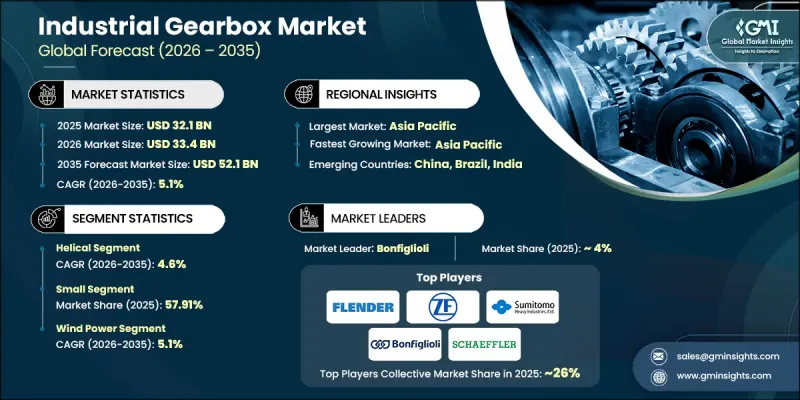
Market growth is driven by the rapid adoption of industrial automation and Industry 4.0 technologies, which demand precise torque transmission and controlled mechanical motion across manufacturing processes. Automated production lines rely on industrial gearboxes to maintain consistent speed and load, ensuring seamless operations. As connected factories and smart manufacturing solutions expand, industrial gearboxes are increasingly critical for handling mechanical stress and ensuring long-term durability. Manufacturers are also prioritizing gearboxes that support predictive maintenance and remote monitoring, enabling efficient operation of robotic systems and automated machinery. The rising intensity of automation, coupled with the need for reliable motion control and energy-efficient solutions, has significantly increased the installation rates of industrial gearboxes across sectors such as automotive, food processing, packaging, and heavy machinery production. This trend reflects the broader move toward smarter, more efficient manufacturing ecosystems.
| Market Scope | |
|---|---|
| Start Year | 2025 |
| Forecast Year | 2026-2035 |
| Start Value | $32.1 Billion |
| Forecast Value | $52.1 Billion |
| CAGR | 5.1% |
The helical gearbox segment accounted for USD 11 billion in 2025 and is anticipated to grow at a CAGR of 4.6% between 2026 and 2035. Helical gearboxes are favored in industrial settings due to their smooth power transmission, reduced vibration, and quieter operation compared to other gearbox types. Angled gear teeth allow for better torque distribution, making them ideal for heavy-duty machinery and processing equipment. Their efficiency in handling high loads and extending operational longevity reduces downtime and maintenance requirements, making them a preferred choice across multiple industrial sectors. The improved stability and energy efficiency of helical gearboxes enhance productivity while lowering operational costs, driving continued adoption.
The small power industrial gearboxes, typically up to 500 kW, held 57.91% share in 2025 and are expected to grow at a CAGR of 4.3% through 2035. These gearboxes are popular due to their versatile applications in manufacturing, packaging, and food processing industries. Their compact design allows seamless integration into equipment with limited space, while moderate power output meets the needs of both continuous and intermittent operations. The combination of affordability, reliability, and adaptability contributes to the dominance of the small gearbox segment within the market.
Germany Industrial Gearbox Market generated USD 1.84 billion in 2025 and is projected to grow at a CAGR of 4.9% from 2026 to 2035. Germany's strong manufacturing infrastructure supports the stable demand for industrial gearboxes. The rising adoption of automated production lines, energy efficiency standards, and modernization initiatives has increased demand for precision gearbox systems. Heavy-duty gearboxes are consistently required in automotive, metal processing, and industrial equipment applications. Continuous investments in advanced drive technologies and factory modernization efforts further support Germany's position as a key market in Europe.
Major companies operating in the Global Industrial Gearbox Market include Siemens, ZF Friedrichshafen, SEW-EURODRIVE, ABB Ltd., Dana Incorporated, Liebherr Group, Getriebebau NORD, Bonfiglioli Riduttori, Nabtesco Corporation, Rossi, Elecon Engineering Company, DB Santasalo, Nidec Motor Corporation, Sumitomo Heavy Industries, Ltd., and Regal Rexnord Corporation. Companies in the Industrial Gearbox Market are leveraging several strategies to strengthen their market presence and maintain a competitive advantage. Innovation in product design, including higher precision, durability, and energy-efficient gearboxes, is central to their strategy. Firms are expanding distribution networks and forming strategic partnerships with manufacturing and automation companies to increase market penetration. Investment in research and development supports the creation of smart, connected gearboxes compatible with predictive maintenance and remote monitoring.