



세계의 저전압 배전반 시장은 2025년에 15억 달러로 평가되었고, 2035년까지 연평균 복합 성장률(CAGR) 5.9%로 성장하여 29억 달러에 이를 것으로 예측됩니다.

시장 확대의 배경에는 주거, 상업 및 경공업 시설에서 분산형 재생에너지 시스템과 계량기 후방 저장 솔루션의 급속한 통합이 이루어지고 있다는 점을 들 수 있습니다. 건물에 태양광 발전, 축전지, 전기화 부하가 도입됨에 따라 양방향 전력 흐름 지원, 보호 조정 기능 강화, 추가 회로 용량을 확보할 수 있는 전기 인프라의 현대화가 요구되고 있습니다. 최근 몇 년 동안 기록적인 재생에너지 설비 용량 증가는 배전 전압 수준에서 계통 연계 활동을 활성화하고, 노후화된 배전반을 미래 지향적인 배전반으로 교체하는 것을 가속화시키고 있습니다. 동시에 데이터센터와 인공지능 워크로드의 성장으로 고도의 모니터링 기능을 갖춘 내결함성, 고밀도, 저전압의 배전 시스템에 대한 수요가 증가하고 있습니다. 전기차 충전 인프라의 확대는 새로운 피더 회로, 부하 분산 시스템, 수익급 계측에 대응하기 위해 전기실 업그레이드를 더욱 촉진하고 있습니다. 그리드 내결함성, 서비스 입구 현대화, 배전 손실 감소 프로그램에 대한 투자는 중요 인프라 및 지역 에너지 네트워크 전반에 걸쳐 저전압 배전반에 대한 수요를 지속적으로 자극하고 있습니다.
| 시장 범위 | |
|---|---|
| 개시 연도 | 2025년 |
| 예측 연도 | 2026-2035년 |
| 개시 연도 가치 | 15억 달러 |
| 예측 금액 | 29억 달러 |
| CAGR | 5.9% |
임베디드 패널 부문은 현대 건축물의 인테리어에 매끄럽게 녹아드는 간소화된 전기 설비에 대한 선호도가 높아짐에 따라 2025년 54.5%의 점유율을 차지할 것으로 예측됩니다. 주택의 전기화 및 개보수 활동이 확대됨에 따라 사용 가능한 공간을 최대한 활용하고 세련된 외관을 제공하는 이식형 저전압 배전반의 채택이 증가하고 있습니다. 공공 지원 주택 효율화 이니셔티브는 컴팩트한 설치로 안전성과 접근성을 향상시키는 공동주택 개조 프로젝트에서 플러시 마운트 구성에 대한 수요를 강화하고 있습니다.
주택 부문은 2025년 47.7%의 점유율을 차지하며 2035년까지 13억 달러 규모에 달할 것으로 예측됩니다. 주택의 경우, 광범위한 주택 기반의 개보수 공사, 전기화 추진, 법규 준수 개선 시 배전반이 자주 교체되기 때문에 큰 수요가 발생하고 있습니다. 시장 동향은 가전제품, 옥상 태양광 발전의 역송전, 전기자동차 충전 시스템 등 점점 확대되는 분기 회로 요구사항에 대응할 수 있는 컴팩트하고 표준을 준수하는 패널에 대한 선호도가 높아지고 있습니다. 시공업체는 설치 작업의 효율성과 유지보수 개입을 최소화하기 위해 추가 회로 용량, 간소화된 배선 구성, 개선된 라벨 표시를 갖춘 설계를 우선시하고 있습니다.
미국 저전압 배전반 시장은 2025년 3억 3,490만 달러에 달할 것으로 예측됩니다. 성장 모멘텀은 상업용 건축물의 확대와 에너지 절약형 배전 솔루션에 대한 수요 증가에 의해 뒷받침되고 있습니다. 연방 정부 및 공공시설의 개보수 계획은 광범위한 전기화 및 효율 개선 프로그램의 일환으로 배전반 교체, 서브 패널 설치 및 보호 시스템 업그레이드에 기여하고 있습니다.
The Global Low Voltage Distribution Panel Market was valued at USD 1.5 billion in 2025 and is estimated to grow at a CAGR of 5.9% to reach USD 2.9 billion by 2035.
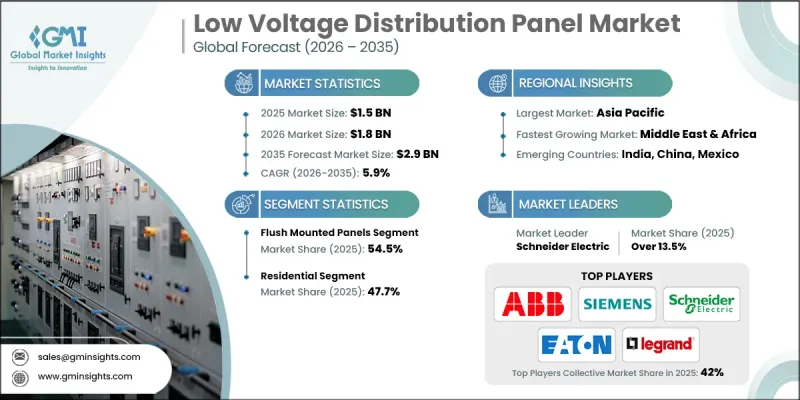
Market expansion is driven by the rapid integration of distributed renewable energy systems and behind-the-meter storage solutions across residential, commercial, and light industrial facilities. As buildings incorporate solar generation, battery storage, and electrified loads, electrical infrastructure requires modernization to support bidirectional power flows, enhanced protection coordination, and additional circuit capacity. Record renewable energy capacity additions in recent years have intensified grid interconnection activity at distribution voltage levels, accelerating the replacement of outdated panelboards with compliant, future-ready assemblies. At the same time, growth in data centers and artificial intelligence workloads is increasing demand for resilient, high-density, low-voltage power distribution systems with advanced monitoring capabilities. Expansion of electric vehicle charging infrastructure is further prompting upgrades in electrical rooms to accommodate new feeder circuits, load balancing systems, and revenue-grade metering. Investments in grid resilience, service entrance modernization, and distribution loss reduction programs continue to stimulate demand for low-voltage distribution panels across critical infrastructure and community energy networks.
| Market Scope | |
|---|---|
| Start Year | 2025 |
| Forecast Year | 2026-2035 |
| Start Value | $1.5 Billion |
| Forecast Value | $2.9 Billion |
| CAGR | 5.9% |
The flush-mounted panels segment accounted for 54.5% share in 2025, supported by rising preference for streamlined electrical installations that blend seamlessly into modern building interiors. Growing residential electrification and renovation activity is encouraging the adoption of recessed low-voltage distribution panels that maximize usable space and provide a refined appearance. Publicly supported housing efficiency initiatives are reinforcing demand for flush-mounted configurations in multi-unit retrofit projects, where compact installations enhance safety and accessibility.
The residential segment represented 47.7% share in 2025 and is expected to reach USD 1.3 billion by 2035. Residential applications generate substantial demand as panelboards are frequently upgraded during remodeling projects, electrification efforts, and code compliance improvements across a broad housing base. Market trends indicate increasing preference for compact, standards-compliant panels that accommodate expanded branch circuit requirements for electrified appliances, rooftop solar backfeed, and electric vehicle charging systems. Contractors are prioritizing designs with additional circuit capacity, simplified wiring configurations, and improved labeling to streamline installation and minimize service interventions.
United States Low Voltage Distribution Panel Market reached USD 334.9 million in 2025. Growth momentum is supported by expanding commercial construction and rising demand for energy-efficient electrical distribution solutions. Retrofit initiatives across federal and institutional facilities are contributing to panelboard replacements, subpanel installations, and upgraded protection systems as part of broader electrification and efficiency improvement programs.
Key companies operating in the Global Low Voltage Distribution Panel Market include ABB, AGS, Alfanar Group, EAMFCO, Eaton, ESL Power Systems, Evolution Interconnect System, GE Vernova, Hager Group, Industrial Electric MFG, Larsen & Toubro, Legrand, Maverick Power, Meba Electric, NHP, Norelco, Projoy Electric, Schneider Electric, Siemens, and TOSUNlux. Companies competing in the Low Voltage Distribution Panel Market are reinforcing their market position through product innovation, smart integration, and geographic expansion strategies. Leading manufacturers are developing intelligent panel solutions equipped with digital monitoring, load management, and energy analytics capabilities to meet evolving electrification needs. Strategic partnerships with renewable energy integrators and EV infrastructure providers are expanding application reach. Firms are also investing in modular and customizable panel designs to address diverse residential and commercial requirements. Emphasis on compliance with updated safety standards and energy regulations strengthens customer confidence. Additionally, companies are enhancing distribution networks and service support to improve delivery timelines and reinforce long-term relationships across construction and retrofit markets.