



세계의 전력 및 제어 케이블 시장은 2025년에 1,563억 달러로 평가되었고, 2035년까지 연평균 복합 성장률(CAGR) 6.5%로 성장하여 2,962억 달러에 이를 것으로 예측됩니다.

시장 확대의 배경에는 급속한 도시화, 전력망 확장, 산업 자동화의 발전으로 산업, 상업, 유틸리티 분야 전반에 걸쳐 수요가 증가하고 있다는 점이 꼽힙니다. 노후화된 송배전 인프라의 현대화도 중요한 요소이며, 각국 정부는 효율성 향상, 전력 손실 감소, 증가하는 에너지 수요에 대응하기 위해 노력하고 있습니다. 예를 들어, 중국은 향후 몇 년 동안 전력 인프라에 약 8,000억 달러의 투자를 계획하고 있어 전력 및 제어 케이블 도입에 막대한 기회를 창출하고 있습니다. 또한, 로봇 공학, IoT 시스템, 스마트 제조가 정밀한 신호 전송과 안정적인 전력 공급을 필요로 하는 인더스트리 4.0 트렌드도 성장을 뒷받침하고 있습니다. 태양광, 풍력, 수력 발전 프로젝트를 포함한 재생에너지의 확대는 고전압 송전 케이블에 대한 수요를 더욱 촉진하고 있습니다. 대규모 상업 프로젝트 및 도시 인프라 건설 증가는 또한 종합적인 전기 배선 및 제어 시스템의 필요성을 강조합니다.
| 시장 범위 | |
|---|---|
| 개시 연도 | 2025년 |
| 예측 연도 | 2026-2035년 |
| 개시 연도 가치 | 1,563억 달러 |
| 예측 금액 | 2,962억 달러 |
| CAGR | 6.5% |
제어 케이블 부문은 산업 자동화 및 상업시설에서 원활한 신호 전송, 시스템 모니터링 및 운영 안전을 보장하기 위해 제어 케이블에 대한 의존도가 높아짐에 따라 2035년까지 450억 달러에 달할 것으로 예측됩니다. 제어 케이블은 현대 제조 공장에서 로봇 시스템, AI 장치, 상호 연결된 IoT 기기 간의 통신을 가능하게 하여 고도로 자동화된 공정에서 효율성과 신뢰성을 보장하는 데 중요한 역할을 합니다.
저전압 부문은 주거, 상업 및 산업 시설의 전기 배선 인프라의 지속적인 확장을 배경으로 2035년까지 연평균 복합 성장률(CAGR) 6%를 나타낼 것으로 예측됩니다. 도시화의 진전, 스마트 빌딩의 보급, 대규모 산업단지의 지속적인 개발은 안전하고 효율적인 전력 분배를 보장하는 신뢰할 수 있는 저전압 케이블에 대한 수요를 촉진하고 있습니다. 또한, 에너지 절약형 건축 지원, 노후화된 전기 시스템 개보수, 대규모 전기화 프로젝트를 추진하는 정부 프로그램이 도입을 촉진하고 있습니다. 현대의 조명, 공조, 보안, 자동화 시스템을 지원하는 확장 가능한 고품질 배선 솔루션의 필요성도 이 부문의 견조한 성장에 기여하고 있습니다.
미국의 전력 및 제어 케이블 시장은 2025년 226억 달러로 평가되었습니다. 이는 국가 전력 인프라 업그레이드를 위한 막대한 투자에 힘입은 것입니다. 전력망 현대화, 정전에 대한 내성 향상, 산업 및 도시 중심부의 용량 강화를 위한 연방 및 주 정부의 이니셔티브는 저전압 케이블 도입에 대한 강력한 기회를 창출하고 있습니다. 재생에너지, 전기차 충전 네트워크, 스마트시티 프로젝트의 통합이 진행되면서 대상 시장은 더욱 확대되고 있습니다. 또한, 안전 기준과 에너지 효율 규제가 강화됨에 따라 전력회사 및 개발업체들은 구식 배선 시스템을 첨단 저전압 솔루션으로 교체해야 하며, 이는 장기적인 시장 성장을 가속하는 동시에 국내외 케이블 제조업체 모두에게 기회를 창출하고 있습니다.
The Global Power and Control Cable Market was valued at USD 156.3 billion in 2025 and is estimated to grow at a CAGR of 6.5% to reach USD 296.2 billion by 2035.
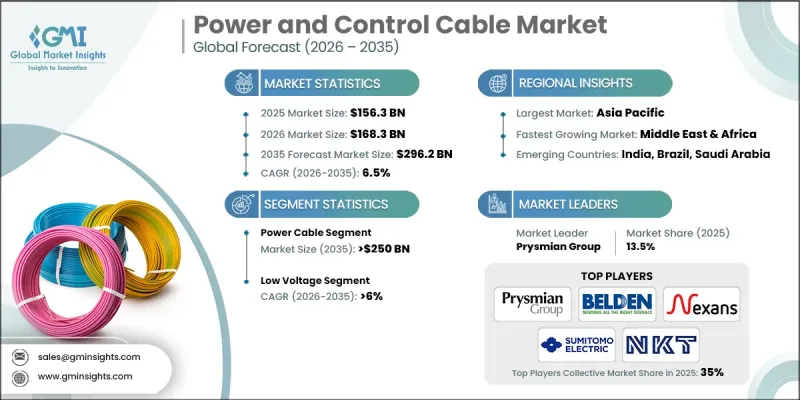
Market expansion is driven by rising demand across industrial, commercial, and utility sectors, fueled by rapid urbanization, expanding electricity networks, and increasing industrial automation. The modernization of aging transmission and distribution infrastructure is a critical factor, as governments seek to improve efficiency, reduce power losses, and meet rising energy demand. China, for instance, is planning investments of approximately USD 800 billion in electricity infrastructure over the coming years, creating vast opportunities for power and control cable deployment. The growth is also supported by Industry 4.0 trends, where robotics, IoT systems, and smart manufacturing require precise signal transmission and reliable electrical supply. Renewable energy expansion, including solar, wind, and hydroelectric projects, is further bolstering demand for high-voltage power transmission cables. Increasing construction of large-scale commercial projects and urban infrastructure also underlines the need for comprehensive electrical wiring and control systems.
| Market Scope | |
|---|---|
| Start Year | 2025 |
| Forecast Year | 2026-2035 |
| Start Value | $156.3 Billion |
| Forecast Value | $296.2 Billion |
| CAGR | 6.5% |
The control cable segment is projected to reach USD 45 billion by 2035 as industrial automation and commercial facilities increasingly rely on control cabling to ensure seamless signal transfer, system monitoring, and operational safety. Control cables play a critical role in enabling communication between robotic systems, AI devices, and interconnected IoT equipment in modern manufacturing plants, ensuring efficiency and reliability in highly automated processes.
The low-voltage segment is anticipated to grow at a CAGR of 6% through 2035, driven by the continuous expansion of electrical wiring infrastructure across residential, commercial, and industrial facilities. Increasing urbanization, the rise of smart buildings, and the ongoing development of large-scale industrial complexes are fueling demand for reliable low-voltage cables that ensure safe and efficient power distribution. Additionally, government programs supporting energy-efficient construction, retrofitting of aging electrical systems, and large-scale electrification projects are further boosting adoption. The need for scalable, high-quality wiring solutions to support modern lighting, HVAC, security, and automation systems is also contributing to robust growth in this segment.
U.S. Power and Control Cable Market was valued at USD 22.6 billion in 2025, underpinned by substantial investments in upgrading the national power infrastructure. Federal and state initiatives aimed at modernizing the electricity grid, improving resilience against outages, and enhancing capacity for industrial and urban centers are creating strong opportunities for low-voltage cable deployment. Rising integration of renewable energy, electric vehicle charging networks, and smart city projects is further expanding the addressable market. Moreover, increasing safety standards and energy-efficiency regulations are prompting utilities and developers to replace outdated wiring systems with advanced low-voltage solutions, reinforcing long-term market growth and creating opportunities for both domestic and international cable manufacturers.
Leading companies in the Global Power and Control Cable Market include Belden Inc., Nexans, LS Cables, Prysmian Group, Southwire Company LLC, Sumitomo Electric Industries, Ltd., Bahra Electric, FURUKAWA ELECTRIC CO., LTD., Havells India Ltd., Fujikura Cables, Helukabel GmbH, KEI Industries Limited, Leoni Cables, NKT A/S, Polycab, Eland Cables, Klaus Faber AG, Thermo Cables, Top Cables, Riyadh Cables, and ZTT Group. Companies in the Global Power and Control Cable Market are strengthening their foothold through several strategies, including expanding production capacity and geographic presence in emerging markets to capitalize on urbanization and infrastructure growth. They are investing heavily in R&D to develop high-performance cables capable of supporting automation, renewable energy, and smart manufacturing applications. Strategic partnerships with utility providers, construction firms, and industrial integrators help firms secure long-term supply contracts and enhance distribution networks. Firms are also focusing on digital solutions, such as IoT-enabled cable monitoring and predictive maintenance services, to differentiate offerings, increase customer loyalty, and reduce operational downtime for end users.