



세계의 화물 스캔 장비 시장은 2025년에 40억 5,000만 달러로 평가되었고, 2035년까지 연평균 복합 성장률(CAGR) 7.7%로 성장하여 83억 7,000만 달러에 이를 것으로 예측됩니다.

이 시장의 성장은 세계 무역의 급격한 확대, 컨테이너 물동량의 급격한 증가, 그리고 세계 안보에 대한 우려 증가에 의해 주도되고 있습니다. 각국 정부와 교통 당국은 세관, 국경 관리, 항만 보안 규제 강화를 추진하고 있으며, 3D 엑스레이 스캐너, 컴퓨터 단층 촬영(CT) 스캐너와 같은 첨단 영상 기술 도입을 촉진하고 있습니다. 화물 검사에 인공지능(AI)과 자동화의 통합은 정확도 향상, 인적 오류 감소, 처리 능력 향상으로 시장 성장을 더욱 가속화하고 있습니다. 보안 위협이 진화하는 가운데, 당국은 고도의 은폐 기법을 감지하고, 중요 인프라를 보호하며, 공공의 안전을 보장할 수 있는 차세대 스캐닝 시스템에 많은 투자를 하고 있습니다. 강화된 데이터 분석과 실시간 모니터링에 기반한 예방적 위험 관리로의 전환은 기술 중심의 고성능 화물 스캐닝 솔루션에 대한 세계 수요를 지속적으로 견인하고 있습니다.
| 시장 범위 | |
|---|---|
| 개시 연도 | 2025년 |
| 예측 연도 | 2026-2035년 |
| 개시 연도 가치 | 40억 5,000만 달러 |
| 예측 금액 | 83억 7,000만 달러 |
| CAGR | 7.7% |
소형 소포 부문은 2025년 19억 달러에 달했습니다. 전자상거래의 급속한 성장에 따라 규제 준수를 유지하면서 안전한 배송을 실현하기 위해 소형 패키지의 신속하고 비침습적인 검사가 절실하게 요구되고 있습니다. 소형 화물의 밀수품, 금지 물품, 불법 물질의 위험이 증가함에 따라 물류 및 우편 서비스 사업자는 자동화된 고처리량 스캐닝 시스템을 도입해야 하는 상황에 직면해 있습니다. 장비 제조업체들은 라스트마일 배송 거점 및 대용량 소포 분류 센터에 최적화된 컴팩트하고 빠른 스캐닝 솔루션 개발에 주력하고 있습니다. 이러한 시스템은 업무 효율성을 떨어뜨리지 않으면서 신뢰할 수 있는 감지 기능을 제공해야 하며, 공급망 운영에 미치는 영향을 최소화해야 합니다.
엑스레이 스캐너 분야는 2025년 14억 달러 시장 규모를 차지했습니다. 공항, 항만, 세관 당국은 다양한 화물 유형에 대한 신속하고 비침습적인 검사를 수행하기 위해 첨단 엑스레이 스캐너의 도입이 확대되고 있습니다. 멀티뷰 및 3D 엑스레이 이미징 기술의 발전으로 감지 정확도가 향상되고 오감지율이 감소하며 작업자의 효율성이 향상되었습니다. 제조업체들은 자동 위협 감지 기능을 갖춘 고해상도 엑스레이 시스템에 투자하여 컨테이너, 팔레트, 벌크 화물의 원활한 검사를 위해 처리 능력과 보안 표준을 손상시키지 않으면서도 원활한 검사가 가능하도록 하고 있습니다.
북미 화물 스캐닝 장비 시장은 높은 무역량, 선진화된 항만 및 국경 인프라, 엄격한 규제 프레임워크로 인해 2025년 33.9%의 점유율을 차지할 것으로 예측됩니다. 세관 및 국토 안보 기관은 해상 항만, 공항, 육로 국경에서 종합적인 검사 절차를 채택하고 있으며, 우수한 위협 감지 능력을 갖춘 자동화 및 고처리량 스캔 장비에 대한 안정적인 수요를 창출하고 있습니다. 북미 당국은 위험 기반 화물 검사를 지원하기 위해 AI 기반 이미지 처리 및 분석 기술의 통합을 가속화하고 있습니다. 이를 통해 강력한 보안 기준을 유지하면서 보다 신속한 통관 처리가 가능합니다. 이 지역은 화물 검사 업무의 혁신성과 효율성 측면에서 업계의 벤치마킹 대상이 되고 있습니다.
The Global Cargo Scanning Equipment Market was valued at USD 4.05 billion in 2025 and is estimated to grow at a CAGR of 7.7% to reach USD 8.37 billion by 2035.
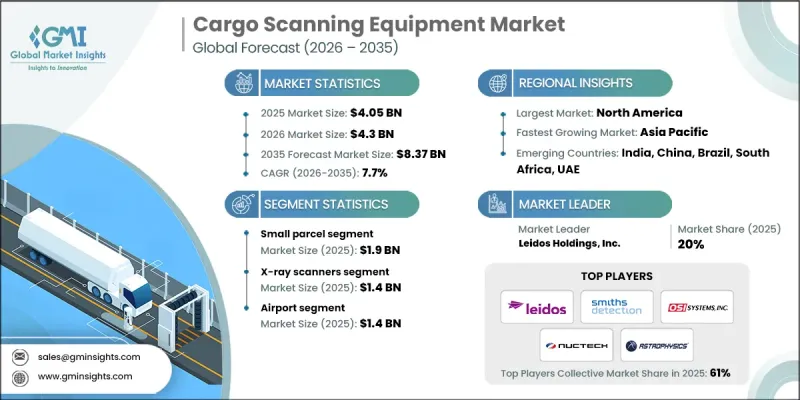
The market is driven by the rapid growth in global trade, surging containerized cargo volumes, and rising security concerns worldwide. Governments and transport authorities are increasingly enforcing stricter customs, border control, and port security regulations, pushing the adoption of advanced imaging technologies such as 3D X-ray and computed tomography (CT) scanners. Integration of artificial intelligence and automation in cargo inspection is further accelerating market growth by enhancing accuracy, reducing human error, and increasing throughput. As security threats evolve, authorities are investing heavily in next-generation scanning systems capable of detecting sophisticated concealment methods, protecting critical infrastructure, and ensuring public safety. The shift toward proactive risk management, supported by enhanced data analytics and real-time monitoring, continues to drive demand for technology-driven, high-performance cargo scanning solutions globally.
| Market Scope | |
|---|---|
| Start Year | 2025 |
| Forecast Year | 2026-2035 |
| Start Value | $4.05 Billion |
| Forecast Value | $8.37 Billion |
| CAGR | 7.7% |
The small parcel segment reached USD 1.9 billion in 2025. Rapid growth in e-commerce has created an urgent need for fast, non-intrusive screening of small packages to ensure timely deliveries while maintaining regulatory compliance. The rising risk of contraband, prohibited items, and illegal substances in small shipments has compelled logistics and postal service providers to adopt automated, high-throughput scanning systems. Equipment manufacturers are focusing on developing compact, high-speed scanning solutions optimized for last-mile distribution hubs and high-volume parcel sorting centers. These systems must provide reliable detection without slowing operational efficiency, while also ensuring minimal disruption to supply chain operations.
The X-ray scanners segment accounted for USD 1.4 billion in 2025. Airports, seaports, and customs authorities are increasingly deploying advanced X-ray scanners to perform rapid, non-intrusive inspections of diverse cargo types. Technological improvements in multi-view and 3D X-ray imaging have enhanced detection accuracy, reduced false positives, and increased operator efficiency. Manufacturers are investing in high-resolution X-ray systems equipped with automated threat detection capabilities, enabling seamless inspection of containers, pallets, and bulk cargo without compromising throughput or security standards.
North America Cargo Scanning Equipment Market held 33.9% share in 2025 due to high trade volumes, advanced port and border infrastructure, and strict regulatory frameworks. Customs and homeland security agencies employ comprehensive screening protocols across maritime ports, airports, and land borders, creating steady demand for automated, high throughput scanning equipment with superior threat detection capabilities. North American authorities are increasingly integrating AI-driven imaging and analytics to support risk-based cargo inspections, allowing faster clearance while maintaining robust security standards. The region continues to set benchmarks for innovation and efficiency in cargo screening operations.
Key players in the Global Cargo Scanning Equipment Market include Autoclear LLC, OSI Systems, Smiths Detection Group Ltd., Astrophysics, Inc., Gilardoni S.p.A., LINEV Systems, TODD Research, Leidos Holdings, Inc., CEIA, Braun & Co. Limited, Nuctech Company Limited, and Westminster Group Plc. Companies in the cargo scanning equipment market are pursuing several strategies to strengthen their market presence. Continuous innovation in imaging technologies, such as 3D and CT scanners with AI-assisted threat detection, is a core focus. Firms are forming strategic partnerships with ports, airports, and logistics providers to expand deployment and service networks. Investment in research and development enhances system reliability, speed, and accuracy to meet evolving regulatory requirements. Manufacturers are also emphasizing modular, scalable systems to accommodate different cargo sizes and inspection environments.