



세계의 제지 및 펄프용 효소 시장은 2025년에 3억 5,110만 달러로 평가되었으며, 2035년까지 CAGR 8.6%로 성장하여 7억 9,820만 달러에 달할 것으로 예측됩니다.
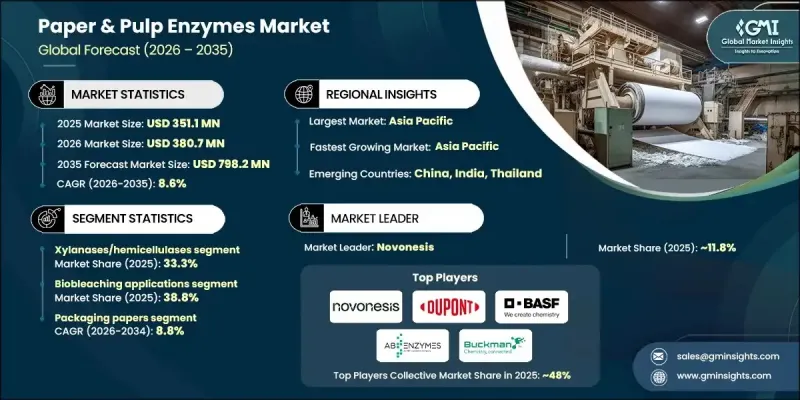
펄프 및 제지 산업이 효율성 향상, 화학제품 사용량 감소, 제품 품질 개선을 위해 바이오테크놀러지 솔루션 도입을 확대하면서 이 시장은 꾸준히 성장하고 있습니다. 미생물 유래 효소는 바이오 표백, 섬유 개질, 탈묵, 배수 최적화 등 현대 제지 공정에서 중요한 역할을 하고 있습니다. 이러한 생물학적 촉매는 버진펄프와 재생펄프 공정 모두에서 고품질 생산을 유지하면서 환경 부하를 줄이는데 기여하고 있습니다. 지속가능한 생산 방식에 대한 수요 증가, 재활용 요건 강화, 첨단 효소 배합 기술 개발로 인해 시장은 매우 역동적인 양상을 보이고 있습니다. 각 업체들은 포장지, 인쇄지, 티슈페이퍼, 특수지 분야에서 멀티 효소 시스템 및 성능 최적화를 위한 투자를 진행하고 있습니다. 환경 규제 준수, 기술 혁신, 전 세계 종이 소비량 증가와 함께 북미, 유럽, 아시아태평양에서 장기적인 수요와 성장이 보장되고 있습니다.
| 시장 범위 | |
|---|---|
| 시작 연도 | 2025년 |
| 예측 연도 | 2026-2035 |
| 개시 금액 | 3억 5,110만 달러 |
| 예측 금액 | 7억 9,820만 달러 |
| CAGR | 8.6% |
자일라나제 및 헤미셀룰라아제 부문은 2025년 33.3%의 점유율을 차지하며 2035년까지 연평균 8.8%의 성장률을 기록할 것으로 예상됩니다. 이 효소는 리그닌 분해, 섬유질 방출 및 선택적 헤미셀룰로오스 가수분해에서 높은 효율로 인해 선호되고 있습니다. 이를 통해 섬유의 강도를 손상시키지 않고 표백 시 화학약품의 침투성을 향상시킵니다. 크래프트 펄프, 케미컬 펄프 등 다양한 펄프 타입에서 입증된 성능은 바이오 표백 용도 및 백색도 향상에 필수적입니다. 자일라나제는 다재다능하며, 제조업체가 염소계 화학제품의 소비를 줄이면서 펄프 품질을 향상시킬 수 있습니다.
바이오 표백 용도 부문은 2025년 38.8%의 점유율을 차지했으며, 2026년부터 2035년까지 CAGR 8.8%로 성장할 것으로 예측됩니다. 바이오 표백은 화학제품 사용량 감소, 환경 배출량 감소, 펄프 가공의 경제성 향상을 실현할 수 있기 때문에 널리 채택되고 있습니다. 효소 보조 표백 공정은 이산화염소 소비를 10-30% 줄이고, 유기질소산화물(AOX) 수준을 낮추어 원하는 백색도 기준을 유지합니다. 이러한 용도는 무염소(ECF) 및 완전 무염소(TCF) 펄프 생산 모두에 필수적이며, 제지 공장이 규제 및 지속가능성 목표를 달성하는 동시에 운영 성과를 최적화할 수 있게 해줍니다.
미국 제지 및 펄프용 효소 시장은 2025년 9,090만 달러 규모에 달했으며, 지역별로 도입이 활발하게 이루어지고 있습니다. 미국은 성숙한 통합 펄프 공장, 탈묵 효소를 필요로 하는 대규모 재생지 사업, 부드러움과 종이 강도를 향상시키기 위해 셀룰라아제를 활용하는 대규모 조직 생산으로 효소 소비의 주요 견인차 역할을 계속하고 있습니다. 효소 응용 기술, 특히 ECF 표백 공정의 지속적인 혁신과 엄격한 환경 규제가 결합되어 미국 시장에서의 입지를 더욱 강화하고 있습니다.
The Global Paper & Pulp Enzymes Market was valued at USD 351.1 million in 2025 and is estimated to grow at a CAGR of 8.6% to reach USD 798.2 million by 2035.
The market is witnessing consistent growth as the pulp and paper industry increasingly adopts biotechnological solutions to enhance efficiency, reduce chemical usage, and improve product quality. Enzymes derived from microbial sources play a critical role in modern papermaking processes, including biobleaching, fiber modification, deinking, and drainage optimization. These biological catalysts help reduce environmental impact while maintaining high-quality output in both virgin and recycled pulp operations. With growing demand for sustainable production practices, rising recycling requirements, and the development of advanced enzyme formulations, the market is becoming highly dynamic. Companies are investing in multi-enzyme systems and performance optimization across packaging, printing, tissue, and specialty paper applications. The convergence of environmental compliance, technological advancements, and rising global paper consumption ensures strong long-term demand and growth across North America, Europe, and Asia-Pacific regions.
| Market Scope | |
|---|---|
| Start Year | 2025 |
| Forecast Year | 2026-2035 |
| Start Value | $351.1 Million |
| Forecast Value | $798.2 Million |
| CAGR | 8.6% |
The xylanases and hemicellulases segment held 33.3% share in 2025 and is expected to grow at a CAGR of 8.8% through 2035. These enzymes are preferred due to their high efficiency in lignin degradation, fiber liberation, and selective hemicellulose hydrolysis, which improves chemical penetration during bleaching without compromising fiber strength. Their proven performance across diverse pulp types, including kraft and chemical pulps, makes them essential for biobleaching applications and brightness enhancement. Xylanases are widely recognized for their versatility, allowing manufacturers to achieve improved pulp quality while reducing chlorine-based chemical consumption.
The biobleaching applications segment held 38.8% share in 2025 and is projected to grow at a CAGR of 8.8% during 2026-2035. Biobleaching is widely adopted due to its ability to reduce chemical use, lower environmental discharge, and improve economic efficiency in pulp processing. Enzyme-assisted bleaching operations decrease chlorine dioxide consumption by 10-30%, lower AOX levels, and maintain desired brightness standards. These applications are essential in both elemental chlorine-free (ECF) and totally chlorine-free (TCF) pulp production, enabling mills to meet regulatory and sustainability targets while optimizing operational performance.
U.S. Paper & Pulp Enzymes Market accounted for USD 90.9 million in 2025, reflecting strong regional adoption. The United States remains a major driver of enzyme consumption due to its mature integrated pulp mills, extensive recycled paper operations requiring deinking enzymes, and large-scale tissue production leveraging cellulases for softness and paper strength improvements. Continuous innovation in enzyme application technologies, especially within ECF bleaching sequences, alongside stringent environmental regulations, further enhances the U.S. market position.
Major companies operating in the Global Paper & Pulp Enzymes Market include AB Enzymes GmbH, Advanced Enzyme Technologies, Amano Enzyme Inc., Buckman, Creative Enzymes, DuPont Industrial Biosciences / IFF, EDT - Enzymatic Deinking Technologies, Jiangsu Boli Bioproducts / Boyang, Metgen Oy, Novonesis, Noor Enzymes, Rossari Biotech, Shandong Longda Bio-Products / Lonct, Sunson Industry Group, and BASF SE. Companies in the paper & pulp enzymes market are strengthening their presence through multiple strategies. They are investing in R&D to develop high-performance enzyme formulations that target diverse pulp types and specific applications such as biobleaching, deinking, and fiber modification. Strategic partnerships with pulp mills, recycling facilities, and specialty paper manufacturers enhance market reach and product adoption. Expansion of production capacities, introduction of multi-enzyme systems, and customization for regional environmental compliance regulations strengthen competitiveness.