



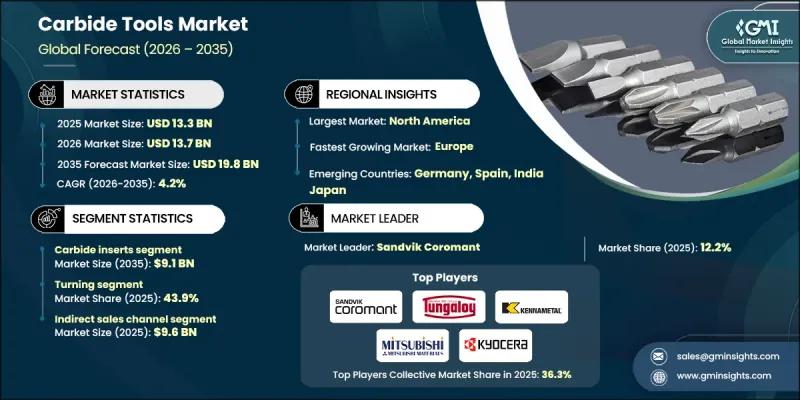
세계의 초경 공구 시장은 2025년에 133억 달러로 평가되었으며, 2035년까지 CAGR 4.2%로 성장하여 198억 달러에 달할 것으로 예측됩니다.
전체 시장의 성장은 산업 생산에서 자동화, 로봇 공학, 디지털 제어 가공 시스템의 채택 확대와 밀접한 관련이 있습니다. 제조업체는 더 엄격한 공차 달성, 반복성 향상, 첨단 가공 환경에서 고속 가공을 실현하기 위해 고정밀 초경 공구에 대한 의존도를 높이고 있습니다. 자동차, 항공우주 및 기타 정밀 가공을 중시하는 산업에서는 일관된 품질을 유지하면서 생산성을 향상시키기 위해 초경 공구를 채택하는 것을 최우선시하고 있습니다. 표면처리 및 코팅 기술의 지속적인 발전으로 공구의 내구성, 내열성 및 작동 수명이 향상되어 시장 수요가 더욱 강화되었습니다. 동시에, 경량 및 첨단 소재의 생산이 확대됨에 따라 복잡한 가공 요건을 충족시킬 수 있는 특수 공구 솔루션에 대한 투자가 촉진되고 있습니다. 산업 시설의 현대화 및 고효율화를 추구하는 가운데, 초경 공구는 진화하는 제조 전략에 있어 필수적인 요소로 자리 잡고 있습니다.
| 시장 범위 | |
|---|---|
| 시작 연도 | 2025년 |
| 예측 연도 | 2026-2035 |
| 개시 금액 | 133억 달러 |
| 예측 금액 | 198억 달러 |
| CAGR | 4.2% |
초경합금 칩 부문은 2025년 61억 달러의 시장 규모를 기록했으며, 2035년까지 91억 달러에 달할 것으로 예상됩니다. 초경 인서트는 우수한 내구성, 내마모성, 고온 조건에서의 성능으로 인해 제품 분야에서 가장 큰 점유율을 차지하고 있습니다. 이러한 특성으로 인해 인서트는 더 빠른 가공 속도, 더 높은 치수 정확도, 더 긴 수명을 제공하여 처리량과 일관성을 중시하는 까다로운 생산 환경에서 인서트가 선호되는 선택이 되었습니다.
터닝 애플리케이션 부문은 2025년 43.9%의 점유율을 차지했습니다. 이 부문은 정밀한 재료 제거와 균일한 표면 마무리가 필요한 산업 분야에서 광범위하게 사용되어 선도적인 위치를 유지하고 있습니다. 선삭 가공은 정밀도와 반복성이 매우 중요한 복잡한 부품 제조에서 핵심적인 역할을 합니다. 첨단 제조 역량 강화를 위한 지원 정책도 선삭 관련 공구 솔루션에 대한 수요 증가에 기여하고 있습니다.
미국 초경합금 공구 시장은 2025년 78.1%의 점유율을 차지했습니다. 자동차, 항공우주, 방위 분야의 정밀 가공에 대한 의존도가 높고, 탄탄한 제조 기반이 견조한 수요를 뒷받침하고 있습니다. 산업 생산 및 인프라에 대한 국내 투자 증가는 금속 가공 활동을 지속적으로 자극하고 있으며, 지역 전체에서 첨단 초경 공구의 꾸준한 채택을 촉진하고 있습니다.
The Global Carbide Tools Market was valued at USD 13.3 billion in 2025 and is estimated to grow at a CAGR of 4.2% to reach USD 19.8 billion by 2035.
Growth across the market is tied to rising adoption of automation, robotics, and digitally controlled machining systems within industrial production. Manufacturers increasingly rely on high-precision carbide tools to meet tighter tolerances, improve repeatability, and support high-speed operations in advanced machining environments. Automotive, aerospace, and other precision-focused industries continue to prioritize carbide tooling to improve productivity while maintaining consistent quality. Ongoing advancements in surface treatment and coating technologies are further strengthening market demand by improving tool durability, heat resistance, and operational lifespan. In parallel, expanding production of lightweight and advanced materials is encouraging greater investment in specialized tooling solutions capable of handling complex machining requirements. As industrial facilities modernize and pursue higher efficiency levels, carbide tools remain essential components within evolving manufacturing strategies.
| Market Scope | |
|---|---|
| Start Year | 2025 |
| Forecast Year | 2026-2035 |
| Start Value | $13.3 Billion |
| Forecast Value | $19.8 Billion |
| CAGR | 4.2% |
The carbide inserts segment generated USD 6.1 billion in 2025 and is projected to reach USD 9.1 billion by 2035. Carbide inserts represent the largest share of the product landscape due to their superior durability, resistance to wear, and ability to perform under high-temperature conditions. These characteristics enable faster machining speeds, improved dimensional accuracy, and longer service life, making inserts a preferred choice for demanding production environments focused on throughput and consistency.
The turning applications segment accounted for 43.9% share in 2025. This segment continues to lead due to widespread use across industries requiring precise material removal and consistent surface finishes. Turning operations play a central role in producing complex components where accuracy and repeatability are critical. Supportive policies aimed at strengthening advanced manufacturing capabilities further contribute to the rising demand for turning-related tooling solutions.
U.S. Carbide Tools Market accounted for 78.1% share in 2025. Strong demand is supported by a well-established manufacturing base across automotive, aerospace, and defense sectors that rely heavily on precision machining. Increased domestic investment in industrial production and infrastructure continues to stimulate metalworking activity, reinforcing steady adoption of advanced carbide tooling across the region.
Key companies operating in the carbide tools market include Sandvik Coromant, Kennametal Inc., Mitsubishi Materials Corporation, Seco Tools, Walter AG, Kyocera Corporation, Iscar Ltd., Sumitomo Electric Industries Ltd., Ceratizit Group, OSG Corporation, Guhring KG, Tungaloy Corporation, Hitachi Tool Engineering, Ltd., YG-1 Co, and ZCC Cutting Tools. Companies in the Global Carbide Tools Market focus on multiple strategies to strengthen market position and sustain competitiveness. Continuous investment in research and development supports innovation in tool geometry, materials engineering, and performance optimization. Many players expand coating and surface treatment capabilities to extend tool life and improve machining efficiency. Strategic partnerships with machine tool manufacturers and industrial customers enable customized solutions and long-term contracts. Geographic expansion through new production facilities and distribution networks improves regional accessibility. Portfolio diversification across application-specific tools allows companies to serve a wider range of industries.