



세계의 창고 시뮬레이션 시장은 2025년에 8억 670만 달러로 평가되었으며, 2035년까지 CAGR 14.3%로 성장하여 29억 달러에 달할 것으로 예측됩니다.
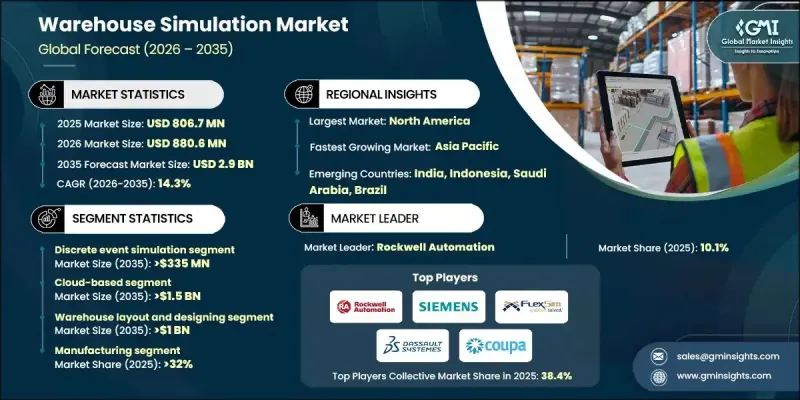
시장 확대는 E-Commerce의 급속한 발전과 현대 창고 업무의 복잡성에 기인합니다. 현재 창고 환경에서는 다양한 주문 구조, 변동하는 수요 주기, 옴니채널에 대응하는 이행 요건을 관리해야 하며, 이 모든 것이 업무 부담을 가중시키고 있습니다. 이러한 문제를 해결하기 위해 기업들은 설비 투자에 앞서 성능 평가, 효율성 개선, 리스크 감소를 위한 시뮬레이션 플랫폼 도입을 가속화하고 있습니다. 창고 시뮬레이션 툴을 통해 운영자는 운영 시나리오 모델링, 인간과 기계의 연계 분석, 자재 흐름 최적화, 도입 전 비효율성을 감지할 수 있습니다. 이 기능은 여러 첨단 시스템과 프로세스를 통합하는 시설에서 특히 중요하며, 부적절한 조정은 상당한 비용 초과를 초래할 수 있습니다. 시뮬레이션은 핵심 계획 및 검증 도구로 자리매김하여 기업이 투자를 정당화하고, 처리량을 향상시키며, 점점 더 역동적인 운영 환경에서도 서비스 수준을 유지할 수 있도록 돕고 있습니다.
| 시장 범위 | |
|---|---|
| 시작 연도 | 2025년 |
| 예측 연도 | 2026-2035 |
| 개시 금액 | 8억 670만 달러 |
| 예측 금액 | 29억 달러 |
| CAGR | 14.3% |
클라우드 기반 창고 시뮬레이션 플랫폼은 확장성, 낮은 초기 비용, 분산형 협업 지원 능력으로 인해 많은 관심을 받고 있습니다. 이러한 솔루션은 시뮬레이션 환경에 대한 유연한 액세스를 제공하며, 모든 규모의 조직이 고급 계획 도구를 사용할 수 있도록 지원합니다. 창고 시뮬레이션 플랫폼에 디지털 트윈 기능을 통합하여 시설 설계 및 운영 관리를 더욱 혁신적으로 변화시키고 있습니다. 디지털 트윈을 통해 실제 창고의 실시간 가상 표현을 생성하여 실제 운영을 방해하지 않고 지속적인 테스트, 최적화 및 예측 분석을 수행할 수 있습니다. 이 접근 방식은 데이터 기반의 실시간 조정을 지원함으로써 의사결정의 정확성을 높이고, 프로세스의 복원력을 향상시키며, 운영 리스크를 줄일 수 있습니다.
2025년 기준, 이산 이벤트 시뮬레이션 분야는 42%의 점유율을 차지하며 2035년까지 3억 3,500만 달러에 달할 것으로 예상됩니다. 이 분야의 성장은 결과에 대한 실시간 접근과 신속한 의사결정을 가능하게 하는 모바일 대응 시뮬레이션 툴의 보급 확대에 힘입은 바 큽니다. 이러한 플랫폼은 작업자 안전 계획 개선, 운영 리스크 감소, 변화하는 창고 환경에 대한 대응력 강화를 실현합니다. 사용자 친화적인 인터페이스를 통해 모바일 기기를 통해 시나리오 평가, 매개변수 조정, 성능 추적을 신속하게 수행할 수 있어 전체 창고 업무의 민첩성을 향상시킬 수 있습니다.
클라우드 기반 전개 모델은 2025년 53.5%의 점유율을 차지했으며, 2035년까지 15억 달러에 달할 것으로 예측됩니다. 클라우드 호스팅 시뮬레이션 솔루션은 기업용 소프트웨어 생태계와 원활하게 통합되어 창고 업무 전반에 걸쳐 원활한 데이터 교환과 통합된 분석을 가능하게 합니다. 이 배포 방식은 연결성을 단순화하고, 실시간 동기화를 지원하며, 전체 물류 네트워크에 대한 엔드투엔드 가시성을 향상시킵니다. 클라우드 플랫폼은 여러 이해관계자가 원격으로 시뮬레이션 모델에 접근하여 수정 및 평가할 수 있도록함으로써 협업을 강화하고, 보다 신속하고 정확한 의사결정을 내릴 수 있도록 돕습니다.
미국 창고 시뮬레이션 시장은 2025년 2억 6,040만 달러로 평가되며, 2026년부터 2035년까지 강력한 성장세를 보일 것으로 예상됩니다. 유통 및 풀필먼트 시설의 자동화, 고급 분석, 데이터 기반 업무 계획의 도입 확대가 성장을 주도하고 있습니다. 기업들은 시뮬레이션 툴을 활용하여 대량 생산 환경에서의 레이아웃 설계, 노동력 활용, 자재 흐름 효율을 개선하기 위해 노력하고 있습니다. 창고 확장 및 현대화 프로젝트에서 안전, 비용 관리, 업무 효율성에 대한 관심이 높아지면서 미국 전역에서 시뮬레이션 도입이 가속화되고 있습니다.
The Global Warehouse Simulation Market was valued at USD 806.7 million in 2025 and is estimated to grow at a CAGR of 14.3% to reach USD 2.9 billion by 2035.
Market expansion is tied to the rapid evolution of e-commerce and the growing complexity of modern warehouse operations. Warehousing environments now manage diverse order structures, fluctuating demand cycles, and omnichannel fulfillment requirements, all of which increase operational pressure. To address these challenges, organizations are increasingly turning to simulation platforms to evaluate performance, improve efficiency, and reduce risk prior to capital investment. Warehouse simulation tools allow operators to model operational scenarios, analyze human-machine coordination, optimize material flow, and detect inefficiencies before deployment. This capability is particularly critical as facilities integrate multiple advanced systems and processes, where improper alignment can result in significant cost overruns. Simulation has become a core planning and validation tool, enabling companies to justify investments, improve throughput, and maintain service levels under increasingly dynamic operating conditions.
| Market Scope | |
|---|---|
| Start Year | 2025 |
| Forecast Year | 2026-2035 |
| Start Value | $806.7 Million |
| Forecast Value | $2.9 Billion |
| CAGR | 14.3% |
Cloud-based warehouse simulation platforms are gaining strong traction due to their scalability, lower upfront costs, and ability to support distributed collaboration. These solutions provide flexible access to simulation environments, making advanced planning tools accessible to organizations of all sizes. Integration of digital twin capabilities within warehouse simulation platforms is further transforming facility design and operational management. Digital twins enable the creation of live virtual representations of physical warehouses, allowing continuous testing, optimization, and predictive analysis without disrupting real-world operations. This approach enhances decision accuracy, improves process resilience, and reduces operational risk by supporting data-driven adjustments in real time.
In 2025, the discrete event simulation segment accounted for 42% share and is projected to reach USD 335 million by 2035. Growth in this segment is supported by the increasing availability of mobile-enabled simulation tools that allow real-time access to results and faster decision-making. These platforms improve workforce safety planning, reduce operational risk, and enhance responsiveness to changing warehouse conditions. User-friendly interfaces enable rapid scenario evaluation, parameter adjustment, and performance tracking through portable devices, increasing agility across warehouse operations.
The cloud-based deployment model held 53.5% share in 2025 and is expected to reach USD 1.5 billion by 2035. Cloud-hosted simulation solutions integrate smoothly with enterprise software ecosystems, enabling seamless data exchange and unified analysis across warehouse operations. This deployment approach simplifies connectivity, supports real-time synchronization, and improves end-to-end visibility across logistics networks. Cloud platforms also strengthen collaboration by allowing multiple stakeholders to access, modify, and evaluate simulation models remotely, supporting faster and more informed decision-making.
U.S. Warehouse Simulation Market was valued at USD 260.4 million in 2025 and is expected to experience strong growth between 2026 and 2035. Expansion is being driven by increasing adoption of automation, advanced analytics, and data-driven operational planning across distribution and fulfillment facilities. Companies are using simulation tools to improve layout design, labor utilization, and material flow efficiency in high-volume environments. The growing emphasis on safety, cost control, and operational excellence during warehouse expansion and modernization initiatives continues to accelerate simulation adoption across the country.
Key companies operating in the Global Warehouse Simulation Market include Siemens, SAP, Oracle, Honeywell, Rockwell Automation, Dassault, AnyLogic, FlexSim, Simio, and Coupa. Companies active in the warehouse simulation market are strengthening their competitive position through continuous innovation, platform integration, and customer-centric solution development. Leading players are investing in advanced analytics, AI-enabled modeling, and digital twin integration to improve simulation accuracy and scalability. Many firms are expanding cloud-native offerings to increase accessibility and reduce deployment complexity for customers. Strategic partnerships with logistics providers and enterprise software vendors are enhancing ecosystem compatibility.