자동차용 휠 시장 : 시장 기회, 성장 요인, 산업 동향 분석 및 예측(2026-2035년)
Automotive Wheel Market Opportunity, Growth Drivers, Industry Trend Analysis, and Forecast 2026 - 2035
상품코드:1936552
리서치사:Global Market Insights Inc.
발행일:2026년 01월
페이지 정보:영문 250 Pages
라이선스 & 가격 (부가세 별도)
ㅁ Add-on 가능: 고객의 요청에 따라 일정한 범위 내에서 Customization이 가능합니다. 자세한 사항은 문의해 주시기 바랍니다.
한글목차
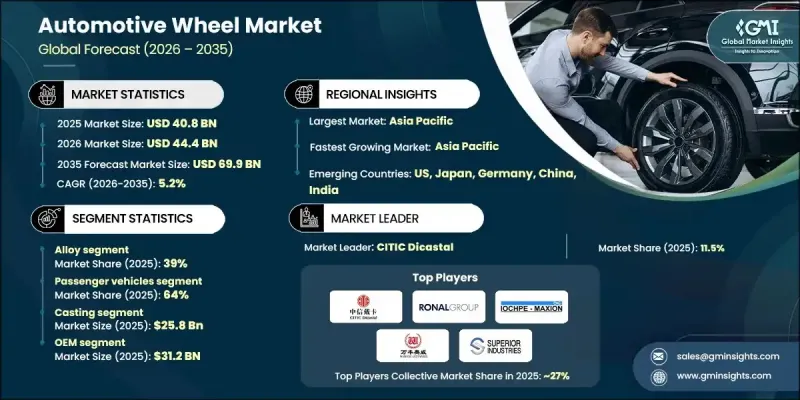
세계의 자동차 휠 시장은 2025년에 408억 달러로 평가되었고, 2035년까지 연평균 복합 성장률(CAGR) 5.2%로 성장할 전망이며, 699억 달러에 이를 것으로 예측됩니다.
세계의 자동차 생산 증가, 프리미엄 자동차 및 고성능 자동차 소비자 지향 증가, 휠 설계 및 제조 기술의 지속적인 혁신으로 시장은 지속적으로 성장하고 있습니다. 자동차 제조업체는 효율성, 내구성, 시각적 매력을 점점 중시하고 있으며, 이것이 차종에 관계없이 휠 사양의 재구축을 촉진하고 있습니다. 제조업체가 차량의 다이내믹스와 연비 효율의 향상에 주력하는 한편, 보다 엄격한 배출 가스 규제 및 성능 기준을 채우는 필요성으로부터, 경량 소재의 채용이 급속하게 확대하고 있습니다. 전동화는 휠 설계를 다시 정의합니다. 전기자동차는 주행 거리를 연장하기 위해 공기 역학 효율을 유지하면서 더 높은 차량 무게를 지원하는 휠이 필요하기 때문입니다. 이러한 변화는 공기 흐름 관리 개선과 구조적 무결성 강화를 포함한 고급 설계의 채택을 촉진합니다. 병행하여 진화하는 제조 기술과 정밀 공학은 일관성 향상, 내하중 능력 강화, 종합적인 성능 향상을 가능하게 하여 OEM 및 애프터마켓의 양 채널에서 장기적인 시장 확대를 지원하고 있습니다.
시장 범위
시작 연도
2025년
예측 연도
2026-2035년
시작 시 가치
408억 달러
예측 금액
699억 달러
CAGR
5.2%
합금 휠 부문은 2025년에 39%의 점유율을 차지했으며, 2035년까지 연평균 복합 성장률(CAGR) 4.3%를 나타낼 것으로 예측됩니다. 합금 휠은 차량 무게를 크게 줄이면서 취급 성능, 제동 성능 및 승차감을 향상시키는 능력에서 널리 채택되었습니다. 이러한 장점은 특히 차별화와 효율성이 구매 판단에 중요한 역할을 하는 중급 및 고급 차량 카테고리에서 승용차에 매우 매력적인 선택입니다. 생산 공정의 지속적인 발전으로 비용 효율적인 생산이 가능하며 동시에 강도와 내구성 향상과 세련된 미관을 실현하고 있습니다.
승용차 부문은 2025년에 64%의 점유율을 차지했으며, 2026-2035년 CAGR 4.5%를 나타낼 것으로 예측됩니다. 높은 생산량, 시각적으로 매력적인 디자인에 대한 수요 증가, 성능에 대한 기대 증가가 이 부문을 계속 지원하고 있습니다. SUV와 크로스오버 차종의 인기는 보다 큰 휠 사이즈, 높은 적재 능력, 고급 마무리에 대한 수요를 견인하고 있습니다. 또, 이 분야에 있어서의 전동화의 흐름에 의해 제조업체는 효율성을 손상시키지 않고, 보다 높은 토크, 회생 브레이크력, 증가한 차량 중량에 대응 가능한 휠의 개발을 강요되고 있습니다.
미국의 자동차용 휠 시장은 2025년 90억 달러 규모에 달했습니다. SUV, 픽업 트럭 및 고성능 차량에 대한 강한 수요가 시장 성장을 계속 지원하고 있으며, 이러한 차량은 일반적으로 더 큰 휠 직경과 높은 부가가치 소재를 필요로 합니다. 국내 자동차 생산 및 강력한 OEM의 존재는 특히 알루미늄 휠 및 단조 휠 카테고리에서 고급 휠 솔루션에 대한 수요를 더욱 강화하고 있습니다.
목차
제1장 조사 방법 및 범위
제2장 주요 요약
제3장 업계 인사이트
생태계 분석
공급자의 상황
원재료 공급자
휠 제조 및 가공
OEM
애프터마켓
최종 용도
비용 구조
이익률
각 공정에 있어서 부가가치
공급망에 영향을 미치는 요인
디스랩터
영향요인
성장 촉진요인
SUV 및 프리미엄 차종 수요 증가
애프터마켓에 있어서 커스터마이즈의 성장
기술적 진보 및 제조 혁신
상용차 및 오프 하이웨이 차량의 함대 확대
업계의 잠재적 위험 및 과제
원재료 가격의 변동성
고액의 자본 투자 요건
시장 기회
신흥 시장 및 현지화 전략
프리미엄화 및 스마트 휠 기술
경량화 및 지속 가능한 소재의 성장
성장 가능성 분석
규제 상황
북미
기업 평균 연비 기준(CAFE)
EPA 차량 배출 가스 규제 및 경량화 규제
USMCA 자동차 원산지 규칙
캘리포니아주 대기자원국(CARB) 제로에미션차(ZEV) 및 재료 적합 기준
유럽
승용차 및 밴용 EU 이산화탄소 배출 성능 기준
유로7 자동차 배출가스 규제
Fit for 55 기후 대책 패키지
REACH 규제 및 폐차(ELV) 지령
아시아태평양
중국 VI 배출 가스 규제
중국 신에너지차(NEV) 정책의 틀
바랏 스테이지 VI(BS-VI) 배출 가스 규제-인도
일본의 톱 러너 연비 기준 프로그램
라틴아메리카
PROCONVE 배출 기준(브라질)
아르헨티나의 자동차 배출 가스 규제 및 안전 기준
멕시코 NOM 자동차 배출 가스 기준
중동 및 아프리카
GCC 지역의 자동차 연비 및 배출 가스 규제
남아프리카 자동차 생산 개발 프로그램(APDP)
국내에서 전기자동차 보급 및 산업의 현지화 정책
Porter's Five Forces 분석
PESTEL 분석
기술 및 혁신 동향
현재 기술 동향
신흥 기술
가격 분석
제품별
지역별
비용 내역 분석
특허 분석
생산 통계
생산 거점
소비 거점
수출과 수입
지속가능성 및 환경면
지속가능한 실천
폐기물 감축 전략
생산에 있어서의 에너지 효율
환경 배려형 이니셔티브
탄소발자국에 관한 고려 사항
OEM 조달 및 구매 전략
EV 전용 휠 설계 및 성능 요건
전기자동차용 하중 및 토크 요건
공력 휠 설계 및 항속 거리 최적화
NVH 저감 및 구조 강성
회생 브레이크가 휠 내구성에 미치는 영향
EV 플랫폼 표준화가 림 사이즈에 미치는 영향
애프터마켓의 경제성 및 커스터마이제이션 동향
OEM 휠 및 가격 프리미엄 비교
커스텀 마무리, 코팅 및 미적 수요
고성능 휠 및 외관 업그레이드 비교
제조 능력 및 가동률 분석
지역별 설비 용량
가동률(OEM 대 애프터마켓)
기존 공장 확장 계획 및 신규 공장 확장 계획
단조 및 플로우 포밍 능력에 있어서의 병목
공급망의 위험 및 탄력성
제4장 경쟁 구도
서문
기업의 시장 점유율 분석
북미
유럽
아시아태평양
라틴아메리카
중동 및 아프리카
주요 시장 기업의 경쟁 분석
경쟁 포지셔닝 매트릭스
전략적 전망 매트릭스
주요 발전
합병 및 인수
제휴 및 협업
신제품 발매
사업 확대 계획 및 자금 조달
제5장 시장 추계 및 예측 : 재료별(2022-2035년)
강재
합금
탄소섬유
알루미늄
제6장 시장 추계 및 예측 : 차량별(2022-2035년)
승용차
해치백
세단
SUV/크로스오버
상용차
소형 상용차(LCV)
중형 상용차(MCV)
대형 상용차(HCV)
오프로드 자동차
제7장 시장 추계 및 예측 : 제조 공정별(2022-2035년)
주조
단조
플로우 포밍
제8장 시장 추계 및 예측 : 림 사이즈별(2022-2035년)
13-15인치
16-18인치
19-21인치
21인치 이상
제9장 시장 추계 및 예측 : 판매 채널별(2022-2035년)
OEM
애프터마켓
제10장 시장 추계 및 예측 : 지역별(2022-2035년)
북미
미국
캐나다
유럽
독일
영국
프랑스
이탈리아
스페인
러시아
북유럽 국가
베네룩스
아시아태평양
중국
인도
일본
호주
한국
필리핀
인도네시아
싱가포르
라틴아메리카
브라질
멕시코
아르헨티나
칠레
중동 및 아프리카
남아프리카
사우디아라비아
아랍에미리트(UAE)
제11장 기업 프로파일
세계 기업
CITIC Dicastal
Iochpe-Maxion
RONAL
Zhejiang Wanfeng Auto Wheel
Superior Industries International
Borbet
Accuride
Enkei
RAYS
Topy Industries
지역 제조업체
ALCAR
Mangels Industrial
Uniwheel
Lizhong
Central Motor Wheel
Jantsa Wheel
Steel Strips Wheels
Maxion Janta Wheels
YHI International
Kosei Aluminum
신흥 제조업체
Zhongnan Aluminum Wheel
Handan Hongda Auto Parts
Samhwa Wheels
AAM India Wheels
AJY
영문 목차
영문목차
The Global Automotive Wheel Market was valued at USD 40.8 billion in 2025 and is estimated to grow at a CAGR of 5.2% to reach USD 69.9 billion by 2035.
The market is witnessing steady momentum due to rising global vehicle production, growing consumer inclination toward premium and performance-focused vehicles, and continuous innovation in wheel design and manufacturing technologies. Automakers are increasingly emphasizing efficiency, durability, and visual appeal, which is reshaping wheel specifications across vehicle categories. Lightweight materials are gaining strong traction as manufacturers focus on improving vehicle dynamics and fuel efficiency while meeting stricter emission and performance standards. Electrification is further redefining wheel engineering, as electric vehicles demand wheels that can support higher vehicle weights while maintaining aerodynamic efficiency to extend driving range. This shift is encouraging the adoption of advanced designs with improved airflow management and enhanced structural integrity. In parallel, evolving manufacturing techniques and precision engineering enable higher consistency, improved load-bearing capacity, and better overall performance, supporting long-term market expansion across both OEM and aftermarket channels.
Market Scope
Start Year
2025
Forecast Year
2026-2035
Start Value
$40.8 Billion
Forecast Value
$69.9 Billion
CAGR
5.2%
The alloy wheel segment held 39% share in 2025 and is expected to grow at a CAGR of 4.3% through 2035. Alloy wheels are widely adopted due to their ability to significantly reduce vehicle weight while improving handling, braking performance, and ride comfort. These advantages make them highly attractive for passenger vehicles, especially in mid-range and premium categories where design differentiation and efficiency play a critical role in purchasing decisions. Ongoing advancements in manufacturing processes are enabling cost-effective production while delivering enhanced strength, durability, and refined aesthetics.
The passenger vehicles segment accounted for 64% share in 2025 and is projected to grow at a CAGR of 4.5% between 2026 and 2035. High production volumes, increasing demand for visually appealing designs, and rising expectations for performance continue to support this segment. The growing popularity of SUVs and crossovers is driving demand for larger wheel sizes, higher load capacities, and premium finishes. Electrification within this segment is also pushing manufacturers to develop wheels capable of handling higher torque, regenerative braking forces, and increased curb weights without compromising efficiency.
U.S. Automotive Wheel Market reached USD 9 billion in 2025. Strong demand for SUVs, pickup trucks, and performance vehicles continues to support market growth, as these vehicles typically require larger wheel diameters and higher-value materials. Domestic vehicle production and a strong OEM presence further reinforce demand for advanced wheel solutions, particularly in aluminum and forged wheel categories.
Key players in the Global Automotive Wheel Market include CITIC Dicastal, Iochpe-Maxion, Ronal, Enkei, Borbet, Superior Industries International, BBS Autotechnik, Prime Wheel, Topy Industries, Zhejiang Wanfeng Auto Wheel, and Accuride. Companies in the automotive wheel market are strengthening their market position by investing heavily in lightweight material development, advanced manufacturing technologies, and precision engineering. Strategic collaborations with OEMs enable early integration of customized wheel designs into new vehicle platforms, including electric and performance vehicles. Manufacturers are expanding production capacities and regional footprints to improve supply chain resilience and reduce delivery timelines. Increased focus on premium finishes, aerodynamic optimization, and sustainability-driven materials is helping companies differentiate their offerings.
Table of Contents
Chapter 1 Methodology & Scope
1.1 Research approach
1.2 Quality Commitments
1.2.1 GMI AI policy & data integrity commitment
1.3 Research Trail & Confidence Scoring
1.3.1 Research Trail Components
1.3.2 Scoring Components
1.4 Data Collection
1.4.1 Partial list of primary sources
1.5 Data mining sources
1.5.1 Paid sources
1.6 Base estimates and calculations
1.6.1 Base year calculation for any one approach
1.7 Forecast model
1.8 Research transparency addendum
Chapter 2 Executive Summary
2.1 Industry 3600 synopsis, 2022-2035
2.2 Key market trends
2.2.1 Regional
2.2.2 Material
2.2.3 Vehicle
2.2.4 Manufacturing process
2.2.5 Rim size
2.2.6 Sales channel
2.3 TAM Analysis, 2026-2035
2.4 CXO perspectives: Strategic imperatives
2.4.1 Key decision points for industry executives
2.4.2 Critical success factors for market players
2.5 Future outlook and strategic recommendations
Chapter 3 Industry Insights
3.1 Industry ecosystem analysis
3.1.1 Supplier landscape
3.1.1.1 Raw material supplier
3.1.1.2 Wheel Manufacturing & Processing
3.1.1.3 OEM
3.1.1.4 Aftermarket
3.1.1.5 End use
3.1.2 Cost structure
3.1.3 Profit margin
3.1.4 Value addition at each stage
3.1.5 Factors impacting the supply chain
3.1.6 Disruptors
3.2 Impact on forces
3.2.1 Growth drivers
3.2.1.1 Rising demand for SUVs and premium vehicles
3.2.1.2 Growth in aftermarket customization
3.2.1.3 Technological advancements and manufacturing innovation
3.2.1.4 Expansion of commercial and off-highway vehicle fleets
3.2.2 Industry pitfalls & challenges
3.2.2.1 Volatility in raw material prices
3.2.2.2 High capital investment requirements
3.2.3 Market opportunities
3.2.3.1 Emerging markets and localization strategies
3.2.3.2 Premiumization and smart wheel technologies
3.2.3.3 Growth of lightweight and sustainable materials
3.3 Growth potential analysis
3.4 Regulatory landscape
3.4.1 North America
3.4.1.1 Corporate Average Fuel Economy (CAFE) Standards