자동차 및 항공우주용 철강 시장 : 시장 기회, 성장 요인, 산업 동향 분석 및 예측(2026-2035년)
Automotive and Aerospace Steel Market Opportunity, Growth Drivers, Industry Trend Analysis, and Forecast 2026 - 2035
상품코드:1936541
리서치사:Global Market Insights Inc.
발행일:2026년 01월
페이지 정보:영문 190 Pages
라이선스 & 가격 (부가세 별도)
ㅁ Add-on 가능: 고객의 요청에 따라 일정한 범위 내에서 Customization이 가능합니다. 자세한 사항은 문의해 주시기 바랍니다.
한글목차
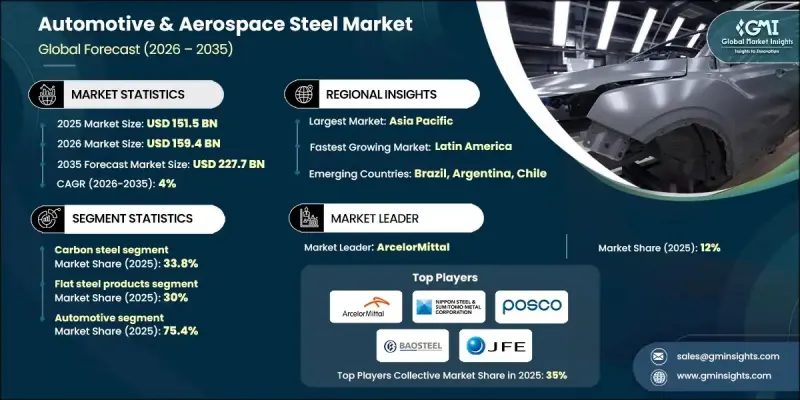
세계의 자동차 및 항공우주용 철강 시장은 2025년에 1,515억 달러로 평가되었고, 2035년까지 연평균 복합 성장률(CAGR) 4%로 성장할 전망이며, 2,277억 달러에 달할 것으로 예측되고 있습니다.
본 시장은 진화하는 모빌리티 및 항공우주 분야의 요구를 지원하는 고성능 재료에 대한 수요 증가를 배경으로 구조적 변혁기를 맞이하고 있습니다. 항공우주용 철강은 자동차 용도에 비해 수량 기준의 점유율은 작고, 극한의 성능 조건용으로 설계된 특수 고강도 강종에 대한 의존도가 높기 때문에 톤당 가치가 현저히 높아지고 있습니다. 차세대 차량 및 고연비 항공기 플랫폼에 대한 투자가 가속화됨에 따라 우수한 내식성, 피로 내구성, 구조 신뢰성을 갖춘 선진 고강도 강철 및 특수 합금에 대한 수요가 증가하고 있습니다. 자동차 분야에서는 배출가스 규제 강화 및 경량화 요구에 의해 제조업체는 안전성을 손상시키지 않고 차량 중량의 삭감을 강요하고 있습니다. 그 결과, 철강 제조업체는 차체 구조나 안전상 중요한 부품용으로 최적화된 선진 강종을 공급하는 경향이 강해지고 있어, 제조업체는 규제 준수를 달성하면서, 비용 효율과 구조적 무결성을 유지하는 것이 가능해지고 있습니다.
시장 범위
시작 연도
2025년
예측 연도
2026-2035년
시작 시 가치
1,515억 달러
예측 금액
2,277억 달러
CAGR
4%
탄소강 부문은 2025년에 33.8%의 점유율을 차지했으며, 2035년까지 연평균 복합 성장률(CAGR) 3.8%를 나타낼 것으로 예측됩니다. 그것의 보급은 낮은 생산 비용, 뛰어난 재활용성, 폭넓은 자동차 및 항공우주 구조 용도에 대한 적응성에 의해 지원됩니다. 탄소강은 저렴한 가격, 내구성 및 제조 용이성이 여전히 주요 고려사항인 비용에 중점을 둔 차량 부문에서 계속 주도적인 역할을 하고 있습니다. 뛰어난 강도 대 비용비로 초고성능이 요구되지 않는 경우 프레스 부품, 보철강, 하중 지지 구조물에 적합합니다.
자동차 부문은 2025년에 75.4%의 점유율을 차지했으며, 2026-2035년 CAGR 3.8%를 나타낼 것으로 예측됩니다. 자동차 제조는 지속적인 세계 자동차 생산과 차량 당 재료 사용량 증가에 힘입어 철강 소비의 가장 큰 원천입니다. 철강은 안전 시스템, 구조 보철강, 전기자동차(EV) 아키텍처에서의 사용이 증가하고 있는 가운데, 모든 차량 플랫폼에서 핵심적인 구조 재료로 남아 있습니다. 충돌 성능, 배터리 보호, 구조 강성에 대한 중시 증가가 자동차 분야에서 철강의 장기적인 수요를 강화하고 있습니다.
유럽의 자동차 및 항공우주용 철강 시장은 2025년에 330억 달러 규모에 이르렀고, 예측 기간 중에 강력한 성장이 전망됩니다. 지역적 확대는 기후 변화 대책에 중점을 둔 산업 정책, 저배출강 생산 도입 확대, 고도강종에 대한 수요 증가에 의해 지원되고 있습니다. 이 지역의 자동차 제조업체는 배출 감축 목표에 부합하여 저탄소 강과 고강도 강의 조달을 증가 시켰습니다. 한편, 항공우주 분야에서는 민간 및 방위항공 프로그램에 대한 지속적인 투자가 계속 추풍되고 있습니다. 이러한 요인들이 결합되어 여러 고부가가치 용도 분야에서 안정적인 철강 수요를 지원합니다.
목차
제1장 조사 방법 및 범위
제2장 주요 요약
제3장 업계 인사이트
생태계 분석
공급자의 상황
이익률
각 단계에서의 부가가치
밸류체인에 영향을 주는 요인
혁신
업계에 미치는 영향요인
성장 촉진요인
업계의 잠재적 위험 및 과제
시장 기회
성장 가능성 분석
규제 상황
북미
유럽
아시아태평양
라틴아메리카
중동 및 아프리카
Porter's Five Forces 분석
PESTEL 분석
가격 동향
지역별
소재 유형별
장래 시장 동향
기술 및 혁신 동향
현재 기술 동향
신흥 기술
특허 상황
무역 통계(HS코드)(참고 : 무역 통계는 주요 국가에서만 제공됨)
주요 수입국
주요 수출국
지속가능성 및 환경면
지속가능한 대처
폐기물 감축 전략
생산에 있어서의 에너지 효율
환경에 배려한 대처
탄소발자국 고려
제4장 경쟁 구도
서문
기업의 시장 점유율 분석
지역별
북미
유럽
아시아태평양
라틴아메리카
중동 및 아프리카
기업 매트릭스 분석
주요 시장 기업의 경쟁 분석
경쟁 포지셔닝 매트릭스
주요 발전
합병 및 인수
제휴 및 협업
신제품 발매
사업 확대 계획
제5장 시장 추계 및 예측 : 재질별(2022-2035년)
탄소강
합금강
스테인레스 스틸
공구강
선진 고강도 강(AHSS)
마르에이징강
기타
제6장 시장 추계 및 예측 : 제품 형태별(2022-2035년)
평강 제품
열간 압연 강판 및 코일
냉간 압연 강판 및 코일
아연 도금 강판(GI, GA)
전기 아연 도금 강판
장형 철강
선재
철근
구조용형강
파이프 및 튜브
원활한 파이프
용접 파이프
정밀 튜브
봉강 및 선재
둥근 막대
평강
각봉 및 육각봉
단조품
자유 단조품
폐형 단조품
링 단조품
주조품
로스트 왁스 주조품
모래 주조품
다이캐스트
강판 및 철강
담금질 및 템퍼링 강판
내마모 강판
압력용기용 강판
클래드강 및 코팅 강판
아연 도금 강판
알루미늄 피복 강판
유기 코팅 강판
호일 및 띠강
극박박
적층 스트립
제7장 시장 추계 및 예측 : 용도별(2022-2035년)
자동차
바디 인 화이트(BIW)
섀시 및 서스펜션
파워트레인 및 엔진 부품
배기 시스템
구동계 부품
안전 구조
EV 부품
구조 보철강
인테리어 시트
체결 부품 및 소형 부품
기타
항공우주
기체 구조
착륙장치 시스템
제트 엔진 부품
유압 및 연료 시스템
체결부품 및 커넥터
객실 내장 구조
군용 및 방위 항공기 부품
우주기 및 위성 부품
기타
제8장 시장 추계 및 예측 : 지역별(2022-2035년)
북미
미국
캐나다
유럽
독일
영국
프랑스
스페인
이탈리아
기타 유럽
아시아태평양
중국
인도
일본
호주
한국
기타 아시아태평양
라틴아메리카
브라질
멕시코
아르헨티나
기타 라틴아메리카
중동 및 아프리카
사우디아라비아
남아프리카
아랍에미리트(UAE)
기타 중동 및 아프리카
제9장 기업 프로파일
Acerinox SA
ArcelorMittal
Baosteel Group
Celsa Steel UK
China Steel Corporation
Commercial Metals Company
Daido Steel Co., Ltd.
Essar Steel
Gerdau S/A
Hyundai Steel
JFE Steel Corporation
Jiangsu Shagang Group
Jindal Steel & Power Ltd.
Kobe Steel. Ltd.
Mechel OAO
Nippon Steel & Sumitomo Metal Corporation
NJR Steel
Nucor Corporation
Outokumpu Oyj
POSCO
Steel Authority of India Limited(SAIL)
Steel Dynamics, Inc.
Tata Steel
ThyssenKrupp AG
United States Steel Corporation
Others
AJY
영문 목차
영문목차
The Global Automotive & Aerospace Steel Market was valued at USD 151.5 billion in 2025 and is estimated to grow at a CAGR of 4% to reach USD 227.7 billion by 2035.
The market is undergoing a period of structural transformation driven by rising demand for high-performance materials that support evolving mobility and aerospace requirements. While aerospace steel represents a smaller share by volume compared to automotive applications, it delivers significantly higher value per ton due to its reliance on specialized, high-strength steel grades engineered for extreme performance conditions. Investments in next-generation vehicles and more fuel-efficient aircraft platforms are accelerating demand for advanced high-strength steels and specialty alloys offering superior corrosion resistance, fatigue endurance, and structural reliability. In the automotive sector, tightening emissions regulations and lightweighting mandates are pushing manufacturers to reduce vehicle mass without compromising safety. As a result, steel producers are increasingly supplying advanced grades optimized for body structures and safety-critical components, enabling manufacturers to meet regulatory compliance while maintaining cost efficiency and structural integrity.
Market Scope
Start Year
2025
Forecast Year
2026-2035
Start Value
$151.5 Billion
Forecast Value
$227.7 Billion
CAGR
4%
The carbon steel segment accounted for 33.8% share in 2025 and is expected to grow at a CAGR of 3.8% through 2035. Its widespread adoption is supported by low production costs, strong recyclability, and adaptability across a wide range of automotive and aerospace structural applications. Carbon steel continues to play a dominant role in cost-sensitive vehicle segments where affordability, durability, and manufacturability remain primary considerations. Its favorable strength-to-cost ratio makes it suitable for stamped components, reinforcements, and load-bearing structures when ultra-high performance is not required.
The automotive segment held 75.4% share in 2025 and is forecast to grow at a CAGR of 3.8% from 2026 to 2035. Automotive manufacturing represents the largest source of steel consumption, supported by sustained global vehicle production and increasing material intensity per vehicle. Steel remains a core structural material across vehicle platforms, with rising use in safety systems, structural reinforcements, and electric vehicle architectures. The growing emphasis on crash performance, battery protection, and structural rigidity is reinforcing long-term steel demand within the automotive sector.
Europe Automotive & Aerospace Steel Market generated USD 33 billion in 2025 and is expected to register strong growth over the forecast period. Regional expansion is supported by climate-focused industrial policies, increasing adoption of low-emission steel production, and rising demand for advanced steel grades. Automotive manufacturers in the region are increasingly sourcing low-carbon and advanced high-strength steels to align with emission reduction targets, while aerospace activity continues to benefit from sustained investment in commercial and defense aviation programs. These factors collectively support steady steel demand across multiple high-value applications.
Key companies operating in the Global Automotive & Aerospace Steel Market include ArcelorMittal, POSCO, Tata Steel, Nucor Corporation, Hyundai Steel, Nippon Steel & Sumitomo Metal Corporation, ThyssenKrupp AG, United States Steel Corporation, JFE Steel Corporation, Baosteel Group, Gerdau S/A, Steel Dynamics, Inc., China Steel Corporation, Outokumpu Oyj, Acerinox S.A., Kobe Steel, Ltd., Jindal Steel & Power Ltd., Daido Steel Co., Ltd., Commercial Metals Company, NJR Steel, Celsa Steel UK, Mechel OAO, Jiangsu Shagang Group, Steel Authority of India Limited, and Essar Steel. Companies in the automotive and aerospace steel market are strengthening their market position by investing in advanced metallurgy and next-generation steel grades that balance strength, weight reduction, and sustainability. Manufacturers are expanding production of advanced high-strength and specialty steels to meet evolving OEM specifications. Strategic partnerships with automotive and aerospace manufacturers are helping secure long-term supply contracts and improve product customization. Firms are also investing in low-carbon steelmaking technologies to align with regulatory requirements and sustainability goals.
Table of Contents
Chapter 1 Methodology & Scope
1.1 Market scope and definition
1.2 Research design
1.2.1 Research approach
1.2.2 Data collection methods
1.3 Data mining sources
1.3.1 Global
1.3.2 Regional/Country
1.4 Base estimates and calculations
1.4.1 Base year calculation
1.4.2 Key trends for market estimation
1.5 Primary research and validation
1.5.1 Primary sources
1.6 Forecast model
1.7 Research assumptions and limitations
Chapter 2 Executive Summary
2.1 Industry 360° synopsis
2.2 Key market trends
2.2.1 Regional
2.2.2 Material type
2.2.3 Product form
2.2.4 Application
2.3 TAM Analysis, 2026-2035
2.4 CXO perspectives: Strategic imperatives
2.4.1 Executive decision points
2.4.2 Critical success factors
2.5 Future outlook and strategic recommendations
Chapter 3 Industry Insights
3.1 Industry ecosystem analysis
3.1.1 Supplier landscape
3.1.2 Profit margin
3.1.3 Value addition at each stage
3.1.4 Factor affecting the value chain
3.1.5 Disruptions
3.2 Industry impact forces
3.2.1 Growth drivers
3.2.2 Industry pitfalls and challenges
3.2.3 Market opportunities
3.3 Growth potential analysis
3.4 Regulatory landscape
3.4.1 North America
3.4.2 Europe
3.4.3 Asia Pacific
3.4.4 Latin America
3.4.5 Middle East & Africa
3.5 Porter's analysis
3.6 PESTEL analysis
3.7 Price trends
3.7.1 By region
3.7.2 By material type
3.8 Future market trends
3.9 Technology and Innovation landscape
3.9.1 Current technological trends
3.9.2 Emerging technologies
3.10 Patent Landscape
3.11 Trade statistics (HS code) ( Note: the trade statistics will be provided for key countries only)
3.11.1 Major importing countries
3.11.2 Major exporting countries
3.12 Sustainability and environmental aspects
3.12.1 Sustainable practices
3.12.2 Waste reduction strategies
3.12.3 Energy efficiency in production
3.12.4 Eco-friendly initiatives
3.13 Carbon footprint consideration
Chapter 4 Competitive Landscape, 2025
4.1 Introduction
4.2 Company market share analysis
4.2.1 By region
4.2.1.1 North America
4.2.1.2 Europe
4.2.1.3 Asia Pacific
4.2.1.4 LATAM
4.2.1.5 MEA
4.3 Company matrix analysis
4.4 Competitive analysis of major market players
4.5 Competitive positioning matrix
4.6 Key developments
4.6.1 Mergers & acquisitions
4.6.2 Partnerships & collaborations
4.6.3 New Product Launches
4.6.4 Expansion Plans
Chapter 5 Market Estimates and Forecast, By Material Type, 2022-2035 (USD Billion) (Kilo Tons)
5.1 Key trends
5.2 Carbon Steel
5.3 Alloy Steel
5.4 Stainless Steel
5.5 Tool Steel
5.6 Advanced High-Strength Steel (AHSS)
5.7 Maraging Steel
5.8 Others
Chapter 6 Market Estimates and Forecast, By Product Form, 2022-2035 (USD Billion) (Kilo Tons)
6.1 Key trends
6.2 Flat Steel Products
6.2.1 Hot Rolled Sheets/Coils
6.2.2 Cold Rolled Sheets/Coils
6.2.3 Galvanized Steel (GI, GA)
6.2.4 Electro-Galvanized Sheets
6.3 Long Steel Products
6.3.1 Wire Rods
6.3.2 Rebars
6.3.3 Structural Sections
6.4 Pipes & Tubes
6.4.1 Seamless Pipes
6.4.2 Welded Pipes
6.4.3 Precision Tubes
6.5 Bars & Rods
6.5.1 Round Bars
6.5.2 Flat Bars
6.5.3 Square/Hex Bars
6.6 Forgings
6.6.1 Open-Die Forgings
6.6.2 Closed-Die Forgings
6.6.3 Ring Forgings
6.7 Castings
6.7.1 Investment Castings
6.7.2 Sand Castings
6.7.3 Die Castings
6.8 Plates & Sheets
6.8.1 Quenched & Tempered Plates
6.8.2 Abrasion-Resistant Plates
6.8.3 Pressure Vessel Plates
6.9 Clad & Coated Steel
6.9.1 Zinc-Coated Steel
6.9.2 Aluminum-Coated Steel
6.9.3 Organic Coated Steel
6.10 Foils & Strips
6.10.1 Ultra-Thin Foils
6.10.2 Laminated Strips
Chapter 7 Market Estimates and Forecast, By Application, 2022-2035 (USD Billion) (Kilo Tons)
7.1 Key trends
7.2 Automotive
7.2.1 Body-in-White (BIW)
7.2.2 Chassis & Suspension
7.2.3 Powertrain & Engine Components
7.2.4 Exhaust System
7.2.5 Drivetrain Components
7.2.6 Safety Structures
7.2.7 EV Components
7.2.8 Structural Reinforcements
7.2.9 Interiors & Seating
7.2.10 Fasteners & Small Components
7.2.11 Others
7.3 Aerospace
7.3.1 Airframe Structures
7.3.2 Landing Gear Systems
7.3.3 Jet Engine Components
7.3.4 Hydraulic & Fuel Systems
7.3.5 Fasteners & Connectors
7.3.6 Cabin Interior Structures
7.3.7 Military & Defense Aircraft Components
7.3.8 Spacecraft & Satellite Components
7.3.9 Others
Chapter 8 Market Estimates and Forecast, By Region, 2022-2035 (USD Billion) (Kilo Tons)