



세계 토양 모니터링 시장은 2025년에 9억 3,810만 달러로 평가되었고, 2035년까지 연평균 복합 성장률(CAGR) 5.6%로 성장할 전망이며, 16억 달러에 이를 것으로 예측됩니다.

시장 확대의 배경은 환경 보호 및 지속 가능한 토지 관리에 대한 인식을 높이고 기후 변화 압력이 증가함에 따라 농업 생산성 최적화가 필요합니다. 업계에서는 빈도가 낮고 수작업에 의존하며 실험실 분석에 의존하는 기존의 토양 검사 방법에서 전환이 진행되고 있습니다. 대신 디지털 기술을 활용한 모니터링 솔루션은 지속적이고 위치 특이적인 지식을 제공함으로써 기세를 늘리고 있습니다. 업계 전반의 전략적 통합으로 혁신이 가속화되고 기술 포트폴리오가 확대되며 세계 시장으로의 전개가 촉진됩니다. 토양 모니터링 솔루션은 수율 향상 및 환경 부하 저감을 양립시키는 데이터 구동 의사 결정을 지원함으로써 현대 농업의 핵심 역할을 담당합니다. 이러한 시스템은 식량 안보 목표, 규제 지속가능성 목표, 스마트 농업 이니셔티브에 대한 관민 투자 증가와 잘 일치합니다. 농가와 농업 관련 기업이 확장성과 효율성을 겸비한 작물 관리 툴을 요구하고 있는 가운데, 토양 모니터링은 세계의 정밀 농업의 핵심 요소로서 중요성을 계속하고 있습니다.
| 시장 범위 | |
|---|---|
| 시작 연도 | 2025년 |
| 예측 연도 | 2026-2035년 |
| 시작 시 가치 | 9억 3,810만 달러 |
| 예측 금액 | 16억 달러 |
| CAGR | 5.6% |
최신 토양 모니터링 시스템은 수분 수준, 양분 함량, 토양 화학 조성을 정확하고 실시간으로 측정하여 물과 비료의 정확한 적용을 가능하게 합니다. 이 기술은 자원 효율성을 높이고 투입 비용을 줄이며 주변 생태계에 악영향을 줄 수 있는 유출을 줄입니다. 북미의 농업 생산량 증가 수요와 유럽 및 아시아태평양의 첨단 농업 기법에 대한 정책 지원이 확대됨에 따라 이러한 기술의 상업적 가치가 더욱 높아지고 있습니다. 농부 및 농학자들은 점점 더 많은 노력을 기울이는 샘플링 기술을 대체하는 자동화 시스템을 선호하고 있으며, 신속한 의사결정과 작물 수율 향상을 지원하고 있습니다.
2025년 인시츄 센서 부문은 48.6%의 점유율을 차지했으며, 4억 5,630만 달러의 수익을 창출했습니다. 이 부문은 또한 CAGR 6.1%라는 최고 성장률을 기록했습니다. 인시츄 센서는 토양 프로파일에서 직접 연속적인 고해상도 데이터를 제공하고 자율적인 농장 운영을 지원하고 인적 개입을 최소화하기 위해 널리 채택되었습니다. 그 보급은 지능적으로 연결된 농업 기술로의 업계 전반의 전환을 반영합니다.
2025년에는 야외 용도 부문이 62.3%의 점유율을 차지하여, 5억 8,470만 달러의 수익을 창출했습니다. 이 부문은 2026-2035년 연평균 복합 성장률(CAGR) 5.8%를 나타낼 것으로 예측됩니다. 야외 모니터링이 주류인 배경에는 세계 작물 재배의 광대한 규모와 대규모 농업 경영에서 정밀 농업 기법의 보급 확대가 있습니다. 실시간 토양 데이터는 생산성과 효율성을 크게 향상시킵니다.
북미의 토양 모니터링 시장은 2025년 3억 850만 달러에 이르렀고, 2035년까지 연평균 복합 성장률(CAGR) 5.6%로 성장할 것으로 예측됩니다. 이 지역은 지속 가능한 토지 이용 및 고수량 농업을 지원하는 첨단 감지 기술과 통합 데이터 플랫폼의 혜택을 누리고 있습니다. 환경보호 및 기후 변화에 대한 책임에 대한 규제의 초점은 토양의 건강 상태, 탄소 함량 및 화학적 영향을 모니터링하는 솔루션에 대한 수요를 더욱 촉진하고 꾸준한 지역 성장을 보장합니다.
The Global Soil Monitoring Market was valued at USD 938.1 million in 2025 and is estimated to grow at a CAGR of 5.6% to reach USD 1.6 billion by 2035.
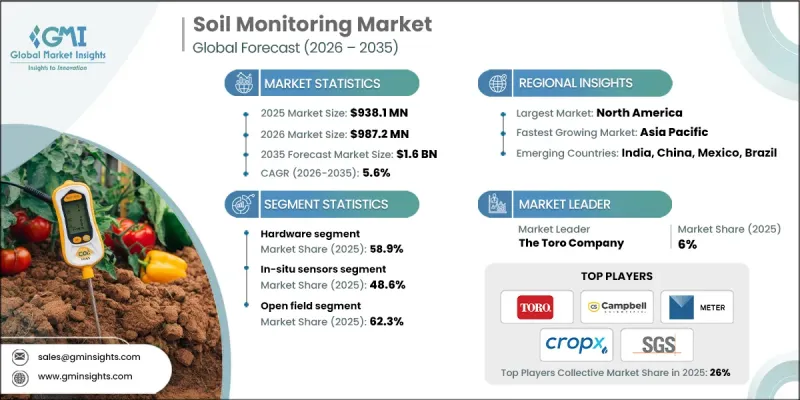
Market expansion is driven by rising awareness of environmental protection, sustainable land management, and the need to optimize agricultural productivity under increasing climate pressure. The industry is shifting away from conventional soil testing approaches that rely on infrequent, manual, and laboratory-dependent analysis. In their place, digitally enabled monitoring solutions are gaining momentum by delivering continuous and location-specific insights. Strategic consolidation across industry is accelerating innovation, expanding technology portfolios, and improving global market reach. Soil monitoring solutions now play a central role in modern agriculture by supporting data-driven decisions that improve yields while reducing environmental stress. These systems align well with food security objectives, regulatory sustainability goals, and increasing public and private investment in smart agriculture initiatives. As farmers and agribusinesses seek scalable and efficient crop management tools, soil monitoring continues to gain relevance as a core component of precision agriculture worldwide.
| Market Scope | |
|---|---|
| Start Year | 2025 |
| Forecast Year | 2026-2035 |
| Start Value | $938.1 Million |
| Forecast Value | $1.6 Billion |
| CAGR | 5.6% |
Modern soil monitoring systems provide accurate, real-time measurements of moisture levels, nutrient content, and soil chemistry, enabling precise application of water and fertilizers. This approach improves resource efficiency, lowers input costs, and reduces runoff that can harm surrounding ecosystems. The growing demand for higher agricultural output in North America, combined with expanding policy support for advanced farming practices in Europe and the Asia-Pacific region, reinforces the commercial value of these technologies. Farmers and agronomists increasingly favor automated systems that replace labor-intensive sampling methods, supporting faster decision-making and improved crop outcomes.
In 2025, the in-situ sensors segment accounted for a 48.6% share and generated USD 456.3 million. This segment also recorded the highest growth rate with a CAGR of 6.1%. In-situ sensors are widely adopted because they deliver continuous, high-resolution data directly from the soil profile, supporting autonomous farm operations and minimizing human intervention. Their widespread use reflects the broader industry shift toward intelligent, connected agricultural technologies.
The open-field applications segment held a 62.3% share, generating USD 584.7 million in 2025. This segment is expected to grow at a CAGR of 5.8% from 2026 to 2035. The dominance of open-field monitoring is linked to the vast scale of global crop cultivation and the increasing adoption of precision farming practices in large agricultural operations, where real-time soil insights significantly enhance productivity and efficiency.
North America Soil Monitoring Market reached USD 308.5 million in 2025 and is projected to grow at a CAGR of 5.6% through 2035. The region benefits from advanced sensing technologies and integrated data platforms that support sustainable land use and high-yield farming. Regulatory focus on environmental protection and climate accountability further drives demand for solutions that monitor soil health, carbon content, and chemical impact, ensuring steady regional growth.
Key companies active in the Global Soil Monitoring Market include METER Group, Inc., CropX Technologies, Acclima, Inc., SGS SA, Spectrum Technologies, Inc., Campbell Scientific, Inc., Sentek Technologies, Soil Scout Oy, Irrometer Company, Inc., Arable Labs, Inc., EarthOptics, Delta-T Devices Ltd, HydroPoint Data Systems, Inc., Element Materials Technology, and The Toro Company. Companies operating in the soil monitoring market strengthen their market position through technology innovation, data integration, and strategic expansion. Many players focus on developing sensor systems with higher accuracy, longer lifespan, and seamless connectivity with farm management platforms. Investments in analytics software and cloud-based dashboards enhance value by translating raw data into actionable insights. Firms also expand geographically to serve emerging agricultural markets while forming partnerships with agribusinesses and research institutions.