조류 기반 화학제품 시장 : 시장 기회, 성장 요인, 산업 동향 분석 및 예측(2026-2035년)
Algae Based Chemical Market Opportunity, Growth Drivers, Industry Trend Analysis, and Forecast 2026 - 2035
상품코드:1936503
리서치사:Global Market Insights Inc.
발행일:2026년 01월
페이지 정보:영문 180 Pages
라이선스 & 가격 (부가세 별도)
ㅁ Add-on 가능: 고객의 요청에 따라 일정한 범위 내에서 Customization이 가능합니다. 자세한 사항은 문의해 주시기 바랍니다.
한글목차
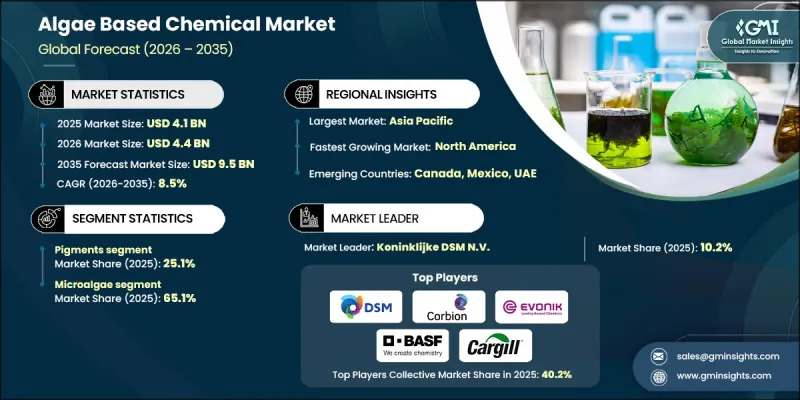
세계의 조류 기반 화학제품 시장은 2025년에 41억 달러로 평가되었고, 2035년까지 연평균 복합 성장률(CAGR) 8.5%로 성장할 전망이며, 95억 달러에 이를 것으로 예측됩니다.
조류 기반 화학제품은 연료, 폴리머, 영양 성분, 기타 의료, 농업, 에너지 및 공업 제조 분야에서 사용되는 생물활성물질 등 폭넓은 제품군을 커버하고 있습니다. 시장 확대는 생물 유래 및 비전통적 자원으로부터의 지속 가능한 원료에 대한 수요 증가에 크게 영향을 받고 있습니다. 세계 각국의 정부는 신재생 자원으로의 전환을 촉진하는 자금 프로그램, 연구 장려책, 규제 체제를 통해 바이오 이코노미를 적극적으로 지원하고 있습니다. 현재 아시아 지역이 최대 시장 규모를 차지하고 있으며, 조류의 재배 및 가공 인프라에 대한 강력한 투자가 이를 지원하고 있습니다. 북미에서는 기술 혁신, 지속 가능한 제조에 대한 자금 증가, 환경 배려 제품에 대한 소비자 선호도가 높아짐에 따라 시장이 급속히 확대되고 있습니다. 첨단 규제 및 공공 투자로 강화된 지원적인 생명 공학 환경이 상업화를 가속화하고 있습니다. 첨단 제조 및 생명과학 분야의 용도 범위 확대는 조류 기반 화학제품 솔루션의 장기적인 성장 전망을 더욱 강화하고 있습니다.
시장 범위
시작 연도
2025년
예측 연도
2026-2035년
시작 시 가치
41억 달러
예측 금액
95억 달러
CAGR
8.5%
안료 부문은 2025년에 25.1%의 점유율을 차지하였고, 2035년까지 연평균 복합 성장률(CAGR) 8.6%로 성장할 것으로 예측됩니다. 안전성 및 성능, 신뢰성, 지속가능성에 있어서 기존의 대체품보다 우위성을 가지는 천연 유래의 착색제를 요구하는 산업 전체에서 수요가 증가하고 있습니다. 규제 압력 및 깨끗한 라벨 제품에 대한 소비자의 선호도는 여러 최종 용도 시장에서의 채택을 더욱 강화하고 있습니다.
미세 조류 부문은 2025년에 65.1%의 점유율을 차지했습니다. 그 이점은 높은 생산성 및 단일 생산 시스템 내에서 여러 개의 고부가가치 화학제품을 생산할 수 있는 능력 때문입니다. 효율적인 토지 이용과 적은 수요로 인해 미세 조류는 영양보조식품, 화장품, 에너지 관련 용도 분야에서 대규모 상업 개발에 특히 매력적입니다.
북미의 조류 기반 화학제품 시장은 2026-2035년 연평균 복합 성장률(CAGR) 8.6%로 성장할 것으로 예측됩니다. 이러한 성장은 지속가능한 가공 방법의 혁신, 순환경제 원칙에 대한 주목 증가, 합성화학제품의 환경 영향에 대한 소비자 의식의 향상에 의해 지원되고 있습니다. 각 브랜드는 지속가능성에 대한 노력과 규제 기대에 부합하기 때문에 조류 기반 원료를 제품 포트폴리오에 계속 통합하고 있습니다.
목차
제1장 조사 방법 및 범위
제2장 주요 요약
제3장 업계 인사이트
생태계 분석
공급자의 상황
이익률
각 단계에서의 부가가치
밸류체인에 영향을 주는 요인
혁신
업계에 미치는 영향요인
성장 촉진요인
지속 가능하고 식물 유래의 원료에 대한 수요 증가
건강 및 웰니스에 대한 소비자 의식 증가
바이오연료 및 신재생 에너지에 대한 규제 지원 강화
업계의 잠재적 위험 및 과제
높은 생산 및 가공 비용
확장성의 과제 및 자본 집약적인 인프라
시장 기회
바이오플라스틱 및 순환형 경제의 새로운 용도 분야
폐수 처리 및 탄소 포집과의 통합
성장 가능성 분석
규제 상황
북미
유럽
아시아태평양
라틴아메리카
중동 및 아프리카
Porter's Five Forces 분석
PESTEL 분석
가격 동향
지역별
제품 유형별
장래 시장 동향
기술 및 혁신 동향
현재 기술 동향
신흥 기술
특허 상황
무역 통계(HS코드)
주요 수입국
주요 수출국
지속가능성 및 환경면
지속가능한 대처
폐기물 감축 전략
생산에 있어서 에너지 효율
환경에 배려한 대처
탄소발자국 고려
제4장 경쟁 구도
서문
기업의 시장 점유율 분석
지역별
북미
유럽
아시아태평양
라틴아메리카
중동 및 아프리카
기업 매트릭스 분석
주요 시장 기업의 경쟁 분석
경쟁 포지셔닝 매트릭스
주요 발전
합병 및 인수
제휴 및 협업
신제품 발매
사업 확대 계획
제5장 시장 추계 및 예측 : 제품 유형별(2022-2035년)
안료
다당류
오메가3 지방산
단백질 및 아미노산
바이오연료
바이오플라스틱
기타
제6장 시장 추계 및 예측 : 조류 유형별(2022-2035년)
미세 조류
스피루리나
클로렐라
헤마토코커스 풀비아리스
기타
대형 조류
갈조류
홍조류
녹조류
제7장 시장 추계 및 예측 : 용도별(2022-2035년)
식품 및 음료
천연 착색료
증점제 및 안정제
영양 성분
뉴트라슈티컬 및 영양보조식품
오메가 3 보충
단백질 파우더
항산화 보충제
의약품
화장품 및 퍼스널케어
스킨 케어 제품
헤어 케어 제품
안티 에이징 제형
사료 및 수산 양식
바이오연료 및 에너지
농업 및 비료
기타
제8장 시장 추계 및 예측 : 지역별(2022-2035년)
북미
미국
캐나다
유럽
독일
영국
프랑스
스페인
이탈리아
기타 유럽
아시아태평양
중국
인도
일본
호주
한국
기타 아시아태평양
라틴아메리카
브라질
멕시코
아르헨티나
기타 라틴아메리카
중동 및 아프리카
사우디아라비아
남아프리카
아랍에미리트(UAE)
기타 중동 및 아프리카
제9장 기업 프로파일
Aliga ApS
BASF SE
Cabio Biotech
Cargill, Incorporated
Cellana Inc
Corbion
Cyanotech Corporation
Earthrise Nutritionals LLC
Evonik Industries AG
Koninklijke DSM NV
Parry Nutraceuticals
AJY
영문 목차
영문목차
The Global Algae Based Chemical Market was valued at USD 4.1 billion in 2025 and is estimated to grow at a CAGR of 8.5% to reach USD 9.5 billion by 2035.
Algae-derived chemicals cover a broad range of outputs, including fuels, polymers, nutritional compounds, and other bioactive materials used across healthcare, agriculture, energy, and industrial manufacturing. Market expansion is strongly influenced by the rising demand for sustainable ingredients from both biological and non-traditional sources. Governments worldwide actively support the bioeconomy through funding programs, research incentives, and regulatory frameworks that encourage the transition toward renewable resources. Asia currently represents the largest regional market, supported by strong investments in algae cultivation and processing infrastructure. North America is emerging rapidly due to technological innovation, increased funding for sustainable manufacturing, and a growing consumer preference for environmentally responsible products. A supportive biotechnology ecosystem, reinforced by progressive regulations and public investment, accelerates commercialization. Expanding applications across advanced manufacturing and life-science sectors further strengthen long-term growth prospects for algae-based chemical solutions.
Market Scope
Start Year
2025
Forecast Year
2026-2035
Start Value
$4.1 Billion
Forecast Value
$9.5 Billion
CAGR
8.5%
The pigments segment held 25.1% share in 2025 and is projected to grow at a CAGR of 8.6% through 2035. Demand increases across industries seeking naturally derived colorants that offer safety, performance, reliability, and sustainability advantages compared to conventional alternatives. Regulatory pressure and consumer preference for clean-label products further support adoption in multiple end-use markets.
The microalgae segment held a share of 65.1% in 2025. Their dominance is driven by high productivity rates and the ability to generate multiple high-value chemical outputs within a single production system. Efficient land use and lower water requirements make microalgae particularly attractive for large-scale commercial deployment across nutraceutical, cosmetic, and energy-related applications.
North America Algae Based Chemical Market is forecast to grow at a CAGR of 8.6% from 2026 to 2035. Growth is supported by innovation in sustainable processing methods, increased emphasis on circular economy principles, and rising consumer awareness of the environmental impact of synthetic chemicals. Brands continue to integrate algae-derived inputs into product portfolios to align with sustainability commitments and regulatory expectations.
Key companies operating in the Global Algae Based Chemical Market include BASF SE, Corbion, Cargill Incorporated, Koninklijke DSM N.V., Evonik Industries AG, Cyanotech Corporation, Earthrise Nutritionals LLC, Cellana Inc, Parry Nutraceuticals, Aliga ApS, and Cabio Biotech. Companies in the algae-based chemical market strengthen their competitive position by investing in scalable cultivation technologies and advanced processing techniques to improve yield and cost efficiency. Strategic collaborations with research institutions accelerate product innovation and application development. Many players focus on expanding downstream integration to capture higher value across the supply chain. Emphasis on sustainability certifications and regulatory compliance enhances customer trust and market acceptance. Geographic expansion into high-growth regions supports revenue diversification. Continuous investment in biotechnology, strain optimization, and process automation improves product consistency and commercial viability.
Table of Contents
Chapter 1 Methodology & Scope
1.1 Market scope and definition
1.2 Research design
1.2.1 Research approach
1.2.2 Data collection methods
1.3 Data mining sources
1.3.1 Global
1.3.2 Regional/Country
1.4 Base estimates and calculations
1.4.1 Base year calculation
1.4.2 Key trends for market estimation
1.5 Primary research and validation
1.5.1 Primary sources
1.6 Forecast model
1.7 Research assumptions and limitations
Chapter 2 Executive Summary
2.1 Industry 360° synopsis
2.2 Key market trends
2.2.1 Regional
2.2.2 Product type
2.2.3 Algae type
2.2.4 Application
2.3 TAM Analysis, 2026-2035
2.4 CXO perspectives: Strategic imperatives
2.4.1 Executive decision points
2.4.2 Critical success factors
2.5 Future Outlook and Strategic Recommendations
Chapter 3 Industry Insights
3.1 Industry ecosystem analysis
3.1.1 Supplier landscape
3.1.2 Profit margin
3.1.3 Value addition at each stage
3.1.4 Factor affecting the value chain
3.1.5 Disruptions
3.2 Industry impact forces
3.2.1 Growth drivers
3.2.1.1 Growing demand for sustainable & plant-based ingredients
3.2.1.2 Rising consumer awareness of health & wellness
3.2.1.3 Increasing regulatory support for biofuels & renewable energy