태양열 해수 담수화 플랜트 시장 기회, 성장요인, 업계 동향 분석 및 예측(2026-2035년)
Solar Water Desalination Plant Market Opportunity, Growth Drivers, Industry Trend Analysis, and Forecast 2026 - 2035
상품코드:1928974
리서치사:Global Market Insights Inc.
발행일:2026년 01월
페이지 정보:영문 250 Pages
라이선스 & 가격 (부가세 별도)
ㅁ Add-on 가능: 고객의 요청에 따라 일정한 범위 내에서 Customization이 가능합니다. 자세한 사항은 문의해 주시기 바랍니다.
한글목차
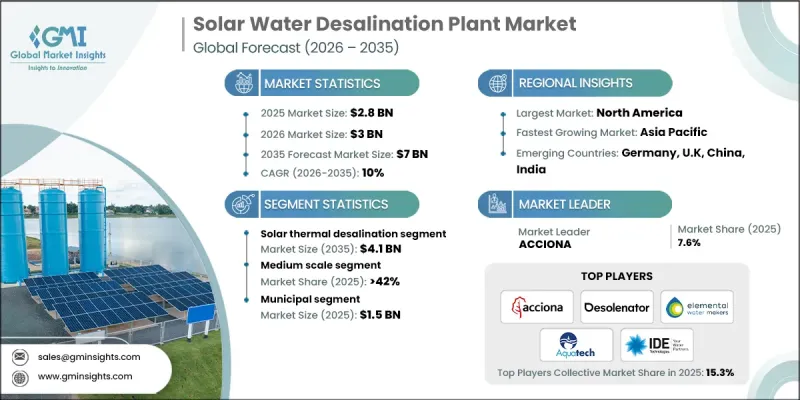
세계의 태양열 해수 담수화 플랜트 시장은 2025년에 28억 달러로 평가되었고, 2035년까지 연평균 복합 성장률(CAGR) 10%로 성장하여 70억 달러에 이를 것으로 예측됩니다.
이러한 강력한 성장은 전 세계 담수 자원에 대한 압력이 증가하고 지속 가능한 물 생산 솔루션에 대한 수요가 증가하고 있음을 반영합니다. 태양열 해수담수화 시스템은 열에너지를 활용하여 바닷물을 실용적인 담수로 전환하기 때문에 기존 처리 기술을 대체할 수 있는 친환경적인 대안으로 자리매김하고 있습니다. 자원 보존과 장기적인 물 안보에 대한 인식이 높아지면서 여러 지역에서 도입이 가속화되고 있습니다. 기술 발전으로 시스템 효율이 향상되고, 재료 사용량이 감소하고, 전반적인 성능이 향상됨에 따라 태양열 해수 담수화는 대규모로 점점 더 실용성이 높아지고 있습니다. 이러한 발전에도 불구하고, 기존 여과 기반 방식에 비해 높은 초기 투자 요건은 여전히 주요한 문제점으로 남아있습니다. 그러나 지속적인 기술 혁신, 부품 비용의 하락, 지원적인 정책 프레임워크로 인해 경제적 타당성은 점차 개선되고 있습니다. 공공 부문의 지원과 장기적인 지속가능성 목표가 시장의 모멘텀을 강화하고, 담수 공급과 수요의 격차를 해소하는 데 있어 태양열 해수담수화가 중요한 역할을 할 것으로 기대됩니다.
시장 범위
개시 연도
2025년
예측 연도
2026-2035년
개시 연도 가치
28억 달러
예측 금액
70억 달러
CAGR
10%
태양열 해수담수화는 2025년 16억 달러 시장 규모를 창출하고 2035년까지 4100억 달러에 달할 것으로 예측됩니다. 이 시스템은 직접 태양열을 이용하여 열분리 공정을 구동하고 더 높은 작동 효율을 달성하면서 더 낮은 에너지 투입 요구 사항을 유지합니다. 비용 우위와 확장성은 전 세계 담수화 시설에 대한 광범위한 도입을 지속적으로 뒷받침하고 있습니다.
중형 시스템은 2025년 42%의 점유율을 차지했습니다. 이 부문의 성장은 다양한 수질 조건에 대한 적응력과 지역적 공급 수요에 대한 대응 능력에 의해 주도되고 있습니다. 유연한 시스템 설계는 도입 효율을 향상시키는 동시에 물의 확보 가능성과 공급의 신뢰성을 강화합니다.
미국의 태양열 담수화 플랜트 시장은 2025년 77.3%의 점유율을 차지할 것으로 예측됩니다. 물 스트레스 증가와 더불어 강력한 공공투자와 재생에너지 우대정책으로 도입이 계속 가속화되고 있습니다. 지속적인 인프라 자금 조달과 탈탄소화 이니셔티브가 시장의 추가 확장을 뒷받침하고 있습니다.
목차
제1장 조사 방법과 범위
제2장 주요 요약
제3장 업계 인사이트
생태계 분석
공급업체 상황
이익률
각 단계 부가가치
밸류체인에 영향을 미치는 요인
업계에 대한 영향요인
성장 촉진요인
담수 수요 증가
심각화하는 물부족
급속한 기술 진보
업계의 잠재적 리스크&과제
초기 투자액이 높고, 유지 관리에 다대한 노력을 필요로 합니다
간헐성과 운영 위 과제
기회
지속가능으로 저탄소인 물솔루션에 대한 강력한 수요
기술 진보와 비용 하락
성장 가능성 분석
향후 시장 동향
기술과 혁신 동향
현재 기술 동향
신기술
가격 동향
기술 유형별
지역별
규제 상황
규격 및 컴플라이언스 요건
지역별 규제 구조
인증 기준
무역 통계
주요 수입국
주요 수출국
갭 분석
리스크 평가와 경감책
Porter의 Five Forces 분석
PESTEL 분석
제4장 경쟁 구도
서론
기업의 시장 점유율 분석
지역별
기업 매트릭스 분석
주요 시장 기업의 경쟁 분석
경쟁 포지셔닝 매트릭스
주요 발전
인수합병(M&A)
제휴 및 협업
신제품 발매
확대 계획
제5장 시장 추산·예측 : 기술 유형별, 2022-2035
태양광발전에 의한 해수담수화
태양열 해수담수화
제6장 시장 추산·예측 : 냉각 능력별, 2022-2035
소규모(1,000입방미터/일 미만)
중규모(1,000-10,000입방미터/일)
대규모(1 양지 10,000입방미터 이상)
제7장 시장 추산·예측 : 태양광 통합 모델별, 2022-2035
Off-grid 태양광발전
하이브리드 태양광+계통 연계 형
태양열 보조형
제8장 시장 추산·예측 : 최종 용도별, 2022-2035
농업 분야
산업용
자치체 용
상업용
제9장 시장 추산·예측 : 지역별, 2022-2035
북미
미국
캐나다
유럽
독일
프랑스
영국
이탈리아
스페인
아시아태평양
중국
인도
일본
한국
호주
라틴아메리카
브라질
멕시코
아르헨티나
중동 및 아프리카
남아프리카공화국
사우디아라비아
아랍에미리트(UAE)
제10장 기업 개요
Acciona
Aquastill
Aquatech
Boreal Light
Condorchem Envirotech
Desolenator
Elemental Water Makers
Empereal Energy and Services
ForeverPure Corporation
IDE Technologies
Memsys
Osmosun
SolarDew
Solar Water
Solar Water Solutions
LSH
영문 목차
영문목차
The Global Solar Water Desalination Plant Market was valued at USD 2.8 billion in 2025 and is estimated to grow at a CAGR of 10% to reach USD 7 billion by 2035.
The strong growth reflects intensifying pressure on global freshwater resources and the increasing need for sustainable water generation solutions. Solar desalination systems convert saline water into usable freshwater by leveraging thermal energy, positioning them as an environmentally aligned alternative to conventional treatment technologies. Rising awareness around resource conservation and long-term water security continues to accelerate adoption across multiple regions. Technological progress has improved system efficiency, reduced material usage, and enhanced overall performance, making solar desalination increasingly viable at scale. Despite these advances, high upfront investment requirements remain a key challenge compared to traditional filtration-based approaches. However, continued innovation, falling component costs, and supportive policy frameworks are gradually improving economic feasibility. Public-sector backing and long-term sustainability goals are expected to reinforce market momentum, enabling solar desalination to play a meaningful role in addressing the widening global gap between freshwater supply and demand.
Market Scope
Start Year
2025
Forecast Year
2026-2035
Start Value
$2.8 Billion
Forecast Value
$7 Billion
CAGR
10%
The solar thermal desalination generated USD 1.6 billion in 2025 and is forecast to reach USD 4.1 billion by 2035. These systems utilize direct solar heat to drive thermal separation processes and deliver higher operational efficiency while maintaining lower energy input requirements. Their cost advantages and scalability continue to support widespread adoption across global desalination capacity.
The medium-scale systems accounted for 42% share in 2025. Growth in this segment is driven by their adaptability to varying water conditions and their ability to address localized supply requirements. Flexible system design improves deployment efficiency while strengthening water availability and supply reliability.
United States Solar Water Desalination Plant Market held 77.3% share in 2025. Increasing water stress, combined with strong public investment and renewable energy incentives, continues to accelerate deployment. Ongoing infrastructure funding and decarbonization initiatives further support market expansion.
Key companies active in the Global Solar Water Desalination Plant Market include Acciona, IDE Technologies, Aquatech, Boreal Light, Osmosun, Desolenator, Aquastill, Condorchem Envitech, Memsys, Solar Water Solutions, SolarDew, Solar Water, Elemental Water Makers, ForeverPure Corporation, and Empereal Energy and Services. Companies operating in the Solar Water Desalination Plant Market focus on strengthening their competitive position through technology optimization, modular system development, and strategic partnerships. Investment in research and development helps improve efficiency, reduce system complexity, and lower lifecycle costs. Firms emphasize scalable designs to address varying capacity requirements while expanding deployment flexibility. Collaboration with governments and infrastructure agencies supports project financing and long-term adoption. Geographic expansion into water-stressed regions enhances growth opportunities.
Table of Contents
Chapter 1 Methodology & Scope
1.1 Market scope and definition
1.2 Research design
1.2.1 Research approach
1.2.2 Data collection methods
1.3 Data mining sources
1.3.1 Global
1.3.2 Regional/Country
1.4 Base estimates and calculations
1.4.1 Base year calculation
1.4.2 Key trends for market estimation
1.5 Primary research and validation
1.5.1 Primary sources
1.6 Forecast model
1.7 Research assumptions and limitations
Chapter 2 Executive Summary
2.1 Industry 3600 synopsis
2.2 Key market trends
2.2.1 Regional
2.2.2 Technology type
2.2.3 Cooling capacity
2.2.4 Solar integration model
2.2.5 End use
2.3 CXO perspectives: Strategic imperatives
2.3.1 Key decision points for industry executives
2.3.2 Critical success factors for market players
2.4 Future outlook and strategic recommendations
Chapter 3 Industry Insights
3.1 Industry ecosystem analysis
3.1.1 Supplier landscape
3.1.2 Profit margin
3.1.3 Value addition at each stage
3.1.4 Factor affecting the value chain
3.2 Industry impact forces
3.2.1 Growth drivers
3.2.1.1 Increasing demand of freshwater
3.2.1.2 Rising water scarcity
3.2.1.3 Rapid technology advancement
3.2.2 Industry pitfalls & challenges
3.2.2.1 High initial investment and intensive maintenance requirement
3.2.2.2 Intermittency and operational challenges
3.2.3 Opportunities
3.2.3.1 Strong demand for sustainable, low-carbon water solutions
3.2.3.2 Technological advancements and cost declines