Industrial Boiler Market Opportunity, Growth Drivers, Industry Trend Analysis, and Forecast 2026 - 2035
상품코드:1928959
리서치사:Global Market Insights Inc.
발행일:2026년 01월
페이지 정보:영문 140 Pages
라이선스 & 가격 (부가세 별도)
ㅁ Add-on 가능: 고객의 요청에 따라 일정한 범위 내에서 Customization이 가능합니다. 자세한 사항은 문의해 주시기 바랍니다.
한글목차
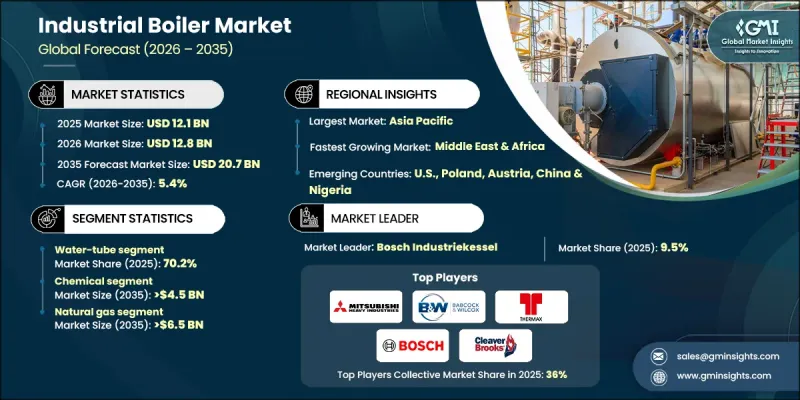
세계의 산업용 보일러 시장은 2025년에 121억 달러로 평가되었고, 2035년까지 연평균 복합 성장률(CAGR) 5.4%로 성장하여 207억 달러에 이를 것으로 예측됩니다.
이러한 성장은 화학, 식음료, 펄프 및 제지, 제지, 금속 등의 산업에서 공정 열 수요 증가와 연속 공정 운영에서 처리량 목표 증가에 의해 주도되고 있습니다. 기업들은 디지털화된 연소 제어 및 산소 트림 시스템을 갖춘 현대식 고효율 연소 보일러에 투자하고 있으며, 이를 통해 에너지 관리 및 운영 신뢰성을 향상시키고 있습니다. 산업용 보일러는 물을 가열하여 증기나 온수를 생성하도록 설계된 대형 밀폐용기로 제조, 발전, 화학처리 등에 널리 사용되고 있습니다. 신뢰성 중심 유지보수(RCM)에 기반한 컴팩트한 수관식 및 하이브리드 설계로 노후화된 화관식 유닛을 대체하는 것이 시장 보급을 가속화하고 있습니다. 황산화물(SOx), 질소산화물(NOx), 입자상 물질(PM), 이산화탄소(CO2)에 대한 배출 규제 강화와 엄격한 허가 심사가 결합되어 첨단 버너, 선택적 촉매 환원(SCR) 시스템, 배기가스 재순환(FGR), 고회분 내성 설계에 대한 수요를 견인하고 있습니다. 연료 가격의 변동성과 가스 공급의 불확실성은 수명 주기 비용과 운영 위험을 최적화하기 위해 다중 연료 대응 장치와 신속한 연료 전환 시스템의 채택을 촉진하고 있습니다.
시장 범위
개시 연도
2025년
예측 연도
2026-2035년
개시 연도 가치
121억 달러
예측 금액
207억 달러
CAGR
5.4%
2025년 기준, 수관식 산업용 보일러 부문은 70.2%의 점유율을 차지했습니다. 화학, 석유화학, 금속 가공 산업의 고압 증기 수요 증가가 성장을 견인하고 있으며, 기존 수관식 시스템을 첨단 과열기, 에너지 절약 장치, 자동 연소 제어 시스템으로 업데이트하는 움직임이 도입을 더욱 가속화하고 있습니다.
식품 가공용 산업용 보일러 시장은 2035년까지 연평균 복합 성장률(CAGR) 5.5%를 나타낼 것으로 예측됩니다. 가공식품 및 포장식품의 소비 증가와 엄격한 위생 기준이 성장을 주도하고 있습니다. 탄소 발자국을 줄이고 지속가능성 목표를 달성하기 위한 천연가스 및 바이오매스 연소 보일러의 도입 증가도 시장 확대를 뒷받침하고 있습니다.
북미 산업용 보일러 시장은 2025년 82.4%의 점유율을 차지하며 18억 달러 규모에 달할 것으로 예측됩니다. 에너지 절약 및 저배출 기술 및 디지털 모니터링 시스템에 대한 투자가 성장을 주도하고 있습니다. 지속가능성에 대한 지속적인 강조와 엄격한 배출 기준 준수에 따라 첨단 연소 솔루션과 운영 효율이 높은 보일러 시스템에 대한 수요가 증가하고 있습니다.
목차
제1장 조사 방법과 범위
정보원 정합성 프로토콜
조사 경위와 신뢰성 스코어 링
조사 경로 구성요소
스코어 링 요소
데이터 수집
1차 정보 일부 리스트
데이터 마이닝 정보원
유료 정보원
지역별 정보원
기본 추정치와 계산
몇개의 방법 기준연도 계산
시장 추산·예측 파라미터
예측 모델
정량화된 시장 영향 분석
성장 파라미터가 예측에게 주는 수학적 영향
조사 투명성 보유
정보원 귀속 프레임워크
품질 보증 지표
신뢰에의 임해
시장의 정의
제2장 주요 요약
제3장 업계 인사이트
생태계 분석
원재료 가용성과 조달 분석
제조능력 평가
공급망 회복탄력성와 리스크 요인
유통 네트워크 분석
규제 상황
업계에 대한 영향요인
성장 촉진요인
업계의 잠재적 리스크&과제
성장 가능성 분석
Porter의 Five Forces 분석
공급 기업의 교섭력
바이어의 교섭력
신규 진출업체의 위협
대체품의 위협
PESTEL 분석
산업용 보일러 비용 구조 분석
가격 동향 분석
제품별
지역별
새로운 기회와 동향
디지털화와 IoT 통합
투자 분석과 전망
제4장 경쟁 구도
서론
기업의 시장 점유율 분석 : 지역별
북미
유럽
아시아태평양
중동 및 아프리카
라틴아메리카
전략적 대시보드
Key partnerships &collaborations
Major M&A activities
Product innovations &launches
Market expansion strategies
전략적 이니셔티브
경쟁 벤치마킹
혁신과 기술 동향
제5장 시장 규모와 예측 : 제품별, 2022-2035
화관식
용량별
<10 MMBTU/hr
10-25 MMBTU/때
25-50 MMBTU/때
50-75 MMBTU/때
75-100 MMBTU/때
100-175 MMBTU/때
175-250 MMBTU/때
>250 MMBTU/hr
용도별
식품 가공
펄프 및 제지
화학
정유소
1차 금속
기타
기술별
응축식
불응축
연료별 천연가스/석유/석탄/기타
천연가스
석유
석탄
기타
수관식
용량별
<10 MMBTU/hr
10-25 MMBTU/때
25-50 MMBTU/때
50-75 MMBTU/hr
75-100 MMBTU/때
100-175 MMBTU/때
175-250 MMBTU/때
>250 MMBTU/hr
용도별
식품 가공
펄프 및 제지
화학
정유소
1차 금속
기타
기술별
응축식
불응축
연료별 천연가스/석유/석탄/기타
천연가스
석유
석탄
기타
제6장 시장 규모와 예측 : 용량별, 2022-2035
10 MMBTU/hr미만
10-25백만 BTU/때
25-50백만 BTU/때
50-75백만 BTU/때
75-100백만 BTU/때
100-175백만 BTU/때
175-250백만 BTU/때
250백만 BTU/시초
제7장 시장 규모와 예측 : 용도별, 2022-2035
식품 가공
펄프 및 제지
화학
정유소
1차 금속
기타
제8장 시장 규모와 예측 : 기술별, 2022-2035
응축식
불응축
제9장 시장 규모와 예측 : 연료별, 2022-2035
천연가스
석유
석탄
기타
제10장 시장 규모와 예측 : 지역별, 2022-2035
북미
미국
캐나다
멕시코
유럽
프랑스
영국
폴란드
이탈리아
스페인
오스트리아
독일
스웨덴
러시아
아시아태평양
중국
인도
필리핀
일본
한국
호주
인도네시아
중동 및 아프리카
사우디아라비아
이란
아랍에미리트
나이지리아
남아프리카공화국
라틴아메리카
브라질
아르헨티나
칠레
제11장 기업 개요
Babcock &Wilcox Enterprises
Bharat Heavy Electricals
Bosch Industriekessel
California Boiler
Clayton Industries
Cleaver-Brooks
Cochran
Doosan Enerbility
FERROLI
Fonderie Sime
FONDITAL
Forbes Marshall
Fulton
Groupe Atlantic
HME Boilers
Hoval
Hurst Boiler &Welding
John Cockerill
John Wood Group
Mitsubishi Heavy Industries
Miura America
Rentech Boiler Systems
Sofinter
Thermax
Thermodyne Engineering Systems
Victory Energy Operations
Viessmann Climate Solutions
Walchandnagar Industries
LSH
영문 목차
영문목차
The Global Industrial Boiler Market was valued at USD 12.1 billion in 2025 and is estimated to grow at a CAGR of 5.4% to reach USD 20.7 billion by 2035.
Growth is fueled by rising demand for process heat across industries such as chemicals, food & beverage, pulp & paper, and metals, along with increasing throughput targets in continuous-process operations. Companies are investing in modern, high-efficiency fired boilers with digitized combustion control and O2 trim systems, which are enhancing energy management and operational reliability. Industrial boilers are large, enclosed vessels designed to produce steam or hot water by applying heat to water, commonly used for manufacturing, power generation, and chemical processing. Replacing aging fire-tube units with compact water-tube and hybrid designs, supported by reliability-centered maintenance, is accelerating market adoption. Stricter emissions regulations for SOx, NOx, PM, and CO2, coupled with permitting scrutiny, are driving demand for advanced burners, selective catalytic reduction systems, flue-gas recirculation, and high-ash-tolerant designs. Volatile fuel prices and gas supply uncertainty are encouraging the adoption of multi-fuel capable units and rapid fuel-switching systems to optimize lifecycle cost and operational risk.
Market Scope
Start Year
2025
Forecast Year
2026-2035
Start Value
$12.1 Billion
Forecast Value
$20.7 Billion
CAGR
5.4%
The water-tube industrial boiler segment accounted for 70.2% share in 2025. Rising demand for high-pressure steam in chemical, petrochemical, and metal processing industries is propelling growth, while upgrading existing water-tube systems with advanced superheaters, economizers, and automated combustion controls is further accelerating adoption.
The food processing industrial boiler market is expected to grow at a CAGR of 5.5% by 2035. Growth is driven by increasing consumption of processed and packaged foods alongside strict hygiene standards. The rising adoption of natural gas and biomass-fired boilers, aimed at reducing carbon footprints and meeting sustainability objectives, is also supporting market expansion.
North America Industrial Boiler Market held an 82.4% share in 2025, generating USD 1.8 billion. Growth is driven by investments in energy-efficient, low-emission technologies and digital monitoring systems. Ongoing emphasis on sustainability and adherence to stringent emission standards is reinforcing demand for advanced combustion solutions and operationally efficient boiler systems.
Leading companies operating in the Global Industrial Boiler Market include Bosch Industriekessel, Viessmann Climate Solutions, Babcock & Wilcox Enterprises, California Boiler, Clayton Industries, Doosan Enerbility, Cleaver-Brooks, Hoval, Miura America, Walchandnagar Industries, John Cockerill, Bharat Heavy Electricals, Thermodyne Engineering Systems, FONDITAL, Rentech Boiler Systems, John Wood Group, Sofinter, Hurst Boiler & Welding, FERROLI, Fonderie Sime, Fulton, Groupe Atlantic, HME Boilers, Thermmax, Cochran, and Victory Energy Operations. Companies in the Global Industrial Boiler Market are employing multiple strategies to strengthen their foothold and expand market presence. They are investing heavily in research and development to enhance energy efficiency, emissions control, and digital integration. Strategic partnerships with industrial users, EPC contractors, and energy service companies help expand customer access. Firms are introducing multi-fuel, hybrid, and compact boiler designs to meet evolving regulatory requirements and operational challenges. Geographic expansion into emerging regions with high industrial growth potential is a key focus.
Table of Contents
Chapter 1 Methodology & Scope
1.1 Research approach
1.2 Quality commitments
1.2.1 GMI AI policy & data integrity commitment
Source consistency protocol
1.3 Research trail & confidence scoring
1.3.1 Research trail components
1.3.2 Scoring components
1.4 Data collection
1.4.1 Partial list of primary sources
1.5 Data mining sources
1.5.1 Paid sources
1.5.1.1 Sources, by region
1.6 Base estimates and calculations
1.6.1 Base year calculation for any one approach
1.7 Market estimates & forecasts parameters
1.8 Forecast model
1.8.1 Quantified market impact analysis
1.8.1.1 Mathematical impact of growth parameters on forecast
1.9 Research transparency addendum
1.9.1 Source attribution framework
1.9.2 Quality assurance metrics
1.9.3 Our commitment to trust
1.10 Market definitions
Chapter 2 Executive Summary
2.1 Industry synopsis, 2022 - 2035
2.2 Business trends
2.3 Product trends
2.4 Capacity trends
2.5 Application trends
2.6 Technology trends
2.7 Fuel trends
2.8 Regional trends
Chapter 3 Industry Insights
3.1 Industry ecosystem analysis
3.1.1 Raw material availability & sourcing analysis
3.1.2 Manufacturing capacity assessment
3.1.3 Supply chain resilience & risk factors
3.1.4 Distribution network analysis
3.2 Regulatory landscape
3.3 Industry impact forces
3.3.1 Growth drivers
3.3.2 Industry pitfalls & challenges
3.4 Growth potential analysis
3.5 Porter';s analysis
3.5.1 Bargaining power of suppliers
3.5.2 Bargaining power of buyers
3.5.3 Threat of new entrants
3.5.4 Threat of substitutes
3.6 PESTEL analysis
3.6.1 Political factors
3.6.2 Economic factors
3.6.3 Social factors
3.6.4 Technological factors
3.6.5 Legal factors
3.6.6 Environmental factors
3.7 Cost structure analysis of industrial boiler
3.8 Price trend analysis
3.8.1 By product
3.8.2 By region
3.9 Emerging opportunities & trends
3.10 Digitalization and IoT integration
3.11 Investment analysis & future outlook
Chapter 4 Competitive Landscape, 2025
4.1 Introduction
4.2 Company market share analysis, by region, 2025
4.2.1 North America
4.2.2 Europe
4.2.3 Asia Pacific
4.2.4 Middle East & Africa
4.2.5 Latin America
4.3 Strategic dashboard
4.3.1 Key partnerships & collaborations
4.3.2 Major M&A activities
4.3.3 Product innovations & launches
4.3.4 Market expansion strategies
4.4 Strategic initiatives
4.5 Competitive benchmarking
4.6 Innovation & technology landscape
Chapter 5 Market Size and Forecast, By Product, 2022 - 2035 (USD Million, MMBTU/hr & Units)
5.1 Key trends
5.2 Fire-tube
5.2.1 By capacity
5.2.1.1 < 10 MMBTU/hr
5.2.1.2 10 - 25 MMBTU/hr
5.2.1.3 25 - 50 MMBTU/hr
5.2.1.4 50 - 75 MMBTU/hr
5.2.1.5 75 - 100 MMBTU/hr
5.2.1.6 100 - 175 MMBTU/hr
5.2.1.7 175 - 250 MMBTU/hr
5.2.1.8 > 250 MMBTU/hr
5.2.2 By application
5.2.2.1 Food processing
5.2.2.2 Pulp & paper
5.2.2.3 Chemical
5.2.2.4 Refinery
5.2.2.5 Primary metal
5.2.2.6 Others
5.2.3 By technology
5.2.3.1 Condensing
5.2.3.2 Non-condensing
5.2.4 By fuel
5.2.4.1 Natural gas
5.2.4.2 Oil
5.2.4.3 Coal
5.2.4.4 Others
5.3 Water-tube
5.3.1 By capacity
5.3.1.1 < 10 MMBTU/hr
5.3.1.2 10 - 25 MMBTU/hr
5.3.1.3 25 - 50 MMBTU/hr
5.3.1.4 50 - 75 MMBTU/hr
5.3.1.5 75 - 100 MMBTU/hr
5.3.1.6 100 - 175 MMBTU/hr
5.3.1.7 175 - 250 MMBTU/hr
5.3.1.8 > 250 MMBTU/hr
5.3.2 By application
5.3.2.1 Food processing
5.3.2.2 Pulp & paper
5.3.2.3 Chemical
5.3.2.4 Refinery
5.3.2.5 Primary metal
5.3.2.6 Others
5.3.3 By technology
5.3.3.1 Condensing
5.3.3.2 Non-condensing
5.3.4 By fuel
5.3.4.1 Natural gas
5.3.4.2 Oil
5.3.4.3 Coal
5.3.4.4 Others
Chapter 6 Market Size and Forecast, By Capacity, 2022 - 2035 (USD Million, MMBTU/hr & Units)
6.1 Key trends
6.2 < 10 MMBTU/hr
6.3 10 - 25 MMBTU/hr
6.4 25 - 50 MMBTU/hr
6.5 50 - 75 MMBTU/hr
6.6 75 - 100 MMBTU/hr
6.7 100 - 175 MMBTU/hr
6.8 175 - 250 MMBTU/hr
6.9 > 250 MMBTU/hr
Chapter 7 Market Size and Forecast, By Application, 2022 - 2035 (USD Million, MMBTU/hr & Units)
7.1 Key trends
7.2 Food processing
7.3 Pulp & paper
7.4 Chemical
7.5 Refinery
7.6 Primary metal
7.7 Others
Chapter 8 Market Size and Forecast, By Technology, 2022 - 2035 (USD Million, MMBTU/hr & Units)
8.1 Key trends
8.2 Condensing
8.3 Non-condensing
Chapter 9 Market Size and Forecast, By Fuel, 2022 - 2035 (USD Million, MMBTU/hr & Units)
9.1 Key trends
9.2 Natural gas
9.3 Oil
9.4 Coal
9.5 Others
Chapter 10 Market Size and Forecast, By Region, 2022 - 2035 (USD Million, MMBTU/hr & Units)