Synthetic Biology Market Opportunity, Growth Drivers, Industry Trend Analysis, and Forecast 2026 - 2035
상품코드:1928945
리서치사:Global Market Insights Inc.
발행일:2026년 01월
페이지 정보:영문 210 Pages
라이선스 & 가격 (부가세 별도)
ㅁ Add-on 가능: 고객의 요청에 따라 일정한 범위 내에서 Customization이 가능합니다. 자세한 사항은 문의해 주시기 바랍니다.
한글목차
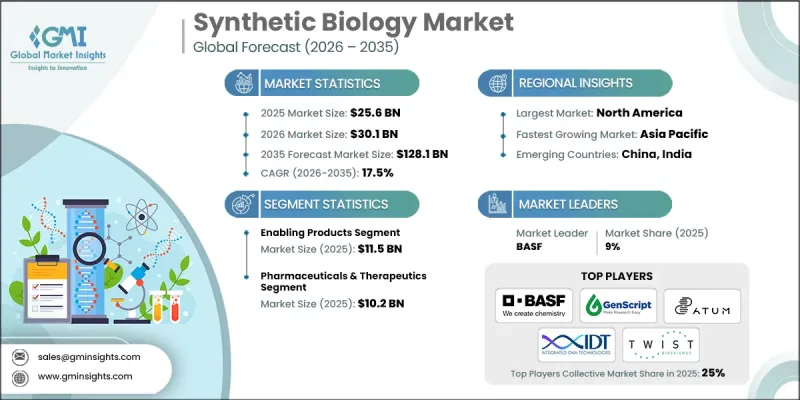
세계의 합성생물학 시장은 2025년에 256억 달러로 평가되었고, 2035년까지 연평균 복합 성장률(CAGR) 17.5%로 성장하여 1,281억 달러에 이를 것으로 예측됩니다.
합성생물학은 공학 원리와 생물학을 통합하여 새로운 생물학적 구성 요소, 장치 및 시스템을 설계함으로써 생물학적 시스템 구축 방식에 혁명을 일으키고 있습니다. 이 분야는 단순한 유전공학에서 세포 기능의 정밀한 프로그래밍을 가능하게 하는 첨단 플랫폼으로 진화했습니다. 이러한 변화는 DNA 합성 및 시퀀싱 기술, 계산 생물학의 혁신, 그리고 생물학적 설계에 대한 깊은 지식에 의해 촉진되고 있습니다. 본 시장은 올리고뉴클레오티드, 효소, 샤시생물 등 기초제품, 합성유전자, 세포, DNA 라이브러리 등 핵심제품, 의약품, 산업용 화학제품, 바이오연료, 생체재료 등 응용제품을 망라하고 있습니다. CRISPR-Cas9와 같은 최첨단 유전체 편집 기술은 치료, 농업, 산업 분야에서 합성생물학의 채택을 가속화하는 동시에 기존의 자원 집약적 공정에 대한 지속 가능한 대안을 제공합니다.
시장 범위
개시 연도
2025년
예측 연도
2026-2035년
개시 연도 가치
256억 달러
예측 금액
1,281억 달러
CAGR
17.5%
기초 제품 부문은 2025년 115억 달러에 달할 것으로 예상되며, 2035년까지 연평균 16.5%의 성장률을 보일 것으로 예측됩니다. 이 카테고리에는 합성생물학 연구개발에 필요한 필수 도구와 시약이 포함되어 있습니다. 구체적으로는 올리고뉴클레오티드, 폴리머라제, 리가제 등의 효소, 클로닝 키트, 박테리아, 효모, 포유류 세포주 등의 기반 생물, 설계 및 시뮬레이션용 소프트웨어 플랫폼 등을 들 수 있습니다. 이러한 장점은 이 제품들이 모든 합성생물학의 노력을 뒷받침하는 기초적인 역할을 하고 있다는 것을 반영합니다.
의약품 및 치료제 부문은 2025년 102억 달러에 달할 것으로 예상되며, 2035년까지 연평균 14.5%의 성장률을 보일 것으로 전망됩니다. 이 부문에는 세포 및 유전자 치료제, mRNA 백신, 디자인 바이오 의약품, 생합성 저분자 화합물 등이 포함됩니다. 여러 제품에서 상업적, 임상적 검증이 이루어지고 있으며, 의약품 및 치료제는 합성생물학 분야에서 가장 상업적으로 발전된 분야로 자리매김하고 있습니다.
미국 합성생물학 시장은 2025년 8.6억 달러로 평가되었고, 2035년까지 4.31억 달러에 달할 것으로 예측됩니다. 정부의 강력한 지원이 연구개발을 뒷받침하고 있으며, 2020년에는 여러 기관에서 바이오 제조 및 바이오에너지에 1억 6,100만 달러가 배정되었고, 2022년에는 에너지부가 석유 기반 제품의 지속 가능한 대체품 개발을 위해 1억 7,800만 달러의 예산을 투입할 예정입니다.
목차
제1장 조사 방법과 범위
제2장 주요 요약
제3장 업계 인사이트
생태계 분석
공급업체 상황
이익률
각 단계 부가가치
밸류체인에 영향을 미치는 요인
파괴적 변화
업계에 대한 영향요인
성장 촉진요인
업계의 잠재적 리스크&과제
시장 기회
성장 가능성 분석
규제 상황
북미
유럽
아시아태평양
라틴아메리카
중동 및 아프리카
Porter의 Five Forces 분석
PESTEL 분석
가격 동향
지역별
향후 시장 동향
기술과 혁신 동향
현재 기술 동향
신기술
특허 상황
무역 통계(HS코드)(주 : 무역 통계는 주요 국가에 한해 제공됩니다)
주요 수입국
주요 수출국
지속가능성과 환경면
지속가능한 대처
폐기물 감축 전략
생산 에너지 효율
친환경 이니셔티브
탄소발자국에 관한 고려사항
제4장 경쟁 구도
서론
기업의 시장 점유율 분석
지역별
북미
유럽
아시아태평양
라틴아메리카
중동 및 아프리카
기업 매트릭스 분석
주요 시장 기업의 경쟁 분석
경쟁 포지셔닝 매트릭스
주요 발전
인수합병(M&A)
제휴 및 협업
신제품 발매
확대 계획
제5장 시장 규모와 예측 : 제품 유형별, 2022-2035
핵심 제품
합성 핵산
유전자 편집 툴·시약
효소·단백질
기반 생물 및 세포주
유전자 파트·벡터
기타
기반 제품
바이오인포매틱스 및 계산 툴
자동화·로보틱스
마이크로플루이딕스 기술·랩온어칩
기타
실현 제품
치료 제품
바이오연료·재생에너지
바이오 화학제품·재료
식품·영양 제품
농산물
진단·바이오센서
기타
제6장 시장 규모와 예측 : 기술별, 2022-2035
뉴클레오티드 합성·시퀀싱 기술
유전자 공학 기술
바이오인포매틱스 및 계산생물학
마이크로플루이딕스 기술과 미소화 기술
기타
제7장 시장 규모와 예측 : 용도별, 2022-2035
의약품·치료제
세포 및 유전자 치료
바이오로지크스 생산
백신 개발
Drug Discovery·의약품 개발
진단·바이오 센싱
의료 진단
환경 모니터링
식품 안전과 품질
바이오 방위 및 보안
산업용 화학제품·재료
특수화학제품즈
폴리머·플라스틱
산업용 효소
바이오 재료·섬유
농업·식품 생산
작물 개량
농업용 생물 제품
축산·수산양식
식품 원료·첨가물
에너지·바이오연료
제1세대·제2세대 바이오연료
첨단 바이오연료
수소·신흥 연료
원료 전환
환경 응용 기술
바이오레메디에이션
탄소 포집·이용
폐수 처리
환경 모니터링 네트워크
기타
제8장 시장 규모와 예측 : 섀시 유형별, 2022-2035
세균 섀시
효모 섀시
포유류 세포 섀시
식물계 섀시
조류(Algae) 및 광합성 섀시
기타
제9장 시장 규모와 예측 : 지역별, 2022-2035
북미
미국
캐나다
유럽
영국
독일
프랑스
이탈리아
스페인
기타 유럽
아시아태평양
중국
인도
일본
한국
호주
기타 아시아태평양
라틴아메리카
브라질
멕시코
아르헨티나
기타 라틴아메리카
중동 및 아프리카
남아프리카공화국
사우디아라비아
아랍에미리트
기타 중동 및 아프리카
제10장 기업 개요
Novozymes
BASF
GenScript
ATUM
Integrated DNA Technologies
Twist Bioscience
Biomax Informatics
Pareto Biotechnologies
Blue Heron
TeselaGenSyntrox
Thermo Fisher Scientific
Gevo Inc
Royal DSM
Bristol-Myers Squibb
Amyris
Genomatica
Synthetic Genomics
Codexis
Butamax Scarab Genomics
Scarab Genomics
MorphoSys
Ginkgo Bioworks
Evolva
Igenbio
LSH
영문 목차
영문목차
The Global Synthetic Biology Market was valued at USD 25.6 billion in 2025 and is estimated to grow at a CAGR of 17.5% to reach USD 128.1 billion by 2035.
Synthetic biology is revolutionizing the way we engineer biological systems by integrating engineering principles with biology to design novel biological components, devices, and systems. The field has evolved from simple genetic engineering to advanced platforms that enable precise programming of cellular functions. This transformation is driven by breakthroughs in DNA synthesis and sequencing, computational biology, and deeper insights into biological design. The market spans enabling products such as oligonucleotides, enzymes, and chassis organisms; core products including synthetic genes, cells, and DNA libraries; and enabled products covering pharmaceuticals, industrial chemicals, biofuels, and biomaterials. Cutting-edge genome editing technologies like CRISPR-Cas9 have accelerated the adoption of synthetic biology across therapeutics, agriculture, and industrial sectors, while also offering sustainable alternatives to traditional resource-intensive processes.
Market Scope
Start Year
2025
Forecast Year
2026-2035
Start Value
$25.6 Billion
Forecast Value
$128.1 Billion
CAGR
17.5%
The enabling products segment reached USD 11.5 billion in 2025 and is expected to grow at a CAGR of 16.5% through 2035. This category includes essential tools and reagents required for synthetic biology R&D, such as oligonucleotides, enzymes like polymerases and ligases, cloning kits, chassis organisms like bacterial, yeast, and mammalian cell lines, and software platforms for design and simulation. Its dominance reflects the foundational role these products play in supporting all synthetic biology initiatives.
The pharmaceuticals and therapeutics segment reached USD 10.2 billion in 2025 and is projected to grow at a CAGR of 14.5% through 2035. This segment encompasses cell and gene therapies, mRNA vaccines, engineered biologics, and biosynthetic small molecules. Commercial and clinical validation has been achieved for multiple products, positioning pharmaceuticals and therapeutics as the most commercially advanced area of synthetic biology.
U.S. Synthetic Biology Market was valued at USD 8.6 billion in 2025 and is expected to reach USD 43.1 billion by 2035. Strong government backing supports research and development, including USD 161 million allocated by various agencies in 2020 for biomanufacturing and bioenergy, alongside USD 178 million from the Department of Energy in 2022 aimed at developing sustainable alternatives to petroleum-based products.
Leading companies in the Global Synthetic Biology Market include Novozymes, GenScript, Thermo Fisher Scientific, Ginkgo Bioworks, Twist Bioscience, Integrated DNA Technologies, ATUM, Blue Heron, Amyris, BASF, Biomax Informatics, Pareto Biotechnologies, Gevo Inc., Royal DSM, Bristol-Myers Squibb, Genomatica, Synthetic Genomics, Codexis, Butamax Scarab Genomics, MorphoSys, Evolva, and Igenbio. Key strategies adopted by synthetic biology companies to strengthen their market presence include investing heavily in research and development to create advanced, high-precision solutions, expanding product portfolios through acquisitions and strategic partnerships, and forming collaborations with academic and industrial research institutions. Companies are also focusing on scaling manufacturing capabilities, integrating AI and computational tools for better biological design, and entering emerging geographic markets to expand their global footprint.
Table of Contents
Chapter 1 Methodology & Scope
1.1 Market scope and definition
1.2 Research design
1.2.1 Research approach
1.2.2 Data collection methods
1.3 Data mining sources
1.3.1 Global
1.3.2 Regional/Country
1.4 Base estimates and calculations
1.4.1 Base year calculation
1.4.2 Key trends for market estimation
1.5 Primary research and validation
1.5.1 Primary sources
1.6 Forecast model
1.7 Research assumptions and limitations
Chapter 2 Executive Summary
2.1 Industry 3600 synopsis
2.2 Key market trends
2.2.1 Product type
2.2.2 Technology
2.2.3 Application
2.2.4 Chassis type
2.3 TAM analysis, 2026-2035
2.4 CXO perspectives: Strategic imperatives
2.4.1 Executive decision points
2.4.2 Critical success factors
2.5 Outlook and strategic recommendations
Chapter 3 Industry Insights
3.1 Industry ecosystem analysis
3.1.1 Supplier landscape
3.1.2 Profit margin
3.1.3 Value addition at each stage
3.1.4 Factor affecting the value chain
3.1.5 Disruptions
3.2 Industry impact forces
3.2.1 Growth drivers
3.2.2 Industry pitfalls and challenges
3.2.3 Market opportunities
3.3 Growth potential analysis
3.4 Regulatory landscape
3.4.1 North America
3.4.2 Europe
3.4.3 Asia Pacific
3.4.4 Latin America
3.4.5 Middle East & Africa
3.5 Porter';s analysis
3.6 PESTEL analysis
3.7 Price trends
3.7.1 By region
3.8 Future market trends
3.9 Technology and innovation landscape
3.9.1 Current technological trends
3.9.2 Emerging technologies
3.10 Patent landscape
3.11 Trade statistics (HS code) (Note: the trade statistics will be provided for key countries only)
3.11.1 Major importing countries
3.11.2 Major exporting countries
3.12 Sustainability and environmental aspects
3.12.1 Sustainable practices
3.12.2 Waste reduction strategies
3.12.3 Energy efficiency in production
3.12.4 Eco-friendly initiatives
3.13 Carbon footprint considerations
Chapter 4 Competitive Landscape, 2025
4.1 Introduction
4.2 Company market share analysis
4.2.1 By region
4.2.1.1 North America
4.2.1.2 Europe
4.2.1.3 Asia Pacific
4.2.1.4 Latin America
4.2.1.5 Middle East & Africa
4.3 Company matrix analysis
4.4 Competitive analysis of major market players
4.5 Competitive positioning matrix
4.6 Key developments
4.6.1 Mergers & acquisitions
4.6.2 Partnerships & collaborations
4.6.3 New product launches
4.6.4 Expansion plans
Chapter 5 Market Size and Forecast, By Product Type, 2022-2035 (USD Billion)
5.1 Key trends
5.2 Core products
5.2.1 Synthetic nucleic acids
5.2.2 Genome editing tools & reagents
5.2.3 Enzymes & proteins
5.2.4 Chassis organisms & cell lines
5.2.5 Genetic parts & vectors
5.2.6 Others
5.3 Enabling products
5.3.1 Bioinformatics & computational tools
5.3.2 Automation & robotics
5.3.3 Microfluidics & lab-on-chip
5.3.4 Others
5.4 Enabled products
5.4.1 Therapeutic products
5.4.2 Biofuels & renewable energy
5.4.3 Bio-based chemicals & materials
5.4.4 Food & nutrition products
5.4.5 Agricultural products
5.4.6 Diagnostics & biosensors
5.4.7 Others
Chapter 6 Market Size and Forecast, By Technology, 2022-2035 (USD Billion)