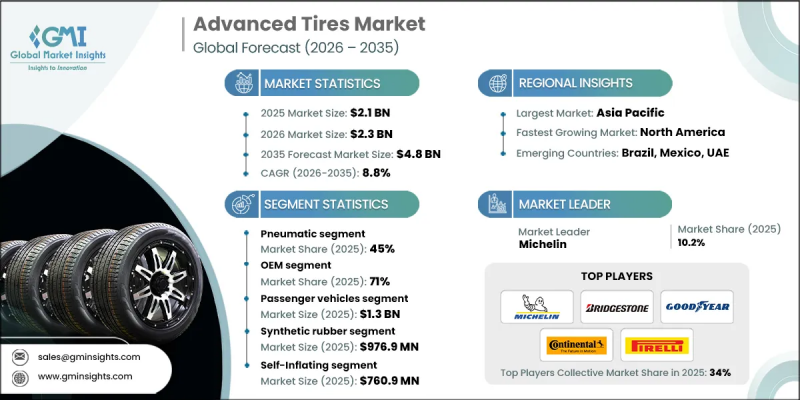
Advanced Tires Market Opportunity, Growth Drivers, Industry Trend Analysis, and Forecast 2026 - 2035
상품코드:1928922
리서치사:Global Market Insights Inc.
발행일:2026년 01월
페이지 정보:영문 235 Pages
라이선스 & 가격 (부가세 별도)
ㅁ Add-on 가능: 고객의 요청에 따라 일정한 범위 내에서 Customization이 가능합니다. 자세한 사항은 문의해 주시기 바랍니다.
한글목차
세계의 첨단 타이어 시장은 2024년에 18억 달러로 평가되었고 자동차 기술 급속한 진보와 고성능 타이어에 수요 증가를 배경으로, 2025-2034년 CAGR 8.8%를 나타낼 것으로 예측됩니다.
자동차 업계가 전기자동차(EV)로 전환하는 가운데, 각 제조업체들은 차량의 효율성, 안전성, 내구성을 향상시키는 차세대 타이어 개발에 집중하고 있습니다. 첨단 타이어는 지능형 모니터링 시스템, 예지보전 기술, 낮은 구름 저항 설계를 통해 차량 성능과 에너지 효율을 최적화합니다. 이러한 혁신 기술은 전기차 및 자율주행차에 매우 중요하며, 배터리 수명 연장, 우수한 도로 안전성 확보, 최소한의 유지보수를 가능하게 합니다. 지속 가능하고 기술적으로 진보된 운송 솔루션에 대한 수요가 증가함에 따라, 자동차 제조업체와 타이어 제조업체는 미래 모빌리티에 부합하는 최첨단 타이어 개발을 위해 협력하고 있습니다.
센서가 내장된 스마트 타이어는 상용차 및 개인 소유 차량 모두에서 보급이 확대되고 있습니다. 이 센서는 타이어 공기압, 온도, 트레드 마모와 같은 주요 성능 지표에 대한 실시간 데이터를 제공하여 예지보전을 가능하게 하고 파열의 위험을 줄여줍니다. 안전성과 연비 효율이 향상됨에 따라 스마트 타이어는 차량 운영업체와 개인 소비자들 사이에서 선호되는 선택이 되고 있습니다. 텔레매틱스 및 차량 진단 기술이 타이어 기술에 통합되면서 제조업체들이 차량 가동률과 주행 성능을 향상시킬 수 있는 솔루션을 지속적으로 개발함에 따라 시장 성장이 더욱 가속화되고 있습니다.
시장 범위
개시 연도
2025년
예측 연도
2026-2035년
개시 연도 가치
21억 달러
예측 금액
48억 달러
CAGR
8.8%
차종별로 보면, 경차가 매출 비중의 대부분을 차지하고 있습니다. 2024년 기준 이 부문 시장 규모는 8억 달러로 평가되었고, 전기자동차(EV)의 보급 확대에 따라 큰 폭의 성장이 예상됩니다. 전기자동차 전용으로 설계된 첨단 타이어는 에너지 효율과 주행거리에 직접적인 영향을 미치는 구름 저항을 줄이는데 중점을 두고 있습니다. 지능형 모니터링 시스템을 통합하여 타이어의 상태를 실시간으로 추적할 수 있어 운전자가 최적의 성능과 안전성을 유지할 수 있도록 돕습니다. 자동차 제조업체들은 변화하는 소비자 선호도와 규제 요건에 대응하기 위해 고효율 타이어 솔루션에 대한 투자를 우선시하고 있습니다.
판매 채널별로 선진 타이어 시장은 OEM(순정 부품)과 애프터마켓으로 구분되며, 2024년에는 OEM이 71%의 점유율을 차지할 것으로 예측됩니다. 자동차 제조업체들은 실시간 공기압 모니터링, 자동 진단, 예지보전 기능을 갖춘 스마트 타이어 기술을 신차에 적용하는 사례가 증가하고 있습니다. 이러한 첨단 기능들은 차량 전체의 성능을 향상시키는 동시에 커넥티드카 및 자율주행으로 나아갈 수 있도록 지원합니다. 차량 자동화에 대한 관심이 높아지면서 최소한의 유지보수로 안전성과 효율성을 극대화하는 지능형 타이어 시스템의 채택이 가속화되고 있습니다. 이러한 혁신 기술을 통해 자동차 제조업체는 사용자 경험을 개선하고 차량 성능 전략을 정교화할 수 있습니다.
아시아태평양은 대규모 인프라 개발과 자동차 산업의 급속한 성장에 힘입어 2024년 세계 첨단 타이어 시장의 40%를 차지할 것으로 예측됩니다. 중국은 2억 5,000만 달러의 지역 수익을 창출하며 주요 기여국으로 부상했습니다. 건설 부문의 급속한 확장, 교통망에 대한 투자 증가, 강력한 생산 능력은 내구성이 뛰어난 고성능 타이어에 대한 수요를 촉진하고 있습니다. 기술 발전이 계속 산업을 형성하고 있는 가운데, 자동차 제조업체와 타이어 제조업체 간의 협력 관계가 향후 몇 년 동안 지속적인 시장 성장을 견인할 것으로 예측됩니다.
목차
제1장 조사 방법과 범위
제2장 주요 요약
제3장 업계 인사이트
생태계 분석
공급업체 상황
이익률
비용 구조
각 단계 부가가치
밸류체인에 영향을 미치는 요인
파괴적 변화
업계에 대한 영향요인
성장 촉진요인
전기자동차 및 하이브리드차 보급 확대
안전성 및 차량 성능에 대한 수요 증가
타이어 설계 기술적 진보
세계의 자동차 생산과 모빌리티 서비스 확대
업계의 잠재적 리스크&과제
높은 개발·제조 비용
소비자 인지도와 인프라 정비 부족
시장 기회
스마트&커넥티드 차량 에코시스템 성장
지속가능으로 친환경 타이어에 수요 증가
재료와 설계 기술적 진보
OEM와의 협업 및 플랫폼 기반 도입
성장 가능성 분석
규제 상황
북미
미국 연방 자동차 안전기준(FMVSS)
캐나다 자동차 안전기준(CMVSS)
유럽
독일 TUV 및 BaFin에의 준거
프랑스 DGITM 가이드라인
영국 차량 인증 기관(VCA) 규제
이탈리아 국교 통운수성 규제 대응
아시아태평양
중국 공업 정보화부(MIIT) 가이드라인
일본 국토 교통성 기준
한국 국토 교통성(MOLIT) 규제
인도 도로 교통성(MoRTH) 및 인도 규격 협회(BIS) 가이드라인
라틴아메리카
브라질 DENATRAN 및 ANFAVEA 규제
멕시코 SCT 및 NOM 규격
중동 및 아프리카
아랍에미리트 도로 교통국(RTA) 가이드라인
사우디아라비아 운송 총국(GAT) 규제
Porter의 Five Forces 분석
PESTEL 분석
기술과 혁신 동향
현재 기술 동향
신기술
가격 동향
지역별
제품별
비용 내역 분석
특허 분석
지속가능성과 환경면
지속가능한 대처
폐기물 감축 전략
생산 에너지 효율
친환경 이니셔티브
탄소발자국에 관한 고려사항
이용 사례 시나리오
OEM 통합과 차량 플랫폼 정합성
OEM 공동 개발 및 인증 취득 전략
EV 및 자율주행차용 타이어 사양
EV 전용 타이어 경제성과 성능 트레이드 오프
플릿 및 상용차 도입 분석
제조 공정 혁신
제4장 경쟁 구도
서론
기업의 시장 점유율 분석
북미
유럽
아시아태평양
라틴아메리카
중동 및 아프리카
주요 시장 기업의 경쟁 분석
경쟁 포지셔닝 매트릭스
전략적 전망 매트릭스
주요 발전
인수합병(M&A)
제휴 및 협업
신제품 발매
사업 확대 계획과 자금조달
제5장 시장 추산·예측 : 타이어별, 2022-2035
공기 들어가 타이어
에어리스
런플랫 타이어
기타
제6장 시장 추산·예측 : 차량별, 2022-2035
승용차
해치백차
세단
SUV
상용차
소형 상용차(LCV)
중형 상용차(MCV)
대형 상용차(HCV)
제7장 시장 추산·예측 : 재료별, 2022-2035
합성고무
천연 고무
엘라스토머
기타
제8장 시장 추산·예측 : 기술별, 2022-2035
자기 팽창식
칩 이식형
자기 씰
멀티 챔버
올인원
제9장 시장 추산·예측 : 판매채널별, 2022-2035
OEM
애프터마켓
제10장 시장 추산·예측 : 지역별, 2022-2035
북미
미국
캐나다
유럽
영국
독일
프랑스
이탈리아
스페인
벨기에
네덜란드
스웨덴
아시아태평양
중국
인도
일본
호주
싱가포르
한국
베트남
인도네시아
말레이시아
라틴아메리카
브라질
멕시코
아르헨티나
중동 및 아프리카
아랍에미리트
남아프리카공화국
사우디아라비아
제11장 기업 개요
Global Player
Bridgestone
Continental
Cooper-Standard
Goodyear
Michelin
Pirelli
Sumitomo
Tenneco(DRiV)
Vibracoustic
Yokohama
Regional Player
Apollo Tyres
Giti Tire
Hankook Tire
Jinyu Tire
Kumho Tire
Linglong Tire
MRF
Nexen Tire
Sailun Tire
Triangle Tire
신흥 제조업체
Aeolus Tyre
CEAT
Double Coin
Ovation Tyres
Tigar Tyres
LSH
영문 목차
영문목차
The global advanced tires market was valued at USD 1.8 billion in 2024 and is projected to grow at a CAGR of 8.8% between 2025 and 2034, driven by rapid advancements in automotive technology and the increasing demand for high-performance tires. As the automotive sector transitions toward electric vehicles (EVs), manufacturers are focusing on next-generation tires that enhance vehicle efficiency, safety, and durability. Advanced tires incorporate intelligent monitoring systems, predictive maintenance technologies, and low rolling resistance designs to optimize vehicle performance and energy efficiency. These innovations are crucial for electric and autonomous vehicles, ensuring extended battery life, superior road safety, and minimal maintenance. The rising demand for sustainable and technologically advanced transportation solutions is driving automakers and tire manufacturers to collaborate on cutting-edge tire developments that align with the future of mobility.
Smart tires equipped with embedded sensors are gaining traction across commercial and personal vehicle fleets. These sensors provide real-time data on critical performance metrics such as tire pressure, temperature, and tread wear, enabling predictive maintenance and reducing the risk of blowouts. Enhanced safety features and improved fuel efficiency make smart tires a preferred choice among fleet operators and individual consumers. The increasing integration of telematics and vehicle diagnostics into tire technology further supports market growth as manufacturers continue to develop solutions that improve vehicle uptime and on-road performance.
Market Scope
Start Year
2025
Forecast Year
2026-2035
Start Value
$2.1 Billion
Forecast Value
$4.8 Billion
CAGR
8.8%
Segmented by vehicle type, the market sees light-duty vehicles holding a major revenue share. In 2024, this segment was valued at USD 800 million, with expectations of substantial growth due to the rising adoption of EVs. Advanced tires specifically designed for electric models focus on reducing rolling resistance, which directly impacts energy efficiency and driving range. By integrating intelligent monitoring systems, these tires offer real-time tracking of tire conditions, helping drivers maintain optimal performance and safety. Automakers are prioritizing investments in high-efficiency tire solutions that cater to evolving consumer preferences and regulatory requirements.
Based on sales channels, the advanced tires market is divided into OEM and aftermarket, with OEMs dominating at a 71% share in 2024. Automakers are increasingly integrating smart tire technologies into new vehicle models, equipping them with real-time pressure monitoring, automated diagnostics, and predictive maintenance capabilities. These advanced features enhance overall vehicle performance while supporting the push toward connected and autonomous driving. The growing emphasis on vehicle automation is accelerating the adoption of intelligent tire systems that require minimal maintenance while maximizing safety and efficiency. By leveraging these innovations, automakers can offer enhanced user experiences and refine their vehicle performance strategies.
The Asia Pacific region accounted for 40% of the global advanced tires market in 2024, driven by large-scale infrastructure developments and the booming automotive industry. China emerged as the leading contributor, generating USD 250 million in regional revenue. The rapid expansion of the construction sector, increasing investments in transportation networks, and strong production capabilities are fueling demand for durable, high-performance tires. As technological advancements continue to shape the industry, growing collaborations between automakers and tire manufacturers are expected to drive sustained market growth in the coming years.
Table of Contents
Chapter 1 Methodology & Scope
1.1 Market scope and definition
1.2 Research design
1.2.1 Research approach
1.2.2 Data collection methods
1.3 Data mining sources
1.3.1 Global
1.3.2 Regional/Country
1.4 Base estimates and calculations
1.4.1 Base year calculation
1.4.2 Key trends for market estimation
1.5 Primary research and validation
1.5.1 Primary sources
1.6 Forecast
1.7 Research assumptions and limitations
Chapter 2 Executive Summary
2.1 Industry 360° synopsis, 2022 - 2035
2.2 Key market trends
2.2.1 Regional
2.2.2 Tire
2.2.3 Vehicle
2.2.4 Material
2.2.5 Technology
2.2.6 Sales Channel
2.3 TAM Analysis, 2026-2035
2.4 CXO perspectives: Strategic imperatives
2.4.1 Executive decision points
2.4.2 Critical success factors
2.5 Future outlook and strategic recommendations
Chapter 3 Industry Insights
3.1 Industry ecosystem analysis
3.1.1 Supplier Landscape
3.1.2 Profit Margin
3.1.3 Cost structure
3.1.4 Value addition at each stage
3.1.5 Factor affecting the value chain
3.1.6 Disruptions
3.2 Industry impact forces
3.2.1 Growth drivers
3.2.1.1 Rising electric & hybrid vehicle adoption
3.2.1.2 Growing demand for safety & vehicle performance
3.2.1.3 Technological advancements in tire design
3.2.1.4 Expansion of global vehicle production & mobility services