Camera Lens Market Opportunity, Growth Drivers, Industry Trend Analysis, and Forecast 2026 - 2035
상품코드:1928875
리서치사:Global Market Insights Inc.
발행일:2026년 01월
페이지 정보:영문 210 Pages
라이선스 & 가격 (부가세 별도)
ㅁ Add-on 가능: 고객의 요청에 따라 일정한 범위 내에서 Customization이 가능합니다. 자세한 사항은 문의해 주시기 바랍니다.
한글목차
세계의 카메라 렌즈 시장은 2025년에 64억 달러로 평가되었으며, 2035년까지 CAGR 6.5%로 성장하여 128억 달러에 달할 것으로 예측됩니다.
컨텐츠 제작, 소셜 미디어용 동영상 제작 및 동영상 블로그(vlog)의 확대가 고품질 카메라 렌즈에 대한 수요를 견인하고 있습니다. 크리에이터들은 전문가 수준의 화질, 선명한 초점, 뛰어난 저조도 성능을 갖춘 렌즈를 점점 더 많이 필요로 하고 있습니다. 컨텐츠 업로드가 잦아지고 온라인 플랫폼의 인기가 높아짐에 따라 사용자들은 고급 촬영 장비에 대한 투자를 늘리고 있습니다. 사진 및 영상 촬영에 관한 교육, 워크숍, 기술 개발 프로그램을 통해 렌즈의 광범위한 보급을 촉진하고 있습니다. 광학식 손떨림 보정, 대구경, 코팅 기술 향상과 같은 기술 혁신은 아마추어부터 전문가까지 폭넓은 층을 끌어들이고 있습니다. 화질은 그대로 유지하면서 컴팩트한 디자인을 구현하는 미러리스 카메라의 인기 상승도 시장 성장을 더욱 가속화하고 있습니다. 이러한 시스템은 교환식 렌즈에 의존하고 있기 때문에 다양한 초점 거리와 특수 광학 렌즈에 대한 수요가 발생하고 있습니다. 아마추어와 전문가를 막론하고 사진 및 동영상 촬영에 있어 창의성의 자유와 성능 향상의 혜택을 누리고 있습니다.
시장 범위
시작 연도
2025년
예측 연도
2026-2035
개시시 가치
64억 달러
예측 금액
128억 달러
CAGR
6.5%
교환식 렌즈 부문은 2025년 42억 달러의 시장 규모를 기록했으며, 2035년까지 CAGR 6.6%로 성장할 것으로 예상됩니다. 그 우위는 다양한 사진 용도의 다재다능함과 뛰어난 화질에 기인합니다. 사용자는 렌즈를 교체하여 다양한 구도와 창의적인 효과를 구현할 수 있으며, 고급 광학 설계, 반사 방지 코팅, 손떨림 보정 시스템을 통해 다양한 조명 조건에서 선명도를 향상시킵니다.
소비자 가전 부문은 2025년 37.3%의 점유율을 차지했으며, 2026년부터 2035년까지 연평균 6.8%의 성장률을 기록할 것으로 전망됩니다. 이러한 성장은 스마트폰, 태블릿, 웨어러블 기기, 웹캠에 카메라 렌즈의 통합에 의해 주도되고 있습니다. 소셜 미디어, 동영상 스트리밍, 사진 촬영에서 고품질 이미지를 원하는 소비자의 요구에 부응하기 위해 자동 초점, 광학 줌, 저조도 성능 등의 기능을 갖춘 컴팩트하고 효율적인 렌즈의 채택이 증가하고 있습니다.
중국 카메라 렌즈 시장은 2025년 69억 달러에 달했으며, 2026년부터 2035년까지 연평균 5.3%의 성장률을 보일 것으로 전망됩니다. 이러한 수요는 스마트폰과 미러리스 카메라의 보급에 힘입어 도시 사용자들과 컨텐츠 제작자들이 사진 촬영과 짧은 동영상 촬영에 다재다능한 렌즈를 원하고 있는 것이 그 배경입니다. 국내 제조업체는 현지 생산의 이점을 살려 경쟁력 있는 가격으로 기술적으로 진보된 제품을 제공하고 있습니다. 한편, E-Commerce의 확대로 인해 고품질의 전문적인 렌즈 옵션에 대한 접근성이 향상되고 있습니다.
목차
제1장 조사 방법과 범위
제2장 주요 요약
제3장 업계 인사이트
생태계 분석
공급업체 상황
이익률
각 단계의 부가가치
밸류체인에 영향을 미치는 요인
업계에 대한 영향요인
성장 촉진요인
컨텐츠 제작, 비디오 블로그(Vlog), 소셜 미디어용 비디오 제작 확대
프로페셔널 및 애호가 사용자 층의 미러리스 카메라 보급 확대
광학식 손떨림 보정 및 오토 포커스 시스템의 기술적 진보
과제와 어려움
프로페셔널용 및 특수 렌즈의 고비용
카메라 마운트 및 브랜드 간의 호환성 단편화
기회
컴팩트하고 경량인 렌즈에 대한 수요 증가
비용 효율이 뛰어난 대체품을 제공하는 서드파티 렌즈 제조업체 성장
성장 가능성 분석
향후 시장 동향
기술과 혁신 동향
현재 기술 동향
신기술
가격 동향
지역별
제품별
규제 상황
규격 및 적합 요건
지역별 규제 프레임워크
인증 기준
무역 통계(HS 코드-9002)
주요 수입국
주요 수출국
Porters 분석
PESTEL 분석
제4장 경쟁 구도
소개
기업의 시장 점유율 분석
지역별
북미
유럽
아시아태평양
라틴아메리카
중동 및 아프리카
기업 매트릭스 분석
주요 시장 기업 경쟁 분석
경쟁 포지셔닝 매트릭스
주요 발전
인수합병
제휴·협업
신제품 발매
확대 계획
제5장 시장 추정 및 예측 : 유형별, 2022-2035
내장 렌즈
교환 렌즈
제6장 시장 추정 및 예측 : 가격대별, 2022-2035
저가격대
중가격대
고가격대
제7장 시장 추정 및 예측 : 최종 용도별, 2022-2035
프로페셔널 사용자
개인
제조업체
소비자 전자제품
자동차
의료 분야
기타
제8장 시장 추정 및 예측 : 유통 채널별, 2022-2035
온라인
오프라인
제9장 시장 추정 및 예측 : 지역별, 2022-2035
북미
미국
캐나다
유럽
독일
영국
프랑스
이탈리아
스페인
아시아태평양
중국
인도
일본
한국
호주
라틴아메리카
브라질
멕시코
아르헨티나
중동 및 아프리카
사우디아라비아
아랍에미리트
남아프리카공화국
제10장 기업 개요
Canon
Carl Zeiss
Fujifilm Holdings Corporation
Leica Camera
Nikon Corporation
Panasonic
RICHO Imaging Co.
Samyang Optics
Schneider Kreuznach
Sigma Corporation
Sony Corporation
Tamron Co.
Viltrox Co.
Voigtlander
Yongnuo
KSM
영문 목차
영문목차
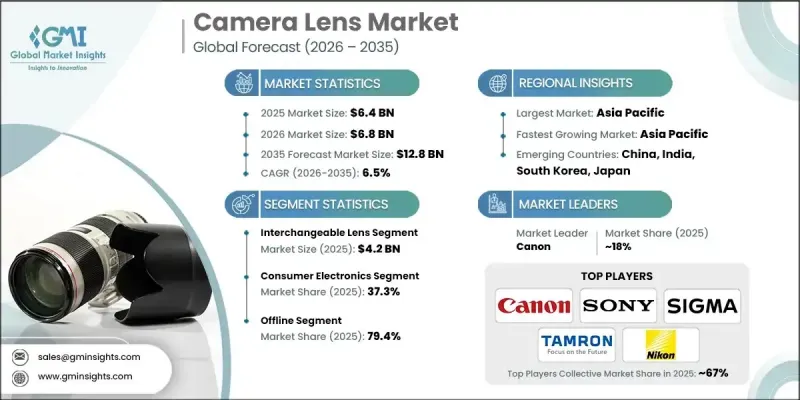
The Global Camera Lens Market was valued at USD 6.4 billion in 2025 and is estimated to grow at a CAGR of 6.5% to reach USD 12.8 billion by 2035.
The expansion of content creation, social media video production, and vlogging is fueling demand for high-quality camera lenses. Creators increasingly require lenses that deliver professional-level imagery, sharp focus, and superior low-light performance. Frequent content uploads and the growing popularity of online platforms are prompting users to invest in advanced imaging equipment. Photography and videography education, workshops, and skill development programs are encouraging wider adoption of lenses. Technological advancements such as optical stabilization, wide apertures, and improved coatings attract both hobbyists and professional photographers. The rising popularity of mirrorless cameras, which offer compact designs without sacrificing image quality, is further boosting market growth. These systems rely on interchangeable lenses, creating demand for a wide array of focal lengths and specialized optics. Both amateur and professional users benefit from enhanced creative flexibility and performance in photography and videography.
Market Scope
Start Year
2025
Forecast Year
2026-2035
Start Value
$6.4 Billion
Forecast Value
$12.8 Billion
CAGR
6.5%
The interchangeable lens segment generated USD 4.2 billion in 2025 and is expected to grow at a CAGR of 6.6% through 2035. Its dominance stems from versatility and superior image quality across a range of photography applications. Users can swap lenses to achieve different compositions and creative effects, while advanced optics, anti-reflective coatings, and stabilization systems improve clarity in varied lighting conditions.
The consumer electronics segment accounted for 37.3% share in 2025 and is forecast to grow at a CAGR of 6.8% from 2026 to 2035. This growth is driven by the integration of camera lenses in smartphones, tablets, wearable devices, and webcams. Consumers demand high-quality imaging for social media, video streaming, and photography, prompting the adoption of compact, efficient lenses with features like autofocus, optical zoom, and low-light capability.
China Camera Lens Market reached USD 6.9 billion in 2025 and is projected to grow at a CAGR of 5.3% from 2026 to 2035. The demand is fueled by smartphone and mirrorless camera adoption, with urban users and content creators seeking versatile lenses for photography and short-form video. Domestic manufacturers benefit from local production advantages, offering technologically advanced products at competitive prices, while e-commerce expansion improves accessibility to premium and specialized lens options.
Major players in the Global Camera Lens Market include Sony Corporation, Carl Zeiss, Nikon Corporation, Sigma Corporation, Panasonic, Fujifilm Holdings Corporation, Tamron Co., Viltrox Co., Canon, Schneider Kreuznach, RICHO Imaging Co., Leica Camera, Samyang Optics, Voigtlander, and Yongnuo. Companies in the Global Camera Lens Market strengthen their foothold by investing in research and development to launch lenses with advanced features such as optical stabilization, low-light optimization, and wide-aperture performance. Strategic partnerships with camera manufacturers and content creators enable tailored solutions for professional and enthusiast users. Expansion into emerging markets increases brand presence, while leveraging e-commerce platforms enhances product accessibility.
Table of Contents
Chapter 1 Methodology & Scope
1.1 Market scope and definition
1.2 Research design
1.2.1 Research approach
1.2.2 Data collection methods
1.3 Data mining sources
1.3.1 Global
1.3.2 Regional/Country
1.4 Base estimates and calculations
1.4.1 Base year calculation
1.4.2 Key trends for market estimation
1.5 Primary research and validation
1.5.1 Primary sources
1.6 Forecast model
1.7 Research assumptions and limitations
Chapter 2 Executive Summary
2.1 Industry 3600 synopsis
2.2 Key market trends
2.2.1 Regional
2.2.2 Type
2.2.3 Price Range
2.2.4 End use
2.2.5 Distribution channel
2.3 CXO perspectives: Strategic imperatives
2.3.1 Key decision points for industry executives
2.3.2 Critical success factors for market players
2.4 Future outlook and strategic recommendations
Chapter 3 Industry Insights
3.1 Industry ecosystem analysis
3.1.1 Supplier landscape
3.1.2 Profit margin
3.1.3 Value addition at each stage
3.1.4 Factor affecting the value chain
3.2 Industry impact forces
3.2.1 Growth drivers
3.2.1.1 Expansion of content creation, vlogging, and social media video production
3.2.1.2 Growing adoption of mirrorless cameras across professional and enthusiast users
3.2.1.3 Technological advancements in optical stabilization and autofocus systems
3.2.2 Pitfalls & Challenges
3.2.2.1 High cost of professional-grade and specialty lenses
3.2.2.2 Compatibility fragmentation across camera mounts and brands
3.2.3 Opportunities
3.2.3.1 Rising demand for compact and lightweight lenses
3.2.3.2 Growth of third-party lens manufacturers offering cost-effective alternatives