Betaine Market Opportunity, Growth Drivers, Industry Trend Analysis, and Forecast 2026 - 2035
상품코드:1913468
리서치사:Global Market Insights Inc.
발행일:2025년 12월
페이지 정보:영문 210 Pages
라이선스 & 가격 (부가세 별도)
ㅁ Add-on 가능: 고객의 요청에 따라 일정한 범위 내에서 Customization이 가능합니다. 자세한 사항은 문의해 주시기 바랍니다.
한글목차
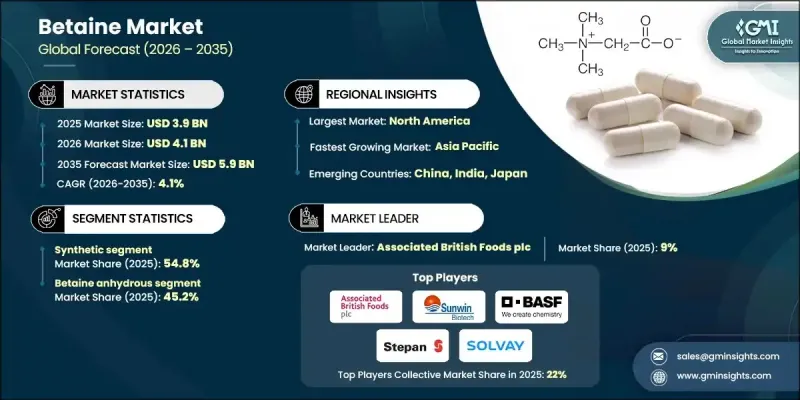
세계 베타인 시장은 2025년 39억 달러로 평가되었으며, 2035년까지 연평균 복합 성장률(CAGR) 4.1%로 성장하고, 59억 달러에 이를 것으로 예측되고 있습니다.
시장의 발전은 영양분야, 소비자분야, 산업분야 등 다수의 최종 용도산업에서 베타인의 용도 확대에 의해 지원되고 있습니다. 베타인의 기능적 다양성에 대한 인식 증가는 영양면, 성능 향상 및 배합 관련 이점을 갖춘 주요 성분으로서의 역할을 강화하고 있습니다. 장기적인 성장은 세계 인구 증가, 축산 확대에 따른 단백질 소비량 증가, 천연 유래 및 환경을 배려한 원료로 수요 시프트 등 구조적 동향에 의해 더욱 강화되고 있습니다. 베타인의 기능적 가치에 대한 과학적 검증은 상업적 용도 전반에 걸친 신뢰성을 지속적으로 향상시키고 있습니다. 시장 전망에는 제형 개선, 생산 효율 향상, 정제 방법 진보에 중점을 둔 꾸준한 혁신 노력도 반영됩니다. 이러한 발전으로 공급업체는 제품의 일관성을 높이고 가용성을 확대하고 진화하는 규제와 소비자의 기대에 대응할 수 있게 되어 확립된 용도 분야와 새로운 용도 분야 모두에서 지속적인 수요를 지원하고 있습니다.
시장 범위
시작 연도
2025년
예측 연도
2026-2035년
시작 금액
39억 달러
예측 금액
59억 달러
CAGR
4.1%
천연 유래 베타인에 대한 선호의 고조가 시장 역학을 형성하는 주요 요인이 되고 있습니다. 특히 지속가능성에 대한 노력과 원료의 투명성이 구매결정과 가격구조에 영향을 주는 지역에서 사탕무 유래 베타인이 주목을 받고 있습니다.
합성 베타인 부문은 2025년에 54.8%의 점유율을 차지했습니다. 이 부문은 비용 효율성과 생산 능력의 확장성의 이점을 계속 누리고 있으며, 가격 경쟁력과 대량 수요가 여전히 중요한 응용 분야에서 광범위한 사용을 지원합니다.
무수 베타인 부문은 2025년에 45.2%의 점유율을 차지했습니다. 이 무수 결정 형태는 고농도, 우수한 안정성, 건조 제제 시스템에 대한 적합성이 높게 평가되었습니다. 그 성능 특성은 수분 관리가 불가결한 영양 보조 식품, 의약품, 사료 관련 제품 등 폭넓은 분야에서 수요를 지지하고 있습니다.
북미 베타인 시장은 2025년 28.8%의 점유율을 차지했습니다. 확립된 규제의 명확성과 다목적 분야의 안정적인 수요에 힘입어 이 지역은 견고한 소비 기반을 유지하고 있습니다. 클린 라벨이나 자연 유래를 구분하는 원료에의 소비자 관심 증가로, 프리미엄 제품의 채택을 계속적으로 추진하고 있습니다.
목차
제1장 조사 방법과 범위
제2장 주요 요약
제3장 업계 인사이트
생태계 분석
공급업체 현황
수익률
단계별 부가가치
밸류체인에 영향을 주는 요인
혁신
업계에 미치는 영향요인
성장 촉진요인
업계의 잠재적 위험 및 과제
시장 기회
성장 가능성 분석
규제 상황
북미
유럽
아시아태평양
라틴아메리카
중동 및 아프리카
Porter's Five Forces 분석
PESTEL 분석
가격 동향
장래 시장 동향
기술과 혁신 동향
현재의 기술 동향
신규 기술
특허 상황
무역 통계(HS코드)(참고 : 무역 통계는 주요 국가에 대해서만 제공됨.)
주요 수입국
주요 수출국
제4장 경쟁 구도
소개
기업의 시장 점유율 분석
지역별
북미
유럽
아시아태평양
라틴아메리카
중동 및 아프리카
기업 매트릭스 분석
주요 시장 기업의 경쟁 분석
경쟁 포지셔닝 매트릭스
주요 발전
합병 및 인수
제휴 및 협업
신제품 발매
사업 확대 계획
제5장 시장 추정 및 예측 : 유형별, 2022-2035
합성
천연
광합성 세균
식물 유래
동물 유래
반합성
제6장 시장추정 및 예측 : 형태별, 2022-2035
베타인 무수물
분말
과립
염산베타인
일수화물 베타인
결정성
용액
제7장 시장 추정 및 예측 : 순도별, 2022-2035
고순도
표준 순도
저순도
맞춤형 순도
제8장 시장추정 및 예측 : 용도별, 2022-2035
동물사료
가금
돼지
수산 양식
반추동물
기타
식음료
제빵 및 제과
스포츠 영양 및 에너지 드링크
기능성 식품
퍼스널케어 및 화장품
스킨 케어
헤어 케어
구강 케어
의약품
산업 용도
화학 중간체
세제 및 계면활성제
농업 제제
제9장 시장추정 및 예측 : 지역별, 2022-2035
북미
미국
캐나다
유럽
독일
영국
프랑스
스페인
이탈리아
기타 유럽
아시아태평양
중국
인도
일본
호주
한국
기타 아시아태평양
라틴아메리카
브라질
멕시코
아르헨티나
기타 라틴아메리카
중동 및 아프리카
사우디아라비아
남아프리카
아랍에미리트(UAE)
기타 중동 및 아프리카
제10장 기업 프로파일
AMINO GmbH
BASF
Kao Corporation
Stepan Company
Solvay
Associated British Foods plc
Nutreco
The Lubrizol Corporation
INOLEX, Inc.
Sunwin Biotech Shandong Co., Ltd.
Merck KGaA
Evonik Industries AG
Fengchen Group Co., Ltd.
Orison Chemicals Limited
Prasol Chemicals Limited
SHW
영문 목차
영문목차
The Global Betaine Market was valued at USD 3.9 billion in 2025 and is estimated to grow at a CAGR of 4.1% to reach USD 5.9 billion by 2035.
Market development is supported by the broadening use of betaine across multiple end-use industries, including nutrition-focused, consumer-oriented, and industrial sectors. Increasing recognition of betaine's functional versatility has strengthened its role as a key ingredient with nutritional, performance-enhancing, and formulation-related benefits. Long-term growth is reinforced by structural trends such as global population expansion, higher protein consumption linked to intensified animal production, and a growing shift toward ingredients perceived as natural and environmentally responsible. Scientific validation of betaine's functional value continues to strengthen confidence across commercial applications. The market outlook also reflects steady innovation efforts focused on refining formulations, improving production efficiency, and advancing purification methods. These developments are enabling suppliers to enhance product consistency, expand usage potential, and address evolving regulatory and consumer expectations, thereby supporting sustained demand across established and emerging application areas.
Market Scope
Start Year
2025
Forecast Year
2026-2035
Start Value
$3.9 Billion
Forecast Value
$5.9 Billion
CAGR
4.1%
Growing preference for naturally sourced betaine has become a major factor shaping market dynamics. Betaine derived from sugar beet sources is gaining increased traction, particularly in regions where sustainability credentials and ingredient transparency influence purchasing decisions and pricing structures.
The synthetic betaine segment held 54.8% share in 2025. This segment continues to benefit from cost efficiency and scalable production capabilities, which support its widespread use in applications where pricing competitiveness and volume requirements remain critical.
The betaine anhydrous segment held 45.2% share in 2025. This water-free crystalline form is valued for its high concentration, strong stability profile, and suitability for dry formulation systems. Its performance characteristics support demand across nutrition-focused, pharmaceutical, and feed-related product formats where moisture control is essential.
North America Betaine Market held 28.8% share in 2025. The region maintains a strong consumption base, supported by established regulatory clarity and consistent demand across multiple application segments. Consumer interest in clean-label and naturally positioned ingredients continues to support the adoption of premium products.
Key companies active in the Global Betaine Market include BASF, Associated British Foods plc, Evonik Industries AG, Stepan Company, AMINO GmbH, Nutreco, Solvay, INOLEX, Inc., Merck KGaA, The Lubrizol Corporation, Fengchen Group Co., Ltd., Kao Corporation, Sunwin Biotech Shandong Co., Ltd., Orison Chemicals Limited, and Prasol Chemicals Limited. Companies operating in the Global Betaine Market are strengthening their market position through a combination of product innovation, supply chain optimization, and strategic expansion. Many players are investing in advanced processing technologies to improve yield, purity, and formulation flexibility. Portfolio diversification is being used to address both cost-sensitive and premium demand segments. Firms are also focusing on sustainability initiatives, including responsible sourcing and reduced environmental impact, to align with evolving regulatory and consumer expectations. Geographic expansion and long-term partnerships with end-use industries are improving market reach and demand stability.
Table of Contents
Chapter 1 Methodology & Scope
1.1 Market scope and definition
1.2 Research design
1.2.1 Research approach
1.2.2 Data collection methods
1.3 Data mining sources
1.3.1 Global
1.3.2 Regional/Country
1.4 Base estimates and calculations
1.4.1 Base year calculation
1.4.2 Key trends for market estimation
1.5 Primary research and validation
1.5.1 Primary sources
1.6 Forecast model
1.7 Research assumptions and limitations
Chapter 2 Executive Summary
2.1 Industry 3600 synopsis
2.2 Key market trends
2.2.1 Regional
2.2.2 Type
2.2.3 Application
2.2.4 Distribution Channel
2.3 TAM Analysis, 2025-2034
2.4 CXO perspectives: Strategic imperatives
2.4.1 Executive decision points
2.4.2 Critical success factors
2.5 Future Outlook and Strategic Recommendations
Chapter 3 Industry Insights
3.1 Industry ecosystem analysis
3.1.1 Supplier landscape
3.1.2 Profit margin
3.1.3 Value addition at each stage
3.1.4 Factor affecting the value chain
3.1.5 Disruptions
3.2 Industry impact forces
3.2.1 Growth drivers
3.2.2 Industry pitfalls and challenges
3.2.3 Market opportunities
3.3 Growth potential analysis
3.4 Regulatory landscape
3.4.1 North America
3.4.2 Europe
3.4.3 Asia Pacific
3.4.4 Latin America
3.4.5 Middle East & Africa
3.5 Porter's analysis
3.6 PESTEL analysis
3.7 Price trends
3.8 Future market trends
3.9 Technology and Innovation landscape
3.9.1 Current technological trends
3.9.2 Emerging technologies
3.10 Patent Landscape
3.11 Trade statistics (HS code) ( Note: the trade statistics will be provided for key countries only)
3.11.1 Major importing countries
3.11.2 Major exporting countries
Chapter 4 Competitive Landscape, 2025
4.1 Introduction
4.2 Company market share analysis
4.2.1 By region
4.2.1.1 North America
4.2.1.2 Europe
4.2.1.3 Asia Pacific
4.2.1.4 LATAM
4.2.1.5 MEA
4.3 Company matrix analysis
4.4 Competitive analysis of major market players
4.5 Competitive positioning matrix
4.6 Key developments
4.6.1 Mergers & acquisitions
4.6.2 Partnerships & collaborations
4.6.3 New Product Launches
4.6.4 Expansion Plans
Chapter 5 Market Estimates and Forecast, By Type, 2022-2035 (USD Billion & Tons)
5.1 Key trends
5.2 Synthetic
5.3 Natural
5.3.1 Photosynthetic Bacteria
5.3.2 Plant Sourced
5.3.3 Animal Sourced
5.4 Semi-synthetic
Chapter 6 Market Estimates and Forecast, By Form, 2022-2035 (USD Billion & Tons)
6.1 Key trends
6.2 Betaine anhydrous
6.2.1 Powder
6.2.2 Granules
6.3 Betaine hydrochloride
6.4 Betaine monohydrate
6.4.1 Crystalline
6.4.2 Solution-based
Chapter 7 Market Estimates and Forecast, By Purity, 2022-2035 (USD Billion & Tons)
7.1 Key trends
7.2 High purity
7.3 Standard purity
7.4 Low purity
7.5 Customized purity
Chapter 8 Market Estimates and Forecast, By Application, 2022-2035 (USD Billion & Tons)
8.1 Key trends
8.2 Animal feed
8.2.1 Poultry
8.2.2 Swine
8.2.3 Aquaculture
8.2.4 Ruminants
8.2.5 Others
8.3 Food & beverages
8.3.1 Bakery & confectionery
8.3.2 Sports nutrition & energy drinks
8.3.3 Functional foods
8.4 Personal care & cosmetics
8.4.1 Skin care
8.4.2 Hair care
8.4.3 Oral care
8.5 Pharmaceuticals
8.6 Industrial applications
8.6.1 Chemical intermediates
8.6.2 Detergents & surfactants
8.6.3 Agricultural formulations
Chapter 9 Market Estimates and Forecast, By Region, 2022-2035 (USD Billion & Tons)