자동차용 차동 기어 시장 : 성장 기회, 성장 요인, 산업 동향 분석 및 예측(2026-2035년)
Automotive Differential Market Opportunity, Growth Drivers, Industry Trend Analysis, and Forecast 2026 - 2035
상품코드:1913451
리서치사:Global Market Insights Inc.
발행일:2026년 01월
페이지 정보:영문 230 Pages
라이선스 & 가격 (부가세 별도)
ㅁ Add-on 가능: 고객의 요청에 따라 일정한 범위 내에서 Customization이 가능합니다. 자세한 사항은 문의해 주시기 바랍니다.
한글목차
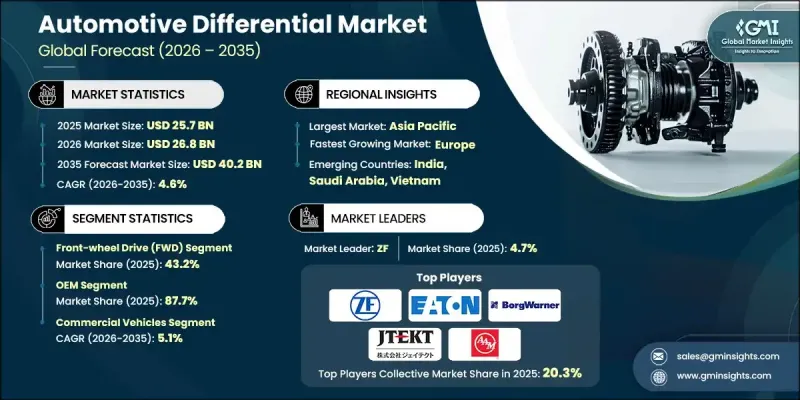
세계의 자동차용 차동 기어 시장은 2025년 257억 달러로 평가되었으며, 2035년까지 연평균 복합 성장률(CAGR) 4.6%로 성장하여 402억 달러에 이를 것으로 예측됩니다.
시장 성장은 중산계급 소비자의 가처분 소득 수준 상승과 운송 및 물류 섹터의 지속적인 확대에 견인되는 세계 자동차 생산 증가에 의해 지원되고 있습니다. 개인 이동 수단과 화물 운송에 대한 수요 증가는 승용차와 상용차 모두의 지속적인 생산에 기여하고 있으며, 이는 자동차용 차동 기어 수요를 직접 지원합니다. 대중교통 시스템과 물류 업무의 성장은 버스, 밴, 트럭의 제조를 더욱 가속화하고 시장의 기세를 강화하고 있습니다. 차동 기어 제조업체는 변화하는 파워트레인 구조에 대응하기 위해 차량 고유의 솔루션 개발을 강화하고 있습니다. 전기자동차와 하이브리드 자동차의 보급 확대로 공급업체는 새로운 구동 시스템 요구 사항에 적합한 차동 시스템의 재 설계 및 통합을 추진하고 있습니다. 기술 진보로 토크 배분, 트랙션 관리, 차량 안정성을 향상시키는 전자 제어식 및 스마트 차동 시스템에 대한 주목이 높아지고 있습니다. 차량 시스템이 소프트웨어 주도형 및 센서 통합형으로 진화하는 가운데, 전자 제어식 첨단 차동 기어는 다양한 차종 카테고리에서 중요성을 증가시키고 있습니다.
시장 범위
시작 연도
2025년
예측 연도
2026-2035년
시작 규모
257억 달러
예측 금액
402억 달러
CAGR
4.6%
2025년 시점에서 전륜 구동 부문은 43.2%의 점유율을 차지하여 111억 달러의 수익을 창출했습니다. 전륜 구동 구성은 비용 효율성과 컴팩트한 설계로 널리 채택되어 동력 전달 부품이 단일 어셈블리에 통합되어 있습니다. 이 구조는 제조의 복잡성과 차량 전체의 비용을 절감하고 세계 시장에서의 보급을 지원합니다.
2025년 시점에서 OEM 부문은 87.7%의 점유율을 차지했으며 2035년까지 359억 달러에 달할 것으로 예측됩니다. OEM 제조업체는 통합된 차량 생산 전략과 진화하는 성능 요구사항을 충족하는 고품질의 용도 특화형 구성 요소를 제공할 수 있기 때문에 차동 장치 공급의 주요 공급원이 되고 있습니다.
미국의 자동차용 차동 기어 시장은 2025년 38억 3,000만 달러에 달했습니다. 시장 성장은 자동차 생산 활동 증가와 자동차 제조업체와 부품 공급업체 간의 협력 강화에 의해 지원됩니다. 자사 생산에 따른 높은 제조 비용이 OEM 제조업체에 전문 차동 기어 제조업체와의 제휴를 촉구해, 맞춤화된 구동계 요구에 대응하고 있습니다.
목차
제1장 조사 방법
제2장 주요 요약
제3장 업계 인사이트
생태계 분석
공급자의 상황
이익률
비용 구조
각 단계에서의 부가가치
밸류체인에 영향을 주는 요인
혁신
업계에 미치는 영향요인
성장 요인
세계 자동차 생산 대수 증가
SUV 및 사륜구동 차량에 대한 수요 증가
오프로드 차량 및 레크리에이션 차량 부문의 성장
상용차의 보급 확대
업계의 잠재적 위험 및 과제
차량의 중량 및 패키징 제약
설계 및 유지 보수의 복잡성
시장 기회
전기자동차에 전기식 차동 장치 보급 확대
고성능 차동 기어에 대한 애프터마켓 수요 증가
신흥 자동차 시장에서의 성장
가볍고 컴팩트한 차동 기어 솔루션 개발
성장 가능성 분석
규제 상황
북미
SAE(자동차 기술회)
FMVSS(연방 자동차 안전 기준-NHTSA)
ASTM International
CSA Group
유럽
UNECE(유엔 유럽 경제위원회) 규제(ECE)
ISO(국제표준화기구)
EN 규격(CEN)
TUV 규격/인증
아시아태평양
JIS(일본 공업 규격)
GB/T 규격(중국)
AIS(자동차 산업 규격 - 인도)
라틴아메리카
ABNT 규격(브라질)
NOM 규격(멕시코)
IRAM 규격(아르헨티나)
중동 및 아프리카
GSO 규격(걸프 협력 회의)
SASO 규격(사우디아라비아)
SABS 규격(남아프리카)
Porter's Five Forces 분석
PESTEL 분석
기술과 혁신 동향
현재의 기술 동향
신흥기술
가격 동향
지역별
제품별
생산 통계
생산 거점
소비 거점
수출과 수입
비용 내역 분석
지속가능성과 환경영향
환경 영향 평가
사회적 영향과 지역사회에의 공헌
거버넌스와 기업의 사회적 책임
지속 가능한 금융과 투자 동향
전기화의 영향 평가
전기자동차용 차동 장치의 설계상 차이
E-axle의 통합 동향
전기자동차의 토크 벡터링
기존 제조업체의 전환 과제
성능 및 효율 벤치마크
유형별 차동 효율 평가
내구성 및 수명 분석
소음, 진동 및 불쾌감(NVH) 성능
열 관리 능력
사례 연구
전망과 기회
제4장 경쟁 구도
소개
기업의 시장 점유율 분석
북미
유럽
아시아태평양
라틴아메리카
중동 및 아프리카
주요 시장 기업의 경쟁 분석
경쟁 포지셔닝 매트릭스
전략적 전망 매트릭스
주요 발전
인수합병
제휴 및 협업
신제품 발매
사업 확대 계획과 자금 조달
제5장 시장 추계 및 예측 : 차종별, 2022-2035년
오픈 디퍼렌셜
리미티드 슬립 디퍼렌셜(LSD)
전자 제어식 리미티드 슬립 디퍼렌셜(ELSD)
잠금식 차동 기어
수동 잠금(드라이버 조작식)
자동 잠금(휠 슬립을 감지)
토크 차동 기어
제6장 시장 추계 및 예측 : 컴포넌트별, 2022-2035년
차동 기어
차동 케이스 및 하우징
베어링 및 씰
전자제어부품
제7장 시장 추계 및 예측 : 차량별, 2022-2035년
승용차
해치백
세단
SUV
상용차
소형 상용차(LCV)
대형 상용차(MCV)
대형 상용차(HCV)
제8장 시장 추계 및 예측 : 구동 방식별, 2022-2035년
전륜 구동(FWD)
후륜 구동(RWD)
총륜 구동(AWD)/사륜구동(4WD)
제9장 시장 추계 및 예측 : 추진력별, 2022-2035년
내연기관(ICE)
전기자동차(EV)
하이브리드
제10장 시장 추계 및 예측 : 판매 채널별, 2022-2035년
OEM
애프터마켓
제11장 시장 추계 및 예측 : 지역별, 2022-2035년
북미
미국
캐나다
유럽
독일
영국
프랑스
이탈리아
스페인
러시아
북유럽 국가
베네룩스
아시아태평양
중국
인도
일본
한국
ANZ
싱가포르
말레이시아
인도네시아
베트남
태국
라틴아메리카
브라질
멕시코
아르헨티나
콜롬비아
중동 및 아프리카
남아프리카
사우디아라비아
아랍에미리트(UAE)
제12장 기업 프로파일
글로벌 기업
ZF
American Axle & Manufacturing(AAM)
Dana
BorgWarner
GKN Automotive
Eaton
JTEKT
Linamar
Schaeffler
Magna
Hyundai Mobis
Meritor(Cummins)
Continental
NSK
지역 기업
Bharat Gears
Neapco
Huayu Automotive Systems
Tata Motors
Sona Comstar
AmTech
Univance
신흥기업
Auburn Gear
Drexler Automotive
RT Quaife
Xtrac
JHS
영문 목차
영문목차
The Global Automotive Differential Market was valued at USD 25.7 billion in 2025 and is estimated to grow at a CAGR of 4.6% to reach USD 40.2 billion by 2035.
Market growth is supported by rising global vehicle production, driven by higher disposable income levels among middle-class consumers and continued expansion within the transportation and logistics sectors. Increasing demand for personal mobility and freight movement is contributing to sustained production of both passenger and commercial vehicles, which directly supports demand for automotive differentials. Growth in public transportation systems and logistics operations has further accelerated manufacturing of buses, vans, and trucks, strengthening market momentum. Differential manufacturers are increasingly developing vehicle-specific solutions to align with changing powertrain architectures. The growing presence of electric and hybrid vehicles is encouraging suppliers to redesign and integrate differential systems suited to new drivetrain requirements. Technology advancement is shifting focus toward electronically controlled and smart differential systems that enhance torque distribution, traction management, and vehicle stability. As vehicle systems become more software-driven and sensor-integrated, electronically advanced differentials are gaining greater relevance across multiple vehicle categories.
Market Scope
Start Year
2025
Forecast Year
2026-2035
Start Value
$25.7 Billion
Forecast Value
$40.2 Billion
CAGR
4.6%
The front-wheel drive segment held 43.2% share and generated USD 11.1 billion in 2025. Front-wheel drive configurations are widely adopted due to their cost efficiency and compact design, where power delivery components are integrated into a single assembly. This structure reduces manufacturing complexity and overall vehicle cost, supporting widespread use across global markets.
The original equipment manufacturer segment accounted for 87.7% share in 2025 and is expected to reach USD 35.9 billion by 2035. OEMs remain the primary channel for differential supply due to their ability to deliver high-quality, application-specific components that align with integrated vehicle production strategies and evolving performance requirements.
U.S. Automotive Differential Market reached USD 3.83 billion in 2025. Market growth is supported by rising vehicle production activity and increasing collaboration between automakers and component suppliers. High manufacturing costs associated with in-house production are encouraging OEMs to partner with specialized differential manufacturers to meet customized drivetrain needs.
Key companies operating in the Global Automotive Differential Market include Dana, ZF, Magna, Eaton, BorgWarner, GKN Automotive, Schaeffler, American Axle & Manufacturing, Linamar, and JTEKT. Companies active in the Global Automotive Differential Market are strengthening their market position through technology innovation, strategic partnerships, and platform-specific product development. Many manufacturers are investing in advanced differential technologies that improve efficiency, durability, and electronic control compatibility. Collaboration with vehicle OEMs is being prioritized to co-develop integrated drivetrain solutions tailored to evolving powertrain architectures. Firms are expanding their global manufacturing footprint to serve regional markets more efficiently and reduce supply chain risks. Emphasis on lightweight materials and precision engineering is helping improve performance and fuel efficiency.
Table of Contents
Chapter 1 Methodology
1.1 Research approach
1.2 Quality commitments
1.2.1 GMI AI policy & data integrity commitment
1.3 Research trail & confidence scoring
1.3.1 Research trail components
1.3.2 Scoring components
1.4 Data collection
1.4.1 Partial list of primary sources
1.5 Data mining sources
1.5.1 Paid sources
1.6 Base estimates and calculations
1.6.1 Base year calculation
1.7 Forecast model
1.8 Research transparency addendum
Chapter 2 Executive Summary
2.1 Industry 360° synopsis
2.2 Key market trends
2.2.1 Regional
2.2.2 Differential
2.2.3 Component
2.2.4 Vehicle
2.2.5 Drive
2.2.6 Propulsion
2.2.7 Sales Channel
2.3 TAM analysis, 2026-2035
2.4 CXO perspectives: Strategic imperatives
2.4.1 Executive decision points
2.4.2 Critical success factors
2.5 Future outlook and recommendations
Chapter 3 Industry Insights
3.1 Industry ecosystem analysis
3.1.1 Supplier landscape
3.1.2 Profit margin
3.1.3 Cost structure
3.1.4 Value addition at each stage
3.1.5 Factor affecting the value chain
3.1.6 Disruptions
3.2 Industry impact forces
3.2.1 Growth drivers
3.2.1.1 Rising global vehicle production
3.2.1.2 Growing demand for SUVs and all-wheel drive vehicles
3.2.1.3 Growth in off-road and recreational vehicle segment
3.2.1.4 Increasing penetration of commercial vehicles
3.2.2 Industry pitfalls and challenges
3.2.2.1 Weight and packaging constraints in vehicles
3.2.2.2 Complexity in design and maintenance
3.2.3 Market opportunities
3.2.3.1 Rising adoption of electric differentials in EVs
3.2.3.2 Increasing aftermarket demand for performance differentials
3.2.3.3 Growth in emerging automotive markets
3.2.3.4 Development of lightweight and compact differential solutions
3.3 Growth potential analysis
3.4 Regulatory landscape
3.4.1 North America
3.4.1.1 SAE (Society of Automotive Engineers)
3.4.1.2 FMVSS (Federal Motor Vehicle Safety Standards - NHTSA)
3.4.1.3 ASTM International
3.4.1.4 CSA Group
3.4.2 Europe
3.4.2.1 UNECE Regulations (ECE)
3.4.2.2 ISO (International Organization for Standardization)
3.4.2.3 EN Standards (CEN)
3.4.2.4 TUV Standards/Certifications
3.4.3 Asia Pacific
3.4.3.1 JIS (Japanese Industrial Standards)
3.4.3.2 GB/T Standards (China)
3.4.3.3 AIS (Automotive Industry Standards - India)
3.4.4 Latin America
3.4.4.1 ABNT Standards (Brazil)
3.4.4.2 NOM Standards (Mexico)
3.4.4.3 IRAM Standards (Argentina)
3.4.5 Middle East & Africa
3.4.5.1 GSO Standards (Gulf Cooperation Council)
3.4.5.2 SASO Standards (Saudi Arabia)
3.4.5.3 SABS Standards (South Africa)
3.5 Porter's analysis
3.6 PESTEL analysis
3.7 Technology and innovation landscape
3.7.1 Current technological trends
3.7.2 Emerging technologies
3.8 Price trends
3.8.1 By region
3.8.2 By product
3.9 Production statistics
3.9.1 Production hubs
3.9.2 Consumption hubs
3.9.3 Export and import
3.10 Cost breakdown analysis
3.11 Sustainability and environmental impact
3.11.1 Environmental impact assessment
3.11.2 Social impact & community benefits
3.11.3 Governance & corporate responsibility
3.11.4 Sustainable finance & investment trends
3.12 Electrification impact assessment
3.12.1 EV differential design differences
3.12.2 E-axle integration trends
3.12.3 Torque vectoring in EVs
3.12.4 Transition challenges for traditional manufacturers
3.13 Performance & efficiency benchmarking
3.13.1 Differential efficiency ratings by type
3.13.2 Durability and lifespan analysis
3.13.3 Noise, vibration, and harshness (NVH) performance