자율형 농업 장비 시장 : 기회, 성장 요인, 산업 동향 분석 및 예측(2026-2035년)
Autonomous Farm Equipment Market Opportunity, Growth Drivers, Industry Trend Analysis, and Forecast 2026 - 2035
상품코드:1913450
리서치사:Global Market Insights Inc.
발행일:2025년 12월
페이지 정보:영문 210 Pages
라이선스 & 가격 (부가세 별도)
ㅁ Add-on 가능: 고객의 요청에 따라 일정한 범위 내에서 Customization이 가능합니다. 자세한 사항은 문의해 주시기 바랍니다.
한글목차
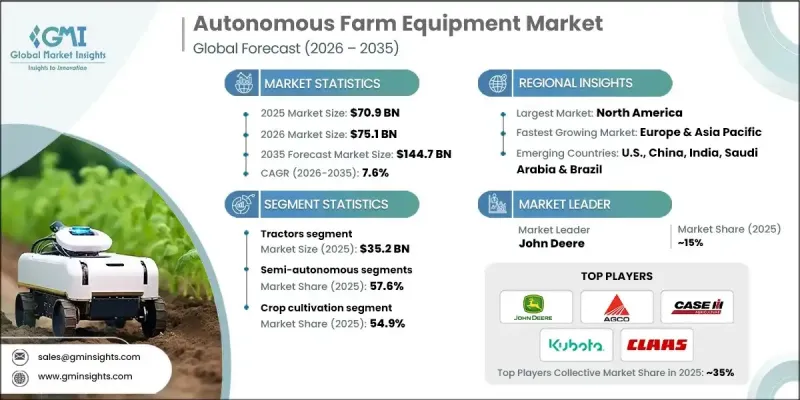
세계의 자율형 농업 장비 시장은 2025년 709억 달러로 평가되었으며, 2035년까지 연평균 복합 성장률(CAGR) 7.6%로 성장하여 1,447억 달러에 이를 것으로 예측됩니다.
이 분야의 성장은 정밀 농업 기술의 보급 확대에 의해 추진되고 있습니다. 이러한 접근법은 농부들이 투입 자재의 사용을 최적화하고, 자원 낭비를 최소화하고, 작물 생산량을 극대화하는 것을 가능하게 합니다. 트랙터, 수확기, 드런 등의 자율 기계를 사용하면 농부가 가장 효과적인 시기에 투입물을 적용할 수 있어 수익성을 향상시키면서 환경에 미치는 영향을 줄일 수 있습니다. AI, IoT, 로보틱스, 머신 비전의 융합은 농업에 혁명을 가져오고, 작물 모니터링, 토양 평가, 최소한의 인위적 개입에 의한 자동 수확 등 고급 작업을 가능하게 하고 있습니다. 5G 및 클라우드 플랫폼을 포함한 고급 통신 네트워크를 통해 실시간 모니터링 및 원격 조작이 가능해 효율성과 보급이 더욱 촉진되고 있습니다.
시장 범위
시작 연도
2025년
예측 연도
2026-2035년
시작 규모
709억 달러
예측 금액
1,447억 달러
CAGR
7.6%
트랙터 부문은 2025년 352억 달러를 차지했으며 2026년부터 2035년까지 연평균 복합 성장률(CAGR) 7.4%를 보일 것으로 예측됩니다. 트랙터는 농업의 중요한 작업에 필수적이며 AI, GPS 네비게이션 및 IoT 연결의 통합으로 고효율 반자율 또는 완전 자율 기계로 진화하고 있습니다. 노동력 부족과 운영 비용 상승은 수요를 견인하고 있으며, 이러한 트랙터는 수작업 의존도를 줄이면서 정확성과 생산성을 향상시킵니다.
반자율 기기 부문은 57.6%의 점유율을 차지했으며, 2026년부터 2035년까지 연평균 복합 성장률(CAGR) 7.1%를 보일 것으로 예측됩니다. 이 장비는 자동화와 인적 감시의 균형을 제공하여 자동 조타 및 정밀 제어와 같은 기능을 제공하면서 농부가 운영상의 유연성을 유지할 수 있도록 합니다. 이 하이브리드 접근법은 투자 비용과 기술적 복잡성에 대한 우려에 대응하고 자동화 시스템의 원활한 도입을 가능하게 하며 반복 작업의 효율성을 실현합니다.
미국의 자율형 농업 장비 시장은 2025년에 185억 달러로 평가되었고 2026년부터 2035년까지 CAGR 8.5%를 보일 것으로 예측됩니다. 대규모 농장과 기술적으로 진행된 농업 부문이 자율 솔루션의 도입을 추진하고 있습니다. 기존 제조업체와 신흥기업에 의한 AI, 로보틱스, IoT에 대한 다액의 투자가 도입을 가속시키고 있습니다. 스마트 농업 기술과 지속 가능한 실천에 대한 정부의 우대 조치가 시장의 추가 확대를 촉진하고 있습니다.
목차
제1장 조사 방법과 범위
제2장 주요 요약
제3장 업계 인사이트
생태계 분석
공급자의 상황
이익률
각 단계에서의 부가가치
밸류체인에 영향을 주는 요인
업계에 미치는 영향요인
성장 요인
정밀농업 도입 확대
기술적 진보
정부의 시책과 보조금
노동력 부족과 비용 상승
업계의 잠재적 위험 및 과제
높은 초기 투자와 비용 장벽
접속성과 인프라의 제약
성장 가능성 분석
미래 시장 동향
기술과 혁신 동향
현재의 기술 동향
신흥기술
가격 동향
지역별
제품별
규제 상황
규격 및 컴플라이언스 요건
지역별 규제 프레임워크
인증기준
Porter's Five Forces 분석
PESTEL 분석
제4장 경쟁 구도
소개
기업의 시장 점유율 분석
지역별
북미
유럽
아시아태평양
라틴아메리카
중동 및 아프리카
기업 매트릭스 분석
주요 시장 기업의 경쟁 분석
경쟁 포지셔닝 매트릭스
주요 발전
인수합병
제휴 및 협업
신제품 발매
확대 계획
제5장 시장 추계 및 예측 : 제품별, 2022-2035년
트랙터
수확기
파종기
분무기
무인 항공기(UAV)
기타(경작기, 관개 설비)
제6장 시장 추계 및 예측 : 기술별, 2022-2035년
안내 및 네비게이션 시스템
센서 기술
인공지능(AI) 및 머신러닝
로보틱스 및 자동화
접속성 및 통신 시스템
제7장 시장 추계 및 예측 : 작동별, 2022-2035년
완전 자율형
준자율형
제8장 시장 추계 및 예측 : 출력별, 2022-2035년
30마력 미만
31-100마력
100마력 초과
제9장 시장 추계 및 예측 : 용도별, 2022-2035년
작물 재배
원예 및 묘목
낙농 및 축산 관리
임업 및 목재 관리
제10장 시장 추계 및 예측 : 유통 채널별, 2022-2035년
직접 판매
간접 판매
제11장 시장 추계 및 예측 : 지역별, 2022-2035년
북미
미국
캐나다
유럽
독일
영국
프랑스
이탈리아
스페인
아시아태평양
중국
인도
일본
한국
호주
인도네시아
말레이시아
라틴아메리카
브라질
멕시코
아르헨티나
중동 및 아프리카
사우디아라비아
아랍에미리트(UAE)
남아프리카
제12장 기업 프로파일
AGCO Corporation
Agrobot
Autonomous Solutions Inc.
Case IH
Claas
Dot Technology Corp
DroneDeploy
Fendt
Harvest Automation
John Deere
Kinze Manufacturing
Kubota Corporation
New Holland Agriculture
Precision Planting
Raven Industries
JHS
영문 목차
영문목차
The Global Autonomous Farm Equipment Market was valued at USD 70.9 billion in 2025 and is estimated to grow at a CAGR of 7.6% to reach USD 144.7 billion by 2035.
Growth in this sector is fueled by the increasing adoption of precision farming techniques. These methods allow farmers to optimize input use, minimize resource wastage, and maximize crop output. Autonomous machines such as tractors, harvesters, and drones enable farmers to apply inputs at the most effective times, improving profitability while reducing environmental impact. The convergence of AI, IoT, robotics, and machine vision is revolutionizing agriculture, enabling sophisticated operations like crop monitoring, soil assessment, and automated harvesting with minimal human intervention. Advanced communication networks, including 5G and cloud platforms, allow real-time monitoring and remote operation, further enhancing efficiency and adoption.
Market Scope
Start Year
2025
Forecast Year
2026-2035
Start Value
$70.9 Billion
Forecast Value
$144.7 Billion
CAGR
7.6%
The tractors segment accounted for USD 35.2 billion in 2025 and is expected to grow at a CAGR of 7.4% from 2026 to 2035. They remain critical for essential farm operations, and the integration of AI, GPS navigation, and IoT connectivity has transformed them into highly efficient, semi- or fully-autonomous machines. Labor shortages and rising operational costs drive demand, as these tractors reduce reliance on manual work while boosting precision and productivity.
The semi-autonomous equipment segment held a 57.6% share and is projected to grow at a CAGR of 7.1% from 2026 to 2035. This equipment offers a balance between automation and human oversight, providing features like auto-steering and precision controls while allowing farmers to retain operational flexibility. This hybrid approach addresses concerns over investment costs and technical complexity, enabling smoother adoption of automated systems and improving efficiency for repetitive tasks.
U.S. Autonomous Farm Equipment Market was valued at USD 18.5 billion in 2025 and is forecasted to grow at a CAGR of 8.5% from 2026 to 2035. Large-scale farms and a technologically advanced agricultural sector drive the adoption of autonomous solutions. Substantial investments in AI, robotics, and IoT by both established manufacturers and startups accelerate deployment. Government incentives for smart farming technologies and sustainable practices further stimulate market expansion.
Key players in the Global Autonomous Farm Equipment Market include Case IH, John Deere, Kinze Manufacturing, Kubota Corporation, AGCO Corporation, Claas, Dot Technology Corp, DroneDeploy, Precision Planting, New Holland Agriculture, Fendt, Harvest Automation, Autonomous Solutions Inc., and Agrobot. Companies in the Autonomous Farm Equipment Market are focusing on multiple strategies to strengthen their foothold. They are investing heavily in research and development to enhance the capabilities of autonomous machines, including AI-driven navigation and advanced sensor integration. Strategic partnerships and collaborations with tech startups and agri-tech firms help expand product portfolios and enter new markets. Firms are also emphasizing after-sales services, training, and support programs to boost customer adoption.
Table of Contents
Chapter 1 Methodology & Scope
1.1 Market scope and definition
1.2 Research design
1.2.1 Research approach
1.2.2 Data collection methods
1.3 Data mining sources
1.3.1 Global
1.3.2 Regional/Country
1.4 Base estimates and calculations
1.4.1 Base year calculation
1.4.2 Key trends for market estimation
1.5 Primary research and validation
1.5.1 Primary sources
1.6 Forecast model
1.7 Research assumptions and limitations
Chapter 2 Executive Summary
2.1 Industry 360° synopsis
2.2 Key market trends
2.2.1 Regional
2.2.2 Product
2.2.3 Technology
2.2.4 Operation
2.2.5 Power output
2.2.6 Application
2.2.7 Distribution channel
2.3 CXO perspectives: Strategic imperatives
2.3.1 Key decision points for industry executives
2.3.2 Critical success factors for market players
2.4 Future outlook and strategic recommendations
Chapter 3 Industry Insights
3.1 Industry ecosystem analysis
3.1.1 Supplier landscape
3.1.2 Profit margin
3.1.3 Value addition at each stage
3.1.4 Factor affecting the value chain
3.2 Industry impact forces
3.2.1 Growth drivers
3.2.1.1 Increasing adoption of precision agriculture
3.2.1.2 Technological advancements
3.2.1.3 Government initiatives and subsidies
3.2.1.4 Labor shortages and rising costs
3.2.2 Industry pitfalls & challenges
3.2.2.1 High initial investment and cost barriers
3.2.2.2 Connectivity and infrastructure limitations