보조생식기술 기술 시장 : 기회, 성장 요인, 산업 동향 분석 및 예측(2026-2035년)
Assisted Reproductive Technology (ART) Market Opportunity, Growth Drivers, Industry Trend Analysis, and Forecast 2026 - 2035
상품코드:1913432
리서치사:Global Market Insights Inc.
발행일:2025년 12월
페이지 정보:영문 165 Pages
라이선스 & 가격 (부가세 별도)
ㅁ Add-on 가능: 고객의 요청에 따라 일정한 범위 내에서 Customization이 가능합니다. 자세한 사항은 문의해 주시기 바랍니다.
한글목차
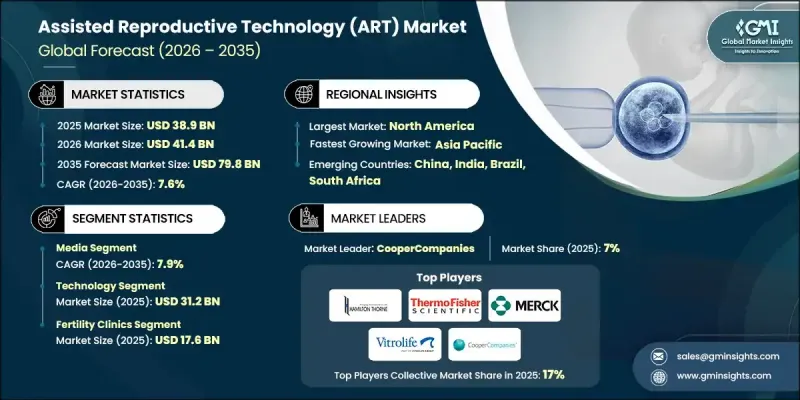
세계의 보조생식기술(ART) 시장은 2025년 389억 달러로 평가되었고, 2035년까지 연평균 복합 성장률(CAGR) 7.6%로 성장해 798억 달러에 이를 것으로 예측되고 있습니다.
이 시장 확대는 치료 효과와 환자 경험을 향상시키는 지속적인 기술 혁신에 의해 추진되고 있습니다. AI를 활용한 배아선택, 타임랩스 이미징, 착상전 유전자검사(PGT) 등의 기술 혁신에 의해 착상 성공률이 향상되는 동시에 주기 실패율이 저하되어 ART의 신뢰성과 매력이 높아지고 있습니다. 보조생식기술(ART)은 자연임신이 어려운 개인과 커플을 지원하기 위해 설계된 의료처치를 말하며, 체외에서의 난자, 정자, 배아의 조작을 수반합니다. 사회적 규범의 변화와 한부모 가정, 동성 커플 가정을 포함한 다양한 가족 형태로의 수용 확대로 ART 솔루션에 대한 수요가 확대되고 있습니다. 인지도 향상, 부모의 기대 변화, 생식 대체 수단에 대한 수용 확대가 함께 시장 성장을 가속화하여 세계 클리닉, 기술 제공업체, 관련 서비스 제공업체에게 성장 기회를 창출하고 있습니다.
시장 범위
시작 연도
2025년
예측 연도
2026-2035년
시작 규모
389억 달러
예측 금액
798억 달러
CAGR
7.6%
기술 부문은 2025년 312억 달러에 이르렀으며 라이프 스타일 변화, 환경 요인 및 출산 연령 지연으로 인해 고급 생식 의료 솔루션에 대한 높은 수요가 반영되었습니다.
불임치료 클리닉 부문은 2025년에 176억 달러를 창출해 생식 내분비학자, 발생학자, 불임치료 전문가를 보유한 전문시설로서 높은 성공률을 제공하여 서비스 분야를 주도하고 있습니다.
북미의 보조생식기술(ART) 시장은 견고한 의료 인프라, 환자의 높은 의식, 강력한 규제 프레임워크, AI 기반 배아 선택, 유전자 스크리닝, 동결보존 기술 등 혁신 기술의 보급에 힘입어 여전히 가장 규모가 큰 지역 시장입니다. 불임증의 유병률 상승과 경제적 장벽을 완화하기 위한 정부와 보험사의 노력이 시장의 보급을 더욱 강화하고 있습니다.
목차
제1장 조사 방법과 범위
제2장 주요 요약
제3장 업계 인사이트
생태계 분석
업계에 미치는 영향요인
성장 요인
인구 기반의 불임증 증가 추세
보조생식기술(ART) 수용을 향한 인구 동태의 변화
보조생식기술의 기술적 진보
보조생식기술에 관한 인식 증가
업계의 잠재적 위험 및 과제
엄격한 규제 환경
ART 처리의 고비용
시장 기회
개별화·정밀 생식 의료
성장 가능성 분석
규제 상황
북미
유럽
아시아태평양
기술적 상황
미래 시장 동향
Porter's Five Forces 분석
PESTEL 분석
제4장 경쟁 구도
소개
기업의 시장 점유율 분석
세계
북미
유럽
기업 매트릭스 분석
주요 시장 기업의 경쟁 분석
경쟁 포지셔닝 매트릭스
주요 발전
인수합병
제휴 및 협력 관계
신제품 발매
확대 계획
제5장 시장 추계 및 예측 : 제품별, 2021-2034년
배지
배아 배양 배지
동결보존 배지
정액 처리 배지
난자 처리 배지
기구
유리화 장치
인큐베이터
정자 분석 시스템
마이크로매니퓰레이터
기타 기구
소모품
카테터
바늘
보존 용기
기타 소모품
첨가제
제6장 시장 추계 및 예측 : 시술별, 2021-2034년
기술
체외수정(IVF)
세포질내 정자 주입(ICSI)을 수반하는 체외수정(IVF)
ICSI를 수반하지 않는 체외수정(IVF)
인공수정 - 자궁내수정(AI-IUI)
유형별
신선 기증
신선 비기증
동결 기증자
동결 비기증
제7장 시장 추계 및 예측 : 최종 용도별, 2021-2034년
병원
불임 치료 클리닉
크라이오뱅크
기타 용도
제8장 시장 추계 및 예측 : 지역별, 2021-2034년
북미
미국
캐나다
유럽
독일
영국
프랑스
스페인
이탈리아
네덜란드
아시아태평양
중국
일본
인도
호주
한국
라틴아메리카
브라질
멕시코
아르헨티나
중동 및 아프리카
남아프리카
사우디아라비아
아랍에미리트(UAE)
제9장 기업 프로파일
Esco Micro
Gynotec
Hamilton Thorne
Indira IVF Hospital
Ivy Fertility
Kitazato
Laboratoire
Liverpool Partners Group
Merck
MISTRAL FERTILITY CLINICS
NidaCon International
The Cooper Companies
Thermo Fisher Scientific
Vitrolife Group
Western Fertility Institute
JHS
영문 목차
영문목차
The Global Assisted Reproductive Technology (ART) Market was valued at USD 38.9 billion in 2025 and is estimated to grow at a CAGR of 7.6% to reach USD 79.8 billion by 2035.
The market expansion is fueled by continuous technological advancements that enhance treatment effectiveness and patient experience. Innovations such as AI-driven embryo selection, time-lapse imaging, and preimplantation genetic testing (PGT) are improving implantation outcomes while reducing cycle failures, making ART increasingly reliable and appealing. Assisted reproductive technology encompasses medical procedures designed to help individuals or couples conceive when natural conception is challenging, involving the manipulation of eggs, sperm, or embryos outside the body. Changing social norms and greater acceptance of diverse family structures, including single-parent and same-sex families, have broadened the demand for ART solutions. Rising awareness, evolving parental expectations, and growing acceptance of reproductive alternatives have collectively accelerated market growth, creating opportunities for clinics, technology providers, and ancillary service providers globally.
Market Scope
Start Year
2025
Forecast Year
2026-2035
Start Value
$38.9 Billion
Forecast Value
$79.8 Billion
CAGR
7.6%
The technology segment reached USD 31.2 billion in 2025, reflecting high demand for advanced reproductive solutions driven by lifestyle changes, environmental factors, and delayed parenthood.
The fertility clinics segment generated USD 17.6 billion in 2025, dominating the service landscape as specialized centers employing reproductive endocrinologists, embryologists, and fertility experts to deliver high success rates.
North America Assisted Reproductive Technology (ART) Market remains the largest regional market, supported by a robust healthcare infrastructure, high patient awareness, strong regulatory frameworks, and widespread adoption of innovative technologies such as AI-based embryo selection, genetic screening, and cryopreservation techniques. Rising infertility prevalence and government or insurance initiatives to reduce financial barriers further strengthen market adoption.
Prominent players in the Global Assisted Reproductive Technology (ART) Market include Hamilton Thorne, Western Fertility Institute, Kitazato, Indira IVF Hospital, Gynotec, Merck, Esco Micro, Ivy Fertility, Laboratoire, Liverpool Partners Group, Thermo Fisher Scientific, The Cooper Companies, Vitrolife Group, NidaCon International, and Mistral Fertility Clinics. Companies in the Global Assisted Reproductive Technology (ART) Market are reinforcing their position through investment in research and development to enhance treatment success rates and patient outcomes. Strategic partnerships with fertility clinics, hospitals, and diagnostic labs help expand service networks and improve accessibility. Adoption of AI, genetic testing, and cryopreservation innovations enables differentiation through advanced and efficient treatment solutions. Firms are also focusing on geographic expansion into high-demand regions and providing patient education programs to build trust and awareness.
Table of Contents
Chapter 1 Methodology and Scope
1.1 Market scope and definitions
1.2 Research design
1.2.1 Research approach
1.2.2 Data collection methods
1.3 Base estimates and calculations
1.3.1 Base year calculation
1.3.2 Key trends for market estimation
1.4 Forecast model
1.5 Primary research and validation
1.5.1 Primary sources
1.5.2 Data mining sources
Chapter 2 Executive Summary
2.1 Industry 360° synopsis
2.2 Key market trends
2.2.1 Regional trends
2.2.2 Product trends
2.2.3 Procedures trends
2.2.4 End use trends
2.3 CXO perspectives: Strategic imperatives
2.3.1 Key decision points for industry executives
2.3.2 Critical success factors for market players
2.4 Future outlook and strategic recommendations
Chapter 3 Industry Insights
3.1 Industry ecosystem analysis
3.2 Industry impact forces
3.2.1 Growth drivers
3.2.1.1 Rising prevalence of infertility across population base
3.2.1.2 Demographical shift towards acceptance of assisted reproductive technology (ART)
3.2.1.3 Technological advancements in assisted reproductive technology